
BuddhistCatholicContemplativeEvangelicalGeneral ChristianHinduJewishLatter-day SaintMuslimNew VisionsProgressive Christian
Beliefs
- Buddhist
- Catholic
- Contemplative
- Evangelical
- General Christian
- Hindu
- Jewish
- Latter-day Saint
- More Voices
- Muslim
- New Visions
- Pagan
- Progressive Christian
Topics
- Religion News
- Food and Religion
- Sports and Religion
- Religious Art
- Religious Music and Entertainment
- Religious Events
- History and Religion
- Style and Religion
- Politics and Religion
- Women in Religion
- Recreation Outdoors and Religion
- Business Finance and Religion
- Careers Workplace and Religion
- Education and Religion
- Family Parenting and Religion
- Health Fitness and Religion
- Home and Religion
- Relationships and Religion
- Technology and Religion
- Travel and Religion
Columnists
- Buddhist Columnists
- Business Finance and Religion Columnists
- Careers Workplace and Religion Columnists
- Catholic Columnists
- Contemplative Columnists
- Education and Religion Columnists
- Evangelists Columnists
- Family Parenting and Religion Columnists
- General Christian Columnists
- Health Fitness and Religion Columnists
- Hindu Columnists
- History and Religion Columnists
- Home and Religion Columnists
- Jewish Columnists
- More Voices Columnists
- Latter Day Columnists
- Muslim Columnists
- New Visions Columnists
- Nonreligious Columnists
- Pagan Columnists
- Politics and Religion Columnists
- Progressive Columnists
- Recreation Outdoors and Religion Columnists
- Relationships and Religion Columnists
- Religion News Columnists
- Religious Art Columnists
- Religious Events Columnists
- Religious Music and Entertainment Columnists
- Sports and Religion Columnists
- Style and Religion Columnists
- Technology and Religion Columnists
- Travel and Religion Columnists
- Women in Religion Columnists
Resource Library
- 2026 Calendar
- Library of World Religions
- The 100 Most Holy Places on Earth
- Patheos Answers
- Podcasts
- Videos
- Faith Leaders Database
- Anglican Episcopalian
- Bahai
- Baptist
- Buddhism
- Christianity
- Confucianism
- Eastern Orthodoxy
- Hinduism
- Holiness and Pentecostal
- ISKCON
- Islam
- Judaism
- Lutheran
- Methodist
- The Church of Jesus Christ of Latter-day Saints
- New Age
- Paganism
- Presbytarian and Reformed
- Protestantism
- Religion Behind the Scenes
- Roman Catholic
- Scientology
- Shia Islam
- Sikhism
- Sufism
- Sunni Islam
- Taoism
- Zen
- See all religions
Research Tools
 Ad-Free & Subscriber Log-In Subscription Support
Ad-Free & Subscriber Log-In Subscription Support
Follow Patheos 

- Trending:
- Forgiveness
- |
- Marriage
- |
- Consciousness
- |
- Death Penalty
- |
- Election
- |
- Halloween
 Messy Inspirations
- Home
- Catholic
- Immaculate Perception for the Immaculate Conception
Immaculate Perception for the Immaculate Conception
Last updated on: December 10, 2020 at 10:41 am by Fellow Dying Inmate
Immaculate Perception for the Immaculate Conception 2020-12-10T10:41:03-04:00 Fellow Dying Inmate
Patheos Explore the world's faith through different perspectives on religion and spirituality! Patheos has the views of the prevalent religions and spiritualities of the world.
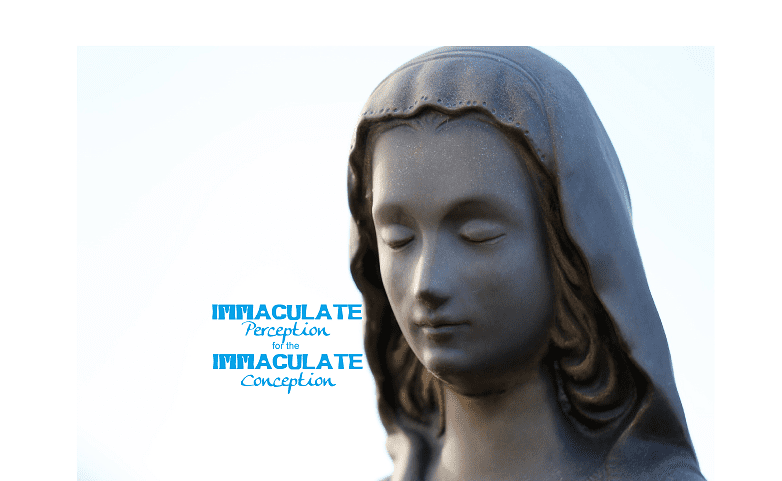
Immaculate / Image by Goran Horvat from Pixabay
The Immaculate Conception showcases why it is better to be wrong for the right reason than right for the wrong reason.
Move the language, and you necessarily change the meaning. Theology changes as we change. You can see what I mean when you consider the theology behind the Solemnity yesterday, the Immaculate Conception.
Here’s a brief video explaining the connections:
Immaculate Conception Means??
What does the Immaculate Conception mean? I could parrot you the basics. But would that be of much help? Theoretically, you could train an African Gray to memorize the Creed, the Pater Noster, and the Ave Maria. If you did that, would the result be a faithful Catholic? I hope you think more of a believing Catholic than a parrot.
Pope Pius IX defined this dogma on December 8, 1854. His papal bull, entitled Ineffabilis Deus (“Ineffable God”), states that the Blessed Virgin Mary was free from sin from the first moment of her existence. Thus it reads,
“the Most Blessed Virgin Mary was, from the first moment of her conception, by the singular grace and privilege of almighty God and because of the merits of Christ Jesus the Savior of the human race, preserved immune from all stain of original sin, [that this] is revealed by God and, therefore, firmly and constantly to be believed by all the faithful.”
Pius IX consulted 603 bishops. Of them, 63 opposed this definition, including the archbishop of Paris.
From Where Do Dogmas Come?
A dogma is a doctrine (Church teaching) promulgated in maximum solemnity and authority. Because it is a dogma, all Catholics are obligated to believe in the Immaculate Conception of Mary. Therefore, to deny dogma is to cut oneself off from the Church. Such post-baptismal denial of dogma is called heresy.
Dogmas don’t pop out of thin air, though. All dogmas and doctrines of the Church are first beliefs, and all beliefs are outcomes of theology. All theology, in turn, is the outcome of faith. Doctrine develops, including those doctrines called dogmas. So it’s silly when some Catholics demand that teachers only “teach the faith!” as if faith can be given in a theologically-pure state. To teach the faith requires theology. There is no giving faith with some theology getting into the mix, including Scripture.
Evolution of the Immaculate Conception
Theologians laid out the groundwork for the Immaculate Conception long before Pius IX. Before it was dogma, it was a belief, although not a universally held belief.
Like Bernard of Clairvaux (d. 1153) before him, and his Franciscan friend Bonaventure (d. 1274), Dominican Thomas Aquinas (d. 1274) refused to accept this belief. Brothers and sisters, in Catholic thought, St. Thomas is about as big a theological gun as you can have. He rejected the Immaculate Conception! It turns out he was wrong for the right reason—St. Thomas thought that believing in the Immaculate Conception necessarily detracted from the universal saving work of Christ.
By the way, the example of SAINT Thomas Aquinas, denying the Immaculate Conception of Mary, offers us an essential window into seeing a fundamental truth about faith, theology, and belief. On a relative scale, it is more important to be wrong for the right reason than to be right for the wrong reason.
In other words, you could have Catholics professing belief in Mary the Immaculate Conception for the wrong reason, and that wouldn’t be too good, would it? For instance, say I told you that I believe in her Immaculate Conception. Still, when you ask me to describe what it means, I respond by saying that it means Mary didn’t need a savior or salvation. Is that okay?
Immaculate Conception and Cleaning Up Theology
This is one of many examples of why Karl Rahner said, “If you keep repeating dogma, it eventually becomes heresy.” Mary, the Immaculate Conception, most definitely required a savior. The Immaculate Conception, adequately understood, is the most outstanding application of Jesus’ saving act in history. It means that Mary is the most saved of all creatures.
This creative thought of Franciscan Duns Scotus (d. 1308) undergirded the definition of the Immaculate Conception by Pius IX. Thus, Scotus had overcome Thomas Aquinas’ objections. Consequently, it detracted nothing of Christ’s universal redemptive work (note what is of crucial importance!).
Connecting the Immaculate Conception
How should we understand and explain this dogma? To do that, we have to make some necessary theological connections. To grasp the dogma of the Immaculate Conception, I had better understand really well the underlying doctrine of Original Sin. Because if I get Original Sin wrong, or in an unhealthy yet verbally-orthodox way, I will necessarily distort the Immaculate Conception. For example, does the doctrine of Original Sin really mean to be conceived with gross underwear tread marks all over my soul? Or does it mean to be somehow created without any grace at all?
No. But nevertheless, many Catholics imagine it does. And it follows that, to them, the dogma of Mary’s Immaculate Conception teaches that she alone among humankind was conceived in grace.
New Directions for the Immaculate Conception
But what if Original Sin meant something different? What if it instead referred to a universal condition of inauthenticity and brokenness that alienates humankind from God? Wouldn’t that change how we view the Immaculate Conception?
God extraordinarily exempts Mary from sin’s common impact (not physical suffering, death, and deterioration, which are natural), which is inauthenticity, alienation, and selfishness. And this was accomplished in anticipation of the redemptive work of Christ and her motherhood in that regard.
The Immaculate Conception says, therefore, that Mary is the most redeemed, the most saved. Grace isn’t a quantity—God is not a quantity—but in Mary and her irreducible yes, God is most intensely present among his creatures. This is for the critical role she would play out freely in the dance of God’s saving love.
Did she get sick, age, become feeble, and die? Why would you deny her these messy glories? Why would you deny Mary her humanity?
Solemnity of the Immaculate Conception
What is the Immaculate Conception?
Previous Post

December 5, 2020
Santa Punching Arius & More Stupidity
Next Post
December 11, 2020 Pagan Christmas!!??
Browse Our Archives
Select a Category Uncategorized
Select a Month August 2021 July 2021 June 2021 May 2021 April 2021 March 2021 February 2021 January 2021 December 2020 November 2020 October 2020 September 2020 August 2020 July 2020 June 2020 May 2020 April 2020 March 2020 February 2020 January 2020 December 2019 November 2019 October 2019 September 2019 August 2019
Follow Us!
TAKE THE
Religious Wisdom Quiz
What does the Hebrew word "Chokmah", often used in Proverbs, mean?
Select your answer to see how you score.
Wisdom Fear Strength Knowledge
Support this
Column


Related posts from Messy Inspirations

Understanding Apocalypse & Its Creatures



TRENDING AT PATHEOS Catholic

The Parable Of The Sower And The Word...
One of Christ’s most famous parables is that of the sower who...

Rejecting Doom: Christian Hope And Human Action
Christianity is a religion of hope. We are to have hope and...

Why I Choose the Eucharist Over the Sermon
Choose the Eucharist, Not the Sermon What are we supposed to get...

5 Design Elements Found in Spiritually Rooted Homes
Putting Spirituality Into Home Decor Our homes are more than our living...

Credo: A Story of God Told with the...
About 10 years ago, I began to imagine a personal "Credo" that...

The Anatomy of Divine Revelation in Catholic Thought
The claim that God has made Himself known to human beings is...
view all Catholic blogs
Ad-Free & Subscriber Log-In Subscription Support
- About Us
- 2026 Calendar
- Videos
- Podcasts
- Library of World Religions
- Faith In Media Tracker
- Advertise With Us
- Write for Us
- Privacy Policy
- Terms of Service
- Do Not Sell My Data
- Contact Us
- Radiant Digital
- Manage Newsletter Subscriptions
- Unsubscribe From Notifications
- Sitemap
Copyright 2008-2026, Patheos. All rights reserved.
Subscription Support Ad-Free & Subscriber Log-In
Follow Patheos