
BuddhistCatholicContemplativeEvangelicalGeneral ChristianHinduJewishLatter-day SaintMuslimNew VisionsProgressive Christian
Beliefs
- Buddhist
- Catholic
- Contemplative
- Evangelical
- General Christian
- Hindu
- Jewish
- Latter-day Saint
- More Voices
- Muslim
- New Visions
- Pagan
- Progressive Christian
Topics
- Religion News
- Food and Religion
- Sports and Religion
- Religious Art
- Religious Music and Entertainment
- Religious Events
- History and Religion
- Style and Religion
- Politics and Religion
- Women in Religion
- Recreation Outdoors and Religion
- Business Finance and Religion
- Careers Workplace and Religion
- Education and Religion
- Family Parenting and Religion
- Health Fitness and Religion
- Home and Religion
- Relationships and Religion
- Technology and Religion
- Travel and Religion
Columnists
- Buddhist Columnists
- Business Finance and Religion Columnists
- Careers Workplace and Religion Columnists
- Catholic Columnists
- Contemplative Columnists
- Education and Religion Columnists
- Evangelists Columnists
- Family Parenting and Religion Columnists
- General Christian Columnists
- Health Fitness and Religion Columnists
- Hindu Columnists
- History and Religion Columnists
- Home and Religion Columnists
- Jewish Columnists
- More Voices Columnists
- Latter Day Columnists
- Muslim Columnists
- New Visions Columnists
- Nonreligious Columnists
- Pagan Columnists
- Politics and Religion Columnists
- Progressive Columnists
- Recreation Outdoors and Religion Columnists
- Relationships and Religion Columnists
- Religion News Columnists
- Religious Art Columnists
- Religious Events Columnists
- Religious Music and Entertainment Columnists
- Sports and Religion Columnists
- Style and Religion Columnists
- Technology and Religion Columnists
- Travel and Religion Columnists
- Women in Religion Columnists
Resource Library
- 2026 Calendar
- Library of World Religions
- The 100 Most Holy Places on Earth
- Patheos Answers
- Podcasts
- Videos
- Faith Leaders Database
- Anglican Episcopalian
- Bahai
- Baptist
- Buddhism
- Christianity
- Confucianism
- Eastern Orthodoxy
- Hinduism
- Holiness and Pentecostal
- ISKCON
- Islam
- Judaism
- Lutheran
- Methodist
- The Church of Jesus Christ of Latter-day Saints
- New Age
- Paganism
- Presbytarian and Reformed
- Protestantism
- Religion Behind the Scenes
- Roman Catholic
- Scientology
- Shia Islam
- Sikhism
- Sufism
- Sunni Islam
- Taoism
- Zen
- See all religions
Research Tools
 Ad-Free & Subscriber Log-In Subscription Support
Ad-Free & Subscriber Log-In Subscription Support
Follow Patheos 

- Trending:
- Forgiveness
- |
- Marriage
- |
- Consciousness
- |
- Death Penalty
- |
- Election
- |
- Halloween
 Messy Inspirations
- Home
- Catholic
- Growing Christmas Stories
Growing Christmas Stories
Last updated on: December 18, 2020 at 1:26 am by Fellow Dying Inmate
Growing Christmas Stories 2020-12-18T01:26:32-04:00 Fellow Dying Inmate
Patheos Explore the world's faith through different perspectives on religion and spirituality! Patheos has the views of the prevalent religions and spiritualities of the world.

Growing Jesus Birth Stories / Image by Myriams-Fotos from Pixabay
Americans find growing problems in the two different Gospel stories of Jesus’ birth, both true, yet neither completely factual.
Last time we learned that to write an account of a great Mediterranean person’s childhood required no research, fact-checking, and “reliable sources” in the modern sense. Thus, the Evangelists “Matthew” and “Luke” wouldn’t have needed to interview Jesus’ parents, or home village, or childhood friends and acquaintances. Growing Christmas came by a different method entirely.
So we discussed where the information in the two Gospel infancy accounts originated. According to scholars Bruce Malina and Richard Rohrbaugh, almost all the information Gospel writers needed for this task could be solidly inferred from Jesus’ adult behavior (Luke 19:45-48, therefore Luke 2:41-52). Like every ancient person, this was because they knew that a great adult (e.g., Matthew 27:29) must have been great in miniature as a child (e.g., Matthew 2:1-12).
The video delves deeper:
Growing with Christmas Stories
Therefore, to answer the riddle, “How did ‘Matthew’ and ‘Luke’ discover the Baby Jesus?” happens by understanding something fundamental by ancient Mediterranean people. If you know how the adult is, that means you likewise see how the child was. Ultimately, growing their stories came by looking regularly and routinely at the adult Risen Jesus (in visions enjoyed by the Jesus group) that the stories (plural!) of Baby Jesus unfolded.
Do you think that being inspired by God means that ancient Mediterranean scribes were transformed into idealized 21st-century American news reporters? Better think again! The most important part of the word “inspiration” is the prefix “IN.” Inspiration happens in—as in history and in culture.
Growing By Way of Imagination
Imagine that you were an author living long ago. You belonged to a culture that had no awareness of human psychological development from children growing into adults. Additionally, you were socialized to believe that children were adults in miniature.
So if you knew a great, heroic adult, whatever heroic or great qualities he had as an adult must have been present in the same person as a child. Now imagine you wrote an account of the hero’s infancy and childhood. Why would you need to suddenly morph into a 21st-century American journalist or biographer to accomplish your task?
Suppose you were an ancient Mediterranean storyteller growing an account of a hero’s childhood. In that case, about 95—99 percent of the materials you need will be provided by your image of the adult hero. Being trained in rhetoric, you would create an honorable childhood account that mirrors the hero as you interpret him (in his adult form). This isn’t deception, but much of it also won’t be factually accurate. Nevertheless, it will be truthful, albeit a limited expression of the truth of who the hero was.
Dealing with Growing Embarrassment
And suppose you are a late first-century Jesus-group author writing about Jesus’ childhood. In that case, about one to five percent of your data will come from embarrassing facts and memories. This would be material passed down either through the Jesus group or remembered by its enemies, scandalous material neither yourself nor the Jesus tradition would ever invent.
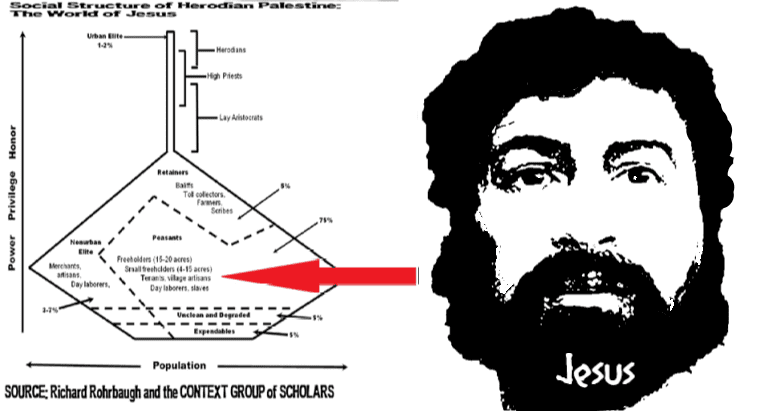
Growing / Fellow Dying Inmate (with inspiration from Donato Giancarlo) / All rights reserved
Examples of this concerning Jesus would be like his lowly village peasant status. Or that he was a starving artisan and day laborer, very probably illiterate. Or the embarrassing fact he comes from Nazareth in Galilee, a nothing-place of nothing-people. Remember how in the Fourth Gospel that Nathanael recalls that nothing good comes from there (John 1:46)?
Why would Gospel authors invent scandals like that? Answer—they wouldn’t. It’s incongruous with Christ Jesus, the Great Hero they continually saw in visions. It doesn’t rhyme with the Cosmic Lord they knew soon to return from the sky vault with power and establish Theocracy in the Land of Israel.
Despite this, both insiders and outsiders to the Jesus groups remembered the Master was called “Jesus of Nazareth.” The authors couldn’t dodge that embarrassment or the other scandals remembered—they were forced to face these facts and did so creatively.
The Truth of Jesus
But their creative responses were not the stuff of “BS artists” or used car salesmen. They were honestly grappling with how the Risen Lord they experienced as risen could possibly have come from such shameful, lowly origins. Therefore, “Matthew” and “Luke” wrote the truth, folks. And that’s okay because factual truths are only one type of truth. Truth is a broader circle than factual truths.
Responding to Jesus’ Lowly Origins
So Jesus’ mother being shamefully pregnant before living with her husband? Paul, writing in the 50s, never mentions this.
After Paul, the earliest Gospel, “Mark,” completely omits any infancy stories. If he knew the wondrous birth accounts “Matthew” and “Luke” describe, how could “Mark” possibly leave these stories out? But like later Evangelists, the anonymous scribe we call “Mark” did know of the Israelite gossip network’s slander: some considered Jesus to be a bastard. The culturally-unusual expression “son of Mary” in Mark 6:3 points to this—
Is he not ὁ τέκτων (the téktōn), ὁ υἱὸς τῆς Μαρίας (the son of Mary)…?
“Mark” (ca. 70 CE) refers to Jesus the tekton or artisan (6:3) but mentions no human father. In fact, other than Joseph of Arimathea, “Mark” names no other character “Joseph.”
According to Context Group scholar Andries van Aarde, from 70 till 135 CE, controversies about peasant Jesus’ illegitimacy raged between Jesus groups and their fellow Israelites. How fascinating to realize that this growing period is also the time we learn about Joseph.
Growing Joseph
Writing in the 80s CE, “Matthew” tells of Joseph’s righteousness (1:19) and his Davidic honor (1:1-17). “Matthew” draws heavily from the Biblical Joseph (Genesis 37—50). Therefore, it is no surprise that Joseph also has prophetic dreams (1:20-25; 2:13-15, 19-21). The Matthean Joseph is described as a hero taking a “holy marriage” with “impure” Mary. Just as the Genesis Joseph saves the people of Israel, aided by God, the Matthean Joseph also saves his family by taking them into Egypt.
Later, “Luke,” who is oblivious to the Holy Family ever going into Egypt or Herod’s plot to murder newborns, reports Joseph with family in their journeys to the temple in Jerusalem (2:22-38; 41-51).
No document composed before 70 CE mentions Joseph. After the second century, literature featuring Joseph begins growing and mutating Joseph sometimes into the bizarre.
How much of these so-called facts about Joseph correspond with the historical situation of Jesus? Did any human father play a role in the life of the historical Jesus? These are essential questions to ask in this “Year of Joseph.” Growing in faith demands that we ask them, friends.
Writing the Birth of a Real Mediterranean Hero
When writing about a great Mediterranean hero, whatever outstanding characteristics he enjoyed as an adult simply must have been there from birth. These gifts would have remained constant throughout his entire life. This is how ancient Mediterraneans perceived, understood, and communicated human maturation. “Matthew” and “Luke” were no different.
Early Jesus groups believed that the hero Jesus of Nazareth was the Messiah soon to come from God with power. Because they recognized this significance and greatness in the adult Jesus, they realized that it must also have belonged to the infant Jesus. He may have been growing in size and age, but those qualities were considered always there. Consequently, since this was indeed so of the Risen Jesus, it was evident to the Jesus groups that his birth and childhood had to be exactly like “Matthew” and “Luke” described it.
Matthew 1—2 and Luke 1—2, even though they have major biographical disagreements and contradict one another, are valid. They bring out the truth of Jesus as understood by some of our earliest ancestors in Faith.
Infancy Accounts: Not Written By, For, or About U.S. People
But American Christian heads explode learning all this because our society fails to distinguish truth and factual truths. Hence our unfair demand that truth always be packaged as Western people present it.
Do you know why we do this? Maybe because we are starved of mythology and our blocked access to panhuman encounters with God in ASC experiences, we are really just many scratch-off atheists. I don’t mean that rare type of profound, mystical atheist who is full of empathy for the world. I mean silly atheists.
Starving to death without healing or meaning, we arrogantly think of ourselves as the center of the universe. Everyone in every age and culture should think just like us and tell stories after our own “perfect” pattern.
How’s that working out for us this year? Merry Christmas, indeed.
Previous Post
December 15, 2020
Discovering Baby Jesus—Matthew, Luke, & Christmas
Next Post

January 6, 2021 Cussing and Prayer: Trumper Chaos at the Capitol
Browse Our Archives
Select a Category Uncategorized
Select a Month August 2021 July 2021 June 2021 May 2021 April 2021 March 2021 February 2021 January 2021 December 2020 November 2020 October 2020 September 2020 August 2020 July 2020 June 2020 May 2020 April 2020 March 2020 February 2020 January 2020 December 2019 November 2019 October 2019 September 2019 August 2019
Follow Us!
TAKE THE
Religious Wisdom Quiz
True or False: John's Gospel identifies Jesus as 'the Lamb of God' in the first chapter.
Select your answer to see how you score.
TRUE FALSE
Support this
Column


Related posts from Messy Inspirations

Understanding Apocalypse & Its Creatures



TRENDING AT PATHEOS Catholic

Rejecting Doom: Christian Hope And Human Action
Christianity is a religion of hope. We are to have hope and...

It’s What Comes From Within Which Matters
One of the most difficult things for us to understand is why...

Why I Choose the Eucharist Over the Sermon
Choose the Eucharist, Not the Sermon What are we supposed to get...

5 Design Elements Found in Spiritually Rooted Homes
Putting Spirituality Into Home Decor Our homes are more than our living...

Credo: A Story of God Told with the...
About 10 years ago, I began to imagine a personal "Credo" that...

The Anatomy of Divine Revelation in Catholic Thought
The claim that God has made Himself known to human beings is...
view all Catholic blogs
Ad-Free & Subscriber Log-In Subscription Support
- About Us
- 2026 Calendar
- Videos
- Podcasts
- Library of World Religions
- Faith In Media Tracker
- Advertise With Us
- Write for Us
- Privacy Policy
- Terms of Service
- Do Not Sell My Data
- Contact Us
- Radiant Digital
- Manage Newsletter Subscriptions
- Unsubscribe From Notifications
- Sitemap
Copyright 2008-2026, Patheos. All rights reserved.
Subscription Support Ad-Free & Subscriber Log-In
Follow Patheos