
BuddhistCatholicContemplativeEvangelicalGeneral ChristianHinduJewishLatter-day SaintMuslimNew VisionsProgressive Christian
Beliefs
- Buddhist
- Catholic
- Contemplative
- Evangelical
- General Christian
- Hindu
- Jewish
- Latter-day Saint
- More Voices
- Muslim
- New Visions
- Pagan
- Progressive Christian
Topics
- Religion News
- Food and Religion
- Sports and Religion
- Religious Art
- Religious Music and Entertainment
- Religious Events
- History and Religion
- Style and Religion
- Politics and Religion
- Women in Religion
- Recreation Outdoors and Religion
- Business Finance and Religion
- Careers Workplace and Religion
- Education and Religion
- Family Parenting and Religion
- Health Fitness and Religion
- Home and Religion
- Relationships and Religion
- Technology and Religion
- Travel and Religion
Columnists
- Buddhist Columnists
- Business Finance and Religion Columnists
- Careers Workplace and Religion Columnists
- Catholic Columnists
- Contemplative Columnists
- Education and Religion Columnists
- Evangelists Columnists
- Family Parenting and Religion Columnists
- General Christian Columnists
- Health Fitness and Religion Columnists
- Hindu Columnists
- History and Religion Columnists
- Home and Religion Columnists
- Jewish Columnists
- More Voices Columnists
- Latter Day Columnists
- Muslim Columnists
- New Visions Columnists
- Nonreligious Columnists
- Pagan Columnists
- Politics and Religion Columnists
- Progressive Columnists
- Recreation Outdoors and Religion Columnists
- Relationships and Religion Columnists
- Religion News Columnists
- Religious Art Columnists
- Religious Events Columnists
- Religious Music and Entertainment Columnists
- Sports and Religion Columnists
- Style and Religion Columnists
- Technology and Religion Columnists
- Travel and Religion Columnists
- Women in Religion Columnists
Resource Library
- 2026 Calendar
- Library of World Religions
- The 100 Most Holy Places on Earth
- Patheos Answers
- Podcasts
- Videos
- Faith Leaders Database
- Anglican Episcopalian
- Bahai
- Baptist
- Buddhism
- Christianity
- Confucianism
- Eastern Orthodoxy
- Hinduism
- Holiness and Pentecostal
- ISKCON
- Islam
- Judaism
- Lutheran
- Methodist
- The Church of Jesus Christ of Latter-day Saints
- New Age
- Paganism
- Presbytarian and Reformed
- Protestantism
- Religion Behind the Scenes
- Roman Catholic
- Scientology
- Shia Islam
- Sikhism
- Sufism
- Sunni Islam
- Taoism
- Zen
- See all religions
Research Tools
 Ad-Free & Subscriber Log-In Subscription Support
Ad-Free & Subscriber Log-In Subscription Support
Follow Patheos 

- Trending:
- Forgiveness
- |
- Marriage
- |
- Consciousness
- |
- Death Penalty
- |
- Election
- |
- Halloween
 Messy Inspirations
- Home
- Catholic
- Discovering Baby Jesus—Matthew, Luke, & Christmas
Discovering Baby Jesus—Matthew, Luke, & Christmas
Last updated on: December 15, 2020 at 5:46 am by Fellow Dying Inmate
Discovering Baby Jesus—Matthew, Luke, & Christmas 2020-12-15T05:46:37-04:00 Fellow Dying Inmate
Patheos Explore the world's faith through different perspectives on religion and spirituality! Patheos has the views of the prevalent religions and spiritualities of the world.
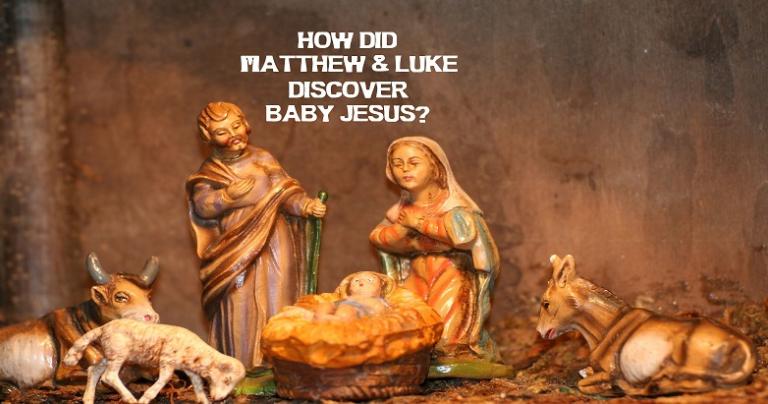
Discovering Baby Jesus / Image by Roland Steinmann from Pixabay
Only “Matthew” and “Luke” tell stories of Jesus’ infancy—from where did they get their information?
When ancient authors, like the anonymous Evangelists we call “Matthew” and “Luke,” described the birth and childhood of a hero or famous person, where would they research and gather data? And how would they verify sources and check facts? Would they interview the parents and relatives of the hero? His childhood friends who knew him?
In fact, these authors performed no journalistic investigations as we’d imagine. It turns out they didn’t need that. Discovering how it happened takes significant rethinking. Watch the video to see what I mean—
Discovering Ancient Mediterranean Childhood Accounts
According to Context Group scholars Bruce Malina and Richard Rohrbaugh, all ancient authors needed was an image of the adult hero’s status and roles. A few factual details and updated memories gathered from the Jesus groups of their day are all “Matthew” and “Luke” would need to construct an account of Jesus’ childhood. This was because such stories were always based on what the hero became as an adult.
How was that possible? How could you write a biographical story about someone’s infancy and childhood if you don’t first confirm your reliable sources and get the facts? That’s just it—Matthew 1—2 and Luke 1—2 aren’t biographies, folks.
Discovering Adults in Miniature
According to Malina and Rohrbaugh, ancient authors were convinced that human personality never changed throughout life. Therefore, to them, a child was an adult in miniature. So we should stop thinking of “Matthew” and “Luke” as Western authors mindful of a child’s psychological development understood through modern scientific research. They were oblivious to psychology. They never imagined anything of that sort.
How did the discovering of baby Jesus happen for “Matthew” and “Luke”?
Ancient Views on Child Development
In the cultural world of Jesus, the transition from child to adult was social, not psychological, says Malina and Rohrbaugh. Thus, when one entered the world of adults, adulthood began. Hence, Mediterranean boys became men when they entered the brutal Mediterranean world of men; Mediterranean girls became women at the wedding-transfer, happening just before or at menarche.
Note the social nature of these movements: boys out from women’s world into the harsh male world. And girls move out from their father’s house into the patriarchal compound of her husband’s father. Again, these transitions were social, not psychological.
Jesus, although first appearing to everyone as a poor, Mediterranean nothing-person, turned out to be a great hero. In other words, he died and became famous. When you die and are risen by God as messiah soon to return to inaugurate Theocracy from sky vault and appear to many as such, that makes you great and famous. The only way an ancient person received a childhood account was after he died, he became famous.
Gospels Present a World of Stereotypes
Malina, Rohrbaugh, and friends in the Context Group of biblical scholars remind us that the Gospels’ Mediterranean cultural world is a world of stereotypes. See one Pharisee? That means you’ve seen them all. See one Nazarene? Then you’ve seen them all, and there’s nothing much to see because you already know nothing good comes from there (John 1:46).
The Evangelists experienced the reality of the Risen Lord regularly and routinely in what cognitive neuroscience and anthropologists term “altered states of consciousness.” They knew he had been raised by God indeed, and therefore was great indeed.
But they were understandably too embarrassed by Jesus’ lowly Galilean origins in nothing-place Nazareth. Added to this was a memory of his mother being shamefully pregnant before living with her husband. The early Jesus groups would never have invented these dishonorable, embarrassing facts. Rest assured, those things were not only true, but also happened.
Discovering How the Infancy Narratives Were Written
To write an account of a great person’s childhood required no research. And Evangelists wouldn’t need to interview parents, or home village, or childhood friends and acquaintances. According to Malina and Rohrbaugh, almost all the information “Matthew” and “Luke” needed for this task could be solidly inferred from Jesus’ adult behavior (Luke 19:45-48, therefore Luke 2:41-52). Because every ancient knew that a great adult (e.g., Matthew 27:29) must have been great in miniature as a child (e.g., Matthew 2:1-12).
Whatever outstanding characteristics the hero had as an adult simply must have been there from birth. They would have remained constant throughout the great one’s heroic life. This is how ancient Mediterraneans perceived, understood, and communicated human maturation. The unknown, anonymous Evangelists we call “Matthew” and “Luke” were no different.
Was the hero Jesus of Nazareth the Messiah soon to come from God with power? “Matthew,” “Luke” and their audiences would unhesitatingly affirm this. Suppose this significance and greatness were real of the adult Jesus. In that case, it must also have been just as accurate of the infant Jesus. Consequently, since this was indeed so of the Risen Jesus, it was evident to the Jesus groups that his birth and childhood had to be exactly like “Matthew” and “Luke” described it.
And who cares that both accounts have so many disagreements and irreconcilably contradict each other?
Biographies or Something Else?
Reading both infancy narratives, consider all the persons surrounding Jesus. “Matthew” and “Luke” feature all these characters in their infancy narratives surrounding the birth of Jesus. Why?
The Evangelists only include them to highlight Jesus the Great One. These characters are not provided to flesh out biographically his relations or to provide a photo of people who actually were there as they were, if they were. Consequently, instead of imagining the infancy narratives as fact-precise biographies, Malina and Rohrbaugh invite us to see them as “preflections” of Jesus, the risen Messiah, and the Cosmic Lord.
Wasn’t it expected that, in the last days before God established Israelite Theocracy, “young men shall see visions and old men shall dream dreams” (Joel 3:1; Acts 2:17)? Therefore “Matthew” features an old man dreaming dreams (1:20-35; 2:13-14; 19-21). Malina and Rohrbaugh explain that “Matthew” doesn’t explicitly say that Joseph is old, still, his readers could infer that he must have been old given his dreaming. In contrast, “Luke” must clarify that Zechariah is an old man because otherwise, his audience would imagine him young due to his visions (1:8-20).
Note how “Matthew” and “Luke” write their infancy narratives according to Mediterranean cultural expectations. When God communicates with women, the exchange is limited to female reproductive functions and gender-based roles (Luke 1:26-38). An inspired Mediterranean man remains still a Mediterranean man, my friends!
Discovering Our Spurious Familiarity with Christmas
Folks, these accounts, like the rest of the Gospels and the whole Bible really, were not written for, by, or about 21st-century North Americans or Northern Europeans. They lack our interests and sensibilities and our obsession with facticity entirely. If we are going to taste their Good News, the first step is reading them respectful of their culture.
Are the Infancy Narratives true?
Previous Post

December 11, 2020
Pagan Christmas!!??
Next Post

December 18, 2020 Growing Christmas Stories
Browse Our Archives
Select a Category Uncategorized
Select a Month August 2021 July 2021 June 2021 May 2021 April 2021 March 2021 February 2021 January 2021 December 2020 November 2020 October 2020 September 2020 August 2020 July 2020 June 2020 May 2020 April 2020 March 2020 February 2020 January 2020 December 2019 November 2019 October 2019 September 2019 August 2019
Follow Us!
TAKE THE
Religious Wisdom Quiz
How many men did Gideon keep from the 32,000?
Select your answer to see how you score.
500 200 400 300
Support this
Column


Related posts from Messy Inspirations

Understanding Apocalypse & Its Creatures



TRENDING AT PATHEOS Catholic

The Parable Of The Sower And The Word...
One of Christ’s most famous parables is that of the sower who...

Rejecting Doom: Christian Hope And Human Action
Christianity is a religion of hope. We are to have hope and...

Why I Choose the Eucharist Over the Sermon
Choose the Eucharist, Not the Sermon What are we supposed to get...

5 Design Elements Found in Spiritually Rooted Homes
Putting Spirituality Into Home Decor Our homes are more than our living...

Credo: A Story of God Told with the...
About 10 years ago, I began to imagine a personal "Credo" that...

The Anatomy of Divine Revelation in Catholic Thought
The claim that God has made Himself known to human beings is...
view all Catholic blogs
Ad-Free & Subscriber Log-In Subscription Support
- About Us
- 2026 Calendar
- Videos
- Podcasts
- Library of World Religions
- Faith In Media Tracker
- Advertise With Us
- Write for Us
- Privacy Policy
- Terms of Service
- Do Not Sell My Data
- Contact Us
- Radiant Digital
- Manage Newsletter Subscriptions
- Unsubscribe From Notifications
- Sitemap
Copyright 2008-2026, Patheos. All rights reserved.
Subscription Support Ad-Free & Subscriber Log-In
Follow Patheos