
BuddhistCatholicContemplativeEvangelicalGeneral ChristianHinduJewishLatter-day SaintMuslimNew VisionsProgressive Christian
Beliefs
- Buddhist
- Catholic
- Contemplative
- Evangelical
- General Christian
- Hindu
- Jewish
- Latter-day Saint
- More Voices
- Muslim
- New Visions
- Pagan
- Progressive Christian
Topics
- Religion News
- Food and Religion
- Sports and Religion
- Religious Art
- Religious Music and Entertainment
- Religious Events
- History and Religion
- Style and Religion
- Politics and Religion
- Women in Religion
- Recreation Outdoors and Religion
- Business Finance and Religion
- Careers Workplace and Religion
- Education and Religion
- Family Parenting and Religion
- Health Fitness and Religion
- Home and Religion
- Relationships and Religion
- Technology and Religion
- Travel and Religion
Columnists
- Buddhist Columnists
- Business Finance and Religion Columnists
- Careers Workplace and Religion Columnists
- Catholic Columnists
- Contemplative Columnists
- Education and Religion Columnists
- Evangelists Columnists
- Family Parenting and Religion Columnists
- General Christian Columnists
- Health Fitness and Religion Columnists
- Hindu Columnists
- History and Religion Columnists
- Home and Religion Columnists
- Jewish Columnists
- More Voices Columnists
- Latter Day Columnists
- Muslim Columnists
- New Visions Columnists
- Nonreligious Columnists
- Pagan Columnists
- Politics and Religion Columnists
- Progressive Columnists
- Recreation Outdoors and Religion Columnists
- Relationships and Religion Columnists
- Religion News Columnists
- Religious Art Columnists
- Religious Events Columnists
- Religious Music and Entertainment Columnists
- Sports and Religion Columnists
- Style and Religion Columnists
- Technology and Religion Columnists
- Travel and Religion Columnists
- Women in Religion Columnists
Resource Library
- 2026 Calendar
- Library of World Religions
- The 100 Most Holy Places on Earth
- Patheos Answers
- Podcasts
- Videos
- Faith Leaders Database
- Anglican Episcopalian
- Bahai
- Baptist
- Buddhism
- Christianity
- Confucianism
- Eastern Orthodoxy
- Hinduism
- Holiness and Pentecostal
- ISKCON
- Islam
- Judaism
- Lutheran
- Methodist
- The Church of Jesus Christ of Latter-day Saints
- New Age
- Paganism
- Presbytarian and Reformed
- Protestantism
- Religion Behind the Scenes
- Roman Catholic
- Scientology
- Shia Islam
- Sikhism
- Sufism
- Sunni Islam
- Taoism
- Zen
- See all religions
Research Tools
 Ad-Free & Subscriber Log-In Subscription Support
Ad-Free & Subscriber Log-In Subscription Support
Follow Patheos 

- Trending:
- Forgiveness
- |
- Marriage
- |
- Consciousness
- |
- Death Penalty
- |
- Election
- |
- Halloween
 Messy Inspirations
- Home
- Catholic
- Understanding Jesus & Ourselves
Understanding Jesus & Ourselves
Last updated on: November 24, 2020 at 2:10 pm by Fellow Dying Inmate
Understanding Jesus & Ourselves 2020-11-24T14:10:42-04:00 Fellow Dying Inmate
Patheos Explore the world's faith through different perspectives on religion and spirituality! Patheos has the views of the prevalent religions and spiritualities of the world.
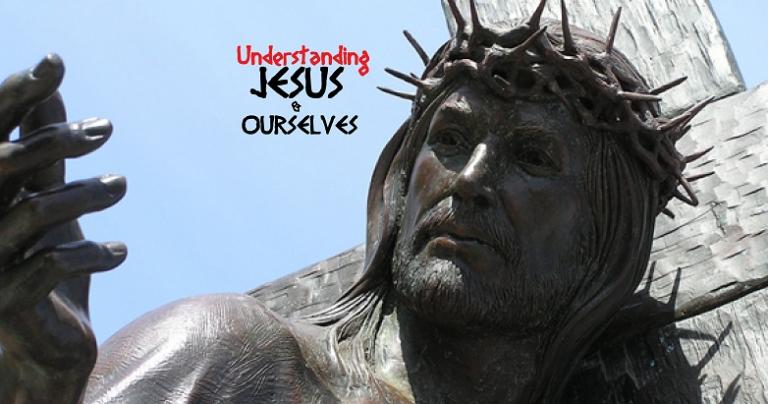
Understanding Jesus & Ourselves / Image by marinas32 from Pixabay
There are tremendous benefits of understanding Jesus and the New Testament communities in ways honest and respectful to his time and culture.
As we explored earlier this year, for Catholics and other Christians, more important than belief in the Real Presence is understanding who Jesus is. What good is believing Jesus to be truly, really, and substantially present at Eucharist if I don’t know who Jesus is? Who is really present?
As with our New Testament ancestors in the faith, culture affects how we describe Jesus. Like way back then, so also now, the danger looms that we will substitute the real Jesus, the one we claim to believe in and love, for a culturally-congenial Jesus of our own invention. In other words, we will reject the real Jesus in favor of a mental fiction and gross identity theft.
Who is this Jesus we celebrate as king of the universe and redeemer of humankind? Between Christ the King and Advent, it’s an excellent exercise to take a close examination of this. We need to see how culture impacts the meaning of words such as “redeemer” and “redemption.” To do that, here is an illuminating video presentation—
Cultural Understanding
As seen in the video-study above, cultural values affect the meaning of words like king, lord, redeemer, and redemption. Therefore, if you change the culture, the meanings change. For example, avenger and redeemer are antonyms according to Western lexical aides. But according to our Mediterranean, Middle-Eastern Bibles, both are two sides of the same coin. Consequently, social systems are the source of the meanings of these and all other terms.
Understanding Compassion
Consider “compassion.” In the Bible’s Mediterranean cultural world, where “belongingness” is everything, “compassion” is a value rooted in kinship. Biblically, human beings are group-personalities, sharing a group-conscience. Thus they suffer together as one body. “Compassion” (suffering-with) therefore must be given to kin, either real (biological) or fictive (e.g., fellow Jesus-group members). It follows that biblical “compassion” (read ancient Mediterranean compassion) would sanction influential people when dealing with underlings, shaming the great into being Patrons or Godfathers. For Mediterranean Jesus groups, Christ and his ingroup-glue is the model for “compassion” (Colossians 3:12-14).
Contrast that with “compassion” from mainstream United States culture, the most individualistic society ever. Here, at best, “compassion” derives from disconnected pity, sad feelings for another’s misfortunes, often peppered by mild contempt for the weak and inferior. Therefore any urge to help a suffering person gets limited by “no personal fault.” This explains our unquestioned American “compassion” for victims of natural disasters but “tough love” for welfare recipients and “leeches of public assistance” who “should pull themselves up by the boot-straps.”
Understanding Freedom & Love
Or consider biblical “freedom.” Thanks to the Exodus story, “freedom” means finite political liberty maintained by and directed to service to God (Exodus 5:1; 7:16; 8:1, 20, 21; 9:1, 13; 10:3). This is replicated and revitalized in Jesus (Romans 6:22; Mark 1:15; Luke 4:18-19; Acts 13:39).
However, biblical (read Mediterranean) “freedom” contrasts sharply with “freedom” according to mainstream U.S. culture. Freedom to us equals “freedom from obstacles,” or freedom from external forces. This explains why American Christians cleverly limit God to keep ourselves totally unlimited. New Testament “freedom,” with its restraints and repeated demands concerning obligations due to our neighbors, clashes with American tastes.
In our Mediterranean Bibles, “love” means group-attachment or social glue without or without feelings of affection (Joshua 22:5; 1 Kings 11:2; Psalm 91:14; Deuteronomy 6:5; Mark 12:30–33; Matthew 19:19; 22:37; 39; Luke 10:27). In contrast, the Western culture sees “love” individualistically, a feeling of one person’s heart toward another individual, but doesn’t necessarily involve attachment.
Therefore, culture shapes how we see “freedom,” “compassion,” and “love.” You don’t think culture would do the same with both “king” and “redeemer”? Think again.
Culture Shapes How We Understand
As explained in the video presentation, biblical redemption depends on kinship-belongingness and commitment to honor and shame. But outside the military academies, mainstream U.S. culture doesn’t pay much attention to honor (we shake off most scandals with enough time). How then does this affect our understanding of “Christ the Redeemer”?
And how are we to understand Jesus as “Lord” or “King of the Universe”? Do U.S. people envision human life being fixed in a closed, static universe, a cosmic hierarchy micromanaged by God and his agents?
Seeing this helps us to understand that all our beloved Christian concepts are laden with two-thousand years of theological freight. In other words, they are full of meanings gathered from various cultural settings. Therefore, we must always inquire about context. It’s very humbling to see how our so-called certainties about Jesus may be at times spurious, merely a culturally-limited misunderstanding or distortion.
Why This Matters
But there is hope! While seeing out a culturally-informed, historically-critical understanding of Jesus can be terrifying initially, it can also ignite exhilaration in our faith. This is because new knowledge can also bring a sense of awestruck wonder. I thought I knew my dearest friend, but seeing him now is like discovering a fortune sitting right under my very nose. Now the romance can really begin.
How can I love someone if I don’t genuinely appreciate him or her? And how can I do that if I am persistently ignorant and apathetic about his concerns and project? What does that do to the value of confessing my belief in and love for Jesus? Ultimately, folks, my words become like rubber checks. Nothing is backing them up!
Don’t we need to be empowered and illuminated to truly appreciate our ancestors in faith? And shouldn’t we strive to understand what their witness of faith meant?
Facing Big Problems
Without this, we can’t identify the crippling diseases afflicting Christianity today. I am referring to various fundamentalisms and clericalism. Without these insights, we simply won’t appreciate, assess, and appropriate Christianity today?
Don’t all Christians need an adult appreciation of the Jesus-tradition at some point in their lives? In light of this need, stop reading right now, and actually give serious thought to what Jesus “the Redeemer” means to you. And take a few minutes to think about what it means to call Jesus “king.”
Do you and I live in a world of kings and redeemers? What does that even mean?
Understanding the Stakes
Friends, look at the crowds of QAnon Americans professing their willingness to die for “the Chosen One,” Donald Trump. The importance of intelligent sharing and conversing about Christian origins should be obvious. But how is this even possible without understanding the evolution of our Christian stories, doctrines, and ethics?
Without respecting Middle Eastern North-African Jesus and our Mediterranean ancestors in the faith, becoming a better Catholic, Christian, and American is greatly impeded. And without a culturally-informed, historically critical understanding of Jesus, we won’t avoid or prevent the terrible pitfalls our country and Church are continually plunging into.
Without this immunization, many U.S. Christians dangerously remain inflexible and “certain” about their “Bible-based” and “religious” positions. This is a disastrous abuse of freedom. It doesn’t matter if it’s anti-Semitism, Zionist racism, white supremacy, dispensationalism, anti-Catholic bigotry, or Catholic triumphalism. Our country and planet cannot afford any more “culture wars” and pooled ignorance.
Maturing in the Faith
Do you want to be paralyzed by fear when confronted by persuasive Bible quoters? Do you want to be bound up by popular chains of ignorance concerning Christianity and its origins? Is superstitious misusing the Bible as an inkblot test or Ouija board for your life the Way Jesus walked? Is abusing God through attempted manipulation and control through a set of Scripture verses what Christian life boils down to? Ultimately, the dangerous consequences of ignorance demand that we mature in understanding both Church teaching and biblical scholarship.
New Directions with Understanding
An enormous gift of healing is to realize that, within the Biblical Tradition itself, the People of God routinely re-read their ancient texts as new circumstances arose. Repeatedly, our biblical ancestors applied them in new ways to their changing contemporary situations and circumstances.
Possibilities explode when we see how the Chronicler re-interpreted David and Israel’s story recounted by the earlier Deuteronomistic Historian. Or how some sacred authors interpreted their patron deity as a Storm-god and War-god (Deuteronomy and Nahum), while another depicted God as a humiliated cuckold (Hosea)! Ultimately, what biblical image of Ultimate Reality is final or fixed?
Turning to the Gospels, we note that the Matthean Jesus had no use for Samaritans and non-Israelites (Matthew 10:5-6). But when Samaritans poured into the later Lukan and Johannine Jesus groups, it was time to get creative (Luke 10:25-37; 17:11-19; John 4:4-42)! Friends, look at the Catholic Church and U.S. Christianity in late 2020. Isn’t it time to adhere to our Tradition and once more get creative?
These insights liberate the Church from any pedantic, fundamentalistic ideas of inspiration being once-for-all marching orders from the skies. Illuminated and equipped, we must ask: how is God inviting us to broaden our horizons today? When it comes to the role of women in the Church? How are we to love marginalized and excluded family members, like homosexuals, bisexuals, and transpersons? How must we respect people of other faith traditions and their religious commitments?
Thanksgiving Challenge
Many exciting new vistas and opportunities to grow can open up for us. Ultimately, this can happen only if we drop the fundamentalist mindset and risk a little.
Here’s an invitation. I would like to encourage everyone to carefully watch this amazing presentation by the brilliant Julia Sweeney. Both entertaining and challenging, it might be wonderful to watch over the Thanksgiving holiday. Put the shields down and watch. Ask yourself—how would I answer her questions? How would I address the problems and issues Sweeney mentions?
Previous Post

November 19, 2020
Master in Parable Cannot Be God
Next Post

November 26, 2020 How Goes your Thanksgiving?
Browse Our Archives
Select a Category Uncategorized
Select a Month August 2021 July 2021 June 2021 May 2021 April 2021 March 2021 February 2021 January 2021 December 2020 November 2020 October 2020 September 2020 August 2020 July 2020 June 2020 May 2020 April 2020 March 2020 February 2020 January 2020 December 2019 November 2019 October 2019 September 2019 August 2019
Follow Us!
TAKE THE
Religious Wisdom Quiz
Which book is the largest by chapters in the Bible?
Select your answer to see how you score.
Isaiah Genesis Psalms Proverbs
Support this
Column


Related posts from Messy Inspirations

Understanding Apocalypse & Its Creatures



TRENDING AT PATHEOS Catholic

Rejecting Doom: Christian Hope And Human Action
Christianity is a religion of hope. We are to have hope and...

It’s What Comes From Within Which Matters
One of the most difficult things for us to understand is why...

Why I Choose the Eucharist Over the Sermon
Choose the Eucharist, Not the Sermon What are we supposed to get...

5 Design Elements Found in Spiritually Rooted Homes
Putting Spirituality Into Home Decor Our homes are more than our living...

Credo: A Story of God Told with the...
About 10 years ago, I began to imagine a personal "Credo" that...

The Anatomy of Divine Revelation in Catholic Thought
The claim that God has made Himself known to human beings is...
view all Catholic blogs
Ad-Free & Subscriber Log-In Subscription Support
- About Us
- 2026 Calendar
- Videos
- Podcasts
- Library of World Religions
- Faith In Media Tracker
- Advertise With Us
- Write for Us
- Privacy Policy
- Terms of Service
- Do Not Sell My Data
- Contact Us
- Radiant Digital
- Manage Newsletter Subscriptions
- Unsubscribe From Notifications
- Sitemap
Copyright 2008-2026, Patheos. All rights reserved.
Subscription Support Ad-Free & Subscriber Log-In
Follow Patheos