
BuddhistCatholicContemplativeEvangelicalGeneral ChristianHinduJewishLatter-day SaintMuslimNew VisionsProgressive Christian
Beliefs
- Buddhist
- Catholic
- Contemplative
- Evangelical
- General Christian
- Hindu
- Jewish
- Latter-day Saint
- More Voices
- Muslim
- New Visions
- Pagan
- Progressive Christian
Topics
- Religion News
- Food and Religion
- Sports and Religion
- Religious Art
- Religious Music and Entertainment
- Religious Events
- History and Religion
- Style and Religion
- Politics and Religion
- Women in Religion
- Recreation Outdoors and Religion
- Business Finance and Religion
- Careers Workplace and Religion
- Education and Religion
- Family Parenting and Religion
- Health Fitness and Religion
- Home and Religion
- Relationships and Religion
- Technology and Religion
- Travel and Religion
Columnists
- Buddhist Columnists
- Business Finance and Religion Columnists
- Careers Workplace and Religion Columnists
- Catholic Columnists
- Contemplative Columnists
- Education and Religion Columnists
- Evangelists Columnists
- Family Parenting and Religion Columnists
- General Christian Columnists
- Health Fitness and Religion Columnists
- Hindu Columnists
- History and Religion Columnists
- Home and Religion Columnists
- Jewish Columnists
- More Voices Columnists
- Latter Day Columnists
- Muslim Columnists
- New Visions Columnists
- Nonreligious Columnists
- Pagan Columnists
- Politics and Religion Columnists
- Progressive Columnists
- Recreation Outdoors and Religion Columnists
- Relationships and Religion Columnists
- Religion News Columnists
- Religious Art Columnists
- Religious Events Columnists
- Religious Music and Entertainment Columnists
- Sports and Religion Columnists
- Style and Religion Columnists
- Technology and Religion Columnists
- Travel and Religion Columnists
- Women in Religion Columnists
Resource Library
- 2026 Calendar
- Library of World Religions
- The 100 Most Holy Places on Earth
- Patheos Answers
- Podcasts
- Videos
- Faith Leaders Database
- Anglican Episcopalian
- Bahai
- Baptist
- Buddhism
- Christianity
- Confucianism
- Eastern Orthodoxy
- Hinduism
- Holiness and Pentecostal
- ISKCON
- Islam
- Judaism
- Lutheran
- Methodist
- The Church of Jesus Christ of Latter-day Saints
- New Age
- Paganism
- Presbytarian and Reformed
- Protestantism
- Religion Behind the Scenes
- Roman Catholic
- Scientology
- Shia Islam
- Sikhism
- Sufism
- Sunni Islam
- Taoism
- Zen
- See all religions
Research Tools
 Ad-Free & Subscriber Log-In Subscription Support
Ad-Free & Subscriber Log-In Subscription Support
Follow Patheos 

- Trending:
- Forgiveness
- |
- Marriage
- |
- Consciousness
- |
- Death Penalty
- |
- Election
- |
- Halloween
 Messy Inspirations
- Home
- Catholic
- Mark 13—Neither Apocalyptic Nor Eschatological
Mark 13—Neither Apocalyptic Nor Eschatological
Last updated on: November 29, 2020 at 10:19 pm by Fellow Dying Inmate
Mark 13—Neither Apocalyptic Nor Eschatological 2020-11-29T22:19:30-04:00 Fellow Dying Inmate
Patheos Explore the world's faith through different perspectives on religion and spirituality! Patheos has the views of the prevalent religions and spiritualities of the world.
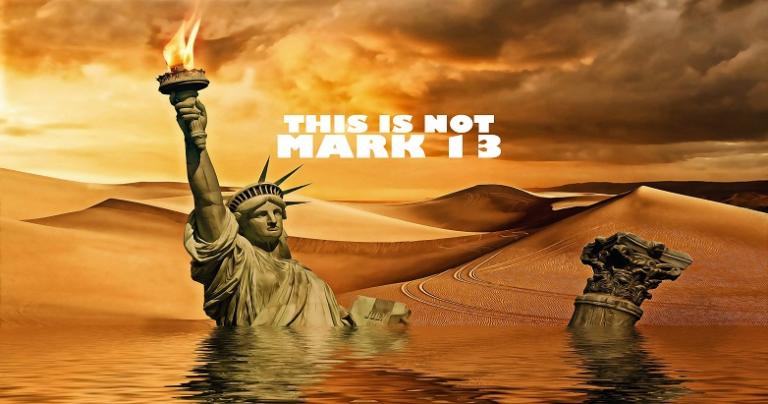
Mark 13 is NOT about THIS / Image by Enrique Meseguer from Pixabay
This Sunday’s Gospel, taken from Mark 13, is about being ready, but not for the end of the world.
This Sunday’s readings (Mark 13:33-37) turn to the so-called Synoptic Apocalypse and “eschatological discourse” (Mark 13:1-37). This is something we spoke about extensively last year, but given the predilection so many have for the “End Times,” it bears another look.
Is there anything “apocalyptic” or “eschatological” in the Gospels? Or in the Scriptures? Had you asked me that question ten years ago, I would have unhesitatingly answered, “Yes!” But now, having read Dr. Bruce Malina, I’m not so sure.
As H. L. Vogl showed us this morning with an insightful blog post from BEYOND ALL TELLING, we believers today should purify our ideas about God. But how did our earliest ancestors in the faith see things?
Is Mark 13 Respectfully Apocalyptic?
Reading Mark 13 (paralleled by Matthew 24:1-51 and Luke 21:5-36), what do you think Jesus was talking about here? Was he talking about the end of the world as the New American Bible Revised Edition forces its readers to conclude by way of a clumsy header (“THE SIGNS OF THE END”)? In other words, is Mark 13 something “apocalyptic”? Or is it instead about the destruction of the Temple (Mark 13:1-2; 3-4)?
By the way, does Jesus sound apocalyptic here? And what is an “apocalypse,” anyway? When you read that word, what images come to mind?
The Markan Jesus claims that only the Father knows about the day and hour when the Son of Man comes (v. 32). Nevertheless, he promised his listeners that they would remain alive “until all these things have taken place” (v. 30). See how this is underscored by how urgently Jesus urges his audience to “Be watchful! Be alert!” (v. 33) and “Watch!” (v. 37)?
Whoa… did Jesus screw up? It’s been almost 2,000 years, folks, and Jesus remains a no-show! Those people are long dead!
Reading Mark 13 in a Culturally Plausible Way
21st century Western Christians can’t understand or appreciate any of this without realizing certain Middle Eastern cultural peculiarities. For example, how did the ancient Middle Eastern peasants view time? And what exactly was the relationship between a Jesus-group owner of slaves and his human property?
First, to dive into that, consider that historians are helped and hindered by the scenarios they have in their minds. This is like the NABRE editors—they had wrong scenarios in their heads when they put together the section of Mark 13:3-8, and these scenarios shaped their header “THE SIGNS OF THE END.”
Testing Our Assertions
Say a scholar confidently asserts, “Jesus is best understood as an apocalyptic prophet, an ancient Jew who thought the world would dramatically end soon.” How do we know that this historical conclusion is accurate? Since we don’t have any time machines, how do we test the scenarios historians use in their interpretations to see if they correspond to what actually happened?
In this case, Bruce Malina offers us a simple test provided by the social-science method. This way discovers comparable behavior found in our contemporary world. A medieval principle of logic rests beneath this test. According to Malina, “if something exists, it could have existed, but if something could exist (if we can conceive of it), it did/does not necessarily exist.” This principle will be important going forward.
Are there any parallel cases we can find to shed light on what’s really going on with Mark 13? According to Malina, yes. He tells a story about another Middle Eastern holy man from our times. To hear it, watch the video here.
Iran So Far Away with Mark 13
Following Malina, there is a fascinating omission that happens whenever biblical scholars, theologians, and homilists comment on Mark 13. Almost universally, they call it “apocalyptic” or “eschatology.” And yet, they always neglect to mention modern Iran.
Of course, the Khomeini event and the resulting Islamic state have nothing to with anything “apocalyptic” or “eschatological.” The thing is, neither does today’s Gospel from Mark 13. Ultimately, there’s nothing apocalyptic about Jesus!
In fact, Mark 13 and how Jesus envisioned the Kingdom of God was far more like the Iranian theocracy of today than the apocalyptic fancies sold by Euro-American academics. As Malina convincingly shows, scholars who think otherwise seem addicted to 19th-century tautologies.
Spurious Familiarity
So often in this blog, we talk about Bible readers afflicted by a “spurious familiarity“—popular conclusions that seem so obvious and certain but are difficult or perhaps impossible to document. Scripture scholars, theologians, and preachers are not immune to spurious familiarity. Indeed, how they treat today’s Gospel displays this.
Let’s break these often-used, tired, and wholly misapplied terms down.
Apocalypse—while appearing to be ancient Greek, how it gets used today is really a 19th century Germanism. Theologian Gottfried Christian Friedrich Lücke reinvented an old Greek expression (ἀποκάλυψις) meaning “an unveiling” (as in a vision, sky journey, or other altered states of consciousness experience) to refer to a genre of literature including Revelation, Daniel, the Enochian literature,4 Ezra, and Baruch. These works are more honestly categorized as Israelite astronomic reports and sky lore.
Eschatology—In 1804, German theologian Karl Gottlieb Bretschneider coined this term. He used it about “the last things” that all humans must individually experience at death.
Other Anachronisms
While we are at it, there is no “delay of the Parousia” anywhere in the Bible, as royalty is never late or early, but instead arrives when it means to. So while we can rightly say that the Parousia “refused to materialize,” it cannot be accurately called “late” or “delayed.”
And without the European novel of the 1700s, and that century’s distinction between fact and fiction, together with seeing the Bible as a narrative or story, a body of literature with character, plot, and setting, there would be no “salvation history” category either.
These terms are inaccurate whenever we apply them to anything before the 1800s—including Scripture. Just the same, the following expressions were non-existent in antiquity—”otherworldly,” “transcendent reality,” “eschatological salvation,” “another, supernatural world,” and “the future.”
Back to the Future with Mark 13
Speaking about “the future,” let’s talk about time and how Jesus’ audience perceived and understood it. Years ago, Malina, then president of the Catholic Biblical Association of America, wrote an article published in the Catholic Biblical Quarterly entitled, Christ and Time: Swiss or Mediterranean? This tour de force dealt with the perception and conception of time in peasant societies and the New Testament.
Malina demonstrated the fierce orientation to the present of Mediterranean culture. With most of the population historically being peasants struggling to survive at subsistence, there was no leisure time to figure out far-away futures. So consideration of future events is almost impossibly remote because the furthest ahead anyone saw was forthcoming. Thus, if some action doesn’t immediately occur, forget about it, as the Spaniards (mañana) and Italians (domani) routinely do. That’s Middle Eastern Jesus also (Matthew 6:34).
Therefore, in Mark 13, Jesus must have been talking about something imminent. But none of these signs were visible in 30 CE, Passover time when he supposedly said this. But later on, in 70 CE, around the time “Mark” wrote his Gospel, Jerusalem was burning. Rome sacked everything and destroyed the Temple.
So Mark 13 isn’t an apocalyptic message about the end of the world bearing a universal impact on humankind. In contrast, it is a prescient message of Jesus concerning the fate of Jerusalem, Temple, and society as Israelites knew it and therefore bore local and particular interest only to Israelites.
Slave to the Family
Now consider biblical slavery. Any time you see the word “servant” in Scripture, including similar terms like “handmaid” in the Magnificat (Luke 1:46-55), scratch it out and put “slave.” As Malina’s associate John Pilch explains, first-century “servants” and “handmaids” were owned property—so use slave every time.
But biblical slaves were not like slaves of the New World. Instead, extensive laws regulated the relationship between master and slave in all Mediterranean peoples during New Testament times. Being group-centered Mediterraneans, biblical people valued slaves according to the status held by the family that owned them.
Therefore New Testament slaves were family members to their owners. Pilch says this explains why “the Pastor” warns believing slaves of taking advantage of their Jesus-group owners. They should instead excel at their service (1 Timothy 6:2).
Slaves, Time, and Mark 13
Pilch says that understanding the importance of the Markan Jesus’ parable (13:34-47) depends on seeing biblical slaves as family members. When a Mediterranean master, the paterfamilias, took a long journey, he expected every household member to do his or her assigned tasks (v. 34). Today, not mañana.
It would be a disaster should the gatekeeper fail at his post and the home snooze on while their beloved Father returns without honored greeting. So must the Markan Jesus group be vigilant gatekeepers watching for their beloved Head to return. Will they be ready?
That was then. But what can we take from this “Good News” of Mark 13?
If you haven’t already, go over to H’s blogpost. After reading, you might want to meditate on new directions.
Catholic Biblical Association of America
Previous Post

November 26, 2020
How Goes your Thanksgiving?
Next Post

December 5, 2020 The Model is Broken—Nothing Apocalyptic About Apocalypse
Browse Our Archives
Select a Category Uncategorized
Select a Month August 2021 July 2021 June 2021 May 2021 April 2021 March 2021 February 2021 January 2021 December 2020 November 2020 October 2020 September 2020 August 2020 July 2020 June 2020 May 2020 April 2020 March 2020 February 2020 January 2020 December 2019 November 2019 October 2019 September 2019 August 2019
Follow Us!
TAKE THE
Religious Wisdom Quiz
Who did Jesus raise from the dead after four days?
Select your answer to see how you score.
Himself Widow's son Lazarus Jairus’ daughter
Support this
Column


Related posts from Messy Inspirations

Understanding Apocalypse & Its Creatures



TRENDING AT PATHEOS Catholic

The Parable Of The Sower And The Word...
One of Christ’s most famous parables is that of the sower who...

Rejecting Doom: Christian Hope And Human Action
Christianity is a religion of hope. We are to have hope and...

Why I Choose the Eucharist Over the Sermon
Choose the Eucharist, Not the Sermon What are we supposed to get...

5 Design Elements Found in Spiritually Rooted Homes
Putting Spirituality Into Home Decor Our homes are more than our living...

Credo: A Story of God Told with the...
About 10 years ago, I began to imagine a personal "Credo" that...

The Anatomy of Divine Revelation in Catholic Thought
The claim that God has made Himself known to human beings is...
view all Catholic blogs
Ad-Free & Subscriber Log-In Subscription Support
- About Us
- 2026 Calendar
- Videos
- Podcasts
- Library of World Religions
- Faith In Media Tracker
- Advertise With Us
- Write for Us
- Privacy Policy
- Terms of Service
- Do Not Sell My Data
- Contact Us
- Radiant Digital
- Manage Newsletter Subscriptions
- Unsubscribe From Notifications
- Sitemap
Copyright 2008-2026, Patheos. All rights reserved.
Subscription Support Ad-Free & Subscriber Log-In
Follow Patheos