
BuddhistCatholicContemplativeEvangelicalGeneral ChristianHinduJewishLatter-day SaintMuslimNew VisionsProgressive Christian
Beliefs
- Buddhist
- Catholic
- Contemplative
- Evangelical
- General Christian
- Hindu
- Jewish
- Latter-day Saint
- More Voices
- Muslim
- New Visions
- Pagan
- Progressive Christian
Topics
- Religion News
- Food and Religion
- Sports and Religion
- Religious Art
- Religious Music and Entertainment
- Religious Events
- History and Religion
- Style and Religion
- Politics and Religion
- Women in Religion
- Recreation Outdoors and Religion
- Business Finance and Religion
- Careers Workplace and Religion
- Education and Religion
- Family Parenting and Religion
- Health Fitness and Religion
- Home and Religion
- Relationships and Religion
- Technology and Religion
- Travel and Religion
Columnists
- Buddhist Columnists
- Business Finance and Religion Columnists
- Careers Workplace and Religion Columnists
- Catholic Columnists
- Contemplative Columnists
- Education and Religion Columnists
- Evangelists Columnists
- Family Parenting and Religion Columnists
- General Christian Columnists
- Health Fitness and Religion Columnists
- Hindu Columnists
- History and Religion Columnists
- Home and Religion Columnists
- Jewish Columnists
- More Voices Columnists
- Latter Day Columnists
- Muslim Columnists
- New Visions Columnists
- Nonreligious Columnists
- Pagan Columnists
- Politics and Religion Columnists
- Progressive Columnists
- Recreation Outdoors and Religion Columnists
- Relationships and Religion Columnists
- Religion News Columnists
- Religious Art Columnists
- Religious Events Columnists
- Religious Music and Entertainment Columnists
- Sports and Religion Columnists
- Style and Religion Columnists
- Technology and Religion Columnists
- Travel and Religion Columnists
- Women in Religion Columnists
Resource Library
- 2026 Calendar
- Library of World Religions
- The 100 Most Holy Places on Earth
- Patheos Answers
- Podcasts
- Videos
- Faith Leaders Database
- Anglican Episcopalian
- Bahai
- Baptist
- Buddhism
- Christianity
- Confucianism
- Eastern Orthodoxy
- Hinduism
- Holiness and Pentecostal
- ISKCON
- Islam
- Judaism
- Lutheran
- Methodist
- The Church of Jesus Christ of Latter-day Saints
- New Age
- Paganism
- Presbytarian and Reformed
- Protestantism
- Religion Behind the Scenes
- Roman Catholic
- Scientology
- Shia Islam
- Sikhism
- Sufism
- Sunni Islam
- Taoism
- Zen
- See all religions
Research Tools
 Ad-Free & Subscriber Log-In Subscription Support
Ad-Free & Subscriber Log-In Subscription Support
Follow Patheos 

- Trending:
- Forgiveness
- |
- Marriage
- |
- Consciousness
- |
- Death Penalty
- |
- Election
- |
- Halloween
 Messy Inspirations
- Home
- Catholic
- The Gospel of Paul VS the Gospel of Jesus
The Gospel of Paul VS the Gospel of Jesus
Last updated on: October 29, 2020 at 5:27 pm by Fellow Dying Inmate
The Gospel of Paul VS the Gospel of Jesus 2020-10-29T17:27:35-04:00 Fellow Dying Inmate
Patheos Explore the world's faith through different perspectives on religion and spirituality! Patheos has the views of the prevalent religions and spiritualities of the world.
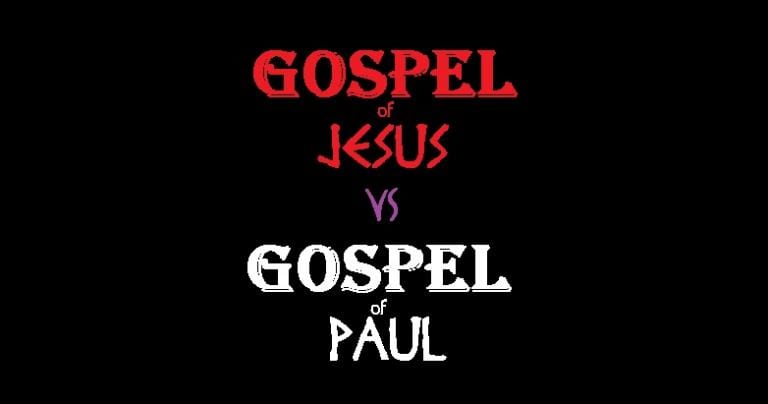
The Gospel of Jesus VS the Gospel of Paul / Fellow Dying Inmate / all rights reserved
The Gospel of Paul differs from the “good news” proclaimed by Jesus before his death and resurrection.
What is the Gospel, anyway? Christians talk about the Gospel all the time, but many seem hard-pressed to say what it means. Try asking random Catholics and other Christians what “the Gospel” is. They get tongue-tied. Or instead, they offer theological anachronisms unknown to Jesus and his immediate followers.
This post is not about the four canonical documents written by anonymous authors yet named after famous figures in the earliest Jesus groups. Nor are we talking about the dozens of other similar writings named after famous personages but excluded from the canon.
By “gospel” I am referring to the “good news” (εὐαγγέλιον) proclaimed by Jesus of Nazareth and his apostles. A gospel is, therefore, a proclamation of something new, something hitherto unheard of. The inspired documents named “Mark,” “Matthew,” “Luke,” and “John” are portraits of updated memories about Jesus that interpret, sometimes in contradictory ways, the Gospel.
The prepaschal Jesus (i.e., Jesus before his death and resurrection) proclaimed a gospel. But Paul also proclaimed a gospel. What’s the difference, if any, between the “good news” of Jesus and that of Paul?
Watch this presentation carefully…
The Gospel of the Prepaschal Jesus
Scholars are unanimous that the prepaschal Jesus proclaimed the kingdom of sky vault (anachronistically translated as “heaven”). “Kingdom of sky vault” was a politically correct Israelite expression, meaning theocracy. In other words, the gospel or “good news” of Jesus was a proclamation about a forthcoming Israelite theocracy. Therefore Jesus’ had a political-religious mission, one that was ethnocentrically particular to biblical Israel. Jesus needed to get Israelites ready for this new, divinely established political order by working repentance and healing in the land of Israel.
To this end, Jesus, a peasant artisan turned folk healer, formed a political faction, worked healings, and preached repentance in the land of Israel. Everything Jesus did, including his Gospel message, was all about political religion and political economy.
And who would be the harbinger of this Israelite Theocracy? According to the earliest layers of Gospel traditions, the prepaschal Jesus claimed it would be a celestial entity called “the Son of Man,” featured in documents like 1 Enoch and Daniel 7. This cosmic figure (probably the ram constellation we call “Ares”) was someone the prepaschal Jesus believed to be different than himself (Mark 8:38; 13:26; 14:62; Luke 9:26; 12:8; Matthew 26:64).
By the way, Christians believe that God worked with the Body of Christ in unpacking Mystery hidden within this messiness. We keep unpacking this inexhaustible treasure. So none of this renders illegitimate all later understandings. This is because we Catholics believe God guides the Church.
How Can We Know What the Gospel of Jesus Was?
This then was the Gospel of Jesus before his resurrection (Mark 1:15; Matthew 4:17; Luke 4:43). How do scholars reach reasonable assurance in this?
- Because the fact that this Theocracy failed to arrive makes it too embarrassing to have been invented by later Jesus followers.
- Theocracy is incongruous with the recorded prescribed behavior of later Jesus groups (see “Matthew” and “Luke”), communities that instead encouraged group maintenance.
- It is multiply attested to in the Synoptic Gospels but lacking in Paul.
Finally, given that Jesus was crucified, punishment for generating political unrest, that he would have proclaimed a subversive Gospel of Theocracy is coherent with his execution.
The Gospel of Paul
Later on, following Jesus’ resurrection, Paul also had a “gospel” or a new message for Israel. Perhaps this new proclamation was inconceivable to most Israelites. Paul proclaimed that the God of Israel had raised up the crucified Jesus into the sky vaults. By raising him from the dead, God indicated that Jesus was indeed Israel’s promised Messiah and cosmic Lord. Therefore an Israelite theocracy was imminent.
Like Jesus, Paul disseminated his innovation among Israelites. But unlike Jesus, Paul sought out his clients residing in non-Israelite urban centers. Paul’s goal was to spread his gospel, proclaiming what God did to Jesus. Ultimately, Paul’s gospel was about God raising Jesus from the dead as Israel’s Messiah and cosmic Lord soon to return to inaugurate Israelite Theocracy. It was a message given by an Israelite, to Israelites, about Israelites.
Romans 1:1-6
Paul, a slave [controlled by Jesus, messiah] of Jesus Christ [messiah, Israelite office of political religion, controller of Paul], called to be an apostle [one commissioned as an emissary and change agent sent to diffuse some innovation], set apart for the gospel [=innovation] of [the] God [of Israel, the change agency] which he [the God of Israel] promised beforehand [to Israelites] through his [Israelite] prophets [authorized spokespersons] in the holy scriptures [of Israel—this assumes his audience is familiar with this tradition, i.e. they are Israelites], the gospel [innovation] concerning his Son [the broker mediating between Israel, the client, and God, the patron], who was descended from David according to the flesh and designated Son of God [divine broker] in power according to the Spirit of holiness by his resurrection [a Persian idea adopted by Yehud after 537 BCE—Pharisees = Farsi = Persian] from the dead, Jesus Christ our [Cosmic] Lord, through whom we have received grace [favor] and apostleship [commissioning and authorization to proclaim and disseminate the innovation] to bring about the obedience of faith [loyalty] for the sake of his name [HONOR] among all the nations [that is, for those Israelites living among all the peoples in the Western diaspora], including yourselves [Israelites] who are called to belong to Jesus Christ [messiah]…
Concerning the Gospel of God
Paul knew his gospel as “the Gospel of God” (Romans 1:1). Paul was commissioned by God in an altered state of consciousness experience to proclaim this innovation—hence, “Gospel of God.” God gave Paul this gospel, and God drove Paul into regions where Israelites resided as a minority among non-Israelite majorities (the ethnē).
Paul’s seven authentic letters—1 Thessalonians, Galatians, 1—2 Corinthians, Philippians, Philemon, and Romans—testify to his concerns. They show that everything Paul said and did was about spreading “the gospel of God.”
Other Differences Between Jesus and Paul
Jesus and Paul were both poor Israelites, but different. Jesus was a peasant from a tiny hamlet in Galilee. He lived in a rural society. Scholars discern that Jesus spoke Aramaic, the language of lower-class people. The Semitisms and Aramaisms we find in the Gospels, of the earliest, most authentic Jesus sayings, indicate Jesus’ low status and rural, peasant origins.
Further, Jesus’ syntax, vocabulary, and style reveal Galilean poverty. Most of Jesus’ sentences are less than five words! His entire vocabulary is only 450 words, just ten percent of that of the New Testament. Jesus’ style is never abstract, always concrete.
Contrasting with Paul
In contrast, Paul lived in an urban society. Paul also communicated in Greek, the language of the polis, of the upper classes. And despite being dirt poor himself, Paul had been educated in a Greco-Roman polis and could write.
Paul’s syntax is superior to that of Jesus. Paul showcases the optative, the genitive absolute, and various infinitive structures, in his letters. In terms of vocabulary, Paul beats Jesus soundly. He quotes Gentile poets (1 Corinthians 15:32). He refers to “mystery” twenty times, while the so-called “mystic” named “John” omits the term entirely.
Unlike Jesus, Paul goes abstract in dealing with Israelite life and the messiah. Hence, the inspired forger Pseudo-Peter recognizes and cautions readers about abstract thought in Pauline documents (2 Peter 3:16).
But don’t think that makes Paul an elite! All indications from his own letters indicate that Paul toiled like poor urbanites from before dawn till after sundown. Paul depended on others for financial support (2 Corinthians 11:8-9; Philippians 4:10-18), despite the spin “Luke” gives him in “Acts.”
The Gospel of Our Expectations
The word “gospel” is multivalent. Therefore it can have multiple meanings and applications.
We Christians enjoy a 2,000-year theologically refined notion of Gospel. It is the result of unpacking the infinite Mystery of Christ.
But when we see what “gospel” meant at the root of our Tradition, and how it was understood by Paul, the change agent, we grow. The earliest meanings to “gospel” don’t necessarily invalidate our theologies and doctrines, but help us in that necessary business of respecting Jesus, Paul, and their distinct yet related projects. Getting that right helps us better unpack the inexhaustible riches of Christ.
More to come, later…
Previous Post
October 27, 2020
Homosexuality, Francis & the Bible
Next Post

November 3, 2020 Don’t Be Confused About Catholic Teaching
Browse Our Archives
Select a Category Uncategorized
Select a Month August 2021 July 2021 June 2021 May 2021 April 2021 March 2021 February 2021 January 2021 December 2020 November 2020 October 2020 September 2020 August 2020 July 2020 June 2020 May 2020 April 2020 March 2020 February 2020 January 2020 December 2019 November 2019 October 2019 September 2019 August 2019
Follow Us!
TAKE THE
Religious Wisdom Quiz
True or False: The mystery hidden for ages is Christ in us, the hope of glory.
Select your answer to see how you score.
FALSE TRUE
Support this
Column


Related posts from Messy Inspirations

Understanding Apocalypse & Its Creatures



TRENDING AT PATHEOS Catholic

Creation, Preservation, and Teleology in Catholic Theology
As I write this, it is very early Monday morning. Like millions...

The Parable Of The Sower And The Word...
One of Christ’s most famous parables is that of the sower who...

Rejecting Doom: Christian Hope And Human Action
Christianity is a religion of hope. We are to have hope and...

Why I Choose the Eucharist Over the Sermon
Choose the Eucharist, Not the Sermon What are we supposed to get...

5 Design Elements Found in Spiritually Rooted Homes
Putting Spirituality Into Home Decor Our homes are more than our living...

Credo: A Story of God Told with the...
About 10 years ago, I began to imagine a personal "Credo" that...
view all Catholic blogs
Ad-Free & Subscriber Log-In Subscription Support
- About Us
- 2026 Calendar
- Videos
- Podcasts
- Library of World Religions
- Faith In Media Tracker
- Advertise With Us
- Write for Us
- Privacy Policy
- Terms of Service
- Do Not Sell My Data
- Contact Us
- Radiant Digital
- Manage Newsletter Subscriptions
- Unsubscribe From Notifications
- Sitemap
Copyright 2008-2026, Patheos. All rights reserved.
Subscription Support Ad-Free & Subscriber Log-In
Follow Patheos