
BuddhistCatholicContemplativeEvangelicalGeneral ChristianHinduJewishLatter-day SaintMuslimNew VisionsProgressive Christian
Beliefs
- Buddhist
- Catholic
- Contemplative
- Evangelical
- General Christian
- Hindu
- Jewish
- Latter-day Saint
- More Voices
- Muslim
- New Visions
- Pagan
- Progressive Christian
Topics
- Religion News
- Food and Religion
- Sports and Religion
- Religious Art
- Religious Music and Entertainment
- Religious Events
- History and Religion
- Style and Religion
- Politics and Religion
- Women in Religion
- Recreation Outdoors and Religion
- Business Finance and Religion
- Careers Workplace and Religion
- Education and Religion
- Family Parenting and Religion
- Health Fitness and Religion
- Home and Religion
- Relationships and Religion
- Technology and Religion
- Travel and Religion
Columnists
- Buddhist Columnists
- Business Finance and Religion Columnists
- Careers Workplace and Religion Columnists
- Catholic Columnists
- Contemplative Columnists
- Education and Religion Columnists
- Evangelists Columnists
- Family Parenting and Religion Columnists
- General Christian Columnists
- Health Fitness and Religion Columnists
- Hindu Columnists
- History and Religion Columnists
- Home and Religion Columnists
- Jewish Columnists
- More Voices Columnists
- Latter Day Columnists
- Muslim Columnists
- New Visions Columnists
- Nonreligious Columnists
- Pagan Columnists
- Politics and Religion Columnists
- Progressive Columnists
- Recreation Outdoors and Religion Columnists
- Relationships and Religion Columnists
- Religion News Columnists
- Religious Art Columnists
- Religious Events Columnists
- Religious Music and Entertainment Columnists
- Sports and Religion Columnists
- Style and Religion Columnists
- Technology and Religion Columnists
- Travel and Religion Columnists
- Women in Religion Columnists
Resource Library
- 2026 Calendar
- Library of World Religions
- The 100 Most Holy Places on Earth
- Patheos Answers
- Podcasts
- Videos
- Faith Leaders Database
- Anglican Episcopalian
- Bahai
- Baptist
- Buddhism
- Christianity
- Confucianism
- Eastern Orthodoxy
- Hinduism
- Holiness and Pentecostal
- ISKCON
- Islam
- Judaism
- Lutheran
- Methodist
- The Church of Jesus Christ of Latter-day Saints
- New Age
- Paganism
- Presbytarian and Reformed
- Protestantism
- Religion Behind the Scenes
- Roman Catholic
- Scientology
- Shia Islam
- Sikhism
- Sufism
- Sunni Islam
- Taoism
- Zen
- See all religions
Research Tools
 Ad-Free & Subscriber Log-In Subscription Support
Ad-Free & Subscriber Log-In Subscription Support
Follow Patheos 

- Trending:
- Forgiveness
- |
- Marriage
- |
- Consciousness
- |
- Death Penalty
- |
- Election
- |
- Halloween
 Messy Inspirations
- Home
- Catholic
- Paul Evangelized the Gentiles, Right??
Paul Evangelized the Gentiles, Right??
Last updated on: October 18, 2020 at 3:36 pm by Fellow Dying Inmate
Paul Evangelized the Gentiles, Right?? 2020-10-18T15:36:09-04:00 Fellow Dying Inmate
Patheos Explore the world's faith through different perspectives on religion and spirituality! Patheos has the views of the prevalent religions and spiritualities of the world.
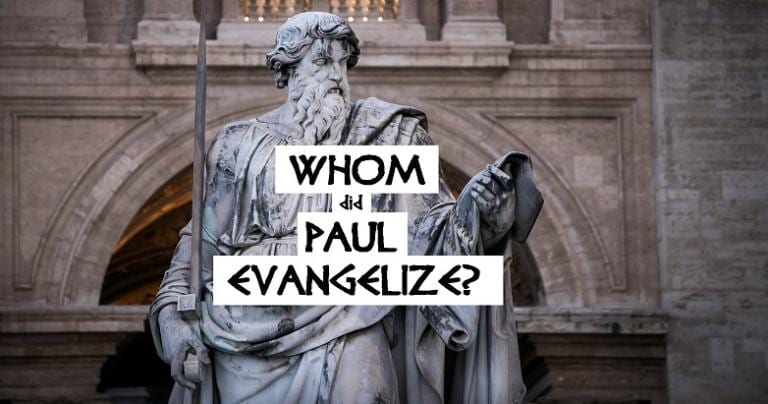
Paul Evangelized / Image by Robert Cheaib from Pixabay
When it comes to reading Paul for cues about how to evangelize, Christians’ worst obstacle is their spurious familiarity.
Paul evangelized. He spread the Gospel among the Gentiles because he was the Apostle to the Gentiles. I shouldn’t have to tell you that, right? It’s basic New Testament knowledge held by every Christian. We all know it. Got it in Sunday school. So we can drop that and move on.
Except maybe we can’t move on. Perhaps our knowledge is spurious. Perhaps we don’t know him at all, like whom Paul evangelized.
Paul being the Apostle to the Gentiles is something the vast majority of Christians presume to know for sure. But try documenting that. Try demonstrating that with Scripture. It should be easy, right? But what if it’s really impossible?
To get what I mean, watch the following video—
Paul Evangelized at Mars Hill?
Let’s talk about Paul’s famous preaching at Mars Hill in Athens (Acts 17:16-34). First off, try not to forget that this isn’t the historical Paul, but rather the Lukan Paul. We don’t really get the historical Paul in “Acts.” Instead, we get a Lukan spin on him.
Don’t be naïve and think the speech (vv. 22-31) is a transcript or recording of something the historical Paul actually said. The spin-meister “Luke” gives his readers what he feels Paul would have said had he addressed Athenians. Ultimately, it’s a Lukan composition, folks.
A quick aside—inspiration doesn’t turn ancient authors like “Luke” into contemporary Western biographers with a desire to present only the facts. Nor does it transform every inspired writing into purely factual accounts. If the Bible has any “inerrancy” (a novel concept produced out of post-Enlightenment obsessions), it is salvific, not cognitive. The Bible is all true, and some of it actually happened.
Paul Evangelized Because He Was Annoyed…
So the Lukan Paul looks around and sees all these images of gods/sky beings (Acts 17:16). This results in him becoming annoyed. He’s upset by this. But why?
The answer seems obvious. Duh! It’s because Paul is a monotheist, like all Jews and Christians. Thus his monotheism has been offended. So Paul evangelized the heathens. Simple. Easy. Case closed.
Except, Paul wasn’t a monotheist. Neither was he Jewish nor Christian. So let’s shake up our spurious familiarity. Monotheism evolved over a long time, and don’t look for Judaism or Christianity before the fourth century CE. Be careful with your English translations, especially when you read “Jew.” The word “Christian,” as used by New Testament documents (a slur in the passive voice), carries a radically different meaning than it does after Nicaea in 325 CE. Additionally, we must distinguish between acorns and oak trees, between roots and shoots. This affects the understanding of how Paul evangelized.
To follow these arguments, please read Context Group scholar John Elliott’s tour-de-force on the subject here:
Jesus the Israelite Was Neither a `Jew’ Nor a `Christian’: On Correcting Misleading Nomenclature
Paul Evangelized Because that’s What Christians Do.
What then should we call followers of Jesus living before Constantine and the Council held at Nicaea (325 CE)? Perhaps Messianists, suggests Dr. John Pilch and his colleagues, the Context Group of biblical scholars. The reason? They were predominantly Israelites (’ Ισραηλίτης) who accepted Jesus as the messiah.
It is very likely Paul, whether the real deal or Lukan spin, was a henotheist (“there are many gods and many lords” in 1 Corinthians 8:5-6). In that case, he would be just like most first century Israelites. Then why is the Lukan Paul annoyed? It seems that the Athenians honor (core Mediterranean value) every Mediterranean sky being with a shrine except the God of Israel. Paul goes to address this slight.
Paul Evangelized in Homophilous Communication
The whole scene is really more reflective of the Lukan situation in the 80s—90s rather than Paul’s own before he died in the 60s. The historical Paul evangelized or communicated with people who shared his beliefs, education, social status, and cultural background. This is called homophilous communication. In contrast, we’ve acquired a spurious idea. Therefore we think the opposite—that Paul operated within a system of peoples belonging to different education, beliefs, social status, and cultural makeup. That is called heterophilous communication.
In short, we wrongly assume that Paul evangelized in heterophilous fashion. When we say he was “apostle to the Gentiles,” we mean that Paul communicated his Gospel heterophilously. But in reality, Paul evangelized through homophilous ways. In other words, throughout the Mediterranean, Paul had daily discussions in the local Israelite meeting place (synagogue, not yet a place of worship). Thus, Paul evangelized other Israelites.
Therefore, this business of going to the Agora (public forum) and shouting ideas heterophilously at random passersby regardless of their ethnic origins is probably more reflective of a later time after Paul’s death. We are talking about decades later. But had the historical Paul done so, for Athenian non-Israelites at least, he would not have been considered an anomaly. For in both Paul’s day and the later time of “Luke,” Athenians enjoyed rigorous debates over philosophy in the marketplace.
Paul Evangelized the Athenian Marketplace?
And who would be arguing in the marketplace at Athens? Among the loud voices would be Epicureans and Stoics. Both Paul and the later anonymous author we call “Luke” would be quite familiar with these schools of thought. Followers of Epicurus (d. 270 BCE) rejected beliefs in an afterlife, postmortem rewards or punishments, and divine providence and judgment.
Stoics belonged to a very different way. Established by Zeno (d. 265 BCE), Stoics held that knowledge discovers and undergirds virtue. To them, nature was guided by divine Reason, and humans should obey Reason and become self-sufficient. In his upbringing in Tarsus, Paul would have been exposed to Stoicism there. You see this influence in his letters—everything happens due to Reason, therefore acquiesce!
Epicureans hearing an Israelite in the marketplace going on about foreign deities might denigrate him as a “babbler” (spermologos). But Stoics might have been given a more fair hearing.
Athenian Confusion
In Acts 17:18c, some Athenians claim that Paul “sounds like a promoter of foreign deities” (xenōn daimoniōn) because he was preaching about ‘Jesus’ and ‘Resurrection’” (Iēsoun kai tēn anastasin).
The Greek for “resurrection” is anastasis. Some scholars like John Pilch, believe that the Stoics heard Jesus (masculine noun) and Anastasin (feminine noun, resurrection). Athenians were familiar with Zeus and Hera, Poseidon and Amphitrite**,** Hades and Persephone, Hephaestus and Aphrodite, and countless more divine couples. So here comes Paul with one more, Jesus and Anastasia. In other words, they misunderstood the Lukan Paul entirely.
It may sound comical imagining Athenians confounding Paul into preaching about Jesus and his wife Anastasia, but don’t laugh too much. We distort Paul all the time. In any case, it’s quite likely these kinds of misunderstandings were very familiar to the Lukan Jesus group living decades after Paul. Even later, Jesus groups would be accused by outsiders of ritual murder and cannibalism.
We’ll return to this topic soon… it’s time to get schooled on Paul.
How did Paul spread the Gospel?
Previous Post

October 17, 2020
HAUNTING on Netflix Offers Deep Spirituality
Next Post

October 19, 2020 Math Debunks Pauline Myths
Browse Our Archives
Select a Category Uncategorized
Select a Month August 2021 July 2021 June 2021 May 2021 April 2021 March 2021 February 2021 January 2021 December 2020 November 2020 October 2020 September 2020 August 2020 July 2020 June 2020 May 2020 April 2020 March 2020 February 2020 January 2020 December 2019 November 2019 October 2019 September 2019 August 2019
Follow Us!
TAKE THE
Religious Wisdom Quiz
What did God create on the second day?
Select your answer to see how you score.
Sun Sky Fish Trees
Support this
Column


Related posts from Messy Inspirations

Understanding Apocalypse & Its Creatures



TRENDING AT PATHEOS Catholic

The Parable Of The Sower And The Word...
One of Christ’s most famous parables is that of the sower who...

Rejecting Doom: Christian Hope And Human Action
Christianity is a religion of hope. We are to have hope and...

Why I Choose the Eucharist Over the Sermon
Choose the Eucharist, Not the Sermon What are we supposed to get...

5 Design Elements Found in Spiritually Rooted Homes
Putting Spirituality Into Home Decor Our homes are more than our living...

Credo: A Story of God Told with the...
About 10 years ago, I began to imagine a personal "Credo" that...

The Anatomy of Divine Revelation in Catholic Thought
The claim that God has made Himself known to human beings is...
view all Catholic blogs
Ad-Free & Subscriber Log-In Subscription Support
- About Us
- 2026 Calendar
- Videos
- Podcasts
- Library of World Religions
- Faith In Media Tracker
- Advertise With Us
- Write for Us
- Privacy Policy
- Terms of Service
- Do Not Sell My Data
- Contact Us
- Radiant Digital
- Manage Newsletter Subscriptions
- Unsubscribe From Notifications
- Sitemap
Copyright 2008-2026, Patheos. All rights reserved.
Subscription Support Ad-Free & Subscriber Log-In
Follow Patheos