
BuddhistCatholicContemplativeEvangelicalGeneral ChristianHinduJewishLatter-day SaintMuslimNew VisionsProgressive Christian
Beliefs
- Buddhist
- Catholic
- Contemplative
- Evangelical
- General Christian
- Hindu
- Jewish
- Latter-day Saint
- More Voices
- Muslim
- New Visions
- Pagan
- Progressive Christian
Topics
- Religion News
- Food and Religion
- Sports and Religion
- Religious Art
- Religious Music and Entertainment
- Religious Events
- History and Religion
- Style and Religion
- Politics and Religion
- Women in Religion
- Recreation Outdoors and Religion
- Business Finance and Religion
- Careers Workplace and Religion
- Education and Religion
- Family Parenting and Religion
- Health Fitness and Religion
- Home and Religion
- Relationships and Religion
- Technology and Religion
- Travel and Religion
Columnists
- Buddhist Columnists
- Business Finance and Religion Columnists
- Careers Workplace and Religion Columnists
- Catholic Columnists
- Contemplative Columnists
- Education and Religion Columnists
- Evangelists Columnists
- Family Parenting and Religion Columnists
- General Christian Columnists
- Health Fitness and Religion Columnists
- Hindu Columnists
- History and Religion Columnists
- Home and Religion Columnists
- Jewish Columnists
- More Voices Columnists
- Latter Day Columnists
- Muslim Columnists
- New Visions Columnists
- Nonreligious Columnists
- Pagan Columnists
- Politics and Religion Columnists
- Progressive Columnists
- Recreation Outdoors and Religion Columnists
- Relationships and Religion Columnists
- Religion News Columnists
- Religious Art Columnists
- Religious Events Columnists
- Religious Music and Entertainment Columnists
- Sports and Religion Columnists
- Style and Religion Columnists
- Technology and Religion Columnists
- Travel and Religion Columnists
- Women in Religion Columnists
Resource Library
- 2026 Calendar
- Library of World Religions
- The 100 Most Holy Places on Earth
- Patheos Answers
- Podcasts
- Videos
- Faith Leaders Database
- Anglican Episcopalian
- Bahai
- Baptist
- Buddhism
- Christianity
- Confucianism
- Eastern Orthodoxy
- Hinduism
- Holiness and Pentecostal
- ISKCON
- Islam
- Judaism
- Lutheran
- Methodist
- The Church of Jesus Christ of Latter-day Saints
- New Age
- Paganism
- Presbytarian and Reformed
- Protestantism
- Religion Behind the Scenes
- Roman Catholic
- Scientology
- Shia Islam
- Sikhism
- Sufism
- Sunni Islam
- Taoism
- Zen
- See all religions
Research Tools
 Ad-Free & Subscriber Log-In Subscription Support
Ad-Free & Subscriber Log-In Subscription Support
Follow Patheos 

- Trending:
- Forgiveness
- |
- Marriage
- |
- Consciousness
- |
- Death Penalty
- |
- Election
- |
- Halloween
 Messy Inspirations
- Home
- Catholic
- Homosexuality, Francis & the Bible
Homosexuality, Francis & the Bible
Last updated on: October 27, 2020 at 7:55 pm by Fellow Dying Inmate
Homosexuality, Francis & the Bible 2020-10-27T19:55:09-04:00 Fellow Dying Inmate
Patheos Explore the world's faith through different perspectives on religion and spirituality! Patheos has the views of the prevalent religions and spiritualities of the world.
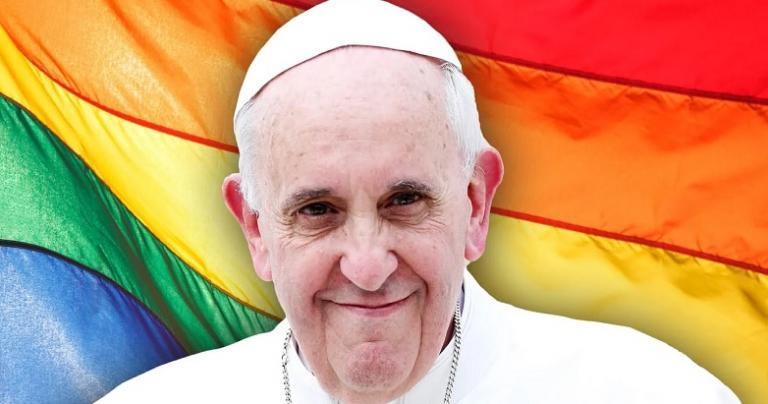
Homosexuality & Pope Francis / Sarah Rogers / The Daily Beast
When it comes to homosexuality, many Christians are being stupid and unfair to both Pope Francis and Saint Paul.
Homosexuality and Pope Francis made the news. Both also fired the forge of animus belonging to so many Catholic fundamentalists. Repeatedly the Holy Father earns their ire, and recently, he has outdone himself. Francis seems to endorse same-sex civil unions. And people caught this on film. And the Francis hate-squad predictably reacted according to their unique brand of Christian “love.”
When it comes to the hatred and phobias of U.S. Christians, gays, lesbians, bisexuals, and transgender persons are favorite targets. Francis outraged many Catholics and other Christians worldwide who believe that the Bible clearly condemns “homosexuals” and “homosexual activity.” Many believe that the Bible clearly addresses gays, lesbians, bisexuals, and transgender persons, condemning them. Additionally, fundamentalists believe that the Bible addresses people with “heterosexual” and “homosexual” “orientations,” and offers explicit moral guidelines for people no matter their culture or historical time. Does it?
Watch this video—
The Bible’s Clear Teaching on Homosexuality
The Bible clearly teaches about “homosexuals” and “homosexual activity,” right? Many agree it does. And does it offer explicit moral guidelines for people no matter the culture or age, yes? “Certainly!” say the fundamentalists.
And they come armed with an arsenal of proof-texts to demonstrate this. Like this “clear” example—
1 Corinthians 6:9–10 Do you not know that unjust persons will not inherit the kingdom of God? Do not be deceived. Neither pornoi, nor idolaters, nor adulterers, nor malakoi, nor arsenokoitai, nor thieves, nor the greedy, nor drunkards, nor revilers, nor robbers will inherit the kingdom of God.
If you don’t read Greek (and even if you do!), that passage rendered above doesn’t seem too straightforward, does it? What do those three odd terms—pornoi, malakoi, and *arsenokoitai—*mean? Let’s leave out pornoi just for now. It deserves another post.
For now, let’s focus on malakoi and arsenokoitai, notoriously tricky terms. And yet you’d never know how confusing they are given the millions of Christians who believe that the Bible clearly condemns homosexuality.
Homosexuality in the Greek?
Who cares about the Greek? Just give us the English translation! Okay. But why not give you a whole bunch of translations? Just remember what Context Scholar John Elliott says: “Every translation is an interpretation.” And what his colleague, John Pilch says, is equally valid: “In the beginning was the interpretation.”
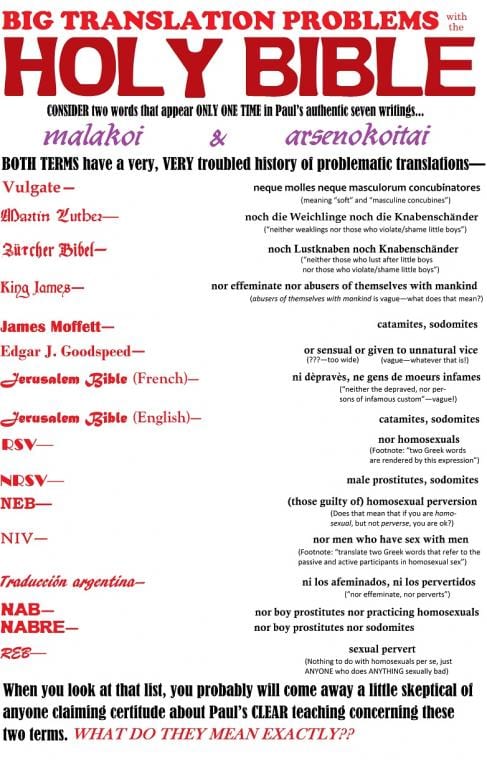
Homosexuality in malakoi & arsenokoitai / Fellow dying inmate / All rights reserved
Look at those disagreements in translations (i.e., interpretations)! Again, “every translation is an interpretation.” This is precisely because all language derives its meaning from social systems. No two cultures are identical in every respect. Hence even the very best translations are, in some way, betrayals. By accommodating a reader in one culture (e.g., 21st-century English-speakers), translators introduce concepts foreign to the cultural world of the texts they translate. Ultimately, translators misrepresent something the ancient author wrote.
Hence the Italian proverb, “Traduttore, traditore.” Or “every translator is a traitor.” 1 Corinthians 6:9–10 offers us a “Judas Iscariot,” “Brutus,” or “Benedict Arnold” sized example of treacherous Biblical translation/interpretation. (Maybe it’s too soon to say “Donald Trump sized betrayal”?)
Wrong Translations
Look at the graph above. Should the two different Greek words, malakoi, and arsenokoitai, be combined into the English “homosexuals”? That’s what the Revised Standard Version did. The translators rendered two Greek words into one English expression. But is that rendering accurate? By the way, that term “homosexual” (just like “heterosexual”) is of recent vintage, coined way after the Enlightenment and watershed event of the Industrial Revolution. We are talking late-1800s, folks!
The Good News Translation (formerly Today’s English Version) renders these two words into one expression, “homosexual perverts.” Why would that be the rendering? Are the translators distinguishing “homosexuals” from “perverse homosexuals”?
How can the Bible, an ancient library, say anything about “homosexual” and “homosexuality” if both these terns are recent 19th-century conceptual constructs? Aramaic, Hebrew, Greek, or any other ancient language, simply lacks counterparts to these concepts. In other words, far from being clear and evident about homosexuals and homosexuality, the Bible doesn’t know either. Ultimately, the Bible mentions nothing about them.
Origin of Homosexuality & Sexual Orientation
As Elliott and friends explain, Austrian-Hungarian Károly Mária Kertbeny coined the term “homosexual” in 1869. Decades later, it was introduced to the English-speaking world in the 1890s by Charles Gilbert Chaddock in his translation of the second edition of R. Krafft-Ebbing’s “Psychopathia Sexualis.” Following that, in 1892, “homosexual” was included in the Oxford English Dictionary.
Could there be “homosexuality,” “heterosexuality,” and “bisexuality” before the 19th-century and before post-Industrial times? Dashing popular spurious assumptions, Elliott and friends say no. Why? These terms are invented labels indicating something genuinely new under the Sun, namely, 19th-century awareness of persons being subjective, psychological centers of awareness. In other words, they are related to individualism, something rare and recent in human societies and history.
Without the watershed of “Romanticism” or “postmodernism” the concepts of homosexuality and sexual orientation would never have evolved. Why? Because, without this cultural shift, human perceptions and experience would not have been drastically rearranged. Hence there would be no Western individualism to give rise to homosexuality as we know it.
How Homosexuality Happened
So what about same-gender sexual orientation in antiquity? Frankly, it just wasn’t a concern at all! This is because homosexuality—and heterosexuality—emerged when economics rose to be a focal social institution and lifestyles changed due to the social upheavals caused by the Industrial Revolution and Romanticism. Ultimately, as Elliott and friends maintain, sexual orientation is of recent vintage. Only by way of eisegesis can someone find that bottle anywhere on the ancient shelves of the Bible.
So in postmodern times, sexual orientation became disjoined from gender. This happened because social interest refocused on persons as individuals and their individualism. While individuality is indeed a human universal, individualism isn’t. As explained, it is a recent, post-Industrial phenomenon.
Before the 19th-century, all persons were anti-introspective collectivists. Human beings were, therefore, not psychologically-minded. So even if someone ancient were attracted to someone else of the same gender, it wouldn’t be ascribed to “sexual orientation.” In contrast, it would be attributed to some collectivistic social custom, convention, tradition, or ethnic way. Ultimately, the group-specific world of Jesus and Paul could never conceive homosexuality, a permanent psychological state involving the sexual orientation to those of the same biological gender.
No Homosexuals, Heterosexuals, or Bisexuals in the Bible
The Bible doesn’t know or distinguish behavior from personal sexual “orientation.” The Bible isn’t psychological. Like all ancients, Biblical persons categorized humans by their origins—gender, genealogy, geography, and behavior. In other words, ancient people judged humans by externals, not internal states. Besides, you could never verify invisible interior features to the biblical cultural world. Only God could look inside the human heart (1 Samuel 16:7).
Therefore Jesus, Paul, all biblical characters and authors—and any other person from antiquity!—had no expression for, or concepts of, what we today define as “homosexual.” Ancients assumed that human beings were attracted to all sexes. Thus how could they develop any behavior-based category for someone demonstrating a fixed preference for same-sex partners? Hence homosexuals, or heterosexuals, were unknown to ancients, including Paul. Consequently, we must be misreading, misinterpreting, and mistranslating him.
Hence whenever anyone brings up Paul’s clear teaching about homosexuality or that from any other Scripture or any ancient document, they’re just wrong. It is always a case of 21st-century people reading a postmodern concept (“homosexuality”) into the text. Don’t do this! Nor should we ever assume that according to 1 Corinthians 6:9, Paul condemns all homosexual relations, in every time and place.
Haters Gonna Hate
Angry people are already typing. “What about Sodom and Gomorrah? What about Leviticus? Romans 1?” Oh, don’t worry. We are going to go through all those verses, one at a time. We’ll talk about Sodom and Gomorrah and Mediterranean myths about hospitality, how sodomy was a Medieval word based on a misinterpretation. We’ll read those laws in Leviticus according to the proper context. And we’ll discover what “abomination” really means. And once more, we will address what Paul means by “natural,” and what it has to do with honor and shame and dishonorable body positions.
For now, I will leave you this salient wisdom, from Michael Damon Guinon, O.F.M.—
“Our modern understanding of homosexuality as a permanent given psychological condition simply did not exist in the ancient world, if in fact it existed ANYWHERE before the rise of modern psychology in the last century and a half … in our modern sense, therefore, THERE IS NO BIBLICAL TEXT ON HOMOSEXUALITY OR HOMOSEXUALS. It is stupid and unfair to expect biblical texts to provide detailed answers for all our modern problems, problems which either did not exist in the ancient world or which were understood in a different way.”
“Homosexuals: A Christian Pastoral Response Now,” in “Challenge to Love: Gay and Lesbian Catholics in the Church” (R. Nugent, ed.; NY: Crossroad, 1983) pp. 66-67.
Dis Pope Francis endorse homosexual civil unions?
Does the Bible condemn homosexuality
Does the Catholic Church condemn homosexuality?
Pope Francis and homosexual civil unions
Previous Post

October 24, 2020
Rising COVID-19 Responsibility
Next Post
October 29, 2020 The Gospel of Paul VS the Gospel of Jesus
Browse Our Archives
Select a Category Uncategorized
Select a Month August 2021 July 2021 June 2021 May 2021 April 2021 March 2021 February 2021 January 2021 December 2020 November 2020 October 2020 September 2020 August 2020 July 2020 June 2020 May 2020 April 2020 March 2020 February 2020 January 2020 December 2019 November 2019 October 2019 September 2019 August 2019
Follow Us!
TAKE THE
Religious Wisdom Quiz
What New Testament book is known for its chapter on charity?
Select your answer to see how you score.
Philippians 1 Corinthians Romans Hebrews
Support this
Column


Related posts from Messy Inspirations

Understanding Apocalypse & Its Creatures



TRENDING AT PATHEOS Catholic

Rejecting Doom: Christian Hope And Human Action
Christianity is a religion of hope. We are to have hope and...

It’s What Comes From Within Which Matters
One of the most difficult things for us to understand is why...

Why I Choose the Eucharist Over the Sermon
Choose the Eucharist, Not the Sermon What are we supposed to get...

5 Design Elements Found in Spiritually Rooted Homes
Putting Spirituality Into Home Decor Our homes are more than our living...

Credo: A Story of God Told with the...
About 10 years ago, I began to imagine a personal "Credo" that...

The Anatomy of Divine Revelation in Catholic Thought
The claim that God has made Himself known to human beings is...
view all Catholic blogs
Ad-Free & Subscriber Log-In Subscription Support
- About Us
- 2026 Calendar
- Videos
- Podcasts
- Library of World Religions
- Faith In Media Tracker
- Advertise With Us
- Write for Us
- Privacy Policy
- Terms of Service
- Do Not Sell My Data
- Contact Us
- Radiant Digital
- Manage Newsletter Subscriptions
- Unsubscribe From Notifications
- Sitemap
Copyright 2008-2026, Patheos. All rights reserved.
Subscription Support Ad-Free & Subscriber Log-In
Follow Patheos