
BuddhistCatholicContemplativeEvangelicalGeneral ChristianHinduJewishLatter-day SaintMuslimNew VisionsProgressive Christian
Beliefs
- Buddhist
- Catholic
- Contemplative
- Evangelical
- General Christian
- Hindu
- Jewish
- Latter-day Saint
- More Voices
- Muslim
- New Visions
- Pagan
- Progressive Christian
Topics
- Religion News
- Food and Religion
- Sports and Religion
- Religious Art
- Religious Music and Entertainment
- Religious Events
- History and Religion
- Style and Religion
- Politics and Religion
- Women in Religion
- Recreation Outdoors and Religion
- Business Finance and Religion
- Careers Workplace and Religion
- Education and Religion
- Family Parenting and Religion
- Health Fitness and Religion
- Home and Religion
- Relationships and Religion
- Technology and Religion
- Travel and Religion
Columnists
- Buddhist Columnists
- Business Finance and Religion Columnists
- Careers Workplace and Religion Columnists
- Catholic Columnists
- Contemplative Columnists
- Education and Religion Columnists
- Evangelists Columnists
- Family Parenting and Religion Columnists
- General Christian Columnists
- Health Fitness and Religion Columnists
- Hindu Columnists
- History and Religion Columnists
- Home and Religion Columnists
- Jewish Columnists
- More Voices Columnists
- Latter Day Columnists
- Muslim Columnists
- New Visions Columnists
- Nonreligious Columnists
- Pagan Columnists
- Politics and Religion Columnists
- Progressive Columnists
- Recreation Outdoors and Religion Columnists
- Relationships and Religion Columnists
- Religion News Columnists
- Religious Art Columnists
- Religious Events Columnists
- Religious Music and Entertainment Columnists
- Sports and Religion Columnists
- Style and Religion Columnists
- Technology and Religion Columnists
- Travel and Religion Columnists
- Women in Religion Columnists
Resource Library
- 2026 Calendar
- Library of World Religions
- The 100 Most Holy Places on Earth
- Patheos Answers
- Podcasts
- Videos
- Faith Leaders Database
- Anglican Episcopalian
- Bahai
- Baptist
- Buddhism
- Christianity
- Confucianism
- Eastern Orthodoxy
- Hinduism
- Holiness and Pentecostal
- ISKCON
- Islam
- Judaism
- Lutheran
- Methodist
- The Church of Jesus Christ of Latter-day Saints
- New Age
- Paganism
- Presbytarian and Reformed
- Protestantism
- Religion Behind the Scenes
- Roman Catholic
- Scientology
- Shia Islam
- Sikhism
- Sufism
- Sunni Islam
- Taoism
- Zen
- See all religions
Research Tools
 Ad-Free & Subscriber Log-In Subscription Support
Ad-Free & Subscriber Log-In Subscription Support
Follow Patheos 

- Trending:
- Forgiveness
- |
- Marriage
- |
- Consciousness
- |
- Death Penalty
- |
- Election
- |
- Halloween
 Messy Inspirations
- Home
- Catholic
- Who Is Worthy of the Eucharist?
Who Is Worthy of the Eucharist?
Last updated on: September 16, 2020 at 7:14 pm by Fellow Dying Inmate
Who Is Worthy of the Eucharist? 2020-09-16T19:14:35-04:00 Fellow Dying Inmate
Patheos Explore the world's faith through different perspectives on religion and spirituality! Patheos has the views of the prevalent religions and spiritualities of the world.
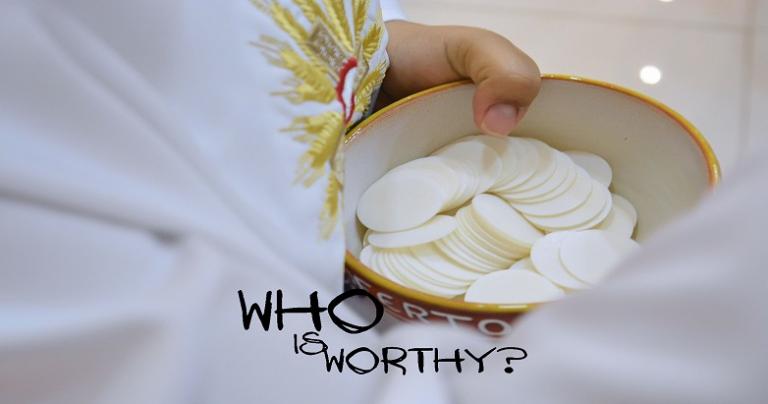
Worthy or Not? / Image by lininha_bs from Pixabay
Who is worthy of inclusion at the Lord’s Table matters in times when Eucharist is more divisive than uniting.
Was Saint Paul an obsessive Catholic? Was he worried that people at Corinth were becoming sick because they took Communion in a state of mortal sin (1 Corinthians 11:27-30)? The short answer is no.
Don’t count me a member of the club that blindly thinks that once you become pope, that means you should, one day, be canonized. I will never call John Paul II “saint” or “great.” Sorry, too many abuse victims for that. I have no doubt he’s with the Lord, enjoying the Beatific Vision (along with many other people that might shock you). But declaring someone a saint is far more than entering them into the registry of people in the Pearly Gates Hotel. It means, among other things, his character is worthy of emulation. Frankly, I find his overlong pontificate full of disturbing behavior, and its fruit is evident except to the brainwashed.
Sorry to upset his cult, but JPII destroyed ecclesial reform in favor of his narrow, revisionist version of Vatican II. Through his slanted, repressive view, we can only see a false council that never was. Despite his many good deeds, JPII betrayed Vatican II, like he betrayed sex abuse victims. His “1950s Restorationist Project” produced the evil of fundamentalist clericalists filling our dioceses and parishes. Many of them brainwashed boys acting more parrot than Christians. JPII appointed bishops, as a favorite teacher of mine says, who were compliant, doctrinally-conservative, and unimaginative.
Breathing in this atmosphere of stupidity JPII produced, reading the Bible becomes hazardous. Maybe Paul was talking about the dangers Corinthians faced by masturbating before receiving Communion? I mean without confessing their mortal sins to a priest or bishop, huh? Such psychologically unhealthy understandings like this and Holy Communion proliferate… watch the video—
Understanding 1 Corinthians
What’s going on in 1 Corinthians 11:27-30? Following scholars Bruce Malina and John Pilch, “1 Corinthians” Paul addresses problems in a Hellenistic-Israelite Corinthian Jesus group. The letter was occasioned by his innovation and his audience’s subsequent refractions of it. After his letter opening (1 Corinthians 1:1-8), we read two sections that constitute Paul’s reaction to Chloe’s people (1 Corinthians 1:9—6:20). Then there is a section where Paul answers various Corinthian questions (1 Corinthians 7:1—15:58).
These questions concern “marriage” (i.e., the complicated, socially-acceptable “taking of a woman” symbolizing the merger of two Israelite families, 7:1-40). Then foods and dining (8:1—11:1). Then Jesus group change agents and their entitlements (9:1-27). And then, showing respect for images (10:1—11:1). This is followed up with Paul addressing proper behavior at Jesus group gatherings (11:2-34), a section which interests us, containing the passage we are considering. Then phenomena induced by altered states of consciousness experiences (12:1—15:40). Next, Paul reminds readers about his gospel and the resurrection (15:1-58). And finally, Paul addresses questions about the Temple tax (16:1-4).
Finally, the letter closes with a final section. Here Paul talks about his travel plans, salutations, and final blessings (16:5-24). With that understanding, we can focus on 1 Corinthians 11:27-30 and see what is going on.
Worthy in Paul
1 Corinthians 11:2-34 concerns proper Jesus group behavior. Within it, 11:17-34 deals with unpraiseworthy behavior, namely cliques, something in the note from Chloe’s people (1:9-16). Paul understands that the presence of cliques has disrupted the social cohesion and shared values of table fellowship. In other words, Christ’s Body is being divided.
Because cliques take up adversarial positions, Eucharist has become a negative experience at Corinth (11:18-19). Paul thinks that God, in control of everything, allows this outrage to disclose genuine Jesus group members from those who are false. In other words, in this nasty business of cliques, God shows who’s really in and out, who belongs, and who doesn’t.
Worthy at the Lord’s Supper
Paul nails home the reason to gather as Jesus group is the Lord’s Supper (11:20). That Paul doesn’t elaborate on this implies he presumes his letter recipients understand what it means. In these early days, Eucharist was primarily a communal meal. That people are going hungry, and others are getting drunk means that cliques are dividing the Jesus group in status-specific dining. The result is higher socially ranked folks are cliquing together and excluding the poor.
This has nothing to do with individuals committing mortal sin and taking Communion. Likewise, this has nothing to do with the Sacrament of Penance and its usefulness as a precursor to Communion. “State of mortal sin,” monastic-style auricular confession, and priestly absolution evolved centuries later. Paul wouldn’t understand any of that.
Cliques were gorging at the Love-Feast while poorer folks starved. Paul understood that the Lord’s Supper proclaimed the significance of Jesus’ death. Malina and Pilch explain that this means the effects and outcomes of Jesus’ death for us. God waiving his Mediterranean vengeance right of satisfaction due to Israelites dishonoring him is one such outcome. That’s what Paul means by God’s “forgiveness of sins.” Unworthy participants at the Lord’s Supper dishonor this and will be answerable to God.
We no longer have to see God through the Mediterranean cultural lens. It turns out that God really isn’t a Don Vito Corleone in the sky. God is also not a cosmic micromanager, pushing buttons for every birth and death. The Bible is the first word for Christians in speaking about God, not the final word.
Evolving Notions of Worthy
Things evolve, folks. Our Church is in continuity with the first-century Jesus Movement. Be aware that’s a living continuity, a continuity-within-development. Understand that “Christ founded the Church” doesn’t have to mean “Christ literally handed Peter and the Twelve exact blueprints for the Church.” It can mean that the Church, an evolving reality, has its origin in Jesus. Same thing for the Sacraments of the Church. And yes, that includes theologies of Apostolic Succession and the priesthood.
Theology isn’t vacuum-sealed. Like everything that evolves, it gets affected by its environment. We theologize in language, and language only means what it means where and when we use it. Words and sentences derive their meaning from social systems. Move the language through culture, space, and time, and you inescapably change its meaning.
Before the 1960s, Latin Catholics confined Christ’s presence to the consecrated bread and wine. But Vatican II reminded us Christ is present also in the assembled community at worship, in the presiding minister, in the biblical word proclaimed (Constitution on the Sacred Liturgy, n. 7).
And let’s call the priest or bishop presiding at Eucharist presider, not the celebrant. He’s not the sole celebrant! And he isn’t some kind of wizard, “saying” the Mass. Vatican II broadened our understanding of Eucharistic participation to include all of the faithful present (Constitution on the Sacred Liturgy, n. 48).
Worthy of Unity
Ultimately, Eucharist is about unity. At least it should be. Eucharist incorporates us into the unity of the Church. Because of this, Thomas Aquinas believed the Eucharist the sacrament of Church unity (Summa Theologiæ, III, q. 82, a. 2). Consequently, the Great Karl Rahner (d. 1984) believed the Church to be most realized when celebrating Eucharist (see his The Church and the Sacraments, p. 84).
Here we see excellent continuity with Paul’s understanding of the Lord’s Supper. For Paul, Eucharist was a banquet open to everyone, marginalized and highly honored. With time and the Spirit’s help, the Church continues to unpack that word “everyone” means. She is “c” catholic and is becoming “c” catholic. All are welcome. Or at least should be, right?
Eucharistic Blasphemy
But we have turned Jesus’ Table into a blasphemy. We have turned this beautiful sacrament of unity into an idol of division. It’s all about who doesn’t belong, who isn’t worthy. We have disregarded the Risen Christ’s heart, closed up his paschal vulnerability, included only head-nodders, and stopped the work of Creation. And we have divided Christ, vivisecting him into a bloody mess. We have forgotten him all the while shouting his holy name in gross identity theft.
Look honestly at our Church right now. A great many say, “To hell with the needs of the faithful or their rights to the sacraments and pastoral care!” All that matters to them is the idolatrous whims of the clericalists. The poor in the Amazon region suffer because conservative bishops have deprived them of their rights. But who cares about this nothing-people? And should they ever find themselves in the United States, Trumper Catholics don’t care if they get sent to concentration camps and sterilized. Just keep repeating, “save the babies!”
Something far worse is going on than de facto schism, as ugly as that is. The Bishops are, in large part, useless. It’s tough love time, laity. It’s long overdue for both ourselves and for our “shepherds.” The Church isn’t just the clergy. Waiting for the clergy to get that is like waiting for an abusive husband to realize he has a problem. Change must come from us, fellow co-dependents.
Previous Post

September 12, 2020
Stupidity In Catholics: Deadly
Next Post

September 19, 2020 What Made John of Apocalypse a Prophet?
Browse Our Archives
Select a Category Uncategorized
Select a Month August 2021 July 2021 June 2021 May 2021 April 2021 March 2021 February 2021 January 2021 December 2020 November 2020 October 2020 September 2020 August 2020 July 2020 June 2020 May 2020 April 2020 March 2020 February 2020 January 2020 December 2019 November 2019 October 2019 September 2019 August 2019
Follow Us!
TAKE THE
Religious Wisdom Quiz
Which Jewish feast marks the beginning of the new year?
Select your answer to see how you score.
Purim Sukkot Shavuot Rosh Hashanah
Support this
Column


Related posts from Messy Inspirations

Understanding Apocalypse & Its Creatures



TRENDING AT PATHEOS Catholic

Rejecting Doom: Christian Hope And Human Action
Christianity is a religion of hope. We are to have hope and...

It’s What Comes From Within Which Matters
One of the most difficult things for us to understand is why...

Why I Choose the Eucharist Over the Sermon
Choose the Eucharist, Not the Sermon What are we supposed to get...

5 Design Elements Found in Spiritually Rooted Homes
Putting Spirituality Into Home Decor Our homes are more than our living...

Credo: A Story of God Told with the...
About 10 years ago, I began to imagine a personal "Credo" that...

The Anatomy of Divine Revelation in Catholic Thought
The claim that God has made Himself known to human beings is...
view all Catholic blogs
Ad-Free & Subscriber Log-In Subscription Support
- About Us
- 2026 Calendar
- Videos
- Podcasts
- Library of World Religions
- Faith In Media Tracker
- Advertise With Us
- Write for Us
- Privacy Policy
- Terms of Service
- Do Not Sell My Data
- Contact Us
- Radiant Digital
- Manage Newsletter Subscriptions
- Unsubscribe From Notifications
- Sitemap
Copyright 2008-2026, Patheos. All rights reserved.
Subscription Support Ad-Free & Subscriber Log-In
Follow Patheos