
BuddhistCatholicContemplativeEvangelicalGeneral ChristianHinduJewishLatter-day SaintMuslimNew VisionsProgressive Christian
Beliefs
- Buddhist
- Catholic
- Contemplative
- Evangelical
- General Christian
- Hindu
- Jewish
- Latter-day Saint
- More Voices
- Muslim
- New Visions
- Pagan
- Progressive Christian
Topics
- Religion News
- Food and Religion
- Sports and Religion
- Religious Art
- Religious Music and Entertainment
- Religious Events
- History and Religion
- Style and Religion
- Politics and Religion
- Women in Religion
- Recreation Outdoors and Religion
- Business Finance and Religion
- Careers Workplace and Religion
- Education and Religion
- Family Parenting and Religion
- Health Fitness and Religion
- Home and Religion
- Relationships and Religion
- Technology and Religion
- Travel and Religion
Columnists
- Buddhist Columnists
- Business Finance and Religion Columnists
- Careers Workplace and Religion Columnists
- Catholic Columnists
- Contemplative Columnists
- Education and Religion Columnists
- Evangelists Columnists
- Family Parenting and Religion Columnists
- General Christian Columnists
- Health Fitness and Religion Columnists
- Hindu Columnists
- History and Religion Columnists
- Home and Religion Columnists
- Jewish Columnists
- More Voices Columnists
- Latter Day Columnists
- Muslim Columnists
- New Visions Columnists
- Nonreligious Columnists
- Pagan Columnists
- Politics and Religion Columnists
- Progressive Columnists
- Recreation Outdoors and Religion Columnists
- Relationships and Religion Columnists
- Religion News Columnists
- Religious Art Columnists
- Religious Events Columnists
- Religious Music and Entertainment Columnists
- Sports and Religion Columnists
- Style and Religion Columnists
- Technology and Religion Columnists
- Travel and Religion Columnists
- Women in Religion Columnists
Resource Library
- 2026 Calendar
- Library of World Religions
- The 100 Most Holy Places on Earth
- Patheos Answers
- Podcasts
- Videos
- Faith Leaders Database
- Anglican Episcopalian
- Bahai
- Baptist
- Buddhism
- Christianity
- Confucianism
- Eastern Orthodoxy
- Hinduism
- Holiness and Pentecostal
- ISKCON
- Islam
- Judaism
- Lutheran
- Methodist
- The Church of Jesus Christ of Latter-day Saints
- New Age
- Paganism
- Presbytarian and Reformed
- Protestantism
- Religion Behind the Scenes
- Roman Catholic
- Scientology
- Shia Islam
- Sikhism
- Sufism
- Sunni Islam
- Taoism
- Zen
- See all religions
Research Tools
 Ad-Free & Subscriber Log-In Subscription Support
Ad-Free & Subscriber Log-In Subscription Support
Follow Patheos 

- Trending:
- Forgiveness
- |
- Marriage
- |
- Consciousness
- |
- Death Penalty
- |
- Election
- |
- Halloween
 Messy Inspirations
- Home
- Catholic
- Predestination & Prophecy: Not About the Future
Predestination & Prophecy: Not About the Future
Last updated on: September 2, 2020 at 9:08 pm by Fellow Dying Inmate
Predestination & Prophecy: Not About the Future 2020-09-02T21:08:00-04:00 Fellow Dying Inmate
Patheos Explore the world's faith through different perspectives on religion and spirituality! Patheos has the views of the prevalent religions and spiritualities of the world.
Predestination & Prophecy in Scripture / Image by PIRO4D from Pixabay
Biblical prophecy and predestination concern the forthcoming, not the far future like in popular American Christian imagination
I love me some Stephen King books and movies. Always have, at least ever since being brutally baptized into his books and films. Once, at 8 years old, teenagers pounced on me and forced me to watch “Creepshow.” I couldn’t sleep for a week after, because I imagined Nathan Grantham visiting my room to get his Father’s Day Cake. I had a vivid imagination.
But something got planted in me that grew into fandom for King’s books and (fair to excellent) film adaptations. I enjoy It, Pet Sematary, The Shining, and Doctor Sleep. Dolores Claiborne, Storm of the Century, and Gerald’s Game. Give me more 1922, Carrie, The Green Mile, Rita Hayworth and Shawshank Redemption, The Mist, and The Dark Tower saga***.*** The list continues.
So you can imagine how thrilled I am that they are making a new miniseries adaptation of King’s end-time epic, “The Stand.” I am all in! We have a pandemic, apocalyptic craziness, the righteous versus the wicked, devils, and angels! It has prophecy and predestination, and an “End of the World” scenario quite familiar to our American Christian eyes.
Therefore, it really has nothing to do with the Book of Revelation or biblical prophecy. It’s just American misunderstandings turned into a remarkable story. See what I mean in this video—
Doctor Frankenstein Lectionary
In Mary Shelley’s Frankenstein, the not-so-good Doctor took many cut-up cadavers and spliced them all into the new life-form he went on to abuse. That works as a great metaphor when applied to the designers of our Lectionary. Vivisect. Redact. Splice and make friendly, comfortable, easygoing on the ears.
We tear “Matthew” apart for our New Scripture. Every three years, on one Summer Sunday, we read about Peter the Rock (Matthew 16:13-20), in light of the papacy. The following week, Jesus calls Peter Satan (Matthew 16:21-27). Even though it happened in the same story, one evolved out of Mark 8:27-33. We Catholics put all the weight on the Matthean version with keys and Kingdom and forget about the Satan remark. Why? Because every group of Christians has their own Dr. Frankenstein-tailored “canon-within-the-canon.” We Catholics aren’t any different.
But this past Sunday, in the “Get Behind Me, Satan” Matthean reading, we again shaved off a key verse. We stopped short, thanks to Dr. Frankenstein. The passage goes on to say—
Matthew 16:28 [Jesus said] “Truly I tell you, there are some standing here who will not taste death before they see the Son of Man coming in his kingdom.”
The Peasant Present
Peasants everywhere live in subsistence, consuming what they produce to survive. Immediate needs fix them in the present. Therefore Mediterranean people of antiquity, mostly peasants like Jesus, were primarily oriented toward the present. Unlike us, post-Industrial Westerners, they lacked leisure time to think “future.” It was almost impossible for them, not because of any lack of intelligence, but due to pressing needs.
The peasant present is kind of fat. It includes today, but also tomorrow. In other words, it contains the forthcoming. Think of an already pregnant mother. Soon there will be a birth, probably—that is forthcoming. Or think of a field sown with seed. Soon there will likely be a harvest—again, the forthcoming.
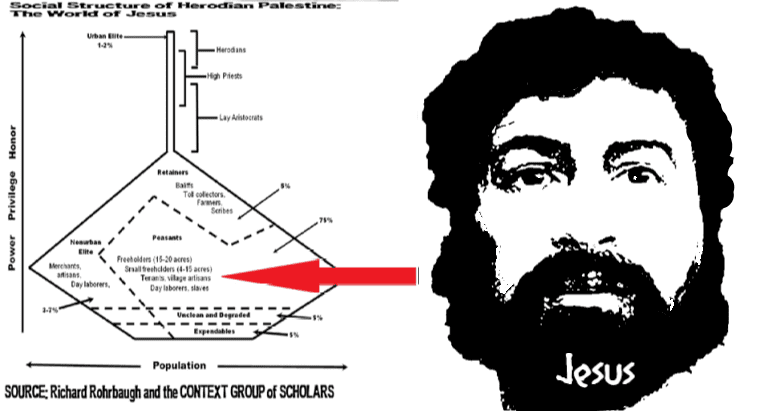
Fellow Dying Inmate (with inspiration from Donato Giancarlo) / All rights reserved
Most of Jesus’ audience were peasants. Jesus was a peasant. They shared this peasant “forthcoming” perspective. That’s evident if we take our American 21st-century reading glasses off while reading the Gospels.
Jesus Was Mistaken?
Look how the Matthean Jesus believes that his audience would still be alive when the Kingdom came. Soon it will be 2,000 years since his death and resurrection. That’s a helluva delay, folks! Where’s the Theocracy? Where is the Kingdom? It refused to materialize! The Son of Man has not come to establish the Kingdom.
It upsets many Christians when informed that neither Revelation nor any of the Prophets are about the future. Revelation and biblical prophecy aren’t concerned about Donald Trump, Bill Gates, Hillary Clinton, or anything American or 21st century! I know, I know we’ve all been told otherwise. But we were told wrong, folks!
Jesus & the Messianic Passages
Sometimes my fellow Christians accuse me of distorting things. They tell me prophecy is indeed about the future. So they will cite a psalm or a verse they claim is “messianic.” Then they will argue it was written maybe a thousand years before Jesus. They inform me it’s about Jesus. Therefore, they claim, prophecy is a prediction of the future. Why would I reject that Psalm 45, for example, is talking about Jesus when it clearly (their word) is?
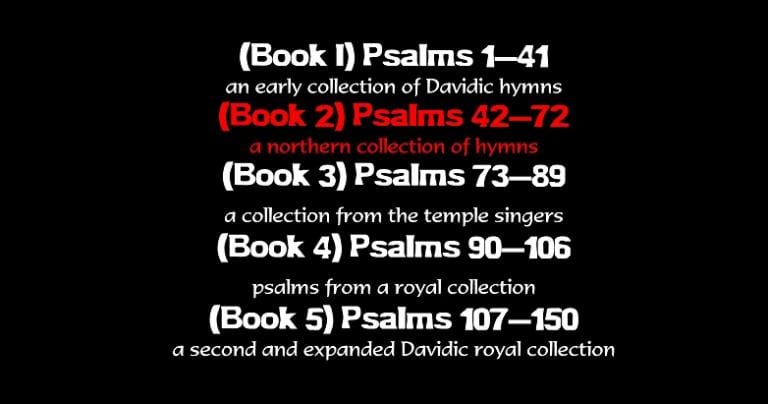
Fellow dying inmate with information from John Pilch / All rights reserved
So let’s look at the Psalter and dive into the context. Looking at the image above, we see that Psalms 42—72 form a collection of hymns taken from the Northern Kingdom. Psalm 45 belongs to that collection.
Going deeper, we see that it is a song for the wedding of a king and a foreign princess from Tyre in Phoenicia (Psalm 45:13). The court poet sings it. Was this song edited to later apply to Davidic kings in Judah? Maybe.
The Psalms have been re-applied and re-contextualized many times, like everything else in the Bible. Eventually, it was called a “messianic Psalm.” Ultimately, it was applied to Jesus. By the way, does every detail about it constitute a photographic description of how the Messiah will be?
After-the-fact Predestination
Another thing about Biblical writings is all this talk about predestination. But Western readers must understand that all biblical predestinarian language is after-the-fact. For instance, imagine you got married. Mashallah! God willed that. How do I know? Because you are married right now.
Or say you were a first-century Mediterranean person who joined the Jesus group (Romans 8:28-30). Mashallah! God willed that. How do I know? Because you are right now part of it. Therefore you must have been eternally predestined for that. See?
Or imagine you belong to the Johannine Jesus group, and you are dealing with those uppity Secessionists who abandoned it (1 John 2:18-19). Mashallah! God willed that. How does the author of 1 John know that? Because they were presently gone. Therefore they never were part of the group! Those SOB’s must have been eternally predestined to show their true colors!
See? Everything in the Bible is after-the-fact predestination. That includes Judas and his suicide (if he actually did that), and even Satan and his fall. Predestination in the Bible is never beforehand, but always after-the-fact.
This Affects Biblical Predestination & the “Messianic” Passages!
So what Bible passages are messianic? That depends on who you deem to be the Messiah. That’s why, in first-century Israel, if you asked two Israelites about the Messiah, you’d get at least three different opinions. Often all would contradict to some degree. The one common thread? “Messiah” had something to do with Theocracy/political-religion. Other than that, as John Pilch says, “Messiah” was like Heinz 57 varieties.
By the way, this helps explain why we Christians do accept that Jesus is indeed the Messiah. It’s because he defined that role after-the-fact. Therefore, suddenly, Isaiah 40—55 looks a lot like Jesus Messiah!
But it also helps explain why our Jewish sisters and brothers, even those who admire Jesus as a Jewish holy man, don’t think of him as the Messiah. Mashiach doesn’t do that! He is not a savior! He isn’t a sacrifice! See? They are looking for someone else. Why would you try to proselytize them with “messianic” passages then? You shouldn’t be proselytizing anyone, really. That’s not love.
So I am not rejecting Psalm 45. Or Jesus, for that matter. I just refuse to play connect-the-dots with Scripture and proof-texting Jesus from it.
Predestination in the Present
So, returning to ancient Mediterranean people and their present-time orientation, they were concerned about the forthcoming, not the future. John the Seer (Revelation 1:9) and his “Compiler” (Revelation 1:3) were the same way. And Jesus was the same way, also.
Matthew 16:28 [Jesus said] “Truly I tell you, there are some standing here who will not taste death before they see the Son of Man coming in his kingdom.”
Jesus was convinced that those who heard him speak would still be alive when God, through the Sky Vault “Son of Man” established Theocracy. It’s been a long time since Jesus died, was raised, and ascended.
Because God refused to materialize the Kingdom, some Mediterranean elite followers of Jesus invented a future. At first, it was this vague idea. It grew into “the Last Things.” Eventually, post-Industrial German theologians evolved it into “eschatology.” All this came from something that refused to materialize.
Is Donald Trump the Antichrist?
Previous Post

August 31, 2020
Jeremiah Raped? A Disturbing Metaphor
Next Post

September 4, 2020 Mirage or Miracle?
Browse Our Archives
Select a Category Uncategorized
Select a Month August 2021 July 2021 June 2021 May 2021 April 2021 March 2021 February 2021 January 2021 December 2020 November 2020 October 2020 September 2020 August 2020 July 2020 June 2020 May 2020 April 2020 March 2020 February 2020 January 2020 December 2019 November 2019 October 2019 September 2019 August 2019
Follow Us!
TAKE THE
Religious Wisdom Quiz
Who was Ruth's mother-in-law?
Select your answer to see how you score.
Hannah Mary Naomi Elizabeth
Support this
Column


Related posts from Messy Inspirations

Understanding Apocalypse & Its Creatures



TRENDING AT PATHEOS Catholic

Rejecting Doom: Christian Hope And Human Action
Christianity is a religion of hope. We are to have hope and...

It’s What Comes From Within Which Matters
One of the most difficult things for us to understand is why...

Why I Choose the Eucharist Over the Sermon
Choose the Eucharist, Not the Sermon What are we supposed to get...

5 Design Elements Found in Spiritually Rooted Homes
Putting Spirituality Into Home Decor Our homes are more than our living...

Credo: A Story of God Told with the...
About 10 years ago, I began to imagine a personal "Credo" that...

The Anatomy of Divine Revelation in Catholic Thought
The claim that God has made Himself known to human beings is...
view all Catholic blogs
Ad-Free & Subscriber Log-In Subscription Support
- About Us
- 2026 Calendar
- Videos
- Podcasts
- Library of World Religions
- Faith In Media Tracker
- Advertise With Us
- Write for Us
- Privacy Policy
- Terms of Service
- Do Not Sell My Data
- Contact Us
- Radiant Digital
- Manage Newsletter Subscriptions
- Unsubscribe From Notifications
- Sitemap
Copyright 2008-2026, Patheos. All rights reserved.
Subscription Support Ad-Free & Subscriber Log-In
Follow Patheos