
BuddhistCatholicContemplativeEvangelicalGeneral ChristianHinduJewishLatter-day SaintMuslimNew VisionsProgressive Christian
Beliefs
- Buddhist
- Catholic
- Contemplative
- Evangelical
- General Christian
- Hindu
- Jewish
- Latter-day Saint
- More Voices
- Muslim
- New Visions
- Pagan
- Progressive Christian
Topics
- Religion News
- Food and Religion
- Sports and Religion
- Religious Art
- Religious Music and Entertainment
- Religious Events
- History and Religion
- Style and Religion
- Politics and Religion
- Women in Religion
- Recreation Outdoors and Religion
- Business Finance and Religion
- Careers Workplace and Religion
- Education and Religion
- Family Parenting and Religion
- Health Fitness and Religion
- Home and Religion
- Relationships and Religion
- Technology and Religion
- Travel and Religion
Columnists
- Buddhist Columnists
- Business Finance and Religion Columnists
- Careers Workplace and Religion Columnists
- Catholic Columnists
- Contemplative Columnists
- Education and Religion Columnists
- Evangelists Columnists
- Family Parenting and Religion Columnists
- General Christian Columnists
- Health Fitness and Religion Columnists
- Hindu Columnists
- History and Religion Columnists
- Home and Religion Columnists
- Jewish Columnists
- More Voices Columnists
- Latter Day Columnists
- Muslim Columnists
- New Visions Columnists
- Nonreligious Columnists
- Pagan Columnists
- Politics and Religion Columnists
- Progressive Columnists
- Recreation Outdoors and Religion Columnists
- Relationships and Religion Columnists
- Religion News Columnists
- Religious Art Columnists
- Religious Events Columnists
- Religious Music and Entertainment Columnists
- Sports and Religion Columnists
- Style and Religion Columnists
- Technology and Religion Columnists
- Travel and Religion Columnists
- Women in Religion Columnists
Resource Library
- 2026 Calendar
- Library of World Religions
- The 100 Most Holy Places on Earth
- Patheos Answers
- Podcasts
- Videos
- Faith Leaders Database
- Anglican Episcopalian
- Bahai
- Baptist
- Buddhism
- Christianity
- Confucianism
- Eastern Orthodoxy
- Hinduism
- Holiness and Pentecostal
- ISKCON
- Islam
- Judaism
- Lutheran
- Methodist
- The Church of Jesus Christ of Latter-day Saints
- New Age
- Paganism
- Presbytarian and Reformed
- Protestantism
- Religion Behind the Scenes
- Roman Catholic
- Scientology
- Shia Islam
- Sikhism
- Sufism
- Sunni Islam
- Taoism
- Zen
- See all religions
Research Tools
 Ad-Free & Subscriber Log-In Subscription Support
Ad-Free & Subscriber Log-In Subscription Support
Follow Patheos 

- Trending:
- Forgiveness
- |
- Marriage
- |
- Consciousness
- |
- Death Penalty
- |
- Election
- |
- Halloween
 Messy Inspirations
- Home
- Catholic
- Mirage or Miracle?
Mirage or Miracle?
Last updated on: September 5, 2020 at 12:19 pm by Fellow Dying Inmate
Mirage or Miracle? 2020-09-05T12:19:33-04:00 Fellow Dying Inmate
Patheos Explore the world's faith through different perspectives on religion and spirituality! Patheos has the views of the prevalent religions and spiritualities of the world.

Mirage or Miracle? / Image by charlotte_202003 from Pixabay
When 21st-century Western Christians take anything in the Bible at face value, it’ll take a miracle to not distort or misunderstand it.
How many miracles are there in the Bible? Many? Few? Is there a definite number? Yes. There is an actual number, and you can know it, for sure.
Are you familiar with a mirage? Something that only appears real or possible, but in fact, isn’t it? Technically a mirage is an optical illusion. When the atmospheric conditions are just right, they work on our eyes and brains as the organs of sight and produce mirages. The mirage can be torturous to a thirsty person melting in a desert! You think you see an oasis, but it’s just a mirage.
My friends, when Americans read the Bible, the cultural conditions are right for producing mirage after mirage. We are guilty of a spurious familiarity. We think we know what we are reading. Still, in reality, we are often clueless about what is going on, what exactly is being communicated, and who the author really was.
Watch the video here—
Eye-Testing for Mirage
Let’s test your eyes for mirages and spurious familiarity. Go through your Bible, looking for the word “miracle.” If it’s a good translation in this regard (e.g., the New American Bible, Revised Edition), be to our spurious familiarity, that word is unbiblical. Truly.
Of course, the Bible does tell of “signs” [in Hebrew ’ot and môpēt; in Greek sēmeia], seven in the Gospel we call “John.” And it is filled with various “wonders” [Hebrew môpēt; pele’], or ‘portents’ [from the Greek terata]. The New Testament speaks of Jesus’ “mighty deeds” [in Greek, dynameis] and “works” [Greek erga]. But never “miracles.” Wonders? Yes. Marvels? Certainly. Miracles? Nope.
Deserts of Understanding, Mirage of Miracles
Our sacred library, the Bible, mainly contains stories of marvels and wonders in three locations. The first is the Exodus narrative. Yahweh mightily delivers Israel out of Egypt and leads them into the Promised Land. The second grouping is found in the Elijah-Elisha cycle, where Yahweh humiliates Baal. Finally, the New Testament proclaims the wonders of Jesus and his earliest followers. These New Testament marvels are bound inexorably to Theocracy. But these are not miracles, despite the mirage of popular imagination and spurious familiarity.
Scholars like Bruce Malina and John Pilch explain that to study “miracles” in the Scriptures is probably illegitimate. Why? “Miracle,” as we use it, is a post-Enlightenment term, and thus, the Hebrew and Greek languages, ancient, offer no equivalent for it. These tongues also are oblivious to the English post-Enlightenment concept “miracle” (see Yair Zakovitch, “Miracle OT,” 1992 Anchor Bible Commentary, p. 845).
Traitorous Translators Enable the Mirage
But that doesn’t stop translators! When reading the Bible, always remember the old Italian proverb—traduttore, traditore! (translators are traitors) Why? Malina and Pilch explain that it is because translators are inconsistent, and they often misrepresent the original author. In cases where “miracle” is found in English Bible translations, the biblical authors have been absurdly misrepresented.
Malina and Pilch explain that translators enable (think drug abuse) contemporary readers to ethnocentrically impose our Western cultural world onto the Bible. Specifically, we get to abuse the Scriptures through the post-Enlightenment understanding of “miracle.” Consequently, great violence is done to sacred documents that neither use that word nor communicate the meaning.
Look at the graphic, carefully—
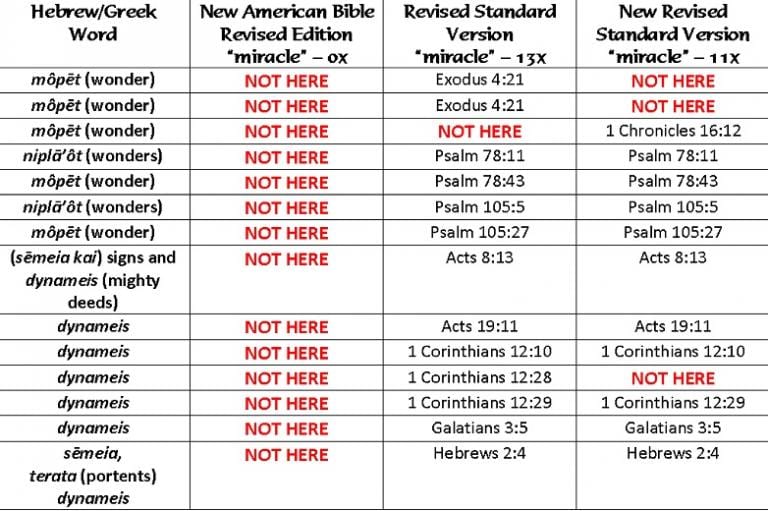
Fellow dying inmate (with information modified from Bruce Malina and John Pilch) / All rights reserved
Look at the differences above. Note how the NABRE never uses the English “miracle.” But the real show is to contrast the RSV with the NRSV. Look at those disagreements. It makes you think about the arbitrariness of English translations. By the way, don’t go getting triumphalistic about the NABRE, fellow Catholics. While it is superior to these others when it comes to “miracle,” it has some real doozies of bad translations!
The Mirage of Impersonal Causality
The point is there is no Greek or Hebrew from the Scriptures that can honestly translate into our word “miracle,” meaning something contrary to the laws of nature. Science, laws of nature, and violations of nature’s laws were simply not part of the cultural consensus reality of Biblical people. Ultimately, words derive their meanings from social systems. No social system with physical laws governing the universe? Well, consequently, no miracles then!
So the New Testament authors, even the eye-witnesses of Jesus’ marvels, could never have considered them to be “miracles.” This is because our ancestors in the faith did not know anything about “laws of nature.” Instead, they were familiar with the regularity of occurrences. In other words, whenever something extraordinary or “irregular” occurred, they marveled at it and attributed it to a personal cause.
There is no impersonal causality in the biblical world. Whenever something happened, the question was never, “WHAT happened.” Instead, the query was always, “WHO did it?” Consequently, it is impossible to say in Biblical Hebrew, “IT rained.” Instead, the expression is, “GOD SENT the rains,” or some equivalent with a personal cause.
In the Bible, WHO, Not WHAT
So in the biblical world, all effects had a personal cause. That means some person was always responsible for all events. Say you can find no human agent responsible. What then? Then, in that case, the person responsible had to be a spirit, like an angel or demon, or perhaps a god, or even the Most High God.
Malina and Pilch explain that in the New Testament, God is the agency behind the Jesus Movement’s wonders. God, the Change Agency, acts as a beneficent patron through his broker, Jesus. Jesus, the Twelve, Paul, and other human change agents performing mighty deeds are like Sonny or Michael or Tom Hagen in “The Godfather Trilogy.” In other words, in doing wonders, they are intermediaries or brokers between God (the patron) and God’s people (the clients).
And suppose you have watched the “Godfather” films. In that case, you know the proper response for a recipient of brokered gifts from your Mediterranean Patron. You become his propaganda machine, singing his praises everywhere, in lifelong loyalty (biblical faith).
Marvels, not Miracles
The Bible is indeed filled with wonders. But it is absent of miracles, that is, violations of the physical laws governing the universe. Openness to the supernatural and God’s omnipotence is good! But it does NOT demand being ethnocentrically anachronistic with Sacred Scripture.
How many miracles are in the Bible?
Previous Post

September 2, 2020
Predestination & Prophecy: Not About the Future
Next Post

September 9, 2020 A Cruel Church Signifies What?
Browse Our Archives
Select a Category Uncategorized
Select a Month August 2021 July 2021 June 2021 May 2021 April 2021 March 2021 February 2021 January 2021 December 2020 November 2020 October 2020 September 2020 August 2020 July 2020 June 2020 May 2020 April 2020 March 2020 February 2020 January 2020 December 2019 November 2019 October 2019 September 2019 August 2019
Follow Us!
TAKE THE
Religious Wisdom Quiz
How many days did God take to create the world?
Select your answer to see how you score.
Ten Six Five Seven
Support this
Column


Related posts from Messy Inspirations

Understanding Apocalypse & Its Creatures



TRENDING AT PATHEOS Catholic

Rejecting Doom: Christian Hope And Human Action
Christianity is a religion of hope. We are to have hope and...

It’s What Comes From Within Which Matters
One of the most difficult things for us to understand is why...

Why I Choose the Eucharist Over the Sermon
Choose the Eucharist, Not the Sermon What are we supposed to get...

5 Design Elements Found in Spiritually Rooted Homes
Putting Spirituality Into Home Decor Our homes are more than our living...

Credo: A Story of God Told with the...
About 10 years ago, I began to imagine a personal "Credo" that...

The Anatomy of Divine Revelation in Catholic Thought
The claim that God has made Himself known to human beings is...
view all Catholic blogs
Ad-Free & Subscriber Log-In Subscription Support
- About Us
- 2026 Calendar
- Videos
- Podcasts
- Library of World Religions
- Faith In Media Tracker
- Advertise With Us
- Write for Us
- Privacy Policy
- Terms of Service
- Do Not Sell My Data
- Contact Us
- Radiant Digital
- Manage Newsletter Subscriptions
- Unsubscribe From Notifications
- Sitemap
Copyright 2008-2026, Patheos. All rights reserved.
Subscription Support Ad-Free & Subscriber Log-In
Follow Patheos