
BuddhistCatholicContemplativeEvangelicalGeneral ChristianHinduJewishLatter-day SaintMuslimNew VisionsProgressive Christian
Beliefs
- Buddhist
- Catholic
- Contemplative
- Evangelical
- General Christian
- Hindu
- Jewish
- Latter-day Saint
- More Voices
- Muslim
- New Visions
- Pagan
- Progressive Christian
Topics
- Religion News
- Food and Religion
- Sports and Religion
- Religious Art
- Religious Music and Entertainment
- Religious Events
- History and Religion
- Style and Religion
- Politics and Religion
- Women in Religion
- Recreation Outdoors and Religion
- Business Finance and Religion
- Careers Workplace and Religion
- Education and Religion
- Family Parenting and Religion
- Health Fitness and Religion
- Home and Religion
- Relationships and Religion
- Technology and Religion
- Travel and Religion
Columnists
- Buddhist Columnists
- Business Finance and Religion Columnists
- Careers Workplace and Religion Columnists
- Catholic Columnists
- Contemplative Columnists
- Education and Religion Columnists
- Evangelists Columnists
- Family Parenting and Religion Columnists
- General Christian Columnists
- Health Fitness and Religion Columnists
- Hindu Columnists
- History and Religion Columnists
- Home and Religion Columnists
- Jewish Columnists
- More Voices Columnists
- Latter Day Columnists
- Muslim Columnists
- New Visions Columnists
- Nonreligious Columnists
- Pagan Columnists
- Politics and Religion Columnists
- Progressive Columnists
- Recreation Outdoors and Religion Columnists
- Relationships and Religion Columnists
- Religion News Columnists
- Religious Art Columnists
- Religious Events Columnists
- Religious Music and Entertainment Columnists
- Sports and Religion Columnists
- Style and Religion Columnists
- Technology and Religion Columnists
- Travel and Religion Columnists
- Women in Religion Columnists
Resource Library
- 2026 Calendar
- Library of World Religions
- The 100 Most Holy Places on Earth
- Patheos Answers
- Podcasts
- Videos
- Faith Leaders Database
- Anglican Episcopalian
- Bahai
- Baptist
- Buddhism
- Christianity
- Confucianism
- Eastern Orthodoxy
- Hinduism
- Holiness and Pentecostal
- ISKCON
- Islam
- Judaism
- Lutheran
- Methodist
- The Church of Jesus Christ of Latter-day Saints
- New Age
- Paganism
- Presbytarian and Reformed
- Protestantism
- Religion Behind the Scenes
- Roman Catholic
- Scientology
- Shia Islam
- Sikhism
- Sufism
- Sunni Islam
- Taoism
- Zen
- See all religions
Research Tools
 Ad-Free & Subscriber Log-In Subscription Support
Ad-Free & Subscriber Log-In Subscription Support
Follow Patheos 

- Trending:
- Forgiveness
- |
- Marriage
- |
- Consciousness
- |
- Death Penalty
- |
- Election
- |
- Halloween
 Messy Inspirations
- Home
- Catholic
- What Made John of Apocalypse a Prophet?
What Made John of Apocalypse a Prophet?
Last updated on: September 19, 2020 at 4:45 am by Fellow Dying Inmate
What Made John of Apocalypse a Prophet? 2020-09-19T04:45:46-04:00 Fellow Dying Inmate
Patheos Explore the world's faith through different perspectives on religion and spirituality! Patheos has the views of the prevalent religions and spiritualities of the world.
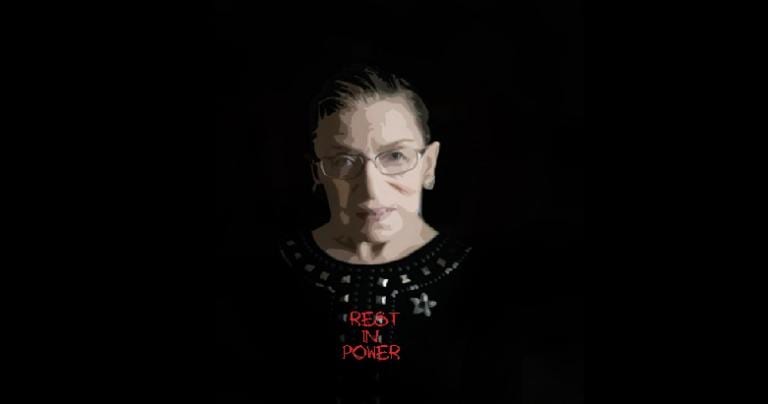
Prophet John Couldn’t See RBG / Todd Heisler/The New York Times via Redux / Modified by Fellow Dying Inmate
While it is tempting to see our dark trials written about in Revelation, John the prophet knew nothing and cared nothing for our times.
Apocalypse is on the minds of many, many American Christians right now. Not the actual book called by that name or “Revelation” (singular, not plural). But what people popularly imagine it’s about. By that, I mean the capital “E” End. As at the end of everything, the end of the world type end.
Things are bleak. Ruth Bader Ginsburg is dead from cancer in a year of a million gut punches. Despite the significant number of self-proclaimed “pro-lifers” who, in bloodthirsty glee, delight imagining hell is welcoming its favorite daughter, today is not a victory for life. The loss of Ginsburg complicates a terrible situation. With the rank evil and hypocrisy of Mitch McConnell, an autocratic Trump doomsday scenario seems likely. The possibility of a brutal civil war grows. And just as there are exact limits to the ecosystem and what it can supply, my friends, there are likewise knowable moral limits to pacifism.
Yes, the possibility of a grotesquely dark and evil end looms before us.
In this time of many doubts, one thing is sure: our impending doom has nothing directly to do with the book called “Revelation.” And all the spurious familiarity about it can’t change that. Watch the video here.
A Prophet & His Editor
When we read Revelation, we must always pay careful attention to two human persons behind this document. Neither were American or 21st-century persons or had the faintest care about such. First, there is John, the human author. Notice how he identifies himself (Revelation 1:9). He does so in the first person. We learn his name—“I, John, your brother…” and something about his intended audience.
Look how he writes that he is “your brother.” Who is the “you” there? Do you think John had anyone in the 21st century in mind when wrote that? Do you imagine he is talking about Catholic priests? Sorry folks, but John wasn’t addressing believers living today, and despite our anachronistic readings, he couldn’t imagine “Christian clergy.” Indeed, John wasn’t even addressing all the believers of his own day. “John’s brothers” were a particular group of people.
Anyway, at 1:9, John identifies himself in the first person. But before we get there, read the opening, vv. 1-2. Here John gets recognized in the third person. But by who? Whoever is speaking in Revelation 1:1 is someone different than John! He refers to John in the third-person. Consequently, we have a narrator who is different from the author! What gives?
Who is this other person, this narrator? First, he prefaces the text, giving it a superscription (vv. 1-2). Then he drops in a beatitude (v. 3) right before we get to the opening of John’s letter to his brothers (v. 9) in seven Jesus groups in Asia Minor (v. 4). This narrator scholars like Bruce Malina and John Pilch call “the Compiler.”
Getting Real with Revelation
So if you’re keeping score, when reading Revelation, drop any nonsensical ideas that it’s about our 21st-century problems. Our contemporary issues are indeed ominous and need us alert and capable of addressing them indeed. God cares about them, but not in this document. And this document came about on the human side of inspiration thanks to two different persons: John the Seer and an anonymous “Compiler.”
Expectations of the Prophet John
Throughout his life, John experienced many visions of sky beings and sky events. He also took many “sky journeys.” In contemporary anthropology and cognitive neuroscience, these are termed “altered states of consciousness.” All humans are capable of them. However, some cultures, like ours in the post-Industrial West, restrict ASCs and other experiences outside of human control. Mainstream white Americans are all about being in control.
When John says he “was in the spirit” we can rightly understand that to mean he fell into a trance. And he expected to have visions and take sky journeys. This expectation aspect is a prerequisite. Without cultural openness and expectation, you see nothing, go nowhere, and nothing happens. But John did expect these experiences, and therefore he had them, and many more, perhaps over decades.
At some point, John wrote about them. He had such an experience and wrote a circular letter to his fellow Israelite astral prophets (his “brothers”) in various Jesus groups littered throughout first-century Asia Minor.
But he also had other visions, and wrote about those, also. He authored several (possibly many) different works about these ASC experiences of his.
Beyond Expectation
I said that he expected to have visions and sky journeys. One thing John never expected was that his letter or any of his various vision accounts would be read by or to ordinary Jesus group people. This can be shocking to 21st-century people.
Be aware that it wasn’t until the Reformation that the New Testament became democratized. Thus in ancient times, writings of divine disclosures weren’t just given to any old person. Divine Revelation was universally held to be intended solely for VIP types such as kings and priests and prophets like John and his “brothers.”
Two other things John never expected: first, for someone else to compile and edit several of his different vision-writings into a new volume called “Revelation.” And second, without a doubt, he didn’t write anything about 21st-century people or events. Therefore, John could never have imagined 21st-century believers reading his writings, much less as sacred Scripture.
Requirements To Be A Prophet
I have a masochistic side in that I like challenging the spurious familiarity of my fellow Christians. It costs, and it hurts. More than a few Bible readers assume that biblical prophets are kin to Nostradamus or Edgar Cayce. In other words, predictors of future events. They weren’t, folks. Biblical prophets don’t predict; instead, they for-speak.
That the prophets enjoyed ASC experiences didn’t make them unique. In Jesus’ society and day, many different types of Israelites routinely went about “in the Spirit.” So being a prophet took more than merely having an ASC.
To be a prophet in first-century Israel, you had to first be recognized as such. In this world, “self” is a group-self of a shared group-conscience. Therefore, your ingroup tells you who you are. While an Israelite wouldn’t require all his fellow Israelites to confirm his role, “prophet” was a socially recognized role. Even if it was only a small circle, your ingroup had to identify you as a prophet.
ASC Experiences
Secondly, as Malina and Pilch explain, prophets were shamanic, adept at ASC experiences. But not all ASC experiences are prophecy. For example, Israelites experiencing glossolalia, a kind of trance-gibberish, and one type of ASC experience, didn’t make them prophets. Speakers in tongues required translators or interpreters (1 Corinthians 14). Likewise, having a vision or taking a sky journey, two different ASCs weren’t only experienced by prophets. Once returning to pragmatic consciousness (or culturally-normal reality), persons undergoing these ASCs might choose not to share their experiences.
Consider that Peter, James, John, and Jesus all experienced the transfiguration in ASC vision. Afterward, Jesus explicitly forbids his three followers recounting what they witnessed (Mark 9:9). And what about Paul, who writes how some ASC experiences offer unrepeatable audible phenomena (2 Corinthians 12:4).
Setting the Prophet Apart
However, other ASC experiences offer essential information and insight pertinent to others inside the ingroup. This is where prophets come in. When prophets these types of incidents, they would interpret them and communicate them for others and their entire community. A prophet is a spokesperson on behalf of God. Prophets experienced ASC trance states, visions, and sky journeys, and through these, gained information for the benefit of others. They were experts at interpreting God’s will for the here and now of their day and situation.
By way of Malina and Pilch, we can think of the prophets as Israelites adept at ASC experiences, and who spoke information gained by them for their fellow ingroup members. Hence Paul writes that “prophecy is not for unbelievers, but for believers” (1 Corinthians 14:22). John the Baptist (Mark 1:4; Luke 3:2), the Synoptic Jesus (Mark 1:15), and Paul all were therefore prophets. Consequently, John the Seer was also (Revelation 1:3; 10:11).
John the Prophet to Other Prophets
But where was John the prophet to perform his prophetic role? About this, Revelation is silent, except that it has a celestial being speak of John’s “brothers, the prophets” (22:9). This then is the audience of John’s prophecy and vision-writings. Not everyone in the seven Jesus groups of Asia Minor, but only those fellow prophets there, like himself.
The Mysterious Compiler of Revelation
Maybe after John the Seer died, an anonymous Compiler—perhaps a fellow astral prophet—collected together John’s various compositions. He compiled them. He edited them together. Hence the name scholars give him.
The Compiler used the circular letter of John like sandwich bread. He split the letter in two and inserted various other documents of John’s visions into it. He added an introduction and an ending. Voila! Revelation. And this is the version eventually canonized into our New Testament probably by way of the politically astute and expedient, Eusebius. Yep, inspiration is a messy business, folks!
Seeing What We Want VS What Is There
Ruth Ginsburg is dead. This is a terrible loss at the worst possible time, at the crossroads of our democracy. But it fulfills nothing from Revelation. Yes, Donald Trump is evil and the worst POTUS in U.S. history. But he’s not the Beast from Apocalypse. We are guilty of planet-wide ecological disasters. And yet none of that is spoken of by John the prophet and his “Compiler.”
No matter how dark, desperate, and bloody things get, John the prophet wasn’t writing about us. The New Testament, Revelation included, was not written for, by, or about Americans.
What are your thoughts? Please leave comments below. This is the first of a three-part series on Revelation. More soon.
Who wrote the Book of Revelation
Previous Post

September 16, 2020
Who Is Worthy of the Eucharist?
Next Post

September 25, 2020 What Are the Moral Limits of Pacifism?
Browse Our Archives
Select a Category Uncategorized
Select a Month August 2021 July 2021 June 2021 May 2021 April 2021 March 2021 February 2021 January 2021 December 2020 November 2020 October 2020 September 2020 August 2020 July 2020 June 2020 May 2020 April 2020 March 2020 February 2020 January 2020 December 2019 November 2019 October 2019 September 2019 August 2019
Follow Us!
TAKE THE
Religious Wisdom Quiz
How many days did God take to create the world?
Select your answer to see how you score.
Ten Six Five Seven
Support this
Column


Related posts from Messy Inspirations

Understanding Apocalypse & Its Creatures



TRENDING AT PATHEOS Catholic

Rejecting Doom: Christian Hope And Human Action
Christianity is a religion of hope. We are to have hope and...

It’s What Comes From Within Which Matters
One of the most difficult things for us to understand is why...

Why I Choose the Eucharist Over the Sermon
Choose the Eucharist, Not the Sermon What are we supposed to get...

5 Design Elements Found in Spiritually Rooted Homes
Putting Spirituality Into Home Decor Our homes are more than our living...

Credo: A Story of God Told with the...
About 10 years ago, I began to imagine a personal "Credo" that...

The Anatomy of Divine Revelation in Catholic Thought
The claim that God has made Himself known to human beings is...
view all Catholic blogs
Ad-Free & Subscriber Log-In Subscription Support
- About Us
- 2026 Calendar
- Videos
- Podcasts
- Library of World Religions
- Faith In Media Tracker
- Advertise With Us
- Write for Us
- Privacy Policy
- Terms of Service
- Do Not Sell My Data
- Contact Us
- Radiant Digital
- Manage Newsletter Subscriptions
- Unsubscribe From Notifications
- Sitemap
Copyright 2008-2026, Patheos. All rights reserved.
Subscription Support Ad-Free & Subscriber Log-In
Follow Patheos