
BuddhistCatholicContemplativeEvangelicalGeneral ChristianHinduJewishLatter-day SaintMuslimNew VisionsProgressive Christian
Beliefs
- Buddhist
- Catholic
- Contemplative
- Evangelical
- General Christian
- Hindu
- Jewish
- Latter-day Saint
- More Voices
- Muslim
- New Visions
- Pagan
- Progressive Christian
Topics
- Religion News
- Food and Religion
- Sports and Religion
- Religious Art
- Religious Music and Entertainment
- Religious Events
- History and Religion
- Style and Religion
- Politics and Religion
- Women in Religion
- Recreation Outdoors and Religion
- Business Finance and Religion
- Careers Workplace and Religion
- Education and Religion
- Family Parenting and Religion
- Health Fitness and Religion
- Home and Religion
- Relationships and Religion
- Technology and Religion
- Travel and Religion
Columnists
- Buddhist Columnists
- Business Finance and Religion Columnists
- Careers Workplace and Religion Columnists
- Catholic Columnists
- Contemplative Columnists
- Education and Religion Columnists
- Evangelists Columnists
- Family Parenting and Religion Columnists
- General Christian Columnists
- Health Fitness and Religion Columnists
- Hindu Columnists
- History and Religion Columnists
- Home and Religion Columnists
- Jewish Columnists
- More Voices Columnists
- Latter Day Columnists
- Muslim Columnists
- New Visions Columnists
- Nonreligious Columnists
- Pagan Columnists
- Politics and Religion Columnists
- Progressive Columnists
- Recreation Outdoors and Religion Columnists
- Relationships and Religion Columnists
- Religion News Columnists
- Religious Art Columnists
- Religious Events Columnists
- Religious Music and Entertainment Columnists
- Sports and Religion Columnists
- Style and Religion Columnists
- Technology and Religion Columnists
- Travel and Religion Columnists
- Women in Religion Columnists
Resource Library
- 2026 Calendar
- Library of World Religions
- The 100 Most Holy Places on Earth
- Patheos Answers
- Podcasts
- Videos
- Faith Leaders Database
- Anglican Episcopalian
- Bahai
- Baptist
- Buddhism
- Christianity
- Confucianism
- Eastern Orthodoxy
- Hinduism
- Holiness and Pentecostal
- ISKCON
- Islam
- Judaism
- Lutheran
- Methodist
- The Church of Jesus Christ of Latter-day Saints
- New Age
- Paganism
- Presbytarian and Reformed
- Protestantism
- Religion Behind the Scenes
- Roman Catholic
- Scientology
- Shia Islam
- Sikhism
- Sufism
- Sunni Islam
- Taoism
- Zen
- See all religions
Research Tools
 Ad-Free & Subscriber Log-In Subscription Support
Ad-Free & Subscriber Log-In Subscription Support
Follow Patheos 

- Trending:
- Forgiveness
- |
- Marriage
- |
- Consciousness
- |
- Death Penalty
- |
- Election
- |
- Halloween
 Messy Inspirations
- Home
- Catholic
- Allegory-gone-wild Makes Scripture “Obvious”
Allegory-gone-wild Makes Scripture “Obvious”
Last updated on: September 28, 2020 at 6:25 pm by Fellow Dying Inmate
Allegory-gone-wild Makes Scripture “Obvious” 2020-09-28T18:25:26-04:00 Fellow Dying Inmate
Patheos Explore the world's faith through different perspectives on religion and spirituality! Patheos has the views of the prevalent religions and spiritualities of the world.

Allegory-gone-wild / Image by Jeff Jacobs from Pixabay
Allegory-gone-wild makes things in Scripture deceptively “obvious”. Since New Testament times, believers seem to be addicted to allegory. We Christians are like a big ol’ crack house for allegory. And like a crack house brings sickness and death and misery, so also has our allegory-gone-wild. It creates dangerous mirages where meaning seems obvious, and this has led to many tragic injustices. It continues to do so. Let me show you with a little help from Context Group scholar, Dr. Richard Rohrbaugh.
But before that, first take a look at this video presentation on allegory-gone-wild applied to the book of Revelation.
Allegory in “Mark” & the Parable of the Tenants
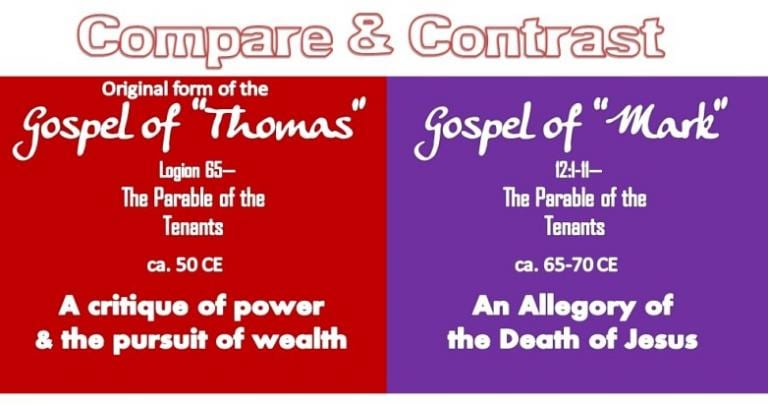
Thanks to his allegorical tinkering, it was “obvious” to “Mark” (ca. 70 CE) that the tenants in the parable of Mark 12:1-12 were wicked. “Mark” thought these evil tenants to be an analog for Israelites who rejected Jesus. So “Mark,” or perhaps the source he got the allegory from, turned Jesus’ original story into an allegory for the death of Jesus.
But the earliest written version of the parable of the tenants is non-allegorical. It is found in the early, pre-Gnostic form of the “Sayings Gospel of Thomas” Logion 65, ca. 50 CE. In its original form, the landowner is a greedy usurer who didn’t represent God, nor was his son Jesus. The tenants were originally just starving peasants. Jesus never intended the tenants to be villains. Also, Jesus never told allegories. To Jesus, vineyards were peasant lands stolen from their owners by usurers, greedy elites who bribed courts and destroyed poor Galileans.
Fellow Dying Inmate / All rights reserved
Rohrbaugh explains that, unlike peasant artisan Jesus, the anonymous author “Mark” originated in the literate Mediterranean, somewhere far removed from starving Galilee. Because of this, he (just like “Matthew” and “Luke” after him) doesn’t always “get” Jesus. Inspiration is messy, folks, and God works in the mess! Therefore “Mark” turns Jesus parable about labor-violence in the Galilee into an allegory of the storyteller.
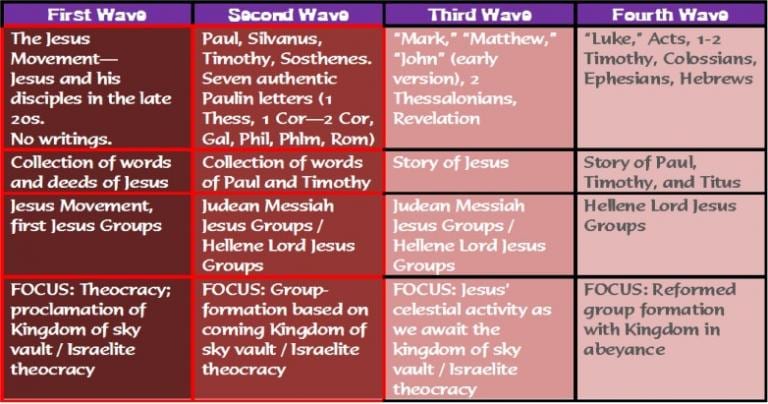
Image by Fellow Dying Inmate (with information by John Pilch) / All rights reserved
Allegory-gone-wild: Imperial Cruelty
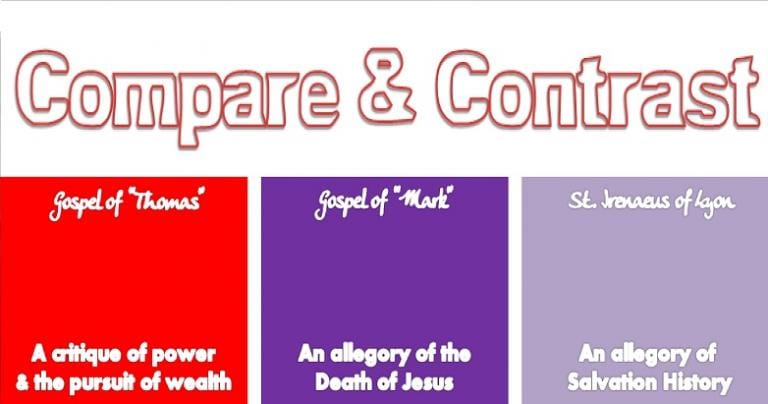
It was “obvious” to Irenaeus of Lyon (180 CE) that the tenants in the parable of Mark 12 symbolized all the wicked people since the beginning of humankind. And that the Beloved Son is Jesus Christ. Ultimately, with Irenaeus’ re-contextualization, we see that Markan allegory has become allegory-gone-wild.
Fellow Dying Inmate / All rights reserved
Later, it was “obvious” to Eusebius (324 CE) that the tenants in Jesus’ parable were the Judaeans who rejected Christ. Via an imperial allegory-gone-wild, Eusebius re-contextualized the parable into a tale about the triumph of Christianity under Constantine. Consequently, any Judaeans who rejected Christ must be the wicked tenants! And the Roman Empire “obviously” meant the New People of God! What should the Holy Romans do with wicked tenants?
So from all of this, Rohrbaugh illustrates that Medieval Christians read Scripture through the lens of divinely-sanctioned imperial cruelty. Thus “obviously” those nasty tenants could only be “perfidious” Jews. It followed that “clearly” Christians were justified in slaughtering them in pogroms. Ultimately, antisemitism became virtuous! Why? It was because of allegory-gone-wild.
Allegory-gone-wild in Aquinas, Luther & Calvin
Allegory-gone-wild gets extra-spiritual with the angelic doctor, Thomas Aquinas (d. 1274). He thought it “obvious” that the vineyard was an analog for the human soul. So Aquinas took the parable as an allegory about self-discipline. Consequently, he spiritualized it away.
Doctor Martin Luther (d. 1546) went the earthy route with his allegory-gone-wild. For Luther, the wicked tenants “obviously” were Papists (Catholics) and the peasants who rebelled against the German princes. Likewise, it was “clear” to Luther that the vineyard (= Kingdom of God) taken away from the Catholics and given to German rulers. The parable of Jesus, God says to crush the German peasants! As Rohrbaugh explains, Luther’s allegory-gone-wild completely reversed the original Galilean peasant story.
With Jean Calvin’s (d. 1564) allegory-gone-wild, you can have it all, it seems. He believed it “obvious” that the tenants in Mark 12 were double analogs for 1. the “perfidious” Jews and 2. sinners. Happy times.
Allegory-gone-wild & English Woes
What about bloody old England? Allegory-gone-wild made things “obvious” to Puritan and Anti-royalists reading the Geneva Bible full of their propaganda. “Unmistakably” the evil tenants were King Charles I (executed 1649) and his magistrates. Also, Lord Oliver Cromwell and his anti-royalist/ puritanical utopia constituted the vineyard or Kingdom of God! Thus Puritan-allegory-gone-wild of Mark 12 says to cut off Charles I head!
But the resurgent Anglican Royalists saw things differently. With Charles II (1660), they also employed allegory-gone-wild, this time reading the “Authorized” King James Version. Therefore to them, the wicked tenants must be the murderous anti-royalists who martyred Charles I. And “clearly” Charles I was the “Beloved Son” in the parable!
The British Empire enshrined allegory-gone-wild. So it was, therefore, “obvious” to William Arnot (1865) that the tenants were the conquered Muslims and Hindus under British colonial rule. Arnot believed that the “Beloved Son” was the British Empire! His allegory-gone-wild of Mark 12 justifies crushing anyone who would dare rebel against the British Empire (e.g., Gandhi)! Allegory-gone-wild, like Arnot’s, was celebrated in poems such as “Rule, Britannia!”
Catholic Neo-orthodox Apologists Go Wild with Allegory
In the 2000s, fundamentalist Catholic and popular author Scott Hahn, writing with Curt Mitch, interpreted the Parable of the Tenants in supersessionist allegory-gone-wild. The following is found on pages 39 and 40 of their commentary on “The Gospel of Mark” for the Ignatius Study Bible—
“The parable of the Wicked Tenants narrates the history of Israel. The story stresses that God [whom Hahn and Mitch take to be represented by the Landowner—FDI] has been patient with his wayward people [anachronistically taken to be Jews—FDI] throughout the ages. The vineyard represents Israel dwelling in the walled city of Jerusalem (Jeremiah 2:21; Hosea 10:1), the tower is the Temple (as in Jewish tradition based on Isaiah 5:1-2), and the tenants are Israel’s leaders stationed in the city. The servants are Old Testament prophets repeatedly sent by God to call for repentance.”
Hahn and Mitch continue—
“Many prophets were abused and killed (Mark 12:5; Luke 13:34), God eventually sent Jesus as the Beloved Son (12:6), whom they also killed (12:8). By adding the detail that the son is thrust out of the vineyard (12:8), Jesus predicts his Crucifixion outside the city walls of Jerusalem (John 19:20). God will avenge his son when he sends him to destroy (12:9) the unfaithful of Jerusalem in AD 70…”
America First!
And most American commentators today? Richard Rohrbaugh explains quite often, the tenants in Mark 12 get seen as evil people who want to take away the private property rights of the landowner. Clearly, the real American works hard for his money. So the parable of the tenants is really about the private property rights of the landowner.
In other words, lock those Mexicans away and Make America White Again. It’s all obvious and clear, right? Thank you, allegory-gone-wild.
Previous Post
September 26, 2020
Penance: What the Hell Are We Doing?
Next Post

September 30, 2020 Embarrassment Worldwide
Browse Our Archives
Select a Category Uncategorized
Select a Month August 2021 July 2021 June 2021 May 2021 April 2021 March 2021 February 2021 January 2021 December 2020 November 2020 October 2020 September 2020 August 2020 July 2020 June 2020 May 2020 April 2020 March 2020 February 2020 January 2020 December 2019 November 2019 October 2019 September 2019 August 2019
Follow Us!
TAKE THE
Religious Wisdom Quiz
What order did the four beasts that rose from the sea in Daniel's vision appear?
Select your answer to see how you score.
Leopard, bear, lion with eagle's wings, terrifying beast with iron teeth Terrifying beast with iron teeth, lion with eagle's wings, leopard, bear Bear, lion with eagle's wings, terrifying beast with iron teeth, leopard Lion with eagle's wings, bear, leopard, terrifying beast with iron teeth
Support this
Column


Related posts from Messy Inspirations

Understanding Apocalypse & Its Creatures



TRENDING AT PATHEOS Catholic

Rejecting Doom: Christian Hope And Human Action
Christianity is a religion of hope. We are to have hope and...

It’s What Comes From Within Which Matters
One of the most difficult things for us to understand is why...

Why I Choose the Eucharist Over the Sermon
Choose the Eucharist, Not the Sermon What are we supposed to get...

5 Design Elements Found in Spiritually Rooted Homes
Putting Spirituality Into Home Decor Our homes are more than our living...

Credo: A Story of God Told with the...
About 10 years ago, I began to imagine a personal "Credo" that...

The Anatomy of Divine Revelation in Catholic Thought
The claim that God has made Himself known to human beings is...
view all Catholic blogs
Ad-Free & Subscriber Log-In Subscription Support
- About Us
- 2026 Calendar
- Videos
- Podcasts
- Library of World Religions
- Faith In Media Tracker
- Advertise With Us
- Write for Us
- Privacy Policy
- Terms of Service
- Do Not Sell My Data
- Contact Us
- Radiant Digital
- Manage Newsletter Subscriptions
- Unsubscribe From Notifications
- Sitemap
Copyright 2008-2026, Patheos. All rights reserved.
Subscription Support Ad-Free & Subscriber Log-In
Follow Patheos