
BuddhistCatholicContemplativeEvangelicalGeneral ChristianHinduJewishLatter-day SaintMuslimNew VisionsProgressive Christian
Beliefs
- Buddhist
- Catholic
- Contemplative
- Evangelical
- General Christian
- Hindu
- Jewish
- Latter-day Saint
- More Voices
- Muslim
- New Visions
- Pagan
- Progressive Christian
Topics
- Religion News
- Food and Religion
- Sports and Religion
- Religious Art
- Religious Music and Entertainment
- Religious Events
- History and Religion
- Style and Religion
- Politics and Religion
- Women in Religion
- Recreation Outdoors and Religion
- Business Finance and Religion
- Careers Workplace and Religion
- Education and Religion
- Family Parenting and Religion
- Health Fitness and Religion
- Home and Religion
- Relationships and Religion
- Technology and Religion
- Travel and Religion
Columnists
- Buddhist Columnists
- Business Finance and Religion Columnists
- Careers Workplace and Religion Columnists
- Catholic Columnists
- Contemplative Columnists
- Education and Religion Columnists
- Evangelists Columnists
- Family Parenting and Religion Columnists
- General Christian Columnists
- Health Fitness and Religion Columnists
- Hindu Columnists
- History and Religion Columnists
- Home and Religion Columnists
- Jewish Columnists
- More Voices Columnists
- Latter Day Columnists
- Muslim Columnists
- New Visions Columnists
- Nonreligious Columnists
- Pagan Columnists
- Politics and Religion Columnists
- Progressive Columnists
- Recreation Outdoors and Religion Columnists
- Relationships and Religion Columnists
- Religion News Columnists
- Religious Art Columnists
- Religious Events Columnists
- Religious Music and Entertainment Columnists
- Sports and Religion Columnists
- Style and Religion Columnists
- Technology and Religion Columnists
- Travel and Religion Columnists
- Women in Religion Columnists
Resource Library
- 2026 Calendar
- Library of World Religions
- The 100 Most Holy Places on Earth
- Patheos Answers
- Podcasts
- Videos
- Faith Leaders Database
- Anglican Episcopalian
- Bahai
- Baptist
- Buddhism
- Christianity
- Confucianism
- Eastern Orthodoxy
- Hinduism
- Holiness and Pentecostal
- ISKCON
- Islam
- Judaism
- Lutheran
- Methodist
- The Church of Jesus Christ of Latter-day Saints
- New Age
- Paganism
- Presbytarian and Reformed
- Protestantism
- Religion Behind the Scenes
- Roman Catholic
- Scientology
- Shia Islam
- Sikhism
- Sufism
- Sunni Islam
- Taoism
- Zen
- See all religions
Research Tools
 Ad-Free & Subscriber Log-In Subscription Support
Ad-Free & Subscriber Log-In Subscription Support
Follow Patheos 

- Trending:
- Forgiveness
- |
- Marriage
- |
- Consciousness
- |
- Death Penalty
- |
- Election
- |
- Halloween
 Messy Inspirations
- Home
- Catholic
- Why You Don’t Understand Jesus’ Sea-Walking
Why You Don’t Understand Jesus’ Sea-Walking
Last updated on: August 9, 2020 at 12:27 pm by Fellow Dying Inmate
Why You Don’t Understand Jesus’ Sea-Walking 2020-08-09T12:27:55-04:00 Fellow Dying Inmate
Patheos Explore the world's faith through different perspectives on religion and spirituality! Patheos has the views of the prevalent religions and spiritualities of the world.
Why You Don’t Understand Jesus’ Sea-Walking / Image by Vincent UK from Pixabay
Why you don’t understand Jesus’ Sea-walking is because you are reading Mediterranean Gospels strained through inappropriate cultural scenarios.
This Sunday’s Gospel is the Matthean version of a tradition where Jesus’ followers experience a vision of him walking on the Sea. The Gospels give three renderings of this tradition—Mark 6;45-52; Matthew 14:22-33 (Sunday’s Gospel); and John 6:16-21. We explored each of these in an earlier blogpost here.
For a quick breakdown, watch the video here—
Sunday’s Gospel: Jesus Walking on the Sea
Here is the Gospel reading for today. It’s good to read it over, carefully.
NABRE Matthew 14:22-33
Then [Jesus] made the disciples get into the boat and precede him to the other side, while he dismissed the crowds. After doing so, he went up on the mountain by himself to pray. When it was evening he was there alone. Meanwhile the boat, already a few miles offshore, was being tossed about by the waves, for the wind was against it.
During the fourth watch of the night, he came toward them, walking on the sea. When the disciples saw him walking on the sea they were terrified. “It is a ghost,” they said, and they cried out in fear.
At once [Jesus] spoke to them, “Take courage, it is I; do not be afraid.”
Peter said to him in reply, “Lord, if it is you, command me to come to you on the water.”
He said, “Come.”
Peter got out of the boat and began to walk on the water toward Jesus. But when he saw how [strong] the wind was he became frightened; and, beginning to sink, he cried out, “Lord, save me!”
Immediately Jesus stretched out his hand and caught him, and said to him, “O you of little faith, why did you doubt?”
After they got into the boat, the wind died down. Those who were in the boat did him homage, saying, “Truly, you are the Son of God.”
Why you don’t understand Jesus’ Sea-walking: Different Cultures
Culture affects how people perceive, think about, and communicate reality. Different cultures therefore understand the Sea differently. Earlier this year, we explored what “Sea” meant to New Testament people. Biblically speaking, “Sea” was seen as a who, rather than a what. Exploring this goes a long way to explain why you don’t understand Jesus’ Sea-walking.
As we discussed in the earlier blog-post, the word who refers to persons, whereas what refers to things. American Christians read about Jesus walking on the Sea (Mark 6;45-52; Matthew 14:22-33; John 6:16-21), but we perceive, think about, and communicate the sea to be a what. In contrast, for ancient people hearing this story, it was quite different. When Jesus walked on the Sea, our ancient ancestors in the faith would understand that he strode over a who rather than a what! In other words, they personified the Sea.
Therefore in today’s Gospel Jesus is walking on a Sea Demon, because to walk on the Sea is, according to biblical peoples, to stride over a demon (i.e., an other-than-human person). What does that do to how you read the story? What is really being said here? Is Jesus walking on H20 (scientific) or a spirit? What does that do to our understanding this Gospel story and what God was revealing to the disciples in their vision?
Consider these questions in light of the video here—
Why you don’t understand Jesus’ Sea-walking: Miracles
Are you a believer in miracles? Would you consider Jesus walking on the Sea a miracle?
Earlier this year, we explored the idea of miracle, meaning an act that overrides physical laws governing the universe. Therefore “miracle” is a nice post-Enlightenment word. In fact, it’s entirely alien to our Scriptures.
Why that is should be no mystery—the holy writings of Israel were written centuries before the Enlightenment. It wasn’t until the time that people began thinking that a set of impersonal physical laws governed the universe. Since Biblical people could not imagine such physical laws governing the universe, they were likewise incapable of imagining violations of such. That’s why there can’t be any miracles in the Bible. Beware anachronism in Bible reading.
While the Gospels do speak of Jesus’ mighty deeds, signs, and works, they mention no miracles whatsoever. What does this do to your understanding of this Sunday’s Gospel story? How are we to understand by Jesus’ walking on the Sea? If it wasn’t miraculous, what was it then? Could it be something wondrous that does not violate “laws of nature” but fits very well into a panhuman experience?
Why you don’t understand Jesus’ Sea-walking is because you are reading the story in ethnocentric anachronism. You are placing foreign concepts into the story, thereby distorting it. You are probably not even aware of this.
Consider all this in light of the video here—
Why you don’t understand Jesus’ Sea-walking: ASC Experiences
In an earlier post, we explored the insights of Dr. John Pilch, Context Group biblical scholar, regarding the story of Jesus walking on the Sea. He explained the disciples’ vision of it as an altered state of consciousness experience. Pilch exhorted Christians and all Gospel readers to respect the fact that Jesus and his followers are MENA (Middle Eastern North African) personalities. Pilch says that even among today’s theologians and biblical scholars that, other than lip service, few recognize that the incarnation happened in the ancient Mediterranean and what that means.
Anthropologists specializing in the Mediterranean cultural region have established that approximately 80 percent of circum-Mediterranean cultures readily experience altered states of consciousness. Pilch explains that ancient biblical people like Jesus and his followers were included in that 80 percent.
Pilch also explains that Jesus and his followers experienced alternate reality often. Culturally speaking, they were open to experiencing altered states of consciousness. Indeed, not only were they familiar with getting into alternate reality, they were adept for it.
This changes how we read Gospel reports of Jesus’ miraculous walking on the Sea, doesn’t it? Wouldn’t it also change how we understand other Gospel stories about the miraculous at Jesus’ baptism, or his transfiguration, or resurrection appearances? Pilch says all of these miraculous wonders handsomely correspond into “the common, Mediterranean cultural experiences of altered states of consciousness.” Part of why you don’t understand Jesus’ Sea-walking is because you come from a society that represses these panhuman experiences.
The following video explains more—
What “Son of God” Meant
In this story, the disciples proclaim Jesus to be “son of God.” Over time, as the Church unpacked the Mystery of Jesus, people came to understand Jesus as “God the Son”—the Second Person of the Trinity. But that understanding came way after “Matthew” was composed. Since language only means where and when you use it, what did “son of God” mean to the Matthean Jesus group writing this Gospel?
Watch the video here to find out—
Why you don’t understand Jesus’ Sea-walking: Middle Class?
Finally, do you imagine that Jesus, Peter and Andrew, James and John, were middle class people? If so, don’t. That socio-economic designation doesn’t apply to these dirt-poor Galileans. Nothing like “middle class” existed in Herodian Palestine.
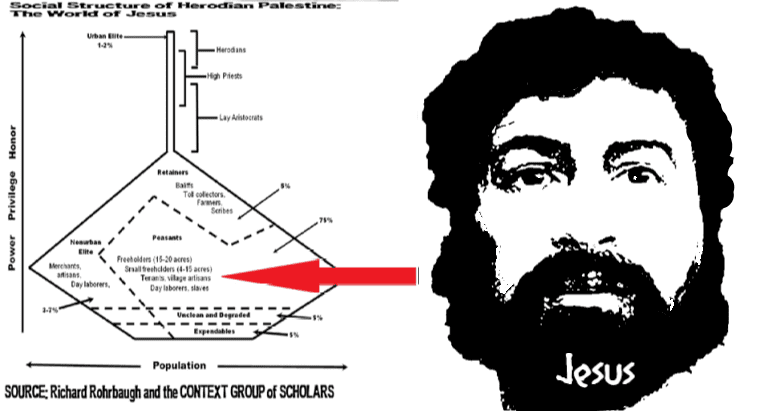
Fellow Dying Inmate (with inspiration from Donato Giancarlo) / All rights reserved
Like Galilean peasant artisans (such as Jesus), first-century Mediterranean fishermen were devastatingly poor. Toll collectors kept them in debt and dominated their work. The capital for fishing syndicates came from those toll collectors.
As did permission to fish the Galilee—government regulated those permissions. Government sold rights to toll collectors, who, in turn, brokered them out to fellow countrymen, for a price. The result was fishermen were in bone-crushing debt and the toll collectors owned them.
These poor Israelite fishermen basically controlled nothing. They had no control over the Wind and the Sea and the Storm, realities they interpreted to be malicious other-than-human persons. They had no control over their Government or the Toll Collectors who financed their ability to work. What would the peasant Jesus walking over the Sea Demon communicate to them? How would that be Good News?
Why you don’t understand Jesus’ Sea-walking: You are Western
Now imagine a 21st century American Christian. On her phone is the weather and stock reports, day planner, banking info, and a host of over controls. Science and technology assist her, pamper her, as she moves throughout her day. Yet she still prays and even reads this Gospel from “Matthew” online, by way of it. What is she to take from this story? Hopefully now you see why you don’t understand Jesus’ Sea-walking.
Later we will explore the first and second readings for this Sunday.
altered states of consciousness
Why you don’t understand Jesus’ Sea-walking
Previous Post

August 7, 2020
Blind Spots Ruin Christianity
Next Post

August 13, 2020 Romans 9—11: Challenges for American Christians
Browse Our Archives
Select a Category Uncategorized
Select a Month August 2021 July 2021 June 2021 May 2021 April 2021 March 2021 February 2021 January 2021 December 2020 November 2020 October 2020 September 2020 August 2020 July 2020 June 2020 May 2020 April 2020 March 2020 February 2020 January 2020 December 2019 November 2019 October 2019 September 2019 August 2019
Follow Us!
TAKE THE
Religious Wisdom Quiz
How many times did Elijah pray for rain?
Select your answer to see how you score.
3 9 7 5
Support this
Column


Related posts from Messy Inspirations

Understanding Apocalypse & Its Creatures



TRENDING AT PATHEOS Catholic

Rejecting Doom: Christian Hope And Human Action
Christianity is a religion of hope. We are to have hope and...

It’s What Comes From Within Which Matters
One of the most difficult things for us to understand is why...

Why I Choose the Eucharist Over the Sermon
Choose the Eucharist, Not the Sermon What are we supposed to get...

5 Design Elements Found in Spiritually Rooted Homes
Putting Spirituality Into Home Decor Our homes are more than our living...

Credo: A Story of God Told with the...
About 10 years ago, I began to imagine a personal "Credo" that...

The Anatomy of Divine Revelation in Catholic Thought
The claim that God has made Himself known to human beings is...
view all Catholic blogs
Ad-Free & Subscriber Log-In Subscription Support
- About Us
- 2026 Calendar
- Videos
- Podcasts
- Library of World Religions
- Faith In Media Tracker
- Advertise With Us
- Write for Us
- Privacy Policy
- Terms of Service
- Do Not Sell My Data
- Contact Us
- Radiant Digital
- Manage Newsletter Subscriptions
- Unsubscribe From Notifications
- Sitemap
Copyright 2008-2026, Patheos. All rights reserved.
Subscription Support Ad-Free & Subscriber Log-In
Follow Patheos