
BuddhistCatholicContemplativeEvangelicalGeneral ChristianHinduJewishLatter-day SaintMuslimNew VisionsProgressive Christian
Beliefs
- Buddhist
- Catholic
- Contemplative
- Evangelical
- General Christian
- Hindu
- Jewish
- Latter-day Saint
- More Voices
- Muslim
- New Visions
- Pagan
- Progressive Christian
Topics
- Religion News
- Food and Religion
- Sports and Religion
- Religious Art
- Religious Music and Entertainment
- Religious Events
- History and Religion
- Style and Religion
- Politics and Religion
- Women in Religion
- Recreation Outdoors and Religion
- Business Finance and Religion
- Careers Workplace and Religion
- Education and Religion
- Family Parenting and Religion
- Health Fitness and Religion
- Home and Religion
- Relationships and Religion
- Technology and Religion
- Travel and Religion
Columnists
- Buddhist Columnists
- Business Finance and Religion Columnists
- Careers Workplace and Religion Columnists
- Catholic Columnists
- Contemplative Columnists
- Education and Religion Columnists
- Evangelists Columnists
- Family Parenting and Religion Columnists
- General Christian Columnists
- Health Fitness and Religion Columnists
- Hindu Columnists
- History and Religion Columnists
- Home and Religion Columnists
- Jewish Columnists
- More Voices Columnists
- Latter Day Columnists
- Muslim Columnists
- New Visions Columnists
- Nonreligious Columnists
- Pagan Columnists
- Politics and Religion Columnists
- Progressive Columnists
- Recreation Outdoors and Religion Columnists
- Relationships and Religion Columnists
- Religion News Columnists
- Religious Art Columnists
- Religious Events Columnists
- Religious Music and Entertainment Columnists
- Sports and Religion Columnists
- Style and Religion Columnists
- Technology and Religion Columnists
- Travel and Religion Columnists
- Women in Religion Columnists
Resource Library
- 2026 Calendar
- Library of World Religions
- The 100 Most Holy Places on Earth
- Patheos Answers
- Podcasts
- Videos
- Faith Leaders Database
- Anglican Episcopalian
- Bahai
- Baptist
- Buddhism
- Christianity
- Confucianism
- Eastern Orthodoxy
- Hinduism
- Holiness and Pentecostal
- ISKCON
- Islam
- Judaism
- Lutheran
- Methodist
- The Church of Jesus Christ of Latter-day Saints
- New Age
- Paganism
- Presbytarian and Reformed
- Protestantism
- Religion Behind the Scenes
- Roman Catholic
- Scientology
- Shia Islam
- Sikhism
- Sufism
- Sunni Islam
- Taoism
- Zen
- See all religions
Research Tools
 Ad-Free & Subscriber Log-In Subscription Support
Ad-Free & Subscriber Log-In Subscription Support
Follow Patheos 

- Trending:
- Forgiveness
- |
- Marriage
- |
- Consciousness
- |
- Death Penalty
- |
- Election
- |
- Halloween
 Messy Inspirations
- Home
- Catholic
- Prophets Edited in Sunday Readings
Prophets Edited in Sunday Readings
Last updated on: August 14, 2020 at 8:34 am by Fellow Dying Inmate
Prophets Edited in Sunday Readings 2020-08-14T08:34:22-04:00 Fellow Dying Inmate
Patheos Explore the world's faith through different perspectives on religion and spirituality! Patheos has the views of the prevalent religions and spiritualities of the world.
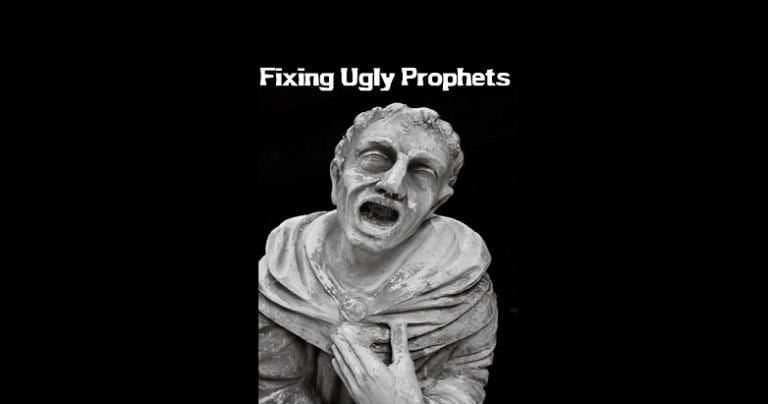
Prophets Are Too Ugly for Our Sensibilities / Image by Wolfgang Brauner from Pixabay
Prophets like Elijah get their ugly parts redacted in Mass readings.
The Prophets can be thought of as the Debbie Downers of the Bible. That’s true for even the greatest of Old Testament prophets, Elijah.
So once more, last Sunday’s readings (e.g., 1 Kings 19:9a, 11-13a) displayed how those who engineered the Common Lectionary have done another Frankenstein-style operation on the Bible. The result is likewise monstrous: the creation of new Scripture at the expense of murdering the old. That’s what happens folks when you slice and dice up the Bible, killing context. You get whatever the hell you want, except the real deal.
The Real Story of Elijah’s Low Point
The real story, as given by someone scholars have called “the Deuteronomist(s),” was different. Before 20th-century tinkerers came along and butchered it, Elijah, the great prophet of God encounters Holy and Absolute Mystery via an altered state of consciousness. In that older, uglier story, Elijah despaired. He was deeply discouraged. He wanted God to allow him to die (1 Kings 19:3-4). And God, in turn, rebuked Elijah (1 Kings 19:13b).
But that was not the first reading we received last weekend, on the 19th Sunday of Ordinary Time. Instead, we got the Joss Whedon version, something with more sunshine, zing, and artificial flavoring. The verses about Elijah’s despair and suicidal gloom are redacted—too much for us lay slobs, I guess, thought our “Superiors.” After surgery, Elijah becomes an example of trusting God, an intimate friend of God, to whom God freely speaks. He never doubts or despairs. And so God holds nothing back—God explains all the mysteries to him clearly, just like the Hierarchy does. Keep it clear, in Pleasantville black-and-white.
Was Horeb or Sinai the Mountain of Prophets?
The Deuteronomist(s) who put together this story originally wanted his Israelite readers to see similarities between Moses and Elijah. The Torah, or five books attributed to Moses (no, he didn’t really write them), is a hodgepodge of different traditions compiled, redacted, and edited after the Deuteronomist(s) (7th and 6th century BCE) had died. He and the Elohist (9th century BCE) called the mountain of God “Horeb.” This is in contrast to the Yahwist (10th-9th century BCE) and the Priest (“P” is also for “Persian,” 5th century BCE), who instead call it “Sinai.” But that editing was before the close of the canon, so it’s kosher, right?
But way after the canon was set, designers of the new lectionary saw fit to give us a superior canon, indeed, a canon-within-the-Canon. They’ll deny this if you ask them. But nevertheless, that’s what happened. Although they dump the gloom and God’s rebuke of Elijah, something essential to truly understand prophets, they keep the mountain! This is probably to artificially link the story with Sunday’s Gospel, Matthew 14:22-33. That’s the Matthean story about Jesus ascending the mountain to pray, and then walking on the Sea demon.
See that’s how typology works, folks. If it doesn’t fit, make it fit. Incidentally, popular Catholic fundamentalists like Scott Hahn adore the typology of Church Fathers. But they either forget or ignore the supersessionism and antisemitism that we inherit from those same Fathers and their typologies. It’s another edit, like with Elijah. Out of sight, out of mind. Just keep repeating, Catholics, “Everything’s perfect! We are the best!”
Pagan Origins of Last Sunday’s Psalm
That rule about making it fit also applies to last Sunday’s Psalm (Psalm 85:9, 10, 11-12, 13-14). Look at the language!
Canaanite mythology heavily influenced Israelite beliefs. Without this mythology, there would be no Psalm 85 as we have it. Each year, Canaanites celebrated Baal conquering Winter (really the personified Wet-Season of late October to mid-March). The personified Winter troubled and churned the Great Sea (Mediterranean). By defeating Winter, Baal ensured that Dry Season would be peaceful with good harvests.
Israelites took all that Canaanite mythology and swapped Baal for Yahweh. It’s Yahweh who did that. Keep in mind that the biblical world is one in which every effect has a personal cause. Therefore if something happens, the question was never WHAT happened, but rather WHO did it? You can’t say in Hebrew, “It rained.” Instead, it is, “God sent the rain.”
Again the creators of New Scripture (the Common Lectionary) murdered Scripture to make Scripture. The short verses of the Responsorial Psalm are embedded inside Israel’s lamentation, begging their Patron to restore the covenant. The people’s disloyalty and faithlessness upset that covenant, bringing creation to ruin, just like Winter does. Just as Baal, I mean Yahweh, restored and balanced creation in Dry Season, so he will also heal those who fear him and act justly.
Moses & Elijah, Twin Prophets
Back to Elijah and the First Reading. He is in terrible shame, and that is, for a Middle Easterner, a fate worse than death. He sits dishonored in a shallow cave. Wasn’t that just like Moses?—he too was in the hollow of the rock. God told Moses to rest there, you’ll recall, as his honor passed by.
As scholar John Pilch explains, the Deuteronomist(s) makes Elijah look and act an awful lot like Moses. Moses brokered the covenant between the Patron of Israel (Yahweh) and Israel (Yahweh’s client). So too must Elijah broker. Elijah must reestablish that covenant and restore the loyalty of Israel to their Patron.
Popular Christian imagination distorts prophets into Nostradamus-style predictors of later times. Because of this, Pilch reminds us that the real prophets were experts in God’s will for their contemporary times. Hence Pilch explains that the Elijah-Elisha stories demonstrate how the prophets responded to the needs of poor Israelite peasants who suffered under the tyranny of elites and the scarcity of drought and famine. Only loyalty to Yahweh will help, trust in kings will not. That sentiment likely reflects lost hopes in the Northern Kingdom about the Omri dynasty (880 BCE—873 BCE). Ultimately, kings will fail, but never Yahweh.
I wonder if American Christians, living through the Trump Virus, can find something in their lives relatable to this?
Previous Post
August 13, 2020
Romans 9—11: Challenges for American Christians
Next Post

August 14, 2020 Assumption of Mary: Mediterranean Maid & Mother
Browse Our Archives
Select a Category Uncategorized
Select a Month August 2021 July 2021 June 2021 May 2021 April 2021 March 2021 February 2021 January 2021 December 2020 November 2020 October 2020 September 2020 August 2020 July 2020 June 2020 May 2020 April 2020 March 2020 February 2020 January 2020 December 2019 November 2019 October 2019 September 2019 August 2019
Follow Us!
TAKE THE
Religious Wisdom Quiz
What Christian group believes in baptism for the dead?
Select your answer to see how you score.
Pentecostals Anglicans Presbyterians Latter-day Saints
Support this
Column


Related posts from Messy Inspirations

Understanding Apocalypse & Its Creatures



TRENDING AT PATHEOS Catholic

The Parable Of The Sower And The Word...
One of Christ’s most famous parables is that of the sower who...

Rejecting Doom: Christian Hope And Human Action
Christianity is a religion of hope. We are to have hope and...

Why I Choose the Eucharist Over the Sermon
Choose the Eucharist, Not the Sermon What are we supposed to get...

5 Design Elements Found in Spiritually Rooted Homes
Putting Spirituality Into Home Decor Our homes are more than our living...

Credo: A Story of God Told with the...
About 10 years ago, I began to imagine a personal "Credo" that...

The Anatomy of Divine Revelation in Catholic Thought
The claim that God has made Himself known to human beings is...
view all Catholic blogs
Ad-Free & Subscriber Log-In Subscription Support
- About Us
- 2026 Calendar
- Videos
- Podcasts
- Library of World Religions
- Faith In Media Tracker
- Advertise With Us
- Write for Us
- Privacy Policy
- Terms of Service
- Do Not Sell My Data
- Contact Us
- Radiant Digital
- Manage Newsletter Subscriptions
- Unsubscribe From Notifications
- Sitemap
Copyright 2008-2026, Patheos. All rights reserved.
Subscription Support Ad-Free & Subscriber Log-In
Follow Patheos