
BuddhistCatholicContemplativeEvangelicalGeneral ChristianHinduJewishLatter-day SaintMuslimNew VisionsProgressive Christian
Beliefs
- Buddhist
- Catholic
- Contemplative
- Evangelical
- General Christian
- Hindu
- Jewish
- Latter-day Saint
- More Voices
- Muslim
- New Visions
- Pagan
- Progressive Christian
Topics
- Religion News
- Food and Religion
- Sports and Religion
- Religious Art
- Religious Music and Entertainment
- Religious Events
- History and Religion
- Style and Religion
- Politics and Religion
- Women in Religion
- Recreation Outdoors and Religion
- Business Finance and Religion
- Careers Workplace and Religion
- Education and Religion
- Family Parenting and Religion
- Health Fitness and Religion
- Home and Religion
- Relationships and Religion
- Technology and Religion
- Travel and Religion
Columnists
- Buddhist Columnists
- Business Finance and Religion Columnists
- Careers Workplace and Religion Columnists
- Catholic Columnists
- Contemplative Columnists
- Education and Religion Columnists
- Evangelists Columnists
- Family Parenting and Religion Columnists
- General Christian Columnists
- Health Fitness and Religion Columnists
- Hindu Columnists
- History and Religion Columnists
- Home and Religion Columnists
- Jewish Columnists
- More Voices Columnists
- Latter Day Columnists
- Muslim Columnists
- New Visions Columnists
- Nonreligious Columnists
- Pagan Columnists
- Politics and Religion Columnists
- Progressive Columnists
- Recreation Outdoors and Religion Columnists
- Relationships and Religion Columnists
- Religion News Columnists
- Religious Art Columnists
- Religious Events Columnists
- Religious Music and Entertainment Columnists
- Sports and Religion Columnists
- Style and Religion Columnists
- Technology and Religion Columnists
- Travel and Religion Columnists
- Women in Religion Columnists
Resource Library
- 2026 Calendar
- Library of World Religions
- The 100 Most Holy Places on Earth
- Patheos Answers
- Podcasts
- Videos
- Faith Leaders Database
- Anglican Episcopalian
- Bahai
- Baptist
- Buddhism
- Christianity
- Confucianism
- Eastern Orthodoxy
- Hinduism
- Holiness and Pentecostal
- ISKCON
- Islam
- Judaism
- Lutheran
- Methodist
- The Church of Jesus Christ of Latter-day Saints
- New Age
- Paganism
- Presbytarian and Reformed
- Protestantism
- Religion Behind the Scenes
- Roman Catholic
- Scientology
- Shia Islam
- Sikhism
- Sufism
- Sunni Islam
- Taoism
- Zen
- See all religions
Research Tools
 Ad-Free & Subscriber Log-In Subscription Support
Follow Patheos 

- Trending:
- Advent
- |
- Forgiveness
- |
- Thanksgiving
- |
- Election
- |
- Seasonal Holidays
- |
- Marriage
 Messy Inspirations
- Home
- Catholic
- Blind Spots Ruin Christianity
Blind Spots Ruin Christianity
Last updated on: August 8, 2020 at 12:14 am by Fellow Dying Inmate
Blind Spots Ruin Christianity 2020-08-08T00:14:02-04:00 Fellow Dying Inmate
Patheos Explore the world's faith through different perspectives on religion and spirituality! Patheos has the views of the prevalent religions and spiritualities of the world.
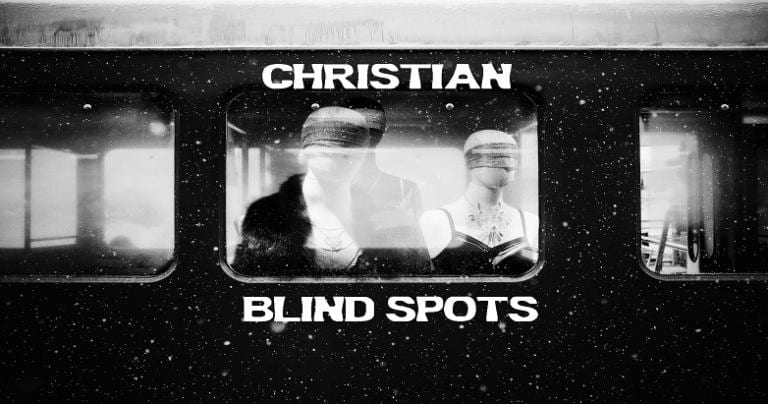
Blind Spots / Image by Karen Smits from Pixabay
Our blind spots render Christianity useless to help and heal the Dark Age we have entered.
It’s scary to think about how many decisions we make, we really don’t. I mean that we are not even there to make the decisions. Oh, sure, decisions do get made, nonetheless. But we didn’t make them—mom did. Or dad did. Maybe friends. Maybe grandparents. Or some other influence. But not you or I. Because for you to really make a decision, you’d have to be present. But you weren’t, despite being physically there. You see, terrifyingly, you were sleepwalking through life. You were on autopilot, like a robot.
That’s how almost every one of us human beings goes through life. On autopilot. My vision narrows and I am rendered unaware of biases programmed into me that force my so-called “free” decisions. Addicted to approval and applause since I was a toddler, how can I be anything but a robot? All someone need do is learn the right combination of buttons to push, and they own me. Blind spots cover up so many things I need to see, but don’t. I don’t see them, because I can’t. I was programmed to be blind. Prejudiced ideas and wishful thinking blur my reality.
The faith-walk of many Christians is no different. How seldom do Christians today challenge assumptions and spurious facts! Added to this, our desire to be correct and safely secure in what is “right” takes us the wrong way and drives us toward unhappy dead ends. Bible reading, faith sharing, and parish life become echo chambers full of enablers. Growth is stunted. The result is a Church ineffective to meet today’s challenges and heal the world.
But there is hope, true believers! Watch the short video here…
Blind Spots, Sleepy Head!
This is all unpleasant I know. Waking up is painful. We are horrified seeing our blind spots and how robotic our lives really are. Following Christ is about being awake (Ephesians 5:14; see also Isaiah 26:19; 60:1), but we are asleep at the wheel.
And yet the anonymous author called “Mark” remembered that Jesus began his coalition and political-religious movement by calling his fellow Israelites call to put on a new mind—
Mark 1:15 [Jesus said] “This is the time of fulfillment. Theocracy (ἡ βασιλεία τοῦ Θεοῦ) is at hand. Put on a new mind (μετανοεῖτε), and believe in the good news.”
That Greek word the Markan Jesus says, metanoeite, gets translated as repent, but it’s something far deeper. It certainly doesn’t mean feel guilty about something—the Bible involves anti-introspective personalities and therefore lacks psychological guilt entirely. The Bible knows shame, not psychological guilt.
Metanoeite… metanoia. It means to put on a new mind. It’s not about feeling lousy and lamenting your sins. It’s about seeing clearly, something prerequisite for love and right action. Jesus and the prophets are all about metanoia. Change of mind. Change of heart. Becoming someone new. In the case of collectivistic Biblical personalities like Jesus and his mostly peasant audience, it meant dying to one group, and immediately becoming another group. I say becoming rather than joining to hammer home that Biblical personalities are group personalities sharing a group conscience.
Everyone Has Blind Spots
No matter the cultural personality, metanoia and seeing our blind spots, is needed. That was true for the earliest first century New Testament Jesus groups. And it’s likewise true for us Western 21st century individualists. And metanoia is not fixed by smarts, being clever, or highly educated. Intelligence won’t help you here! Mister Spock, Sherlock Holmes, Dr. House and the congenial Jesus we make like these Western ideals won’t save us.
Aristotle: Parade Example on Blind Spots
Considering metanoia and blind spots, look at the extremely influential Aristotle. Unlike peasant day laborer Jesus and the vast majority of Mediterraneans, Aristotle was a quasi-individualistic elite. Aristotle was brilliant also. But nevertheless, he suffered major blind spots.
For example, Aristotle couldn’t imagine that more honorable beings like the moon and stars were governed by the same laws as mundane things like apples and rocks. To Aristotle, the sky vaults were made of a more noble substance than anything terrestrial even though they we all parts of the same closed environment. To think otherwise would be sacrilege.
Besides that Aristotle held that women were not complete humans (Generation of Animals, 729 a). He believed that woman was, at best, a mutilated male (Generation of Animals, 2.3.737a27-8).
Consider how devastating the effects of “the Teacher’s” blind spots (Politics, 1254b13–14) here have been. Even saints and doctors of the Church were affected by these blind spots. Just read Augustine and Thomas Aquinas or various Islamic thinkers. That one about women has quite an enduring shelf-life and distribution. Don’t believe me? Go read Ordinatio Sacerdotalis. Go read John Paul II or Benedict XVI about why women can’t be ordained, and even discussion of this is forbidden. And then go ask William Morris, former bishop of the diocese of Toowoomba, Queensland, about what happened when he dared to raise the subject.
But the Church (= Hierarchy) is Perfect!
What did I just write? Am I crazy? Please forgive me, brothers and sisters! I don’t know what came over me!
The Church, the final destiny for all mankind, has no problems with women, of course. Don’t you know why? It’s because it is a perfect society. It was established that way by God, and don’t you ever doubt that. Can a perfect society have blind spots? No way. Then it would be imperfect. Therefore it cannot have blind spots, like misogyny and racism. End of story. End of discussion. Out of sight, out of mind.
Therefore let’s stop all this critical thinking and go follow the man in a dress carrying the Golden Sun in Procession. Thank God we have a good man in the White House, by the way. Let’s make America great again…
Strong Coffee
Sarcasm too harsh? I’ll dial it down. I wouldn’t like to sound too much like the real Jesus. He was far harsher, by the way. I will strive to be more like the American congenial Jesus the Pal. He has Care Bear goodness and a smile that won’t quit. Plus clean breath and I can see all his teeth.
But then again, were I to dial it down, I wouldn’t be loving you as my neighbor, would I? Sometimes tough love is needed.
What is more loving? For a fellow dying addict in the crack house to say to you, “Alleluia” or “God is on our side!” or some other insipid, feel-good drivel? Or “Hey! We are dying! Stop smoking that pipe! Call for help!”? Which do you think is more popular?
Blind Spots in Bible Reading
Blind spots made up of spurious familiarity with the Bible prevent us from seeing people like Paul clearly. I’ve always heard that Paul was sent to Gentiles and that he was the Apostle to the Gentiles. In a way the historical Paul could never have anticipated, he did become that. The originally Hellenized Israelite Jesus groups he formed had descendants. Those descendants influenced the non-Israelite majorities they lived among. Eventually those people became Jesus group people.
Consequently, after Constantine, those communities became almost 100 percent non-Israelites. So, yeah, I guess, in a strange way, Paul became “apostle to the Gentiles.” But that’s quite different than how we imagine it.
Paul, As He Was
Was Paul really writing to non-Israelites? Look at the complexity of his writings. Consider the many times he references things only first century Israelites would understand or care about. Paul expects his audience to get his many Israelite references. Look carefully below—
Romans 1:1-6— Paul, a slave [controlled by Jesus, messiah] of Jesus Christ [messiah, Israelite office of political religion], called to be an apostle [one commissioned as an emissary and change agent sent to diffuse some innovation], set apart for the gospel [= innovation] of [the] God [of Israel, the change agency] which he [the God of Israel] promised beforehand [to Israelites] through his [Israelite] prophets [authorized Israelite spokespersons] in the holy scriptures [sacred writings of Israel—this assumes his audience is familiar with this tradition, i.e. they are Israelites], the gospel [innovation] concerning his Son [the broker mediating between Israel, the client, and God, the patron], who was descended from David [legendary Israelite king] according to the flesh and designated Son of God [divine broker] in power according to the Spirit of holiness by his resurrection [became a star; resurrection was a Persian idea adopted by Yehud after 537 BCE—Pharisees = Farsi = Persian] from the dead, Jesus Christ [Israelite messiah] our [Cosmic] Lord, through whom we have received grace [favor] and apostleship [commissioning and authorization to proclaim and disseminate the innovation among Israelites] to bring about the obedience of faith [loyalty; watch “The Godfather Trilogy”] for the sake of his name [honor] among all the nations [really peoples, that is, Mediterranean non-Issraelite majorities Paul’s Israelite clients live among as minorities], including yourselves [Paul’s Israelite clients] who are called to belong to Jesus Christ [messiah]…
Step back for a moment and read carefully the brackets! Paul refers to things that would be quite foreign to non-Israelite Mediterranean peoples. Given the mostly illiterate Mediterranean world at the time, and the fiercely ingroup/outgroup boundaries of all ancients, how likely do you think Paul’s Gentile contemporaries would be familiar enough with Israel’s traditions to understand Paul here in “Romans”? What does that say about who his audience really is?
But bad translations and interpretations of Paul, suffering blind spots caused by 2,000 years of theological and devotional freight, oversimplify all that. Therefore we transform Paul’s audience of Hellenized Israelite emigres into “ethnic Greeks” and “Gentiles.” Thus, the ethnocentrically particular Paul becomes universalist Paul. Consequently, Paul gets remembered as having an active ministry to Gentiles. Bring everyone in! And don’t you doubt it! Why? Blind spots.
Opening Eyes is a Joint Spiritual Partnership
Of course, what is at stake here goes beyond squabbles about Paul’s intended audience. It get into really serious issues about our problems today.
Hope lies in the Holy Spirit. Hope consists of waking up. But the Spirit never coerces. Challenges? You bet. Invites us to awaken? Surely. But no coercion. Unlike so many bishops, priests, and other demanding, controlling people. Not that all bishops and priests are manipulative, coercive, narcissistic types living richly distant from the poor they “serve,” mind you. But you’d be suffering serious blind spots to think that none are or that only few are. Open your eyes. Look at the world. Look at the Church. If you’re offended at this, you may just a real serious case of blind spots.
What do you think about all this? Does this sound crazy? Please take part in the conversation. Comment below…
Dunning-Kruger effect in Christianity
Previous Post

August 4, 2020
Trump and 666—Any Connections?
Next Post
August 9, 2020 Why You Don’t Understand Jesus’ Sea-Walking
Browse Our Archives
Select a Category Uncategorized
Select a Month August 2021 July 2021 June 2021 May 2021 April 2021 March 2021 February 2021 January 2021 December 2020 November 2020 October 2020 September 2020 August 2020 July 2020 June 2020 May 2020 April 2020 March 2020 February 2020 January 2020 December 2019 November 2019 October 2019 September 2019 August 2019
Follow Us!
TAKE THE
Religious Wisdom Quiz
What does "Gad" mean in Hebrew?
Select your answer to see how you score.
Fortune Joyful Warrior Chosen One
Support this
Column


Related posts from Messy Inspirations
Understanding Apocalypse & Its Creatures
TRENDING AT PATHEOS Catholic

The Kingdom Of God In Ordinary Life And...
The kingdom of God is all around us; it is in us...

How Discretion Guides Us Away From Extremes
Prudence is an important virtue for all of us. While we should...

If Baptism Washes Away Sin, Why Do Catholics...
The seven sacraments stand as the foundation of Catholic ecclesial life. The...

The Power of Setting a Good Example
Remember last August when the Chicago White Sox hosted a "Pope Hat...

A Catholic Critique of Biblical Unitarianism
If the statistics are to be believed, Unitarianism is rising worldwide. Although...

How Grandma Tourism Helps Grandparents Live Their Vocation
Grandma, The New Travel Influencer What started as a nostalgia-inspired social media...
view all Catholic blogs
Ad-Free & Subscriber Log-In Subscription Support
- About Us
- 2026 Calendar
- Videos
- Podcasts
- Library of World Religions
- Faith In Media Tracker
- Advertise With Us
- Write for Us
- Privacy Policy
- Terms of Service
- Do Not Sell My Data
- Contact Us
- Radiant Digital
- Manage Newsletter Subscriptions
- Unsubscribe From Notifications
- Sitemap
Copyright 2008-2026, Patheos, part of the Radiant Digital network of media brands. All rights reserved.
Subscription Support Ad-Free & Subscriber Log-In
Follow Patheos