
BuddhistCatholicContemplativeEvangelicalGeneral ChristianHinduJewishLatter-day SaintMuslimNew VisionsProgressive Christian
Beliefs
- Buddhist
- Catholic
- Contemplative
- Evangelical
- General Christian
- Hindu
- Jewish
- Latter-day Saint
- More Voices
- Muslim
- New Visions
- Pagan
- Progressive Christian
Topics
- Religion News
- Food and Religion
- Sports and Religion
- Religious Art
- Religious Music and Entertainment
- Religious Events
- History and Religion
- Style and Religion
- Politics and Religion
- Women in Religion
- Recreation Outdoors and Religion
- Business Finance and Religion
- Careers Workplace and Religion
- Education and Religion
- Family Parenting and Religion
- Health Fitness and Religion
- Home and Religion
- Relationships and Religion
- Technology and Religion
- Travel and Religion
Columnists
- Buddhist Columnists
- Business Finance and Religion Columnists
- Careers Workplace and Religion Columnists
- Catholic Columnists
- Contemplative Columnists
- Education and Religion Columnists
- Evangelists Columnists
- Family Parenting and Religion Columnists
- General Christian Columnists
- Health Fitness and Religion Columnists
- Hindu Columnists
- History and Religion Columnists
- Home and Religion Columnists
- Jewish Columnists
- More Voices Columnists
- Latter Day Columnists
- Muslim Columnists
- New Visions Columnists
- Nonreligious Columnists
- Pagan Columnists
- Politics and Religion Columnists
- Progressive Columnists
- Recreation Outdoors and Religion Columnists
- Relationships and Religion Columnists
- Religion News Columnists
- Religious Art Columnists
- Religious Events Columnists
- Religious Music and Entertainment Columnists
- Sports and Religion Columnists
- Style and Religion Columnists
- Technology and Religion Columnists
- Travel and Religion Columnists
- Women in Religion Columnists
Resource Library
- 2026 Calendar
- Library of World Religions
- The 100 Most Holy Places on Earth
- Patheos Answers
- Podcasts
- Videos
- Faith Leaders Database
- Anglican Episcopalian
- Bahai
- Baptist
- Buddhism
- Christianity
- Confucianism
- Eastern Orthodoxy
- Hinduism
- Holiness and Pentecostal
- ISKCON
- Islam
- Judaism
- Lutheran
- Methodist
- The Church of Jesus Christ of Latter-day Saints
- New Age
- Paganism
- Presbytarian and Reformed
- Protestantism
- Religion Behind the Scenes
- Roman Catholic
- Scientology
- Shia Islam
- Sikhism
- Sufism
- Sunni Islam
- Taoism
- Zen
- See all religions
Research Tools
 Ad-Free & Subscriber Log-In Subscription Support
Ad-Free & Subscriber Log-In Subscription Support
Follow Patheos 

- Trending:
- Forgiveness
- |
- Marriage
- |
- Consciousness
- |
- Death Penalty
- |
- Election
- |
- Halloween
 Messy Inspirations
- Home
- Catholic
- Assumption of Mary: Mediterranean Maid & Mother
Assumption of Mary: Mediterranean Maid & Mother
Last updated on: August 14, 2020 at 10:13 pm by Fellow Dying Inmate
Assumption of Mary: Mediterranean Maid & Mother 2020-08-14T22:13:30-04:00 Fellow Dying Inmate
Patheos Explore the world's faith through different perspectives on religion and spirituality! Patheos has the views of the prevalent religions and spiritualities of the world.
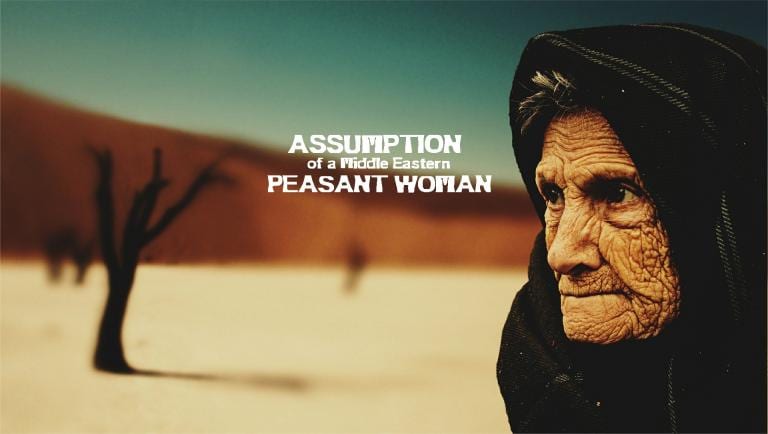
Assumption of a Middle Eastern Peasant Woman / Image by Michal Jarmoluk from Pixabay
The Assumption of Mary offers us a challenge—either see her with new eyes or continue using her as a theological weapon for unjust structures and hegemony.
Mary is beloved by Catholics worldwide. That is, the Mary we’ve created. The overwhelming majority of Catholics approach her exclusively through what I call “the devotional and the emotional.” Few critically reflect on this or her.
Please watch the video below carefully…
Mary in the New Testament and History
You would never know from Catholics the lack of information we have on the historical Mary. Because despite the way many Catholics act, we know next to nothing of Mary’s actual peasant life. And the New Testament doesn’t offer much in this regard.
Her assumption and almost everything else we Catholics proclaim about Mary is nowhere mentioned by the New Testament. Only ignorance would see the New Testament as the norm under-girding Marian devotion or practice.
How did Mary die? Silence. What was her exact role in the early Jesus groups? Not a word is given. What was her life like in Nazareth with her family? Zilch. How was her marriage with Joseph? Nada. What was her childhood like? Nothing is said. How did her birth come about? Complete quiet. Who were her parents? There is no answer. And when it comes to the Assumption, Perpetual Virginity, and the Immaculate Conception, we hear nothing but deafening silence.
By the second century, two main things are known about Mary: she was mother to Jesus, and she was a virgin (maid) untouched by a man when she became pregnant. All subsequent Mariology until recent times was birthed out of 1) her Mediterranean motherhood and 2) her being a Mediterranean maiden.
Mediterranean Cultural Mary
What could be the foundation and explanation of all Marian devotion and understanding? It can only be Mediterranean culture. Without the Mediterranean-style father-ineffective family and “Godfather” patron-client relations, there would be no Marian devotions or dogmas. There wouldn’t be any visions of Mary, either. As scholar Bruce Malina explains, subtract those Mediterranean social institutions and cultural scripts, all these Marian staples wouldn’t exist.
We have a hard time even being able to see this. Watch this:
How familiar are you with Mediterranean motherhood? How familiar are you with the way it gender-divides labor in that region? Are you intimate with how Mediterranean mother-son symbiosis works? Do you relate to a neighbor with a considerable surplus as do characters in “The Godfather Trilogy” (i.e., looking to them in Mediterranean patronage, giving favors in ongoing reciprocity)?
Wouldn’t it be honest to say that these are remote to you? Wouldn’t you be lying if you affirmed that U.S. female roles and aspirations connect with Marian Mediterranean symbolism? Dropping the sentimentality and being honest with all of this, how would this affect our Marian practice and Mariological understanding?
New Testament Data is Scant on Mary
This past May, I blogged about the earliest and most negative picture of the mother of Jesus in the New Testament. We also saw that there was some evolution in this regard as later Gospels were produced (check out this post, and this post, and this post). Consequently, until someone wrote the Gospel called “Luke,” Marian devotion wasn’t possible.
Christian thinking about Mary originates in the infancy narratives of the documents we call “Matthew” (chapters 1—2) and “Luke” (chapters 1—2). However, Jesus was the focus of these stories, not Mary. These stories weren’t 21st-century Western biographies.
Mary and a Fitting Devotion
The Body of Christ stayed Mediterranean even when it became more sophisticated along Greco-Roman lines. Emperor Constantine adopted Christianity as a Roman legal religion at the beginning of the fourth century. Hence philosophically-minded Christian leaders, elites, needed to articulate the right ideas about Jesus.
But even as elites, they were all still Mediterranean men, enculturated and socialized accordingly. Consequently, their high regard for their Mediterranean mothers would naturally lead to Mary’s inclusion and prominence.
Mediterranean male Christian thinkers appreciated the principle of propriety (“fittingness”). Proper Mariology evolved out of this appreciation. These thinkers held that followers of Jesus needed to speak about and act toward the mother of Messiah Jesus in a most fitting manner.
Potuit, decuit, ergo fecit!
To the rescue came the principle of propriety. As Bruce Malina explains it: potuit, decuit, ergo fecit (if it is proper or fitting, it must have been and therefore it was).
Wasn’t it proper and fitting to call Jesus “God”? Sure it was, early Mediterranean Christian philosophy-types thought. If that is so, is it appropriate and suitable to call Mary “the Mother of God”? You bet, they answered.
But hold on! What good is a dead and buried Mother of God? That’s not fitting at all for such a high honor status VIP like Mary! The proper and fitting thing would be for Mary to have been raised following her death (potuit). Therefore, she must have been raised following her death (decuit). And hence she, in fact, was lifted up after dying (ergo fecit). Makes sense, right?
But being raised back to regular human life just wouldn’t be fitting! Hence, wouldn’t it be equally proper that she be taken up into sky vault upon her death and resurrection? Therefore that must have happened also. Consequently, she was, in fact, taken up into sky vault and is right there even now. See all the “facts” we can produce once the principle of propriety becomes accepted?
Assumption about a Sky Woman
The earliest mention of our (Mediterranean) Lady’s dormition or assumption comes not before the third century. Sorry Dr. Hahn and friends, but the Pregnant Sky Woman in Revelation 12 is a colossal nonhuman person giving birth at the beginning of time. She can’t be Mary, not in the literal sense anyway. All theology, Mariology included, evolves.
Appropriately Understanding Mary and Jesus
With that principle of propriety, intelligent Marian invention discovered prolific parallels between the life of Jesus and the experience and status of his mother. Jesus suffered. So too, Mary must have suffered. Jesus healed people. Therefore Mary must have healed people, as well.
Was Jesus the Cosmic Lord? Yes he is. So wouldn’t that also mean that Mary would have to be a Cosmic Lady of some type, a Sky Queen? After all, Jesus was king, and so Mary would have to be queen, wouldn’t she?
Stereotypes, not Psychology for Mary
Being Mediterranean personalities, early Christian elites, while adept at philosophical thinking, were distant from anything psychological. Anti-introspective personalities, Mediterranean elites and non-elites utilized stereotypical descriptions and explanations to understand others and themselves. They were not introspective Americans, judging people individually and psychologically. This leads us to ask: which stereotypes would they find fitting for Mary?
Seen philosophically through the Mediterranean cultural lens, Mary became a cipher for the Mediterranean feminine-positive, namely “virgin” (maid) and “mother.” With a paltry biological knowledge and zero interest in psychology, Mediterranean males turned Mary into a symbol within their contemporary cultural context in service to the established religious system.
Mediterranean male theologians celebrated culturally-specific understandings of the feminine. They did this by stirring in their biological misunderstandings, seasoned it well with their misogyny and dread of the feminine, and baked it all in the oven of abasing everything ordinarily female.
Mary is a perfect (Mediterranean) woman! Thus, because this is so, we cannot permit any “negative female qualities” in Mary. Hence, Mediterranean male theologians denied these qualities in Mary. Thus, they stripped away so much of her humanity to make her into a fitting symbol. This is identical to what the pre-Christian Mediterranean theologians did when they assessed the feminine in favorite goddesses such as Isis, Cybele, Demeter, etc. Ultimately, we committed the same crime on Mary.
Assumption Today
Today American Catholics reside in a world rightly insisting on equal pay and benefits for the same work regardless of gender differentiation. We believe that everyone, no matter their gender, should realize their full potential. This severely contrasts with the Church’s revered role of Mary, “gentle woman, quiet dove.” Our United States values clash with Mediterranean gender-based sexual roles.
Wouldn’t it be unbalanced for any Euro-American woman to define herself exclusively on gender-based sexual roles? But how many bishops and priests urge precisely this? Imitate Mary. Women everywhere should assume her Bible-based role. But what is there to imitate? All we know about her is 1) she was a Mediterranean and 2) a mother.
But what if, instead, we explored Mary as a disciple? Sadly, our approach to her in this regard has been anemic at best and ethnocentric anachronism at worst. We suffocate this approach by perennially depicting Mary exclusively as Mediterranean maid and mother. Insidiously, we promote this as the definitive feminine.
Therefore the hierarchical Church says that woman must be be sweet, submissive, and passive. Consequently, Mary, the Woman, is also. Because, after all, isn’t this the only holy woman permissible? For a patriarchal society, yes.
Because of this, we see Mary prominently featured in societies where women are totally absent in the public square. The result is a Mary far away from the powerhouse of the Lukan Magnificat. It follows that the Mary we imagine is hardly a symbol of change to unjust social structures. Instead she becomes the very opposite, a symbol of the patriarchal status quo. Ultimately, Mary symbolizes mothers devoted to motherhood, and the proper submission of wives.
New Directions with Old Dogmas
How do we find balance here, and keep our sister-made-our-mother? How do we continue to venerate Mary without losing the illiterate, starving Galilean peasant woman she definitely was?
Tomorrow as we celebrate the Solemnity of her Assumption, we have to ask ourselves: who do we venerate in Heaven? Is it a Galilean peasant girl and nothing-person? Or do we instead enthrone idealized Mediterranean womanhood sitting at the right hand of patriarchal hegemony?
Previous Post

August 14, 2020
Prophets Edited in Sunday Readings
Next Post

August 16, 2020 Jesus Loses to a Foreign Woman
Browse Our Archives
Select a Category Uncategorized
Select a Month August 2021 July 2021 June 2021 May 2021 April 2021 March 2021 February 2021 January 2021 December 2020 November 2020 October 2020 September 2020 August 2020 July 2020 June 2020 May 2020 April 2020 March 2020 February 2020 January 2020 December 2019 November 2019 October 2019 September 2019 August 2019
Follow Us!
TAKE THE
Religious Wisdom Quiz
How many times did Elijah pray for rain?
Select your answer to see how you score.
3 9 7 5
Support this
Column


Related posts from Messy Inspirations

Understanding Apocalypse & Its Creatures



TRENDING AT PATHEOS Catholic

Rejecting Doom: Christian Hope And Human Action
Christianity is a religion of hope. We are to have hope and...

It’s What Comes From Within Which Matters
One of the most difficult things for us to understand is why...

Why I Choose the Eucharist Over the Sermon
Choose the Eucharist, Not the Sermon What are we supposed to get...

5 Design Elements Found in Spiritually Rooted Homes
Putting Spirituality Into Home Decor Our homes are more than our living...

Credo: A Story of God Told with the...
About 10 years ago, I began to imagine a personal "Credo" that...

The Anatomy of Divine Revelation in Catholic Thought
The claim that God has made Himself known to human beings is...
view all Catholic blogs
Ad-Free & Subscriber Log-In Subscription Support
- About Us
- 2026 Calendar
- Videos
- Podcasts
- Library of World Religions
- Faith In Media Tracker
- Advertise With Us
- Write for Us
- Privacy Policy
- Terms of Service
- Do Not Sell My Data
- Contact Us
- Radiant Digital
- Manage Newsletter Subscriptions
- Unsubscribe From Notifications
- Sitemap
Copyright 2008-2026, Patheos. All rights reserved.
Subscription Support Ad-Free & Subscriber Log-In
Follow Patheos