
BuddhistCatholicContemplativeEvangelicalGeneral ChristianHinduJewishLatter-day SaintMuslimNew VisionsProgressive Christian
Beliefs
- Buddhist
- Catholic
- Contemplative
- Evangelical
- General Christian
- Hindu
- Jewish
- Latter-day Saint
- More Voices
- Muslim
- New Visions
- Pagan
- Progressive Christian
Topics
- Religion News
- Food and Religion
- Sports and Religion
- Religious Art
- Religious Music and Entertainment
- Religious Events
- History and Religion
- Style and Religion
- Politics and Religion
- Women in Religion
- Recreation Outdoors and Religion
- Business Finance and Religion
- Careers Workplace and Religion
- Education and Religion
- Family Parenting and Religion
- Health Fitness and Religion
- Home and Religion
- Relationships and Religion
- Technology and Religion
- Travel and Religion
Columnists
- Buddhist Columnists
- Business Finance and Religion Columnists
- Careers Workplace and Religion Columnists
- Catholic Columnists
- Contemplative Columnists
- Education and Religion Columnists
- Evangelists Columnists
- Family Parenting and Religion Columnists
- General Christian Columnists
- Health Fitness and Religion Columnists
- Hindu Columnists
- History and Religion Columnists
- Home and Religion Columnists
- Jewish Columnists
- More Voices Columnists
- Latter Day Columnists
- Muslim Columnists
- New Visions Columnists
- Nonreligious Columnists
- Pagan Columnists
- Politics and Religion Columnists
- Progressive Columnists
- Recreation Outdoors and Religion Columnists
- Relationships and Religion Columnists
- Religion News Columnists
- Religious Art Columnists
- Religious Events Columnists
- Religious Music and Entertainment Columnists
- Sports and Religion Columnists
- Style and Religion Columnists
- Technology and Religion Columnists
- Travel and Religion Columnists
- Women in Religion Columnists
Resource Library
- 2026 Calendar
- Library of World Religions
- The 100 Most Holy Places on Earth
- Patheos Answers
- Podcasts
- Videos
- Faith Leaders Database
- Anglican Episcopalian
- Bahai
- Baptist
- Buddhism
- Christianity
- Confucianism
- Eastern Orthodoxy
- Hinduism
- Holiness and Pentecostal
- ISKCON
- Islam
- Judaism
- Lutheran
- Methodist
- The Church of Jesus Christ of Latter-day Saints
- New Age
- Paganism
- Presbytarian and Reformed
- Protestantism
- Religion Behind the Scenes
- Roman Catholic
- Scientology
- Shia Islam
- Sikhism
- Sufism
- Sunni Islam
- Taoism
- Zen
- See all religions
Research Tools
 Ad-Free & Subscriber Log-In Subscription Support
Ad-Free & Subscriber Log-In Subscription Support
Follow Patheos 

- Trending:
- Forgiveness
- |
- Marriage
- |
- Consciousness
- |
- Death Penalty
- |
- Election
- |
- Halloween
 Messy Inspirations
- Home
- Catholic
- Apocalypse Then VS. Apocalypse Now
Apocalypse Then VS. Apocalypse Now
Last updated on: August 26, 2020 at 12:12 pm by Fellow Dying Inmate
Apocalypse Then VS. Apocalypse Now 2020-08-26T12:12:27-04:00 Fellow Dying Inmate
Patheos Explore the world's faith through different perspectives on religion and spirituality! Patheos has the views of the prevalent religions and spiritualities of the world.
Apocalypse Then or Now? / Image by Philip Barrington from Pixabay
Apocalypse then meant something, and Revelation, as well as any other Scripture, must first be read according to this literal sense.
How differently we read Apocalypse these days compared with how it’s first audience read it. Apocalypse then? It was understood to be about the sky and it’s denizens, an ancient Israelite astronomic report. Apocalypse now, read today by U.S. Christians? In contrast, it can mean anything, especially about current American events and persons.
We are clueless as to what was meant by the author of Apocalypse then, back in the first century. Same with the rest of the Bible. Worse, we are mostly apathetic as to why we should care to get informed. Even worse, so many people are absolutely confident and certain when they read Revelation. They ignorantly think their interpretation is obvious and assured. It isn’t.
Watch the video carefully…
Understanding Apocalypse Then
When it comes to Revelation or any other Scripture, it’s good to keep in mind that one and the same set of words or symbols can have at least two different meanings. The Middle Eastern Mediterranean library called “the Bible” is full of symbols and expressions. It has multiple meanings, and it generates a multitude of meanings.
This is especially applies to Revelation, or Apocalypse. But which of these many meanings did the author have in mind? In other words, what was he actually trying to communicate?
The Sky Creatures of Apocalypse Then
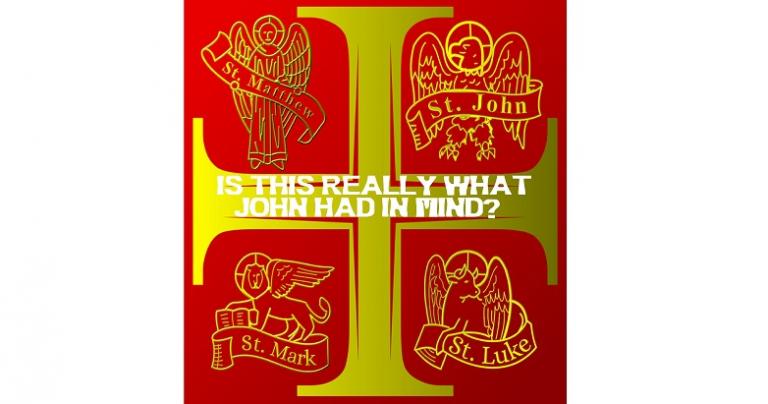
Take, for instance, the four living sky creatures of Revelation 4:1-11. What are they? What did John the Seer have in mind when he wrote about them? Don’t we see these sky beings also in the vision reported in Ezekiel 1:5-21? What are they? What do they mean?
Combing, through various scholarly and nonscholarly commentaries, produces a plethora of contradictory answers. Who is right? Who is wrong? Can all answers be correct, even if they contradict? Perhaps the most crucial question is: which of these interpretations, if any, was shared by the author?
Many think the four living creatures refer to the four canonical Gospels. Is that what John the Seer had in mind? Did he even know these documents, in his day?
Patristic Re-contextualizations Disagree
But let’s assume that he did and that the creatures do refer to these texts. But which sky creature symbolizes which Gospel? And how would you know?
If you asked Irenaeus of Lyon (d. 202), you would get a different answer than if you inquired about this with Victorinus of Pattau (d. ca. 303) or Jerome (d. 420). And it is not uncommon to be called “impious” and “sent to hell” by these and similar figures should you dare to disagree with them. Sadly, this tradition has been passed down to present-day Christians on social media and through so-called “apologetics.”
Discovery Sheds Light
The problems with allegory-gone-wild in biblical interpretation and the meaning of the living creatures of Revelation is illustrated by a recent and exciting discovery. In 2017, Dr. Lukas Dorfbauer, researcher and expert on Patristics literature from the University of Salzburg, identified a marvel—something lost for 1,500 years. It is the earliest known Latin commentary on the Gospels. It was composed by a bishop in northern Italy, Fortunatianus of Aquileia (d. 369).
This work predates the Latin Vulgate by half a century. It is a treasury of insights into how early fourth century Latin Christians read and understood the Gospels. It also demonstrates how words and images can generate numerous, contradictory interpretations, even among those in the same Christian tradition. You can find an English translation, here.
Ask the Fathers and Apocalypse Then
So let’s say I ask the Fathers of the Church why the bull creature in Revelation represents “Luke.” Some, employing allegory-gone-wild, will assume the answer is obvious! It’s because of his infancy narrative (Luke 1—2), where Jesus is born in a barn-like stable where cows are kept. (Pssst! Not too many cows among the peasantry of first-century Palestine! And mangers weren’t barns. They were inside the home, keeping no livestock larger than goats and sheep).
But if I ask Bishop Fortunatianus the same question, he provides a contradictory answer. To him, it’s because way later in the text, the so-called Parable of the Prodigal Son features a fatted calf. Therefore it is obvious! “Luke” can only be symbolized by the calf.
Note the disagreements. But also note what lines up! First, their respective interpretations are apparent and evident to them. Second, they all employ allegory-gone-wild. Third, the bull creature must mean “Luke.” And what happens if you challenge either of these commentators on this? You are impious.
“It’s Obvious!”
Turning to the lion creature, say we ask about which Gospel it symbolizes? It’s obvious, says Jerome and Augustine! It can only be “Mark”! Because that Gospel opens with someone crying in the wilderness! And what is the king of beasts in the wild? The lion, of course! Thank you, allegory-gone-wild.
And if we ask the same to good Bishop Fortunatianus? He also claims the meaning is obvious! It can only be “John”! This is the royal Gospel, after all. Thank you, allegory-gone-wild.
See to Irenaeus of Lyon and Fortunatianus of Aquileia know for sure that the lion must mean “John” and the eagle must mean “Mark.” How so? By allegory-gone-wild. But Jerome and Augustine know for sure something contradictory. It’s just as evident that the lion means “Mark” and the eagle means “John.” How? The same way—allegory-gone-wild.
The Dangers of Forsaking Apocalypse Then
This is all fanciful nonsense, of course. Now pepper in some supersessionism and antisemitism and we see a disturbing trend in how the Church has read the Gospels historically. Now we have dangerous fanciful nonsense.
And this dangerous fanciful nonsense proliferates among Catholics. Scott Hahn and friends romanticize and promote this hazardous way of reading Scripture. The literal sense gets thrown out the window in favor of Patristic allegory-gone-wild. In contrast, shouldn’t we begin with the literal sense—that is, the meaning that the author actually intended?
We need to return to Apocalypse then. What were the Lion and Bull in Ezekiel and Revelation? To John the Seer, they were constellations, great sky servants of God in the sky. The lion we call “Leo” and the bull is “Taurus.” When it comes to interpreting Revelation or any book of the Bible, the literal sense comes first. Otherwise we spiritualize the sacred writings away, creating fanciful nonsense and many dangerous possibilities.
Previous Post
August 23, 2020
Do Baptism and Eucharist Need Magic Words?
Next Post

August 29, 2020 Is Donald Trump the Antichrist?
Browse Our Archives
Select a Category Uncategorized
Select a Month August 2021 July 2021 June 2021 May 2021 April 2021 March 2021 February 2021 January 2021 December 2020 November 2020 October 2020 September 2020 August 2020 July 2020 June 2020 May 2020 April 2020 March 2020 February 2020 January 2020 December 2019 November 2019 October 2019 September 2019 August 2019
Follow Us!
TAKE THE
Religious Wisdom Quiz
Who said, "Lord, if you are willing, you can make me clean"?
Select your answer to see how you score.
A leper A blind man A centurion A tax collector
Support this
Column


Related posts from Messy Inspirations

Understanding Apocalypse & Its Creatures



TRENDING AT PATHEOS Catholic

Rejecting Doom: Christian Hope And Human Action
Christianity is a religion of hope. We are to have hope and...

It’s What Comes From Within Which Matters
One of the most difficult things for us to understand is why...

Why I Choose the Eucharist Over the Sermon
Choose the Eucharist, Not the Sermon What are we supposed to get...

5 Design Elements Found in Spiritually Rooted Homes
Putting Spirituality Into Home Decor Our homes are more than our living...

Credo: A Story of God Told with the...
About 10 years ago, I began to imagine a personal "Credo" that...

The Anatomy of Divine Revelation in Catholic Thought
The claim that God has made Himself known to human beings is...
view all Catholic blogs
Ad-Free & Subscriber Log-In Subscription Support
- About Us
- 2026 Calendar
- Videos
- Podcasts
- Library of World Religions
- Faith In Media Tracker
- Advertise With Us
- Write for Us
- Privacy Policy
- Terms of Service
- Do Not Sell My Data
- Contact Us
- Radiant Digital
- Manage Newsletter Subscriptions
- Unsubscribe From Notifications
- Sitemap
Copyright 2008-2026, Patheos. All rights reserved.
Subscription Support Ad-Free & Subscriber Log-In
Follow Patheos