
BuddhistCatholicContemplativeEvangelicalGeneral ChristianHinduJewishLatter-day SaintMuslimNew VisionsProgressive Christian
Beliefs
- Buddhist
- Catholic
- Contemplative
- Evangelical
- General Christian
- Hindu
- Jewish
- Latter-day Saint
- More Voices
- Muslim
- New Visions
- Pagan
- Progressive Christian
Topics
- Religion News
- Food and Religion
- Sports and Religion
- Religious Art
- Religious Music and Entertainment
- Religious Events
- History and Religion
- Style and Religion
- Politics and Religion
- Women in Religion
- Recreation Outdoors and Religion
- Business Finance and Religion
- Careers Workplace and Religion
- Education and Religion
- Family Parenting and Religion
- Health Fitness and Religion
- Home and Religion
- Relationships and Religion
- Technology and Religion
- Travel and Religion
Columnists
- Buddhist Columnists
- Business Finance and Religion Columnists
- Careers Workplace and Religion Columnists
- Catholic Columnists
- Contemplative Columnists
- Education and Religion Columnists
- Evangelists Columnists
- Family Parenting and Religion Columnists
- General Christian Columnists
- Health Fitness and Religion Columnists
- Hindu Columnists
- History and Religion Columnists
- Home and Religion Columnists
- Jewish Columnists
- More Voices Columnists
- Latter Day Columnists
- Muslim Columnists
- New Visions Columnists
- Nonreligious Columnists
- Pagan Columnists
- Politics and Religion Columnists
- Progressive Columnists
- Recreation Outdoors and Religion Columnists
- Relationships and Religion Columnists
- Religion News Columnists
- Religious Art Columnists
- Religious Events Columnists
- Religious Music and Entertainment Columnists
- Sports and Religion Columnists
- Style and Religion Columnists
- Technology and Religion Columnists
- Travel and Religion Columnists
- Women in Religion Columnists
Resource Library
- 2026 Calendar
- Library of World Religions
- The 100 Most Holy Places on Earth
- Patheos Answers
- Podcasts
- Videos
- Faith Leaders Database
- Anglican Episcopalian
- Bahai
- Baptist
- Buddhism
- Christianity
- Confucianism
- Eastern Orthodoxy
- Hinduism
- Holiness and Pentecostal
- ISKCON
- Islam
- Judaism
- Lutheran
- Methodist
- The Church of Jesus Christ of Latter-day Saints
- New Age
- Paganism
- Presbytarian and Reformed
- Protestantism
- Religion Behind the Scenes
- Roman Catholic
- Scientology
- Shia Islam
- Sikhism
- Sufism
- Sunni Islam
- Taoism
- Zen
- See all religions
Research Tools
 Ad-Free & Subscriber Log-In Subscription Support
Ad-Free & Subscriber Log-In Subscription Support
Follow Patheos 

- Trending:
- Forgiveness
- |
- Marriage
- |
- Consciousness
- |
- Death Penalty
- |
- Election
- |
- Halloween
 Messy Inspirations
- Home
- Catholic
- More Important than Belief in the Real Presence?
More Important than Belief in the Real Presence?
Last updated on: July 31, 2020 at 4:04 pm by Fellow Dying Inmate
More Important than Belief in the Real Presence? 2020-07-31T16:04:23-04:00 Fellow Dying Inmate
Patheos Explore the world's faith through different perspectives on religion and spirituality! Patheos has the views of the prevalent religions and spiritualities of the world.
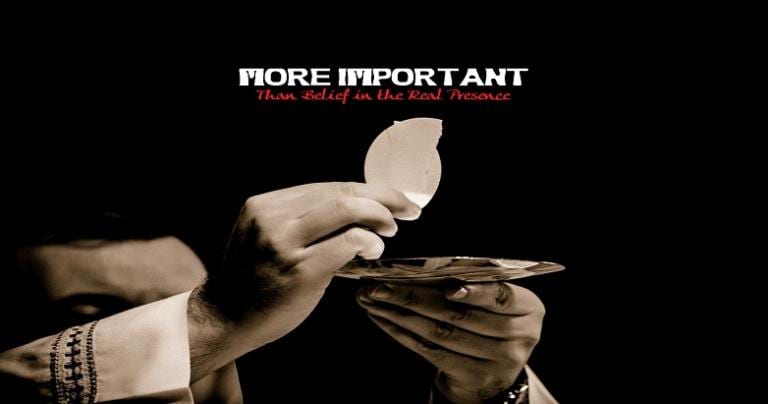
More Important than Belief in the Real Presence / Image by Robert Cheaib from Pixabay
More important than belief in the real presence is knowing who is really present.
Sometimes questions ruffle feathers. This happens quite often among Christians who receive tough questions. If faith is only expressed inside the emotional and devotional with little to no critical reflection, yes, some feathers will eventually be ruffled.
It’s like when the preacher visited the old woman. He informed her that if she accepted Jesus she would be saved. And the preacher even spelled that out for her. But she asked him, “So if I accept Jesus, where will my soul go when I die?” Said the preacher, “to heaven.” And then the old woman asked, “where will my body go?” And he answered, “Into the ground.” To which she wisely asked, “Well, if my soul is in heaven, and my body is in the ground, where will I be?”
That was one too many questions for that preacher. Annoyed, he left her house in a huff.
In the spirit of that fabled exchange, I have a question for you. Perhaps it will ruffle feathers on you. Who knows? You may feel a bit like what the preacher experienced after watching the following video—
Ruffled Feathers
Feathers were ruffled at the end of a spirited class. Almost all of the participants that evening were seasoned lay ministers. They were not newbies to controversial subjects. Nonetheless, a few of them were miffed, confused, and even upset by the question. Why?
Allow me to pose the question to you. Which is more important? A. Knowing who Jesus is. B. Believing in the real presence of Jesus in the Eucharist.
Look carefully at both A and B. They both involve exceedingly important matters. But one comes first without diminishing the importance of the other. Moreover, the more important of the two impacts and determines how the other! If I fail or refuse to know who Jesus is, claiming that he is really present in the Eucharist is pretty much meaningless.
Honest Ignorance vs Sincere Stupidity
Let’s imagine that I believe Jesus is really present in the Eucharist. But the “Jesus” that I believe to be present there is, in my mind, an identity theft and fiction, a “Jesus” congenial to my cultural values. Sure this idea I have in my mind bears the name “Jesus.” Perhaps this mental Jesus could even be quite popular in my society, promoted everywhere. Nevertheless, it does not correspond to the real Jesus and who he is. So in that case, what becomes of my confession about the real presence?
Worse yet, let’s say I am doing this in sincere stupidity (i.e., sinful, culpable ignorance). That means that I refuse all attempts to challenge this mental fiction, to grow and mature in understanding the authentic Jesus. Imagine that I continue immutable and incorrigible in this regard. While I may go merrily along affirming in verbal orthodoxy that Jesus is really present in the Eucharist, tell me: what is the value of my belief?
By the way, we are all honestly ignorant about many things, and no believer has a perfectly mature understanding of who Jesus is. This is certainly true at the beginning of their faith walk. But to remain complacently in childish belief, mistaking it for childlike faith, is to be culpably ignorant. It is a sincere misuse of intelligence—stupidity. A faith without critical reflection is not worth having.
Coloring the One Who is Really Present
Friends, our mental images and ideas of Jesus necessarily affect our belief in his real presence. If “Jesus” to me means a “magical genie” that grants wishes, that will necessarily impact my belief in the Eucharist. Therefore, I might just approach Mass, Adoration, and prayer like Aladdin would the magic lamp!
Also, consider about how so many Catholics isolate holiness to the bizarre.
And if Jesus to me means Mickey Mouse, Santa Clause, Superman, or some sort of hybrid of all these, the same results. Sure, I may be verbally orthodox when I say Jesus is really present in the Eucharist. However my belief in the real presence isn’t actually in alignment with what the Church teaches, is it? Therefore, Catholics and other Christians need to become aware that there are limits to verbal orthodoxy.
Moral Limits to Verbal Orthodoxy
Indeed there are moral limits to verbal orthodoxy. In the 1980s, Pope John Paul II, a great champion of verbal orthodoxy, visited the city where I lived. My parents knew public officials, Catholics, who were involved in this highly public event. Some of these people were daily communicants. All prided themselves in being “faithful Catholics.” By the way, all of them were racists, anti-Semitic, homophobic bigots who either enabled or committed physical and psychological abuse to their families.
To these Italian rednecks (a Florida phenomenon), AIDS was punishment for “disgusting gays.” And these people expressed, in my 12-year-old earshot, that the only thing worse living next to a black or Latino/a person was if they were gay besides. But hey, don’t mind that! Because, well, they believed in Jesus and his real presence! They went to Mass every day.
Clearly belief in the real presence depends on how you know Jesus. As important as belief in the real presence of Jesus in the Eucharist is, it is more important to know who Jesus is. This is because how I understand Jesus inescapably affects how I understand the presence of Jesus whether at liturgy or in my neighbors. Ergo, it is more important to know Jesus rightly then to believe in the real presence of Jesus in the Eucharist.
How Much More Important? An Old Tradition
None of this should seem new to Catholics reading this. Long ago, people recalled John Chrysostom admonishing Christians along these lines,
“If you cannot find Christ in the beggar at the church door, you will not find Him in the chalice.”
Keep in mind: we are not talking about the truth of his real presence. We are talking about knowing who Jesus is versus believing in his real presence.
Also don’t misunderstand me. I am not offering you an either/or here. I am not saying that one of these items is wrong, dispensable, or irrelevant. Instead, I am saying that one of these two comes first, and so much so, that it is more important. If I don’t know who Jesus is, but I believe he is really present in the Eucharist, what becomes of that belief? Who is this Jesus, anyway? Who is really present?
By the way: our belief in the real presence does not produce the real presence. Christ is present in the Eucharist whether or not we believe. Our belief merely, in gratitude, receives what is already there. We do not produce the real presence by our belief.
The Hierarchy of Truths
I have blogged before concerning the hierarchy of truths. Among Christian truths we have essentials without which Christianity cannot exist. However, not all Christian truths are essential truths. We also hold to other important truths, beliefs and theologies that didn’t always exist in our church’s history. But now, having been theologically developed and worked out, they do. We’re not going to part with these important truths. Beyond these essential and important (but not essential) truths are tertiary and marginal beliefs and practices.
Clearly among these truths there exists a hierarchy. And among Christian essentials there are truths which are more important than others even if we need them all in order to be Christian. Everything revolves around the Trinity of God and the Incarnation of Christ.
Vatican II, Where Are You?
It’s a tragedy that so many 21st century Catholics scoff at this idea of a hierarchy of truths. We desperately need to acquaint ourselves with the Second Vatican Council. Look here at the Decree on Ecumenism, n. 11:
“Moreover, in ecumenical dialogue, Catholic theologians standing fast by the teaching of the Church and investigating the divine mysteries with the separated brethren must proceed with love for the truth, with charity, and with humility. When comparing doctrines with one another, they should remember that in Catholic doctrine there exists a HIERARCHY OF TRUTHS, since they vary in their relation to the fundamental Christian faith. Thus the way will be opened by which through fraternal rivalry all will be stirred to a deeper understanding and a clearer presentation of the unfathomable riches of Christ.”
We can imagine the hierarchy of truths like a solar system. At the absolute center is the Trinity of God and humanity of Christ. Everything between the core of the Sun and Earth’s orbit is set up in such a way to allow life to flourish here—essentials. Everything from Mars to just before Pluto is important—though we don’t need Saturn’s rings in order to be, who will part with them? And beyond Pluto is, well, tertiary and marginal realities. Though imperfect, perhaps this solar system analogy can be helpful.
Nebulous
I feel that far too many Christians, unfortunately, imagine that all the truths of our faith are analogous to a nebula rather than the solar system. The truths are imagined to just float there, hanging in the void of space. Many people see everything Christian as equally important. Should we hold hands during the Our Father? Some think that this is just as important as whether Mary was physically a virgin when she conceived Jesus. And some people think that Mary’s virgin-motherhood, in turn, as being just as important as God being Trinity!
Of course, this is all false. Even among the Christian essential truths, there exists a hierarchy of truths.
More Important than Belief in the Real Presence?
How you understand Jesus affects and determines how you understand who is really present in the Eucharist. Therefore, the more important task when comparing belief in the real presence and knowing who Jesus is rightly, must be knowing who Jesus is rightly.
Not understanding this goes a long way to explain our present situation in the United States, the so-called “Christian” nation. Woe to Americans who exclusively and fanatically celebrate Christianity from dopamine and serotonin fluctuations, but who never critically reflect. They help turn democracies into oligarchies, and oligarchies into dictatorships. Hence in American White Supremacy, Blacks, Latino/as, and First Americans get crucified daily. Meanwhile God-emperor Trump hears thunderous applause from Catholic idolaters at January’s March for Life.
All this helps explain the overwhelming and crippling sentimentality that drowns our parishes in America. Our Gospel is sugar-coated, tailored and toned down for the well-dressed and affluent. By it, we are lulled into being useless to the trials of our times. And forget about holding the demigods called bishops and priests accountable. Let’s face reality, folks—we, the Body of Christ, are pathetic and stagnant.
More Important than Belief in the Real Presence?
Previous Post

July 30, 2020
What Do Babylon & the Sea Beast of Apocalypse Really Mean?
Next Post

August 4, 2020 Trump and 666—Any Connections?
Browse Our Archives
Select a Category Uncategorized
Select a Month August 2021 July 2021 June 2021 May 2021 April 2021 March 2021 February 2021 January 2021 December 2020 November 2020 October 2020 September 2020 August 2020 July 2020 June 2020 May 2020 April 2020 March 2020 February 2020 January 2020 December 2019 November 2019 October 2019 September 2019 August 2019
Follow Us!
TAKE THE
Religious Wisdom Quiz
What does the name "Abraham" mean?
Select your answer to see how you score.
Shelter Father of many Blessed man Strong leader
Support this
Column


Related posts from Messy Inspirations

Understanding Apocalypse & Its Creatures



TRENDING AT PATHEOS Catholic

Rejecting Doom: Christian Hope And Human Action
Christianity is a religion of hope. We are to have hope and...

It’s What Comes From Within Which Matters
One of the most difficult things for us to understand is why...

Why I Choose the Eucharist Over the Sermon
Choose the Eucharist, Not the Sermon What are we supposed to get...

5 Design Elements Found in Spiritually Rooted Homes
Putting Spirituality Into Home Decor Our homes are more than our living...

Credo: A Story of God Told with the...
About 10 years ago, I began to imagine a personal "Credo" that...

The Anatomy of Divine Revelation in Catholic Thought
The claim that God has made Himself known to human beings is...
view all Catholic blogs
Ad-Free & Subscriber Log-In Subscription Support
- About Us
- 2026 Calendar
- Videos
- Podcasts
- Library of World Religions
- Faith In Media Tracker
- Advertise With Us
- Write for Us
- Privacy Policy
- Terms of Service
- Do Not Sell My Data
- Contact Us
- Radiant Digital
- Manage Newsletter Subscriptions
- Unsubscribe From Notifications
- Sitemap
Copyright 2008-2026, Patheos. All rights reserved.
Subscription Support Ad-Free & Subscriber Log-In
Follow Patheos