
BuddhistCatholicContemplativeEvangelicalGeneral ChristianHinduJewishLatter-day SaintMuslimNew VisionsProgressive Christian
Beliefs
- Buddhist
- Catholic
- Contemplative
- Evangelical
- General Christian
- Hindu
- Jewish
- Latter-day Saint
- More Voices
- Muslim
- New Visions
- Pagan
- Progressive Christian
Topics
- Religion News
- Food and Religion
- Sports and Religion
- Religious Art
- Religious Music and Entertainment
- Religious Events
- History and Religion
- Style and Religion
- Politics and Religion
- Women in Religion
- Recreation Outdoors and Religion
- Business Finance and Religion
- Careers Workplace and Religion
- Education and Religion
- Family Parenting and Religion
- Health Fitness and Religion
- Home and Religion
- Relationships and Religion
- Technology and Religion
- Travel and Religion
Columnists
- Buddhist Columnists
- Business Finance and Religion Columnists
- Careers Workplace and Religion Columnists
- Catholic Columnists
- Contemplative Columnists
- Education and Religion Columnists
- Evangelists Columnists
- Family Parenting and Religion Columnists
- General Christian Columnists
- Health Fitness and Religion Columnists
- Hindu Columnists
- History and Religion Columnists
- Home and Religion Columnists
- Jewish Columnists
- More Voices Columnists
- Latter Day Columnists
- Muslim Columnists
- New Visions Columnists
- Nonreligious Columnists
- Pagan Columnists
- Politics and Religion Columnists
- Progressive Columnists
- Recreation Outdoors and Religion Columnists
- Relationships and Religion Columnists
- Religion News Columnists
- Religious Art Columnists
- Religious Events Columnists
- Religious Music and Entertainment Columnists
- Sports and Religion Columnists
- Style and Religion Columnists
- Technology and Religion Columnists
- Travel and Religion Columnists
- Women in Religion Columnists
Resource Library
- 2026 Calendar
- Library of World Religions
- The 100 Most Holy Places on Earth
- Patheos Answers
- Podcasts
- Videos
- Faith Leaders Database
- Anglican Episcopalian
- Bahai
- Baptist
- Buddhism
- Christianity
- Confucianism
- Eastern Orthodoxy
- Hinduism
- Holiness and Pentecostal
- ISKCON
- Islam
- Judaism
- Lutheran
- Methodist
- The Church of Jesus Christ of Latter-day Saints
- New Age
- Paganism
- Presbytarian and Reformed
- Protestantism
- Religion Behind the Scenes
- Roman Catholic
- Scientology
- Shia Islam
- Sikhism
- Sufism
- Sunni Islam
- Taoism
- Zen
- See all religions
Research Tools
 Ad-Free & Subscriber Log-In Subscription Support
Ad-Free & Subscriber Log-In Subscription Support
Follow Patheos 

- Trending:
- Forgiveness
- |
- Marriage
- |
- Consciousness
- |
- Death Penalty
- |
- Election
- |
- Halloween
 Messy Inspirations
- Home
- Catholic
- Images or Idols? Paul & 1 Corinthians 8:1-13
Images or Idols? Paul & 1 Corinthians 8:1-13
Last updated on: July 13, 2020 at 10:58 pm by Fellow Dying Inmate
Images or Idols? Paul & 1 Corinthians 8:1-13 2020-07-13T22:58:22-04:00 Fellow Dying Inmate
Patheos Explore the world's faith through different perspectives on religion and spirituality! Patheos has the views of the prevalent religions and spiritualities of the world.
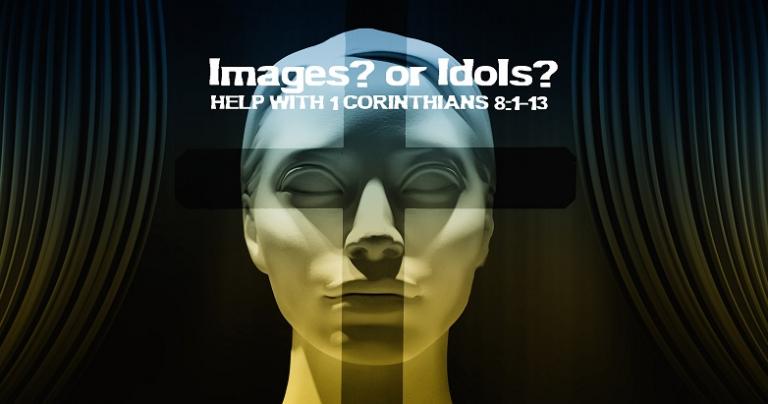
Images or Idols in 1 Corinthians 8:1-13? / Image by Gerd Altmann from Pixabay
Images and their shadow-power, not worshiping false gods, is what Paul is addressing in 1 Corinthians 8:1-13.
This is the conclusion to a two-part series on understanding Paul and what he is writing about in 1 Corinthians 8:4-6. Last time, we broke down the seven authentic letters of Paul, the occasion of their composition, and gave an outline of the document called “1 Corinthians.” I encourage everyone before proceeding with this post, to first read the previous entry. Having done that, let’s pick up the thread.
Images or Idols?
With all that understood, let’s plug 1 Corinthians 8:4-6 into its proper place. Going by the outline given in the last post, we see this passage is situated in a section of questions Paul is answering concerning food and dining (8:1—11:1). Specifically, 1 Corinthians 8:1-13 concerns “eating idolothytes” (Greek for “that which has been offered before images”). Now, let’s render out a better translation than that given by the NABRE—
1 Corinthians 8:4-6 Concerning eating of that which has been offered before images: we [Jesus group people] know that “there is no image in the world” [that has any real force and impact over us] and that [for us] “there is no God but one”. Indeed, even though there are so-called gods in sky vaults and on earth (there are, to be sure, many gods and many lords), but for us [inclusive], [there is] one God, the Patron, from whom [comes] everything, and we [exist] for him, and one Lord, Jesus Christ, through whom [comes] everything and we [exist] through him.
By the way, as Dr. John Pilch explained beautifully, always feel free to correct your English Bible translations. For the most part, they are fine. But there are anachronistic and ethnocentric “doozies” in them. By all means pray with them, read them, study with them! Just don’t trust them.
Tertullian’s Mistake
My friends, our typical English translations of 1 Corinthians 8:1-13, on display in the RSV, NRSV, and NABRE versions, is all messed up by an ancient hangover bequeathed us from Tertullian (d. 220). Slavish to tradition stemming from Tertullian, many English translators turn idolothytes into something like “food or meat sacrificed/offered to idols.” This is wrong. The Greek word these translations render as “idol” is eidolon. The Greek really means “image” or “likeness” or “appearance.” In other words, eidōlon simply means some kind of visible shape.
But the RSV, the NRSV, and the NABRE slavishly follow Tertullian. He’s responsible for getting us off-track with this passage, transliterating the Greek eidolon into the Latin “idolum.” This led to later Christians misunderstanding Paul. They mistook him to be referring to any “image of a false god.” But that’s not what Paul was talking about! Instead, Paul was talking about a far more general concept of images.
Images Covers More than Idols
In the first century Mediterranean world of Paul, you could certainly find images of gods in temples everywhere. But don’t limit “images” to representations of sky beings (gods) in such centers of political religion. They could also be found in homes, as essential parts of domestic religion (like ancestorism).
Images therefore could also be those of venerated ancestors, represented by statues, busts, and death masks. Mediterranean households enshrined these. Families solemnly processed these images periodically to burial sites for the purposes of funerary celebrations. There, descendants ate and drank and even engaged in sexual relations in the shadows of their ancestors. We have almost totally lost the original meaning of cemetery (κοιμητήριον or “sleeping place,” as in sleeping together).
Shadow Power
Ancient Hellenistic Israelites and other Mediterraneans believed that images carried the shadows of the one represented. Shadows were the life force, the doppelganger of the person, whether divine or human, and therefore, held his or her power (Luke 1:35; Acts 5:15). Ancients believed that you could harm or help someone simply by affecting his or her shadow.
Thus, Mediterranean peoples strongly believed that a person was tightly connected to their shadow. Therefore, many feared noon, because shadows shrunk precisely at that time! And everyone knew that when death comes, a person’s shadow vanishes. Consequently, ancients believed that the eidōlon (image)—like the statue of a sky being or the death mask of the departed—bore the magical properties and power of the shadow.
Food Before Images & Paul
In order to maintain Jesus group integrity, and therefore their social identity, Paul addresses the dilemma of his Corinthian Israelite clients eating food under the shadow of images. Some in the Corinthian Jesus group thought that to do such a thing automatically excluded you from the Jesus group. Others, like those who wrote to Paul (1 Corinthians 7:1), thought it insignificant. But what does Paul say?
How does Paul interpret the shadow-power? Does he think that a force really emanates from these images? Or are the images powerless?
In 1 Corinthians 8:4-6, Paul agrees with those “strong” clients who believe that the God of Israel cannot be represented by any images. To him, images are just images. Apparently, those who wrote him the earlier letter (1 Corinthians 7:1) agree. But not everyone in the Corinthian Jesus group sees things that way (1 Corinthians 8:7). Some believe eating and drinking in the shadow of images automatically excludes you from the Jesus group. So how does Paul solve this dilemma (1 Corinthians 8:7-13)?
See How Bible Passages Aren’t Obvious?
Before continuing, allow me to ask you a personal question. Did you think, before reading this, that this passage is about idols and idolatry? It’s not. As we’ve seen, this high context passage is really about images, whether those of gods or ancestors, and eating sacrifices offered to them during regular funeral times.
As we’ve seen, the images cast shadows. These shadows were believed to be the powerful life-force, the alter-egos of the person (remember that Peter’s shadow healed, Acts 5:15).
Folks, the issue of this high context passage (1 Corinthians 8:4-6, and really all of 8:1-13) is how do members of the Jesus group interpret these images and their shadow power? Do images and the shadows they cast really accomplish something, or are they impotent? Everything rides on how the Jesus group member believes.
Passages like this remind us that the Bible is not easy to read, clear to understand, and obvious. It is a high context library, coming from a culture mostly alien to our Western society. Because of this, it takes great work not to read into it things that are culturally implausible to its social world.
Complicated Issues
Keep in mind that Paul and his audience are not Christians, folks. They are not Trinitarian monotheists. Many in Paul’s social network believed just like Philo (20 BCE—50 CE). Despite the fact that many think of Philo as the Jewish “apostle of monotheism,” he was really something different entirely. Philo was a sophisticated Israelite henotheist who considered the God of Israel to be “the supreme father of the gods” (see Philo, “Special Laws” 2). Does that sound like monotheism to you?
Philo, like Paul and many other first century Israelites, be they followers of Jesus or not, can hardly be called Jews or Christians. This is because, among many other things, they acknowledged the existence of other deities alongside the Patron God of Israel and did not see God as “supernatural” in the way later Christians, Jews, and Muslims do. In fact, they didn’t have a natural-supernatural distinction at all.
Part of how I understand the definition of monotheism is the demand that only one God (being a se) exists with an absolute ontological distinction from all other beings (per se). But Philo, Paul, and other first century Israelites? In them we see henotheism, not monotheism. But as I said at the beginning, I will get around to addressing Dr. Tait’s excellent post.
The Weak Matter to Paul
Ultimately, in 1 Corinthians 8:1-13, Paul says that group integrity (“holiness”) is destroyed when no one cares about the weak (8:9-12). Who are the weak? They are those Jesus group members with less understanding and susceptible to scandals (stumbling blocks). Weak Jesus group members might resume their own old ways were they to witness other members eating offerings made to images. In turn, both they and Christ will be dishonored. So look out for the weak, says Paul, because group integrity is paramount, even over getting all the beliefs correct.
Sure, some messianists at Corinth may have had superior knowledge about the nature of food in the shadows of images (i.e., God doesn’t really care what you eat). Nevertheless, Paul tells them to put that aside, so as to not disturb or dislodge the less informed.
Paul says don’t shame the weak. They too are embedded in Christ. To shame the weak means shaming Christ. Hence, group integrity (“holiness”) is damaged, or worse.
Previous Post

July 13, 2020
Fixing Distortions: Paul & 1 Corinthians 8:1-13
Next Post

July 18, 2020 Quiz on Jesus, Paul, & the Gospels: How Much Do We Really Know?
Browse Our Archives
Select a Category Uncategorized
Select a Month August 2021 July 2021 June 2021 May 2021 April 2021 March 2021 February 2021 January 2021 December 2020 November 2020 October 2020 September 2020 August 2020 July 2020 June 2020 May 2020 April 2020 March 2020 February 2020 January 2020 December 2019 November 2019 October 2019 September 2019 August 2019
Follow Us!
TAKE THE
Religious Wisdom Quiz
True or False: John's Gospel identifies Jesus as 'the Lamb of God' in the first chapter.
Select your answer to see how you score.
TRUE FALSE
Support this
Column


Related posts from Messy Inspirations

Understanding Apocalypse & Its Creatures



TRENDING AT PATHEOS Catholic

Rejecting Doom: Christian Hope And Human Action
Christianity is a religion of hope. We are to have hope and...

It’s What Comes From Within Which Matters
One of the most difficult things for us to understand is why...

Why I Choose the Eucharist Over the Sermon
Choose the Eucharist, Not the Sermon What are we supposed to get...

5 Design Elements Found in Spiritually Rooted Homes
Putting Spirituality Into Home Decor Our homes are more than our living...

Credo: A Story of God Told with the...
About 10 years ago, I began to imagine a personal "Credo" that...

The Anatomy of Divine Revelation in Catholic Thought
The claim that God has made Himself known to human beings is...
view all Catholic blogs
Ad-Free & Subscriber Log-In Subscription Support
- About Us
- 2026 Calendar
- Videos
- Podcasts
- Library of World Religions
- Faith In Media Tracker
- Advertise With Us
- Write for Us
- Privacy Policy
- Terms of Service
- Do Not Sell My Data
- Contact Us
- Radiant Digital
- Manage Newsletter Subscriptions
- Unsubscribe From Notifications
- Sitemap
Copyright 2008-2026, Patheos. All rights reserved.
Subscription Support Ad-Free & Subscriber Log-In
Follow Patheos