
BuddhistCatholicContemplativeEvangelicalGeneral ChristianHinduJewishLatter-day SaintMuslimNew VisionsProgressive Christian
Beliefs
- Buddhist
- Catholic
- Contemplative
- Evangelical
- General Christian
- Hindu
- Jewish
- Latter-day Saint
- More Voices
- Muslim
- New Visions
- Pagan
- Progressive Christian
Topics
- Religion News
- Food and Religion
- Sports and Religion
- Religious Art
- Religious Music and Entertainment
- Religious Events
- History and Religion
- Style and Religion
- Politics and Religion
- Women in Religion
- Recreation Outdoors and Religion
- Business Finance and Religion
- Careers Workplace and Religion
- Education and Religion
- Family Parenting and Religion
- Health Fitness and Religion
- Home and Religion
- Relationships and Religion
- Technology and Religion
- Travel and Religion
Columnists
- Buddhist Columnists
- Business Finance and Religion Columnists
- Careers Workplace and Religion Columnists
- Catholic Columnists
- Contemplative Columnists
- Education and Religion Columnists
- Evangelists Columnists
- Family Parenting and Religion Columnists
- General Christian Columnists
- Health Fitness and Religion Columnists
- Hindu Columnists
- History and Religion Columnists
- Home and Religion Columnists
- Jewish Columnists
- More Voices Columnists
- Latter Day Columnists
- Muslim Columnists
- New Visions Columnists
- Nonreligious Columnists
- Pagan Columnists
- Politics and Religion Columnists
- Progressive Columnists
- Recreation Outdoors and Religion Columnists
- Relationships and Religion Columnists
- Religion News Columnists
- Religious Art Columnists
- Religious Events Columnists
- Religious Music and Entertainment Columnists
- Sports and Religion Columnists
- Style and Religion Columnists
- Technology and Religion Columnists
- Travel and Religion Columnists
- Women in Religion Columnists
Resource Library
- 2026 Calendar
- Library of World Religions
- The 100 Most Holy Places on Earth
- Patheos Answers
- Podcasts
- Videos
- Faith Leaders Database
- Anglican Episcopalian
- Bahai
- Baptist
- Buddhism
- Christianity
- Confucianism
- Eastern Orthodoxy
- Hinduism
- Holiness and Pentecostal
- ISKCON
- Islam
- Judaism
- Lutheran
- Methodist
- The Church of Jesus Christ of Latter-day Saints
- New Age
- Paganism
- Presbytarian and Reformed
- Protestantism
- Religion Behind the Scenes
- Roman Catholic
- Scientology
- Shia Islam
- Sikhism
- Sufism
- Sunni Islam
- Taoism
- Zen
- See all religions
Research Tools
 Ad-Free & Subscriber Log-In Subscription Support
Ad-Free & Subscriber Log-In Subscription Support
Follow Patheos 

- Trending:
- Forgiveness
- |
- Marriage
- |
- Consciousness
- |
- Death Penalty
- |
- Election
- |
- Halloween
 Messy Inspirations
- Home
- Catholic
- Even More Henotheism—Paul and the New Testament Writings
Even More Henotheism—Paul and the New Testament Writings
Last updated on: July 7, 2020 at 2:47 pm by Fellow Dying Inmate
Even More Henotheism—Paul and the New Testament Writings 2020-07-07T14:47:48-04:00 Fellow Dying Inmate
Patheos Explore the world's faith through different perspectives on religion and spirituality! Patheos has the views of the prevalent religions and spiritualities of the world.
Even More Henotheism / Image by skeeze from Pixabay
Even more henotheism is to be found throughout the pages of the New Testament documents.
“Really?? Even more talk about henotheism in the Bible?” you ask. Yes.
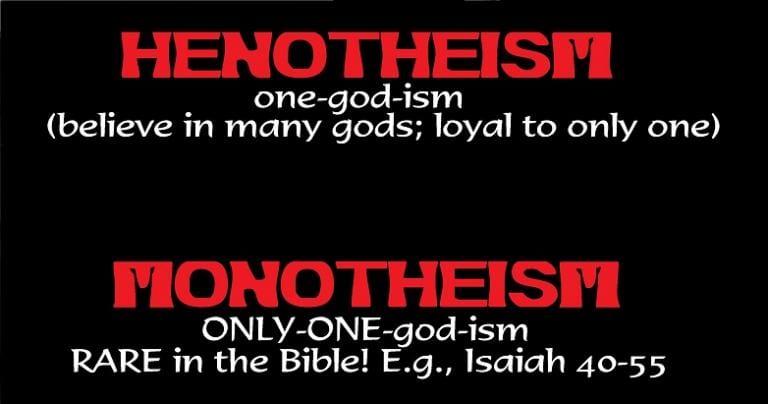
Last time we revisited henotheism found throughout the Hebrew Scriptures. And some weeks ago, we covered how monotheism, surprisingly rare in the Bible, slowly developed. At the risk of beating a dead horse, once again I will reiterate that as a Catholic Christian, I am a Trinitarian monotheist. I believe in the Trinity of God and the humanity of Christ. What I reject is the currently popular, nonscholarly fundamentalist Catholic “connect-the-dots” proof-texting abuse of Scripture.
Fellow dying inmate / all rights reserved
Even more on Paul, Henotheist
Paul, like the vast amount of first century Israelites but unlike later Christians and Jews, was a henotheist. He refers to “many gods and many lords” in the document called “First Corinthians.”
1 Corinthians 8:4-6 So about the eating of meat sacrificed to idols: we know that “there is no idol in the world,” and that “there is no God but one.” Indeed, even though there are so-called gods in sky vaults and on earth (there are, to be sure, many gods and many lords), yet for us there is one God, the Father, from whom all things are and for whom we exist, and one Lord, Jesus Christ, through whom all things are and through whom we exist.
Contemporary Christians tend to be spuriously familiar about New Testament events and persons such as Paul. Even scholars fall prey to spuriously familiar ideas about him. For an enumerated list of common mistakes about this ancient Israelite change agent, watch this brief video very carefully:
Even more to This Than Meets the Eye
In the passage quoted above, Paul does not mean that the many gods and lords, sky “other-than-human-persons” known by Corinthians do not exist. He very much believes they do! However, these gods and spirits can only impact outsiders to the Jesus groups. For the Jesus ingroup, there is only one God (henotheism). The primitive henotheistic theology is set out in what is perhaps an early Jesus group hymn, illustrated below by Context Group scholars Bruce Malina and John Pilch—
But for us [inclusive], [there is] one God the Patron from whom [comes] everything, and we for him And one Lord Jesus Christ, through whom [comes] everything and we [exist] through him.
This is Mediterranean henotheism, not monotheism. Here we see the God of Israel (henotheism), the Most High God (henotheism), as celestial Patron, creator of the cosmos. In true Mediterranean fashion, this cosmic Patron has a broker or intermediary, who builds bridges or opens doors for the clients (Israelite Jesus group members). Jesus is the broker. He mediates all from the Patron of all, and so, is cosmic Lord.
So very much in context, 1 Corinthians 8:4-6 showcases Paul’s henotheism (especially for those who reject a nonscholarly fundamentalistic reading of the Bible). Hardly denying the existence of other gods, Paul acknowledges these while remaining firmly loyal to the greatest of gods, the God of Israel and Patron to the Jesus group.
What About Paul in Galatians?
Some raise the issue of Galatians 4:8 as an example to prove that Paul was a monotheist. It doesn’t work, frankly.
Galatians 4:8-10 At a time when you did not know God, you became slaves to things that by nature are not gods; but now that you have come to know God, or rather to be known by God, how can you turn back again to the weak and destitute elemental powers? Do you want to be slaves to them all over again? You are observing days, months, seasons, and years.
In context, Judaean (in Paul’s perspective, barbarian Israelite) Jesus-group people have infultrated and negatively impacted the Galatian Israelite Jesus-group members, shifting them away from Paul’s innovation to their inferior Gospel. Paul is outraged. As mentioned before, Paul was a difficult man, as were other Jesus group leaders.
He says that his Galatian Israelite clients returned to “observing special days, and months, and seasons, and years” (Galatians 4:10; see Genesis 1:14). As Malina and Pilch explain, the Torah calendar is based and bound up with the zodiacal almanac and its horoscopes (see the Treatise of Shem; 1 Enoch 72-82; and various astrological documents from Qumran).
Fake Gods?
But who are these things enslaving the Galatians? They are elemental powers treated as gods, but are not really gods, according to Paul.
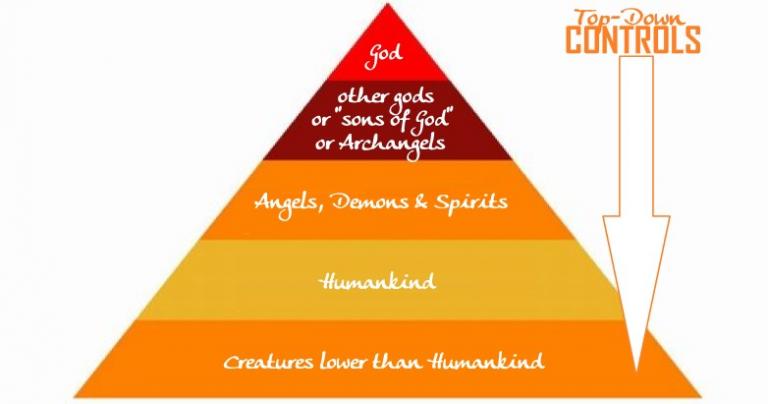
Consider the hierarchical chart of beings below:
Fellow Dying Inmate / All rights reserved
All ancient peoples studied the sky and those beings that populated it—stars, whether singular or constellated, comets, planets, the moon and sun. Calendars and holy observances depended on such study. It was the same for ancient Israel. But Paul considers these third-tier stoicheia (elemental other-than-human persons) “weak and destitute,” or perhaps better, “weak and beggarly.”
Fellow dying inmate / all rights reserved
For Paul, Nature Means Custom
Paul says they are not gods by nature—when Paul uses the term nature (physein), he doesn’t mean what Thomas Aquinas means by the term, or what contemporary scientists mean by it. By “nature,” Paul means custom, as in it was customary for many Mediterraneans to refer to these third-tier spirits as gods. But calling these sky entities gods was definitely not the custom of the Jesus groups! This distinction helps us understand things here. The common belief was that all light-emitting sky entities, believed to govern all things below on earth, were living persons (see 1 Corinthians 15:40). The whole of the book called “Revelation” is filled with these sky persons.
Were they gods? To Paul they are the servants of the higher, unseen gods, or sons of God, the head and Father of which is the Most High God and Patron to the Israel.
This is no proof of monotheism. Moving in the direction of monotheism is not monotheism. But it also should not be called polytheism. Henotheism, as reflected in the Bible, is a step between. We must make distinctions.
What About Monotheism Elsewhere in the New Testament?
I won’t rehash what we already covered concerning New Testament henotheism. But some may still ask, what about Paul’s monotheism in the documents called “Ephesians” and “1 Timothy”
So here are a few things. First, Paul didn’t write these documents. We Catholics accept them as inspired, and that’s fine, but that doesn’t change what they are—forgeries. By the way, “inspired” doesn’t mean “God-dictated.”
Secondly, what we read in the late, fourth wave documents such as Ephesians 4:5-6 and 1 Timothy 2:5 reflects henotheism moving toward eventual monotheism, not monotheism. Monotheism took a while to develop. That doesn’t make the truth it proclaims false.
Even More on the Evolution of Monotheism
As explained in my earlier blog post, doctrine develops. And that’s okay! God is with us through the evolution and messiness. And the Real God is more than we can make of God, or think about God, or say about God, always. The Real is always more. Our words are good—but none of our words and God-talk, no matter how solemnly proclaimed or enshrined, can ever box up God or definitively explain God. No one, no age, and no culture, no theologian or mystic, owns the patent on articulating God and Christ. We are forever unpacking the Mystery that has been revealed.
And this helps show why so much popular Catholic authorship, apologetics, media, and personalities are wrong-headed and spiritually bankrupt. Don’t proof-text the Bible, folks. Despite Scott Hahn, Catholic Answers, and a host of others, don’t turn it into a connect-the-dots for Bible Wars that “prove” our Catholic tradition.
That’s missing the mark, fellow dying inmates.
More later…
Previous Post
July 6, 2020
Revisiting Henotheism
Next Post

July 7, 2020 Nature in Paul's Writings
Browse Our Archives
Select a Category Uncategorized
Select a Month August 2021 July 2021 June 2021 May 2021 April 2021 March 2021 February 2021 January 2021 December 2020 November 2020 October 2020 September 2020 August 2020 July 2020 June 2020 May 2020 April 2020 March 2020 February 2020 January 2020 December 2019 November 2019 October 2019 September 2019 August 2019
Follow Us!
TAKE THE
Religious Wisdom Quiz
How did Jesus provide for the temple tax?
Select your answer to see how you score.
He borrowed from Judas He multiplied bread Found in a tree A coin in a fish's mouth
Support this
Column


Related posts from Messy Inspirations

Understanding Apocalypse & Its Creatures



TRENDING AT PATHEOS Catholic

Rejecting Doom: Christian Hope And Human Action
Christianity is a religion of hope. We are to have hope and...

It’s What Comes From Within Which Matters
One of the most difficult things for us to understand is why...

Why I Choose the Eucharist Over the Sermon
Choose the Eucharist, Not the Sermon What are we supposed to get...

5 Design Elements Found in Spiritually Rooted Homes
Putting Spirituality Into Home Decor Our homes are more than our living...

Credo: A Story of God Told with the...
About 10 years ago, I began to imagine a personal "Credo" that...

The Anatomy of Divine Revelation in Catholic Thought
The claim that God has made Himself known to human beings is...
view all Catholic blogs
Ad-Free & Subscriber Log-In Subscription Support
- About Us
- 2026 Calendar
- Videos
- Podcasts
- Library of World Religions
- Faith In Media Tracker
- Advertise With Us
- Write for Us
- Privacy Policy
- Terms of Service
- Do Not Sell My Data
- Contact Us
- Radiant Digital
- Manage Newsletter Subscriptions
- Unsubscribe From Notifications
- Sitemap
Copyright 2008-2026, Patheos. All rights reserved.
Subscription Support Ad-Free & Subscriber Log-In
Follow Patheos