
BuddhistCatholicContemplativeEvangelicalGeneral ChristianHinduJewishLatter-day SaintMuslimNew VisionsProgressive Christian
Beliefs
- Buddhist
- Catholic
- Contemplative
- Evangelical
- General Christian
- Hindu
- Jewish
- Latter-day Saint
- More Voices
- Muslim
- New Visions
- Pagan
- Progressive Christian
Topics
- Religion News
- Food and Religion
- Sports and Religion
- Religious Art
- Religious Music and Entertainment
- Religious Events
- History and Religion
- Style and Religion
- Politics and Religion
- Women in Religion
- Recreation Outdoors and Religion
- Business Finance and Religion
- Careers Workplace and Religion
- Education and Religion
- Family Parenting and Religion
- Health Fitness and Religion
- Home and Religion
- Relationships and Religion
- Technology and Religion
- Travel and Religion
Columnists
- Buddhist Columnists
- Business Finance and Religion Columnists
- Careers Workplace and Religion Columnists
- Catholic Columnists
- Contemplative Columnists
- Education and Religion Columnists
- Evangelists Columnists
- Family Parenting and Religion Columnists
- General Christian Columnists
- Health Fitness and Religion Columnists
- Hindu Columnists
- History and Religion Columnists
- Home and Religion Columnists
- Jewish Columnists
- More Voices Columnists
- Latter Day Columnists
- Muslim Columnists
- New Visions Columnists
- Nonreligious Columnists
- Pagan Columnists
- Politics and Religion Columnists
- Progressive Columnists
- Recreation Outdoors and Religion Columnists
- Relationships and Religion Columnists
- Religion News Columnists
- Religious Art Columnists
- Religious Events Columnists
- Religious Music and Entertainment Columnists
- Sports and Religion Columnists
- Style and Religion Columnists
- Technology and Religion Columnists
- Travel and Religion Columnists
- Women in Religion Columnists
Resource Library
- 2026 Calendar
- Library of World Religions
- The 100 Most Holy Places on Earth
- Patheos Answers
- Podcasts
- Videos
- Faith Leaders Database
- Anglican Episcopalian
- Bahai
- Baptist
- Buddhism
- Christianity
- Confucianism
- Eastern Orthodoxy
- Hinduism
- Holiness and Pentecostal
- ISKCON
- Islam
- Judaism
- Lutheran
- Methodist
- The Church of Jesus Christ of Latter-day Saints
- New Age
- Paganism
- Presbytarian and Reformed
- Protestantism
- Religion Behind the Scenes
- Roman Catholic
- Scientology
- Shia Islam
- Sikhism
- Sufism
- Sunni Islam
- Taoism
- Zen
- See all religions
Research Tools
 Ad-Free & Subscriber Log-In Subscription Support
Ad-Free & Subscriber Log-In Subscription Support
Follow Patheos 

- Trending:
- Forgiveness
- |
- Marriage
- |
- Consciousness
- |
- Death Penalty
- |
- Election
- |
- Halloween
 Messy Inspirations
- Home
- Catholic
- Difficult Men: Paul & the Pillars
Difficult Men: Paul & the Pillars
Last updated on: July 5, 2020 at 9:49 pm by Fellow Dying Inmate
Difficult Men: Paul & the Pillars 2020-07-05T21:49:18-04:00 Fellow Dying Inmate
Patheos Explore the world's faith through different perspectives on religion and spirituality! Patheos has the views of the prevalent religions and spiritualities of the world.
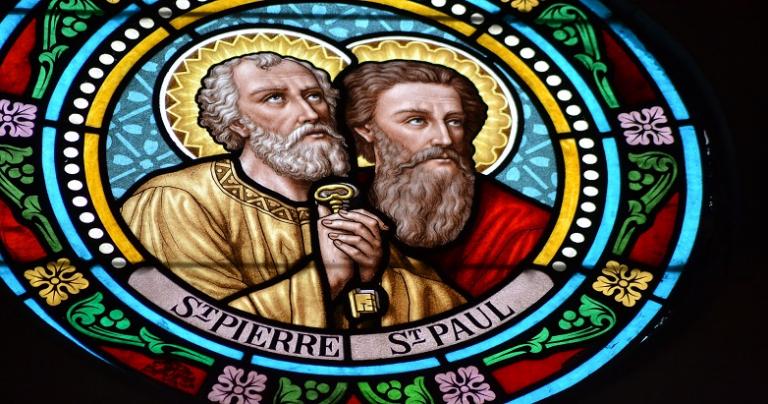
Difficult Peter & Paul / Image by Dorothée QUENNESSON from Pixabay
Difficult men are found at the roots of the Church, and nasty disputes between them are on display in Galatians 2.
It is much more than “mere speculation” to say that, historically, Paul and Peter were two difficult men did not get along. Nor did Paul hold Peter and other “so-called pillars” like James, the brother of Jesus, and John son of Zebedee, in high regard (Galatians 2:6). Surely, Paul certainly recognized that others in the Jesus groups certainly did esteem these men. But Paul uses irony and thick sarcasm to speak of these figures “of high repute.”
Last time, we spoke about popular misconceptions Christians have about apostolic succession. In this post, we continue with that, focusing on the two most famous apostles, Peter and Paul.
“Acts” is Difficult to See for Western Christians
“Acts” is a spin, and not a 21st century, fact-precise biography of the early Church. John Pilch and many other scholars agree that the account of the so-called “Council” of Jerusalem in Acts 15 is near impossible to harmonize with Paul’s own report in Galatians 2. The spin-meister we call “Luke” has, decades later, constructed an irenic fiction. Look here at this video:
Difficult Superiors for Paul
In Galatians 2:1-10, Paul recalls how he had initially placed himself on par with Peter. But at the time he wrote “Galatians,” Paul has exalted himself above Peter (Galatians 2:11-14). To give “the right hand of fellowship” is not a gesture signifying equality or balance and amity between parties. Rather it means that Kephas (Peter), James, and John are acting as if they occupy the superior position, Paul is the suppliant, and they graciously offer him cessation of hostilities.
In other words, these “pillars” who outranked Paul agreed not to hassle him due to behaviors that proceeded from his Gospel of God.
Though Paul accepted the sign of peace offered in their condescending manner, he dissented from their implied superiority over him. In Galatians 2:9, Paul sarcastically says of the Jerusalem leaders that they only seem to be pillars.
Difficult Hostilities between Paul the Pillars
The extent of this cessation of hostilities was limited to table fellowship. Read what follows in “Galatians” carefully to see what happens to the resulting peace. Kephas (Peter) breaches the agreement of table fellowship made by the Jerusalem leaders with Paul by refusing table fellowship with civilized Israelites (wrongly thought of and translated as Gentiles). Paul was a change agent the God of Israel sent to Israelites living as emigres in the non-Israelite Mediterranean (to “Foreskins”)—not non-Israelites, as many mistakenly hold in spurious familiarity.
There is so much spurious familiarity when it comes to Paul and his ministry… watch the videos to see what I mean:
Paul opposed Peter to his face. But what does that mean, in cultural context? This expression describes when someone under military assault resists manfully (in Mediterranean and Middle Eastern understanding), even though losing is probably inevitable. A modern example would be Saddam Hussein’s response to George H.W. Bush during and after the Gulf War in 1991.
With that in mind, we can see that Paul implies he ultimately lost against Peter when the hostilities resumed. The whole reason for Galatians 2:11-14 is that since Peter is blamed, and so Paul must be praised.
Difficult to Paint Paul and Peter Pretty
So reading Galatians and Paul’s own account of things, do you really get the sense that there weren’t ongoing hostilities between Paul and Peter? Kephas (Peter) and the Twelve as well as James would have looked down at Paul. Paul himself refers to such figures sarcastically as “pillars.” Cleverly, because they were renown, he benefits from associating himself with them in his letters. He isn’t giving primacy to anyone, merely acknowledging Peter’s renown (1 Corinthians 9:5; 15:5). Hostilities were ongoing between these parties.
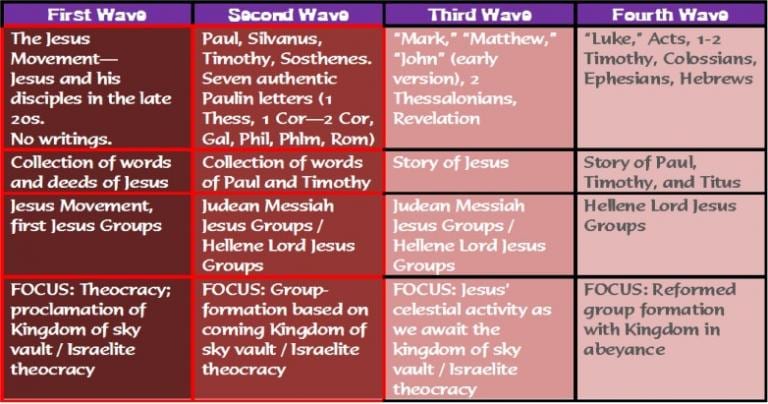
Image by Fellow Dying Inmate (with information by John Pilch) / All rights reserved
This continued after their deaths, by the way. As with “Luke,” various fourth wave Jesus group authors attempted to irenicize things, and painted pretty pictures over these earlier, messier conflicts. In the early second century CE, we see such an attempt with the forgery called “Second Peter” (3:15-16). Like Ignatius of Antioch (d. 108), the unknown author of 2 Peter also knows about and respects a collection of Paul’s letters (3:15–16) and assumes that his readers do as well. Keep in mind that the historical Peter was an illiterate Galilean fisherman.
Peter was long dead when that text was written. Some in the second century Jesus groups, familiar with Paul’s letters, worked hard to maintain peace and unity because of ongoing conflicts, especially with itinerant prophets and change agents. Hence the fictional warmth and respect between Peter and Paul in 2 Peter.
Not Everyone Loved Paul
But many in the second century Jesus groups had serious problems with Paul. It didn’t help Paul’s case that Marcion of Sinope and the Valentinian Gnostics championed their re-contextualized version of him. Justin Martyr wouldn’t touch Paul with a ten-foot pole—he never quotes him! The Kerygmata Petrou, an apocryphal work, compares Peter’s relationship to Paul as “light upon darkness,” and as “knowledge upon ignorance,” and as “healing upon sickness.” This was another developed spin, stemming from real conflicts between the two historical difficult men.
But, as John Pilch explains, eventually Paul was “rehabilitated” and by the fourth century his letters were included in our canonical New Testament.
One More Snippet on Apostolic Succession
By the way, early Jesus group elders and supervisors were married men!—is it outlandish to believe that they arranged for their sons to succeed them? Consider the influence Marcion had. His father was a supervisor of a Jesus group. And remember what we know of James and the biological family of Jesus, mentioned here. We simply need more data to make a conclusive claim.
The Jesus groups kept evolving folks. By the third century, a regularized pattern of selecting and ordaining episkopoi had been universally adopted.
More later…
Previous Post

July 5, 2020
Apostolic Succession: What It Is
Next Post
July 6, 2020 Revisiting Henotheism
Browse Our Archives
Select a Category Uncategorized
Select a Month August 2021 July 2021 June 2021 May 2021 April 2021 March 2021 February 2021 January 2021 December 2020 November 2020 October 2020 September 2020 August 2020 July 2020 June 2020 May 2020 April 2020 March 2020 February 2020 January 2020 December 2019 November 2019 October 2019 September 2019 August 2019
Follow Us!
TAKE THE
Religious Wisdom Quiz
What did Jesus use to feed the 5,000?
Select your answer to see how you score.
Manna from heaven Grapes and figs Five loaves and two fish A basket of quail
Support this
Column


Related posts from Messy Inspirations

Understanding Apocalypse & Its Creatures



TRENDING AT PATHEOS Catholic

Rejecting Doom: Christian Hope And Human Action
Christianity is a religion of hope. We are to have hope and...

It’s What Comes From Within Which Matters
One of the most difficult things for us to understand is why...

Why I Choose the Eucharist Over the Sermon
Choose the Eucharist, Not the Sermon What are we supposed to get...

5 Design Elements Found in Spiritually Rooted Homes
Putting Spirituality Into Home Decor Our homes are more than our living...

Credo: A Story of God Told with the...
About 10 years ago, I began to imagine a personal "Credo" that...

The Anatomy of Divine Revelation in Catholic Thought
The claim that God has made Himself known to human beings is...
view all Catholic blogs
Ad-Free & Subscriber Log-In Subscription Support
- About Us
- 2026 Calendar
- Videos
- Podcasts
- Library of World Religions
- Faith In Media Tracker
- Advertise With Us
- Write for Us
- Privacy Policy
- Terms of Service
- Do Not Sell My Data
- Contact Us
- Radiant Digital
- Manage Newsletter Subscriptions
- Unsubscribe From Notifications
- Sitemap
Copyright 2008-2026, Patheos. All rights reserved.
Subscription Support Ad-Free & Subscriber Log-In
Follow Patheos