
BuddhistCatholicContemplativeEvangelicalGeneral ChristianHinduJewishLatter-day SaintMuslimNew VisionsProgressive Christian
Beliefs
- Buddhist
- Catholic
- Contemplative
- Evangelical
- General Christian
- Hindu
- Jewish
- Latter-day Saint
- More Voices
- Muslim
- New Visions
- Pagan
- Progressive Christian
Topics
- Religion News
- Food and Religion
- Sports and Religion
- Religious Art
- Religious Music and Entertainment
- Religious Events
- History and Religion
- Style and Religion
- Politics and Religion
- Women in Religion
- Recreation Outdoors and Religion
- Business Finance and Religion
- Careers Workplace and Religion
- Education and Religion
- Family Parenting and Religion
- Health Fitness and Religion
- Home and Religion
- Relationships and Religion
- Technology and Religion
- Travel and Religion
Columnists
- Buddhist Columnists
- Business Finance and Religion Columnists
- Careers Workplace and Religion Columnists
- Catholic Columnists
- Contemplative Columnists
- Education and Religion Columnists
- Evangelists Columnists
- Family Parenting and Religion Columnists
- General Christian Columnists
- Health Fitness and Religion Columnists
- Hindu Columnists
- History and Religion Columnists
- Home and Religion Columnists
- Jewish Columnists
- More Voices Columnists
- Latter Day Columnists
- Muslim Columnists
- New Visions Columnists
- Nonreligious Columnists
- Pagan Columnists
- Politics and Religion Columnists
- Progressive Columnists
- Recreation Outdoors and Religion Columnists
- Relationships and Religion Columnists
- Religion News Columnists
- Religious Art Columnists
- Religious Events Columnists
- Religious Music and Entertainment Columnists
- Sports and Religion Columnists
- Style and Religion Columnists
- Technology and Religion Columnists
- Travel and Religion Columnists
- Women in Religion Columnists
Resource Library
- 2026 Calendar
- Library of World Religions
- The 100 Most Holy Places on Earth
- Patheos Answers
- Podcasts
- Videos
- Faith Leaders Database
- Anglican Episcopalian
- Bahai
- Baptist
- Buddhism
- Christianity
- Confucianism
- Eastern Orthodoxy
- Hinduism
- Holiness and Pentecostal
- ISKCON
- Islam
- Judaism
- Lutheran
- Methodist
- The Church of Jesus Christ of Latter-day Saints
- New Age
- Paganism
- Presbytarian and Reformed
- Protestantism
- Religion Behind the Scenes
- Roman Catholic
- Scientology
- Shia Islam
- Sikhism
- Sufism
- Sunni Islam
- Taoism
- Zen
- See all religions
Research Tools
 Ad-Free & Subscriber Log-In Subscription Support
Ad-Free & Subscriber Log-In Subscription Support
Follow Patheos 

- Trending:
- Forgiveness
- |
- Marriage
- |
- Consciousness
- |
- Death Penalty
- |
- Election
- |
- Halloween
 Messy Inspirations
- Home
- Catholic
- What Do Babylon & the Sea Beast of Apocalypse Really Mean?
What Do Babylon & the Sea Beast of Apocalypse Really Mean?
Last updated on: July 30, 2020 at 9:25 am by Fellow Dying Inmate
What Do Babylon & the Sea Beast of Apocalypse Really Mean? 2020-07-30T09:25:56-04:00 Fellow Dying Inmate
Patheos Explore the world's faith through different perspectives on religion and spirituality! Patheos has the views of the prevalent religions and spiritualities of the world.
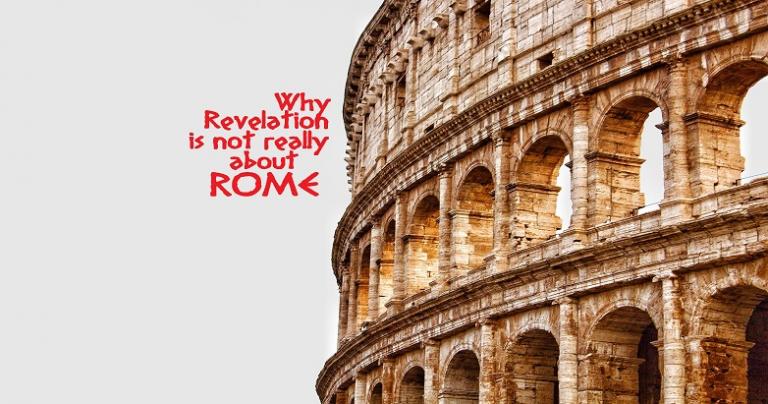
Babylon in Apocalypse isn’t Rome / Image by Andrea Albanese from Pixabay
Babylon, the Sea Beast, 666, and everything else in the book of Revelation is not about Nero, Rome, or the Roman Empire.
Following up from our last post, some people insist that Revelation be understood as promising that God will judge polytheistic Rome. This is because the Empire persecuted Christians. To readers like these, the villain of Revelation is Rome. But is there any evidence for this?
Christians in the 21st century need to understand something about words, language, and symbols. When things, like the Book of Revelation, move around in place and time, they pick up new meanings and associations. Thus, one and the same set of symbols can have at least two different meanings. The Middle Eastern, Mediterranean library called “the Bible” is full of symbols. It has multiple meanings. This is especially true of the book of Revelation. So too words and names that equal 666.
Should a Christian see the numbers three and one, he might think of the Trinity—whereas a non-Christian might imagine something entirely different. And should you pull out an apple, bread, and wine, a Catholic might be reminded of Original Sin and Eucharist. But to someone else, it might only mean lunch!
Sure, at some point some Christians understood that “Revelation” was all about Rome, and that Emperor Nero was the Beast and “666.” But these Christians with their assigned meanings came much after what John the Seer (Revelation 1:9) his Compiler (Revelation 1:1-3). What did the Beast mean to John the Seer? Watch the video…
The Origins of the Rome Interpretation
The idea that Revelation was all about Rome and the Roman Empire got an early start. Constantine converted. The Emperor commissioned fifty Bibles for his new capital polis, Constantinople. His advisor and political architect, Eusebius (rather hastily around 331 CE) made an “executive decision.” Without pope or Council, the good bishop included Revelation and six other documents into these new Bibles for needs of the Empire.
That’s right! Eusebius’ reasons were political rather than theological or historical, folks! So too the construction of our New Testament. So next time you read Revelation, or “Hebrews,” or “James,” “2 Peter,” “2 John,” “3 John,” or “Jude,” thank the politically astute bishop, Eusebius. And let’s all realize that God works in the mess. Be thankful for that! Cause it’s messy indeed!
Taking all of that, stir in some collective memory. Fourth century post-Constantinian Christians remembered the vile first century tyrant Nero in new, re-contextualized ways. They saw Nero through the lens of relatively recent Decian and Diocletianic Empire-wide persecutions. All of this helps produce and hand on a new Christian understanding where Nero became the Beast of Revelation 13:1-18. After all, didn’t his name equal 666 in Aramaic? Er, I mean 616 in Latin?
Please understand folks that this re-contextualizing of Revelation 13 was heavily allegorical and spiritual. But our Church teaches that before the Spiritual Sense, the Literal Sense comes first. The Literal Sense is what the human author had in mind to communicate to his audience. Folks, despite our Constantinian ancestors in the faith, John didn’t have Nero on his radar screen when he wrote Revelation 13. Again, watch the video above.
Babbling About Beastly Babylon
Turning to Revelation 17:1-18 we enter another set of visions, this time depicting the post-Flood period and the Tower of Babel/Babylon. Again we encounter the same Beast with seven heads and ten horns of 13:1. Therefore this story is a continuation from the pre-Flood times in Revelation 12.
Reading Revelation 13—16, the Sky Beast over the Sea, vice-regent to the Dragon, controls his lackey, the Sky Beast over the Land (the constellation Lupus). Now in Revelation 17, presumably still representing the Dragon, the Sea Beast controls the Woman.
Pretexts & Proof-texts
Some who insist that this Beast must represent Nero, Rome, the Roman Empire, or all of the above, proof-text their position from this chapter—
Revelation 17:9-10 Here is a clue for one who has wisdom. The seven heads represent seven hills upon which the woman sits. They also represent seven kings: five have already fallen, one still lives, and the last has not yet come, and when he comes he must remain only a short while.
These people argue that Rome was built on seven hills—the Aventine, the Caelian, Capitoline, Esquiline, Palatine, Quirinal, and Viminal. Therefore, the matter is settled, the case is closed. John obviously was writing about Rome!
Not so fast. Rome was not the only ancient polis built on seven hills. People can make similar counts with other locations, like Jerusalem and Babylon. By the way, what exactly is a “hill” or a “wilderness” according to first century people? We are not talking National Geographic here, folks.
Revelation? Or Genesis?
The Beast has ten horns. Both older Mesopotamian tradition and Israelite lore held that ten kings ruled before the Flood (Genesis 1—8). Scholars Bruce Malina and John Pilch cite Berossus of Babylon who says that seven wise monsters (apkallu) instructed the antediluvians all sorts of arts and crafts. Israelites had their own takes on this, with Genesis 6:1-4 and 1 Enoch. This helps explain the collections of ten and seven in John’s visions.
Although it does take creative liberties, Darren Aronofsky’s brilliant 2014 film “NOAH” offers a glimpse of this in the following clip. Both Aronofsky and John the Seer were heavily influenced by 1 Enoch—
Seven Hills, Seven Kings, Seven Days
The sky servant tells John the seer about the seven hills representing the seven king in Revelation 17. These are the planets or wanderers on the Ecliptic Pathway in the sky. They are the same planets (non-scientific definition!) which name our weekdays—Sun, Moon, Wargod, Fastgod, Thundergod, Lustgoddess, and Saturn. Nero was human; these sky-rulers are not. So, in context, here is an explanation earlier than and different from the one offered by early 4th and 5th century Christians.
Babylon ≠ Rome!
When we read John the Seer and his Compiler honestly and respectfully, we find zero clear, unambiguous, or direct references to either Rome or to Roman emperors. I recognize that for today’s theologians and exegetes this is the favorite historical reference. Too bad this tenuous hypothesis, with the exception of gratuitous insistence, lacks any evidence.
When Israelite writers of the period refer to Rome as Babylon (4 Ezra, Apocalypse of Baruch, Sibylline Oracles 5 and 1 Peter 5:13), there is no hostility or pejorative overtones. They are just calling Rome a place of exile. How different that is from John’s attitude against his Babylon in Revelation! This author is extremely hostile to Babylon! And his Babylon is Babylon, and not Rome at all.
However, could it be said that John makes the destruction of Babel/Babylon, a ruined heap in his day, into an allegory for another city? Perhaps he does, but then this would be Jerusalem, not Rome. To John, destroyed Jerusalem was like Sodom, Egypt, and Babylon. Why? Jerusalem was deceived.
For John, the biggest problem in the world is deception. According to Israelite tradition, the first city of humankind after the Flood, Babel (in Greek, Babylon), is the mother of all deception. Babel/Babylon was the mother of all cities. That includes the old, destroyed Jerusalem. But never fear, says John to his fellow Israelite astral prophets. The old will soon be replaced by the Celestial Jerusalem.
Previous Post
July 28, 2020
The Beast in Revelation: What and Who?
Next Post

July 31, 2020 More Important than Belief in the Real Presence?
Browse Our Archives
Select a Category Uncategorized
Select a Month August 2021 July 2021 June 2021 May 2021 April 2021 March 2021 February 2021 January 2021 December 2020 November 2020 October 2020 September 2020 August 2020 July 2020 June 2020 May 2020 April 2020 March 2020 February 2020 January 2020 December 2019 November 2019 October 2019 September 2019 August 2019
Follow Us!
TAKE THE
Religious Wisdom Quiz
What type of building was Jesus born in?
Select your answer to see how you score.
A stable A cave A tent A castle
Support this
Column


Related posts from Messy Inspirations

Understanding Apocalypse & Its Creatures



TRENDING AT PATHEOS Catholic

Rejecting Doom: Christian Hope And Human Action
Christianity is a religion of hope. We are to have hope and...

It’s What Comes From Within Which Matters
One of the most difficult things for us to understand is why...

Why I Choose the Eucharist Over the Sermon
Choose the Eucharist, Not the Sermon What are we supposed to get...

5 Design Elements Found in Spiritually Rooted Homes
Putting Spirituality Into Home Decor Our homes are more than our living...

Credo: A Story of God Told with the...
About 10 years ago, I began to imagine a personal "Credo" that...

The Anatomy of Divine Revelation in Catholic Thought
The claim that God has made Himself known to human beings is...
view all Catholic blogs
Ad-Free & Subscriber Log-In Subscription Support
- About Us
- 2026 Calendar
- Videos
- Podcasts
- Library of World Religions
- Faith In Media Tracker
- Advertise With Us
- Write for Us
- Privacy Policy
- Terms of Service
- Do Not Sell My Data
- Contact Us
- Radiant Digital
- Manage Newsletter Subscriptions
- Unsubscribe From Notifications
- Sitemap
Copyright 2008-2026, Patheos. All rights reserved.
Subscription Support Ad-Free & Subscriber Log-In
Follow Patheos