
BuddhistCatholicContemplativeEvangelicalGeneral ChristianHinduJewishLatter-day SaintMuslimNew VisionsProgressive Christian
Beliefs
- Buddhist
- Catholic
- Contemplative
- Evangelical
- General Christian
- Hindu
- Jewish
- Latter-day Saint
- More Voices
- Muslim
- New Visions
- Pagan
- Progressive Christian
Topics
- Religion News
- Food and Religion
- Sports and Religion
- Religious Art
- Religious Music and Entertainment
- Religious Events
- History and Religion
- Style and Religion
- Politics and Religion
- Women in Religion
- Recreation Outdoors and Religion
- Business Finance and Religion
- Careers Workplace and Religion
- Education and Religion
- Family Parenting and Religion
- Health Fitness and Religion
- Home and Religion
- Relationships and Religion
- Technology and Religion
- Travel and Religion
Columnists
- Buddhist Columnists
- Business Finance and Religion Columnists
- Careers Workplace and Religion Columnists
- Catholic Columnists
- Contemplative Columnists
- Education and Religion Columnists
- Evangelists Columnists
- Family Parenting and Religion Columnists
- General Christian Columnists
- Health Fitness and Religion Columnists
- Hindu Columnists
- History and Religion Columnists
- Home and Religion Columnists
- Jewish Columnists
- More Voices Columnists
- Latter Day Columnists
- Muslim Columnists
- New Visions Columnists
- Nonreligious Columnists
- Pagan Columnists
- Politics and Religion Columnists
- Progressive Columnists
- Recreation Outdoors and Religion Columnists
- Relationships and Religion Columnists
- Religion News Columnists
- Religious Art Columnists
- Religious Events Columnists
- Religious Music and Entertainment Columnists
- Sports and Religion Columnists
- Style and Religion Columnists
- Technology and Religion Columnists
- Travel and Religion Columnists
- Women in Religion Columnists
Resource Library
- 2026 Calendar
- Library of World Religions
- The 100 Most Holy Places on Earth
- Patheos Answers
- Podcasts
- Videos
- Faith Leaders Database
- Anglican Episcopalian
- Bahai
- Baptist
- Buddhism
- Christianity
- Confucianism
- Eastern Orthodoxy
- Hinduism
- Holiness and Pentecostal
- ISKCON
- Islam
- Judaism
- Lutheran
- Methodist
- The Church of Jesus Christ of Latter-day Saints
- New Age
- Paganism
- Presbytarian and Reformed
- Protestantism
- Religion Behind the Scenes
- Roman Catholic
- Scientology
- Shia Islam
- Sikhism
- Sufism
- Sunni Islam
- Taoism
- Zen
- See all religions
Research Tools
 Ad-Free & Subscriber Log-In Subscription Support
Ad-Free & Subscriber Log-In Subscription Support
Follow Patheos 

- Trending:
- Forgiveness
- |
- Marriage
- |
- Consciousness
- |
- Death Penalty
- |
- Election
- |
- Halloween
 Messy Inspirations
- Home
- Catholic
- Succession of Apostles on the Feast of Peter & Paul
Succession of Apostles on the Feast of Peter & Paul
Last updated on: June 29, 2020 at 11:17 pm by Fellow Dying Inmate
Succession of Apostles on the Feast of Peter & Paul 2020-06-29T23:17:38-04:00 Fellow Dying Inmate
Patheos Explore the world's faith through different perspectives on religion and spirituality! Patheos has the views of the prevalent religions and spiritualities of the world.
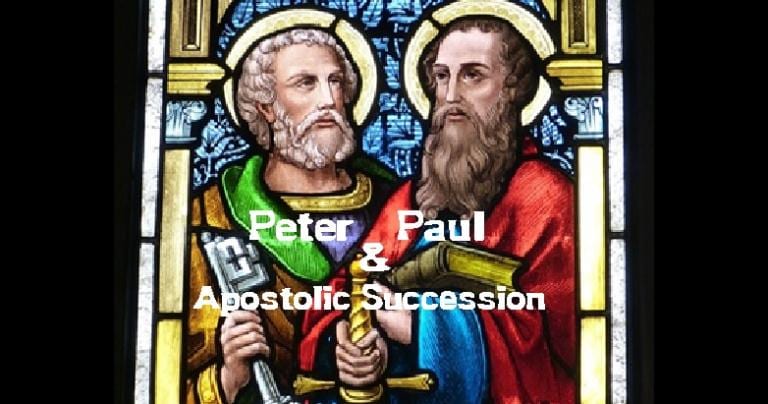
Succession of the Apostles deals with the fact that bishops later assumed the pastoral responsibilities of the apostles, not how early bishops got selected.
Succession of the apostles—from where did bishops originate? Did they take over from the apostles? Were the apostles the first bishops? Did they choose those next in their succession?
Hello gang. Just wanted to give you all a quick post on apostolic succession. Today is the Feast of Peter and Paul, apostles. Usually today is filled with sacred and religious images depicting the two apostles embracing. That’s definitely something imagined way after their deaths.
These two extraordinary Israelites were difficult men. And they probably couldn’t stand one another. As scholar Philip Esler explains, Galatians 2:9 should not be read as an expression of balance and amity between parties. Peter and friends (James and John) condescend from their superior position to those they view as inferiors (Paul and Barnabas) so as to cease hostilities. So don’t think of Peter and Paul as best buds. They were far from that, really. And yet God worked through them. The Body of Christ is a messy, messy business.
Peter the Pope?
It’s one thing to say that through a trajectory of development, in the Spirit, the Church gradually recognized and developed the See of Rome and the papacy as the visible sign of unity for all bishops and the faithful. It is a very different thing to say that Peter functioned as the first monarchical bishop of Rome and literally handpicked his successors. One of these sentences is simply inaccurate and historically bankrupt.
When Catholics look at Peter they tend to see him through a lens two thousand years thick. Both theological freight and popular imagination cloud the view. We tend to see Peter through the highly evolved papacy of which we are familiar but one unknown to New Testament communities. And certainly, through a trajectory of development, various Petrine images inside the New Testament were arranged and helped give rise to the evolution of Church authority. But that took time!
By the middle of the first century, Peter would have been the most prominent member of the Twelve. But he was not the only leading figure in the early Jesus groups. And “the Twelve” were unique among “apostles.”
Making Distinctions with Apostolic Succession
By the way, apostolic succession concerns the fact that men called “episkopoi” (managers), and later on “bishops,” eventually assumed the pastoral responsibilities of the “apostles” (God’s authorized change agents). What apostolic succession does not involve is exactly how the early bishops got chosen or appointed. We know next to nothing about that. Did some formal means exist to designate those overseers of the earliest Jesus groups? Of this we cannot be certain.
Also: never forget to properly distinguish “apostles” and “the Twelve”—while all of “the Twelve” were “apostles,” there were many more “apostles” besides just “the Twelve!” “Apostles” is a much larger circle than just “the Twelve.”
Moreover, it is futile to reduce apostolic succession to mere history, as Catholic fundamentalists enjoy doing. Drawing out an unbroken sequence of valid ordinations, making a connect-the-dots from Peter to Francis, doesn’t validate anything here. Instead, these historical pointers scream at us a universal call to a most awesome responsibility. None of it gives us an excuse for Catholic triumphalism, a permission slip to obnoxiously remind our non-Catholic Christian family members, “Our Church is the best!” On the contrary, do that would really be diabolic.
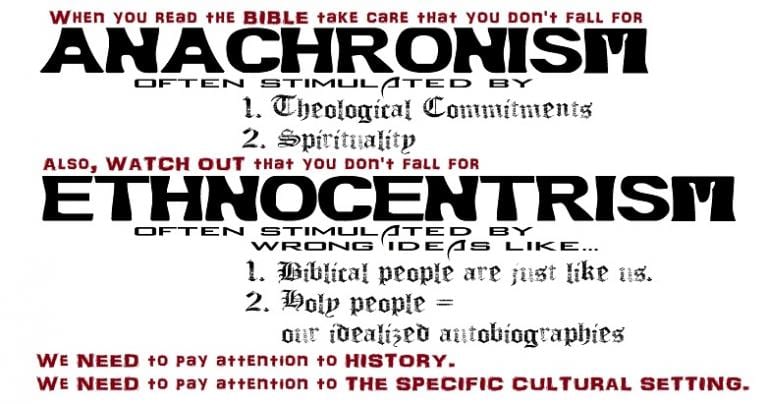
It’s so popular (and ignorant) to equate “the Twelve” with “Catholic bishops.” Folks, “the Twelve” did not manage any early Jesus groups. What then was their role? It was symbolic, all about the renewal of biblical Israel and theocracy or “the Kingdom of God.” But as far as local administration of Jesus groups went, Peter and “the Twelve” were simply not involved. That wasn’t their business. Beware anachronism.
Fellow Dying Inmate / All rights reserved
Irenaeus’ List & Papal Succession
We encounter Irenaeus at the close of the second century, the time we begin seeing lists of episkopoi in major Mediterranean poleis (ancient Mediterranean “cities”). Much evolution had transpired. Irenaeus places Peter first on his list of the episkopoi of Rome. What are we to make of that?
Scholar Raymond Brown explains that by the mid-second century, some major structural changes had developed in the Jesus group at Rome. Therefore, eventually, the messianists in Rome had arrived at a management system with a single episkopos and plural presbyteroi (servant-elders). However, before that one-servant-leader system had evolved, Brown and other scholars agree that probably a group of presbyteroi handled the problems.
So looking backward, Irenaeus would have recalled stories of Peter and Paul being martyred in Rome. It follows that Peter and Paul, being the most famous figures visiting the Jesus group in Rome at the times of their deaths, would have been the most prominent names there. This would be true even though neither person founded the Jesus group there or were episkopos to it. Consequently, Irenaeus’ list has Peter and Paul named first.
But the New Testament never depicts Simon Peter administrating any local Jesus group, be it at Jerusalem, Antioch, or Rome. None of this makes the Petrine ministry of the Church and the highly evolved papacy illegitimate, mind you. It just exposes popular Catholic speakers as dead wrong when they go proof-texting in the Bible looking for a connect-the-dots scheme that proves to certainty our Catholic way.
Explore More!
To learn more about Paul, the change agent, look here…
So much more to say. We’ll discuss Peter and Paul at some length later.
Previous Post

June 14, 2020
Eucharist: The Most Important Transformation
Next Post

July 1, 2020 Idols & Statues
Browse Our Archives
Select a Category Uncategorized
Select a Month August 2021 July 2021 June 2021 May 2021 April 2021 March 2021 February 2021 January 2021 December 2020 November 2020 October 2020 September 2020 August 2020 July 2020 June 2020 May 2020 April 2020 March 2020 February 2020 January 2020 December 2019 November 2019 October 2019 September 2019 August 2019
Follow Us!
TAKE THE
Religious Wisdom Quiz
How many fish were caught in the miraculous catch in John?
Select your answer to see how you score.
153 100 150 200
Support this
Column


Related posts from Messy Inspirations

Understanding Apocalypse & Its Creatures



TRENDING AT PATHEOS Catholic

Rejecting Doom: Christian Hope And Human Action
Christianity is a religion of hope. We are to have hope and...

It’s What Comes From Within Which Matters
One of the most difficult things for us to understand is why...

Why I Choose the Eucharist Over the Sermon
Choose the Eucharist, Not the Sermon What are we supposed to get...

5 Design Elements Found in Spiritually Rooted Homes
Putting Spirituality Into Home Decor Our homes are more than our living...

Credo: A Story of God Told with the...
About 10 years ago, I began to imagine a personal "Credo" that...

The Anatomy of Divine Revelation in Catholic Thought
The claim that God has made Himself known to human beings is...
view all Catholic blogs
Ad-Free & Subscriber Log-In Subscription Support
- About Us
- 2026 Calendar
- Videos
- Podcasts
- Library of World Religions
- Faith In Media Tracker
- Advertise With Us
- Write for Us
- Privacy Policy
- Terms of Service
- Do Not Sell My Data
- Contact Us
- Radiant Digital
- Manage Newsletter Subscriptions
- Unsubscribe From Notifications
- Sitemap
Copyright 2008-2026, Patheos. All rights reserved.
Subscription Support Ad-Free & Subscriber Log-In
Follow Patheos