
BuddhistCatholicContemplativeEvangelicalGeneral ChristianHinduJewishLatter-day SaintMuslimNew VisionsProgressive Christian
Beliefs
- Buddhist
- Catholic
- Contemplative
- Evangelical
- General Christian
- Hindu
- Jewish
- Latter-day Saint
- More Voices
- Muslim
- New Visions
- Pagan
- Progressive Christian
Topics
- Religion News
- Food and Religion
- Sports and Religion
- Religious Art
- Religious Music and Entertainment
- Religious Events
- History and Religion
- Style and Religion
- Politics and Religion
- Women in Religion
- Recreation Outdoors and Religion
- Business Finance and Religion
- Careers Workplace and Religion
- Education and Religion
- Family Parenting and Religion
- Health Fitness and Religion
- Home and Religion
- Relationships and Religion
- Technology and Religion
- Travel and Religion
Columnists
- Buddhist Columnists
- Business Finance and Religion Columnists
- Careers Workplace and Religion Columnists
- Catholic Columnists
- Contemplative Columnists
- Education and Religion Columnists
- Evangelists Columnists
- Family Parenting and Religion Columnists
- General Christian Columnists
- Health Fitness and Religion Columnists
- Hindu Columnists
- History and Religion Columnists
- Home and Religion Columnists
- Jewish Columnists
- More Voices Columnists
- Latter Day Columnists
- Muslim Columnists
- New Visions Columnists
- Nonreligious Columnists
- Pagan Columnists
- Politics and Religion Columnists
- Progressive Columnists
- Recreation Outdoors and Religion Columnists
- Relationships and Religion Columnists
- Religion News Columnists
- Religious Art Columnists
- Religious Events Columnists
- Religious Music and Entertainment Columnists
- Sports and Religion Columnists
- Style and Religion Columnists
- Technology and Religion Columnists
- Travel and Religion Columnists
- Women in Religion Columnists
Resource Library
- 2026 Calendar
- Library of World Religions
- The 100 Most Holy Places on Earth
- Patheos Answers
- Podcasts
- Videos
- Faith Leaders Database
- Anglican Episcopalian
- Bahai
- Baptist
- Buddhism
- Christianity
- Confucianism
- Eastern Orthodoxy
- Hinduism
- Holiness and Pentecostal
- ISKCON
- Islam
- Judaism
- Lutheran
- Methodist
- The Church of Jesus Christ of Latter-day Saints
- New Age
- Paganism
- Presbytarian and Reformed
- Protestantism
- Religion Behind the Scenes
- Roman Catholic
- Scientology
- Shia Islam
- Sikhism
- Sufism
- Sunni Islam
- Taoism
- Zen
- See all religions
Research Tools
 Ad-Free & Subscriber Log-In Subscription Support
Ad-Free & Subscriber Log-In Subscription Support
Follow Patheos 

- Trending:
- Forgiveness
- |
- Marriage
- |
- Consciousness
- |
- Death Penalty
- |
- Election
- |
- Halloween
 Messy Inspirations
- Home
- Catholic
- Straw Man Predilections & How Resurrection was Experienced
Straw Man Predilections & How Resurrection was Experienced
Last updated on: June 12, 2020 at 3:26 pm by Fellow Dying Inmate
Straw Man Predilections & How Resurrection was Experienced 2020-06-12T15:26:28-04:00 Fellow Dying Inmate
Patheos Explore the world's faith through different perspectives on religion and spirituality! Patheos has the views of the prevalent religions and spiritualities of the world.
Image by Gordon Johnson from Pixabay
Straw man arguments, in theology and Scripture, don’t become valid if they come from good places and good people.
Straw man—someone states their position, and another person substitutes what was argued in a distorted way, then destroys the misrepresented argument. Knocking out a straw man is easy. Unless we are talking about Harold from “Scary Stories to Tell in the Dark,” a straw man doesn’t fight back.
The Good, Bad, and Ugly of This Straw Man
The straw man fallacy sometimes comes from good places and good people. Recently a fellow blogger with good intentions misrepresented some things I wrote concerning New Testament reports of the resurrection of Jesus. He linked an article I published. This is a good brother. I mean what I say—his mistaken take on my work is not from a bad place. He seeks to defend truth. Give my brother a fair reading. Do so also with me. Everything he affirms in his opening paragraph, I also affirm.
This correction and its follow-up likewise comes from good intentions. I am a recovering fundamentalist, someone once called “Mini-Hahn” (as in Scott Hahn) by many in my community. I know the place where fear and love meets that makes would-be defenders come on strong.
By the way, is Jesus a divine being? God is not a being among beings—God is not a being. Holy and absolute Mystery called “God” is the sheer act of existence itself (ipsum esse subsistens). I think my brother means to say that Jesus is a divine person?
Let’s get to the meat of our disagreement. My brother presents at least two straw man caricatures of what I presented this past Easter season over many posts. Posts here, here, here, here, here, here, here, here, here, here, and here.
The First Straw Man
First straw man—the resurrection is an altered state of consciousness (henceforth, ASC) experience. My brother links my piece saying I claimed this. I never did. That’s not my position.
In contrast, what I presented was that the reality of the resurrection was experienced via an ASC experience. That’s quite different. Indeed, my piece says
“Encountering Jesus raised and transformed by God after death is the heart of the Easter kerygma (1 Corinthians 15:3b-5). Last time we discussed failed attempts to explain away New Testament accounts of people encountering the risen Jesus as hallucinations and psychosis. But I should add that affirming the historicity of the resurrection in a naively realist or fundamentalistic way is also incorrect.”
Real & Physical
In his recent post, my brother states plainly that “It [the resurrection account] really happened and was not an altered state.” His assumption must be that by calling the experience of the risen Lord an ASC renders the resurrection unreal. To be fair, I believe the resurrection is ontological and nevertheless was experienced via an ASC. To argue against someone, people should take the time to respectfully read what the other person is actually stating.
My brother also confuses “physical” and “bodily” throughout his post. As illustrated elsewhere on my blog, is Jesus raised physically or bodily? If physically, where is Jesus? Does he suffer cold in outer space? Aging? Hunger? Disease? Entropy? Radiation? The Lord is bodily risen beyond what we would call space, time, matter, and energy—i.e., the physical.
The Second Straw Man
The second straw man follows sharply on the first—because the resurrection is an ASC experience, therefore it didn’t really happen. In other words, my brother is telling us I am denying the resurrection. That is, I am claiming that it is a fraud, a fiction, or a delusion. This is also a dishonest portrayal of what I presented. I also claim the resurrection really happened, that it is real, and that it is the foundation of all we Christians believe.
In contrast to this straw man, what I have presented in multiple posts is that the whole cosmos exists in two basic realities. What we call “ordinary” is cultural consensus reality—we experience this aspect of the Real via pragmatic consciousness in our daily lives.
But this “ordinary” is not all there is. There is also alternate reality, the domain where God and spirits dwell, and the dead continue existing. We experience this aspect of the Real in trance states, visions, dreams, sky journeys, and other ASCs.
Neither dimension is more real than its counterpart. Both are very real. When things happen in either dimension, they really happen. Experiences in alternate reality can and do impact and influence consensus or “ordinary” reality. When people encounter departed loved ones in their dreams it is just as real as the wakened experience where the dead are no longer experienced. Both aspects or dimensions of Reality are heavily interpreted. The Real is always more.
The Meaning of Altered State of Consciousness.
Words do not derive their meanings from lexica and dictionaries. Social systems give words their meanings. Words are multivalent. Waking consciousness is just one of 35 altered states of consciousness. If I belong to an anomalous culture (Western) that blocks the pan-human experience of ASCs, then my interpretation of these experiences would be somewhat different than the vast majority of peoples who regularly and routinely enter them. This also was explained in my numerous blog posts.
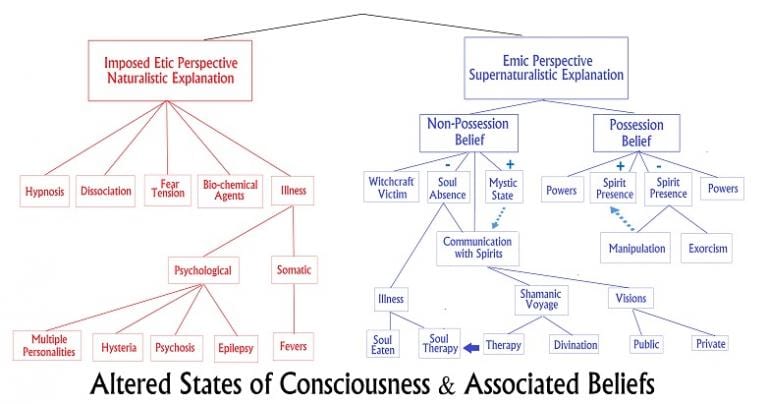
Fellow Dying Inmate, re-creation of model of John Pilch / All rights reserved
In my first post in the series, I offer a more nuanced definition of the ASC than does Merriam-Webster.
“According to Dr. John Pilch, following Bourguignon and Dr. Felicitas Goodman, an ASC is a condition whereby perceptions, sensations, cognition, and emotions change (see “Flights of the Soul, Visions, Heavenly Journeys, and Peak Experiences in the Biblical World”). But more to it, such states transform the relationship a human person has to the self, the body, their sense of identity, and the whole environment including space, time, and all other persons.”
This fleshes out things a little better. Not that the Merriam-Webster definition offered by brother does a bad job, mind you! It really does not say what he wants it to say, namely, that ASC experiences are not real.
Straw Man from Naive Realism
One of the problems in our culture is our predilection for naïve realism and rationalistic thinking. We are the only culture in world history that fails to distinguish between truth and facts. This inevitably creeps into our study of the ancients, such as biblical authors and early church writings. We anachronistically and ethnocentrically assume their way of viewing reality is ours. It wasn’t! This disease infects our translations—all translations are interpretations.
I’m afraid that this is at work in my brother’s implied condemnation of me via re-contextualized quotes of Polycarp and Cyril of Jerusalem. It’s okay—he’s trying to save me from the fires and help people see the life-transforming impact of the reality of the risen Lord. I am touched by this, no lie, despite our disagreement.
It might be helpful to see how we got here and how this affects our interpretations of New Testament reports of the resurrection.
Defensive Against Negative Interpretations of the Resurrection
Since ancient times, those who deny the resurrection give various negative explanations for it. Some dismiss it as a fraud. Others believe it to be a fable, a tall tale progressively augmented with time, turning the man Jesus into a Paul Bunyan-type Superman. Others explain it as a psychogenic hallucination without a jot of reality, merely a mental creation.
The fraud theory is perhaps older than the Gospels, recalled in Matthew 28:11-15. The resurrection was a total deception. The disciples concocted the lie. They stole Jesus’ corpse and hid it. A more recent and popular version of the fraud idea espoused by Hugh Schonfield in his “The Passover Plot.” In this more sophisticated version, disciples remove a very much alive Jesus from the Cross. Believed to be dead but really unconscious, they nurse Jesus back to health, and present him “risen.”
Both of these explanations don’t work. I suggest why in the following posts here and here. For a brief rundown of my understanding, watch the following two video presentations:
Straw Man!
NONE of these negative explanations, including the evolution hypothesis or the idea that Jesus’ resurrection was a hallucination, are mine. I never denied the resurrection. I even explicitly called out the hallucinatory explanation as a false etic. So it would be tremendously uncharitable to misrepresent my work or positions as any of these untenable negative interpretations. Please read carefully what I write. Amen, Jesus is risen.
The understanding of the resurrection experiences I present are positive in that they accept the reality of the risen Lord. But not all positive interpretations are sound. Next time, I am going to expose problems with one positive explanation of the resurrection, namely the Neo-orthodox theory beloved by today’s popular “apologists.” I hope to show serious flaws in this naïve realist position showcased by Catholic fundamentalists.
altered states of consciousness
Previous Post
June 10, 2020
Monotheism & Trinity—Doctrine Develops
Next Post

June 14, 2020 Eucharist: The Most Important Transformation
Browse Our Archives
Select a Category Uncategorized
Select a Month August 2021 July 2021 June 2021 May 2021 April 2021 March 2021 February 2021 January 2021 December 2020 November 2020 October 2020 September 2020 August 2020 July 2020 June 2020 May 2020 April 2020 March 2020 February 2020 January 2020 December 2019 November 2019 October 2019 September 2019 August 2019
Follow Us!
TAKE THE
Religious Wisdom Quiz
We celebrate a feast with feasting and joy, remembering deliverance from destruction in Persia. What feast are we?
Select your answer to see how you score.
Purim Passover Pentecost Hanukkah
Support this
Column


Related posts from Messy Inspirations

Understanding Apocalypse & Its Creatures



TRENDING AT PATHEOS Catholic

The Parable Of The Sower And The Word...
One of Christ’s most famous parables is that of the sower who...

Rejecting Doom: Christian Hope And Human Action
Christianity is a religion of hope. We are to have hope and...

Why I Choose the Eucharist Over the Sermon
Choose the Eucharist, Not the Sermon What are we supposed to get...

5 Design Elements Found in Spiritually Rooted Homes
Putting Spirituality Into Home Decor Our homes are more than our living...

Credo: A Story of God Told with the...
About 10 years ago, I began to imagine a personal "Credo" that...

The Anatomy of Divine Revelation in Catholic Thought
The claim that God has made Himself known to human beings is...
view all Catholic blogs
Ad-Free & Subscriber Log-In Subscription Support
- About Us
- 2026 Calendar
- Videos
- Podcasts
- Library of World Religions
- Faith In Media Tracker
- Advertise With Us
- Write for Us
- Privacy Policy
- Terms of Service
- Do Not Sell My Data
- Contact Us
- Radiant Digital
- Manage Newsletter Subscriptions
- Unsubscribe From Notifications
- Sitemap
Copyright 2008-2026, Patheos. All rights reserved.
Subscription Support Ad-Free & Subscriber Log-In
Follow Patheos