
BuddhistCatholicContemplativeEvangelicalGeneral ChristianHinduJewishLatter-day SaintMuslimNew VisionsProgressive Christian
Beliefs
- Buddhist
- Catholic
- Contemplative
- Evangelical
- General Christian
- Hindu
- Jewish
- Latter-day Saint
- More Voices
- Muslim
- New Visions
- Pagan
- Progressive Christian
Topics
- Religion News
- Food and Religion
- Sports and Religion
- Religious Art
- Religious Music and Entertainment
- Religious Events
- History and Religion
- Style and Religion
- Politics and Religion
- Women in Religion
- Recreation Outdoors and Religion
- Business Finance and Religion
- Careers Workplace and Religion
- Education and Religion
- Family Parenting and Religion
- Health Fitness and Religion
- Home and Religion
- Relationships and Religion
- Technology and Religion
- Travel and Religion
Columnists
- Buddhist Columnists
- Business Finance and Religion Columnists
- Careers Workplace and Religion Columnists
- Catholic Columnists
- Contemplative Columnists
- Education and Religion Columnists
- Evangelists Columnists
- Family Parenting and Religion Columnists
- General Christian Columnists
- Health Fitness and Religion Columnists
- Hindu Columnists
- History and Religion Columnists
- Home and Religion Columnists
- Jewish Columnists
- More Voices Columnists
- Latter Day Columnists
- Muslim Columnists
- New Visions Columnists
- Nonreligious Columnists
- Pagan Columnists
- Politics and Religion Columnists
- Progressive Columnists
- Recreation Outdoors and Religion Columnists
- Relationships and Religion Columnists
- Religion News Columnists
- Religious Art Columnists
- Religious Events Columnists
- Religious Music and Entertainment Columnists
- Sports and Religion Columnists
- Style and Religion Columnists
- Technology and Religion Columnists
- Travel and Religion Columnists
- Women in Religion Columnists
Resource Library
- 2026 Calendar
- Library of World Religions
- The 100 Most Holy Places on Earth
- Patheos Answers
- Podcasts
- Videos
- Faith Leaders Database
- Anglican Episcopalian
- Bahai
- Baptist
- Buddhism
- Christianity
- Confucianism
- Eastern Orthodoxy
- Hinduism
- Holiness and Pentecostal
- ISKCON
- Islam
- Judaism
- Lutheran
- Methodist
- The Church of Jesus Christ of Latter-day Saints
- New Age
- Paganism
- Presbytarian and Reformed
- Protestantism
- Religion Behind the Scenes
- Roman Catholic
- Scientology
- Shia Islam
- Sikhism
- Sufism
- Sunni Islam
- Taoism
- Zen
- See all religions
Research Tools
 Ad-Free & Subscriber Log-In Subscription Support
Ad-Free & Subscriber Log-In Subscription Support
Follow Patheos 

- Trending:
- Forgiveness
- |
- Marriage
- |
- Consciousness
- |
- Death Penalty
- |
- Election
- |
- Halloween
 Messy Inspirations
- Home
- Catholic
- Miraculous Walking on the Sea—Experienced in Alternate Reality
Miraculous Walking on the Sea—Experienced in Alternate Reality
Last updated on: May 22, 2020 at 12:19 pm by Fellow Dying Inmate
Miraculous Walking on the Sea—Experienced in Alternate Reality 2020-05-22T12:19:22-04:00 Fellow Dying Inmate
Patheos Explore the world's faith through different perspectives on religion and spirituality! Patheos has the views of the prevalent religions and spiritualities of the world.
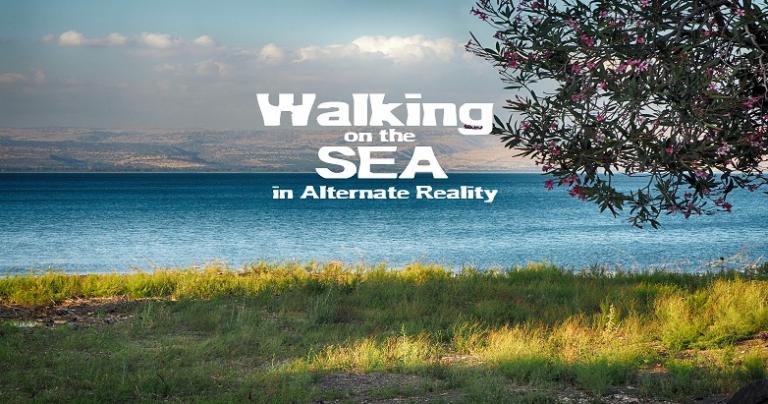
Image by dozemode from Pixabay
Miraculous doings of Jesus, such as his walking on the Sea, can be better understood through cultural insights into altered states of consciousness experiences.
Miraculous? Or something wondrous that does not violate “laws of nature” but fits very well into a panhuman experience?
Last time, we spoke about two different 21st century Westerners readers and how they misread the story of Jesus walking on the Sea. People from our time and culture tend to read Bible stories like this one (Mark 6;45-52; Matthew 14:22-33; John 6:16-21) as if they written by, for, and about Americans and other Western people. Misunderstanding and distortion necessarily results.
Please watch the video here—
Miraculous? Or Marvelous?
All of this needs to be kept in mind when reading how miraculous Jesus’ marvels and wonders are described in New Testament literature—
-
The Synoptic Gospels (“Mark,” “Matthew,” “Luke”) speak of Jesus’ “mighty deeds” (dynameis)
-
The Fourth Gospel (“John”) calls these “signs” (semeia) and “works” (ta erga).
There are no miracles in the Bible, As we explained before, “miracles” are post-Enlightenment violations of physical laws governing the universe, the so-called “laws of nature.” This needs to be remembered when reading about Jesus “walking on the sea.”
Getting the Culture Right
Dr. John Pilch, Context Group biblical scholar, exhorted Christians and all Gospel readers to respect the fact that Jesus and his followers are MENA (Middle Eastern North African) personalities. Pilch says that even among today’s theologians and biblical scholars that, other than lip service, few recognize that the incarnation happened in the ancient Mediterranean and what that means.
As we explained in an earlier post, anthropologists specializing in the Mediterranean cultural region have established that approximately 80 percent of circum-Mediterranean cultures readily experience altered states of consciousness. Pilch explains that ancient biblical people like Jesus and his followers were included in that 80 percent.
Pilch also explains that Jesus and his followers experienced alternate reality often. Culturally speaking, they were open to experiencing altered states of consciousness. Indeed, not only were they familiar with getting into alternate reality, they were adept for it.
This changes how we read Gospel reports of Jesus’ miraculous walking on the Sea. It also changes how we understand Gospel stories about the miraculous at Jesus’ baptism, or his transfiguration, or resurrection appearances. Pilch says all of these miraculous wonders handsomely correspond into “the common, Mediterranean cultural experiences of altered states of consciousness.
Miraculous Happens in Alternate Reality
Look at four elements common in an ASC experiences such as visions.
-
People experiencing a vision initially are scared.
-
At first, they fail to recognize the figure seen in the vision.
-
But then the figure offers a calming gesture to the visionary (e.g., “be not afraid”).
-
The figure seen provides self-identification (“it is I…”).
Usually this is followed by helpful information or the bestowal of a favor, usually healing or some strategy for solving a problem vexing the visionary.
Consider how this pattern aligns with the experience of the disciples having a vision of Jesus walking toward them on the Sea—
-
Initially they are terrified (Mark 6:50; Matthew 14:26; John 6:19).
-
At first they fail to recognize Jesus, confusing him with a ghost (Mark 6:49; Matthew 14:26; John 6:20 implies a complete failure to recognize him).
-
Next Jesus calms and reassures them (“Take courage, it is I, do not be afraid!”—Mark 6:50; Matthew 14:27; John 6:20).
-
Jesus identifies himself: “It is I” (Mark 6:50; Matthew 14:27; John 6:20).
These accounts correspond strongly with a typical ASC experience (a vision). Is this miraculous? Or a capacity that God hardwired into everyone?
Breaking Trance
Pilch illustrates what happens when a visionary in ASC comes out of his or her trance. He cites the Matthean version of Jesus walking on the Sea (14:28-31). An unconvinced Peter demands, “Kyrie, if it is you, command me to come to you on the water.” Jesus responds, “Come.” Peter then obeys!
But Pilch explains that Peter begins to sink after he is startled by the wind and his fear and skepticism returns. Pilch clarifies that this is exactly what would happen if you break a trance returning into consensual reality and out of alternate reality. Whether you understand the Sea to obey laws of buoyancy or as a great watery demon, you cannot walk on it in waking, pragmatic consciousness.
In the same way your interrupted dream won’t ordinarily resume when you diligently try to recover it, so too with your trance experiences once you wake up.
What Does It Mean?
What was the impact of the experience of going into trance and seeing in an alternate reality the peasant Galilean nothing-person Jesus walking over and thereby shaming a great Sea Demon? Both “Mark” and “John” don’t bother to spell it out—these high context documents expect their audiences to already know it even if the story characters are baffled (Mark 6:52).
But “Matthew” (14:33) slips the meaning— “Truly, you are the Son of God.” Only a powerful holy man (“son of God” in context) could be authorized and empowered by the God of Israel to humiliate the Sea Demon known so well by fishermen. The vision provides information about who Jesus really is. He’s not just a poor Galilean nothing-person—he’s a holy one authorized by God.
Culture Helps Provide the Meaning
But Pilch reminds us what anthropological psychologists have learned about ASC experiences, namely that the content of these experiences is vacuous. That’s why Peter could doubt! The information necessary to interpret the experience is provided by the cultural world informing the brain of the visionary.
Only the God of Israel can master the Sea Demon. Jesus, the Holy Man, can somehow do this also. What an extraordinary peasant he must be, huh? To do what only God can do, Jesus must have the qualities of God. “Son of…” in the Bible means “having the qualities of…” Hence, Jesus, who walks on the Sea Demon is Son of God indeed.
Still a far way out from our official Christological understandings of Nicaea (325 CE) and Chalcedon (451 CE), as “Son of God” in this first century Israelite sense, Jesus’ reputation would be further established as God’s “holy man.” In Israelite terms, Jesus would would be a ḥasîd or ṣaddîq Israelite shamanic type, one in special relationship with God and who can barter favors for his fellow human beings.
Reading with Understanding
Altered states of consciousness are pan-human experiences. All people are capable of them. However, some cultures suppress these; others, celebrate them. John Pilch was convinced that these cultural insights would enhance literary and historical-critical studies of the Bible and help us to see Jesus more clearly.
Next week, as we come to the close of Easter Season, we will apply these insights to the resurrection appearances.
altered states of consciousness
Previous Post
May 21, 2020
Ascension of Jesus and Other Sky Journeys
Next Post
May 23, 2020 Mother of Jesus in “John” is Highly Symbolic
Browse Our Archives
Select a Category Uncategorized
Select a Month August 2021 July 2021 June 2021 May 2021 April 2021 March 2021 February 2021 January 2021 December 2020 November 2020 October 2020 September 2020 August 2020 July 2020 June 2020 May 2020 April 2020 March 2020 February 2020 January 2020 December 2019 November 2019 October 2019 September 2019 August 2019
Follow Us!
TAKE THE
Religious Wisdom Quiz
How many times did Elijah pray for rain?
Select your answer to see how you score.
3 9 7 5
Support this
Column


Related posts from Messy Inspirations

Understanding Apocalypse & Its Creatures



TRENDING AT PATHEOS Catholic

Rejecting Doom: Christian Hope And Human Action
Christianity is a religion of hope. We are to have hope and...

It’s What Comes From Within Which Matters
One of the most difficult things for us to understand is why...

Why I Choose the Eucharist Over the Sermon
Choose the Eucharist, Not the Sermon What are we supposed to get...

5 Design Elements Found in Spiritually Rooted Homes
Putting Spirituality Into Home Decor Our homes are more than our living...

Credo: A Story of God Told with the...
About 10 years ago, I began to imagine a personal "Credo" that...

The Anatomy of Divine Revelation in Catholic Thought
The claim that God has made Himself known to human beings is...
view all Catholic blogs
Ad-Free & Subscriber Log-In Subscription Support
- About Us
- 2026 Calendar
- Videos
- Podcasts
- Library of World Religions
- Faith In Media Tracker
- Advertise With Us
- Write for Us
- Privacy Policy
- Terms of Service
- Do Not Sell My Data
- Contact Us
- Radiant Digital
- Manage Newsletter Subscriptions
- Unsubscribe From Notifications
- Sitemap
Copyright 2008-2026, Patheos. All rights reserved.
Subscription Support Ad-Free & Subscriber Log-In
Follow Patheos