
BuddhistCatholicContemplativeEvangelicalGeneral ChristianHinduJewishLatter-day SaintMuslimNew VisionsProgressive Christian
Beliefs
- Buddhist
- Catholic
- Contemplative
- Evangelical
- General Christian
- Hindu
- Jewish
- Latter-day Saint
- More Voices
- Muslim
- New Visions
- Pagan
- Progressive Christian
Topics
- Religion News
- Food and Religion
- Sports and Religion
- Religious Art
- Religious Music and Entertainment
- Religious Events
- History and Religion
- Style and Religion
- Politics and Religion
- Women in Religion
- Recreation Outdoors and Religion
- Business Finance and Religion
- Careers Workplace and Religion
- Education and Religion
- Family Parenting and Religion
- Health Fitness and Religion
- Home and Religion
- Relationships and Religion
- Technology and Religion
- Travel and Religion
Columnists
- Buddhist Columnists
- Business Finance and Religion Columnists
- Careers Workplace and Religion Columnists
- Catholic Columnists
- Contemplative Columnists
- Education and Religion Columnists
- Evangelists Columnists
- Family Parenting and Religion Columnists
- General Christian Columnists
- Health Fitness and Religion Columnists
- Hindu Columnists
- History and Religion Columnists
- Home and Religion Columnists
- Jewish Columnists
- More Voices Columnists
- Latter Day Columnists
- Muslim Columnists
- New Visions Columnists
- Nonreligious Columnists
- Pagan Columnists
- Politics and Religion Columnists
- Progressive Columnists
- Recreation Outdoors and Religion Columnists
- Relationships and Religion Columnists
- Religion News Columnists
- Religious Art Columnists
- Religious Events Columnists
- Religious Music and Entertainment Columnists
- Sports and Religion Columnists
- Style and Religion Columnists
- Technology and Religion Columnists
- Travel and Religion Columnists
- Women in Religion Columnists
Resource Library
- 2026 Calendar
- Library of World Religions
- The 100 Most Holy Places on Earth
- Patheos Answers
- Podcasts
- Videos
- Faith Leaders Database
- Anglican Episcopalian
- Bahai
- Baptist
- Buddhism
- Christianity
- Confucianism
- Eastern Orthodoxy
- Hinduism
- Holiness and Pentecostal
- ISKCON
- Islam
- Judaism
- Lutheran
- Methodist
- The Church of Jesus Christ of Latter-day Saints
- New Age
- Paganism
- Presbytarian and Reformed
- Protestantism
- Religion Behind the Scenes
- Roman Catholic
- Scientology
- Shia Islam
- Sikhism
- Sufism
- Sunni Islam
- Taoism
- Zen
- See all religions
Research Tools
 Ad-Free & Subscriber Log-In Subscription Support
Ad-Free & Subscriber Log-In Subscription Support
Follow Patheos 

- Trending:
- Forgiveness
- |
- Marriage
- |
- Consciousness
- |
- Death Penalty
- |
- Election
- |
- Halloween
 Messy Inspirations
- Home
- Catholic
- Thomas the Doubter
Thomas the Doubter
Last updated on: April 19, 2020 at 10:21 am by Fellow Dying Inmate
Thomas the Doubter 2020-04-19T10:21:56-04:00 Fellow Dying Inmate
Patheos Explore the world's faith through different perspectives on religion and spirituality! Patheos has the views of the prevalent religions and spiritualities of the world.
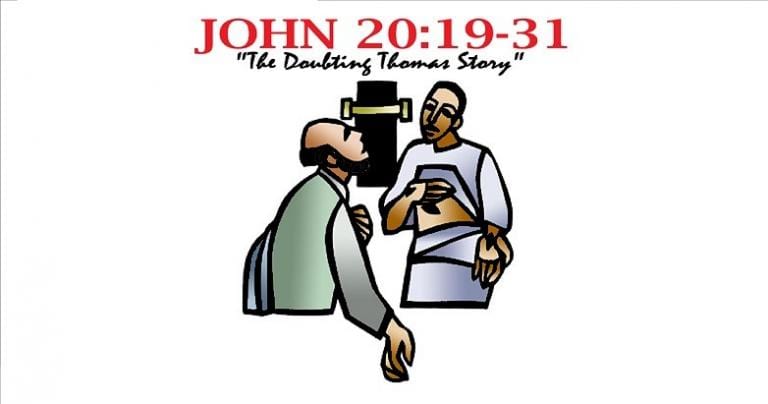
Modified Clipart by Fellow Dying Inmate / KissClipart.com
Thomas, the disciple associated with doubt and incredulity, is the featured character in the original ending of the Gospel called “John.”
Thomas and Divine Mercy go together every year. This Sunday’s Gospel is John 20:19-31 and it presents the Risen Jesus commissioning his disciples and the famous “doubting Thomas” episode. It is part of the original conclusion to the Fourth Gospel called “John” (John 20:1-31, as chapter 21 was a later appended section). In its original ending, “John” concludes by expressing that God vindicated Jesus, the Sent One, who truly ascended and then descended twice to his friends.
You can find the Gospel section below. I invite you to read it and then watch the video presentation linked above it. Next, go over (by yourself or with your family) the following questions—really ruminate and grapple with them. Later, in a follow-up post, I will go into more detail with this Gospel story.
John 20:19-31
On the evening of that first day of the week, when the doors were locked, where the disciples were, for fear of the Judaeans, Jesus came and stood in their midst and said to them, “Peace be with you.”
When he had said this, he showed them his hands and his side. The disciples rejoiced when they saw the Lord.
[Jesus] said to them again, “Peace be with you. As the Father has sent me, so I send you.” And when he had said this, he breathed on them and said to them, “Receive the holy Spirit. Whose sins you forgive are forgiven them, and whose sins you retain are retained.”
Thomas, called Didymus, one of the Twelve, was not with them when Jesus came. So the other disciples said to him, “We have seen the Lord.” But he said to them, “Unless I see the mark of the nails in his hands and put my finger into the nailmarks and put my hand into his side, I will not believe.”
(The Appearance with Thomas)
Now a week later his disciples were again inside and Thomas was with them.
Jesus came, although the doors were locked, and stood in their midst and said, “Peace be with you.”
Then he said to Thomas, “Put your finger here and see my hands, and bring your hand and put it into my side, and do not be unbelieving, but believe.”
Thomas answered and said to him, “My Lord and my God!”
Jesus said to him, “Have you come to believe because you have seen me? Blessed are those who have not seen and have believed.”
Now Jesus did many other signs in the presence of [his] disciples that are not written in this book. But these are written that you may [come to] believe that Jesus is the Messiah, the Son of God, and that through this belief you may have life in his name.
Questions & Directions for Reflection—
“Doubting” Thomas
It seems that the adjective “doubting” has forever marked our understanding of Judas Didymus Thomas, member of the Twelve. But the Fourth Gospel often presents us with typical characters, symbols who represent theological positions or traits that address pastoral problems experienced by the Johannine Jesus group. Examples of typical characters in “John” include the Samaritan Woman, the Sighted Blind Man, the Beloved Disciples Lazarus and Martha, and Mary Magdalene.
Consider that if the Johannine Thomas is a typical character symbolizing a condition that all early Jesus group members suffered, how should we understand him today?
Is the Thomas Story True or Factual?
Scholars are confident that the unknown, anonymous author we call “John” is not giving us a 21st century, fact-precise biography of Jesus and his earliest followers. Moreover, scholars believe that several stories in “John” are theological fictions addressing crises and pastoral issues in the Jesus group to which he belonged. Also, Catholics are not obliged to consider every detail and story in the Gospels as factual and historical.
What becomes of the truth of “Doubting Thomas” if this story proves to be yet another brilliant theological fiction invented by the author?
Thomas and the Skeptics
Often 21st century skeptics of the Bible caricaturize biblical peoples as a credulous, superstitious lot, gullible fools and suckers who will believe any fantastical account proposed to them. But the daily life of the Middle Eastern world of the Bible was very skeptical. This was because of its prevalence for secrecy, deception, and lying as legitimate and commonly used strategies to defend honor. Ancient and modern Middle Easterners are so skeptical they disagree with our Western maxim, “seeing is believing” as eyes are often tricked. In light of this, what is real the meaning behind the “Doubting Thomas” story?
Thomas and the Vocation-Commissioning
Besides the “Doubting Thomas” report, there seems to be a vocation or commissioning at work in this Sunday’s Gospel (John 20:19-31). Can you find any similarities between this Johannine story and other biblical vocation accounts (Exodus 3:4–4:9; Judges 6:11-36ff.; Jeremiah 1:1-10; Matthew 28:16-20; Luke 24:33-53)? What makes this commissioning different?
For Whom Was it Written?
To whom is this story being addressed? It’s great to recognize that this is another “vocation-commissioning” story. Many are found in the Bible, but what value does this one have for us today? So was this commissioning only for Eleven disciples back in the first century or a wider group?
Forgiving Sins
The disciples are commissioned to preach repentance and forgive sins (John 20:22-23). What is sin in the Bible? What is sin specifically in the Gospel called “John” and its Jesus group (1 John 1:9; 2:19)? How is forgiving sins mentioned here in verses 22-23 different than elsewhere in the Fourth Gospel? How is it similar to what is instructed in Matthew 28:19 and Luke 24:47?
Did Peter and the Beloved Disciple Forget?
Read carefully the whole of John 20:1-31, which includes this Sunday’s Gospel. Did you notice that verses 19-31 begin “on the evening of that first day of the week”? This is the same day as the experiences of Mary Magdalene, Peter, and Lazarus (John 20:1-18). Why do the Eleven (or more?) disciples seem oblivious to what happened just hours earlier (v. 18)?
Stages of Gospel Development
The Church recognizes officially what scholars have understood for a long time—the Gospels evolved. Gospel stories are not eye-witness accounts. The evangelists lived decades following Jesus’ death and resurrection. They received a diversity of traditions developed in the intervening years. They recontextualized and reinterpreted these different traditions even further according to the “situation of the churches” or Jesus groups for which they composed their Gospels (Pontifical Biblical Commission Instruction on the Historical Truth of the Gospels, n. 9).
Why do the Gospels give such diverse interpretations to the traditions of the resurrection appearances?
Much more, later.
Previous Post
April 17, 2020
Health of Jesus VS the Shroud of Turin
Next Post

April 20, 2020 Mourning at the Empty Tomb: Ancient Israelite Burial Customs
Browse Our Archives
Select a Category Uncategorized
Select a Month August 2021 July 2021 June 2021 May 2021 April 2021 March 2021 February 2021 January 2021 December 2020 November 2020 October 2020 September 2020 August 2020 July 2020 June 2020 May 2020 April 2020 March 2020 February 2020 January 2020 December 2019 November 2019 October 2019 September 2019 August 2019
Follow Us!
TAKE THE
Religious Wisdom Quiz
Who played instruments in Temple?
Select your answer to see how you score.
Prophets Kings Priests Levites
Support this
Column


Related posts from Messy Inspirations

Understanding Apocalypse & Its Creatures



TRENDING AT PATHEOS Catholic

Rejecting Doom: Christian Hope And Human Action
Christianity is a religion of hope. We are to have hope and...

It’s What Comes From Within Which Matters
One of the most difficult things for us to understand is why...

Why I Choose the Eucharist Over the Sermon
Choose the Eucharist, Not the Sermon What are we supposed to get...

5 Design Elements Found in Spiritually Rooted Homes
Putting Spirituality Into Home Decor Our homes are more than our living...

Credo: A Story of God Told with the...
About 10 years ago, I began to imagine a personal "Credo" that...

The Anatomy of Divine Revelation in Catholic Thought
The claim that God has made Himself known to human beings is...
view all Catholic blogs
Ad-Free & Subscriber Log-In Subscription Support
- About Us
- 2026 Calendar
- Videos
- Podcasts
- Library of World Religions
- Faith In Media Tracker
- Advertise With Us
- Write for Us
- Privacy Policy
- Terms of Service
- Do Not Sell My Data
- Contact Us
- Radiant Digital
- Manage Newsletter Subscriptions
- Unsubscribe From Notifications
- Sitemap
Copyright 2008-2026, Patheos. All rights reserved.
Subscription Support Ad-Free & Subscriber Log-In
Follow Patheos