
BuddhistCatholicContemplativeEvangelicalGeneral ChristianHinduJewishLatter-day SaintMuslimNew VisionsProgressive Christian
Beliefs
- Buddhist
- Catholic
- Contemplative
- Evangelical
- General Christian
- Hindu
- Jewish
- Latter-day Saint
- More Voices
- Muslim
- New Visions
- Pagan
- Progressive Christian
Topics
- Religion News
- Food and Religion
- Sports and Religion
- Religious Art
- Religious Music and Entertainment
- Religious Events
- History and Religion
- Style and Religion
- Politics and Religion
- Women in Religion
- Recreation Outdoors and Religion
- Business Finance and Religion
- Careers Workplace and Religion
- Education and Religion
- Family Parenting and Religion
- Health Fitness and Religion
- Home and Religion
- Relationships and Religion
- Technology and Religion
- Travel and Religion
Columnists
- Buddhist Columnists
- Business Finance and Religion Columnists
- Careers Workplace and Religion Columnists
- Catholic Columnists
- Contemplative Columnists
- Education and Religion Columnists
- Evangelists Columnists
- Family Parenting and Religion Columnists
- General Christian Columnists
- Health Fitness and Religion Columnists
- Hindu Columnists
- History and Religion Columnists
- Home and Religion Columnists
- Jewish Columnists
- More Voices Columnists
- Latter Day Columnists
- Muslim Columnists
- New Visions Columnists
- Nonreligious Columnists
- Pagan Columnists
- Politics and Religion Columnists
- Progressive Columnists
- Recreation Outdoors and Religion Columnists
- Relationships and Religion Columnists
- Religion News Columnists
- Religious Art Columnists
- Religious Events Columnists
- Religious Music and Entertainment Columnists
- Sports and Religion Columnists
- Style and Religion Columnists
- Technology and Religion Columnists
- Travel and Religion Columnists
- Women in Religion Columnists
Resource Library
- 2026 Calendar
- Library of World Religions
- The 100 Most Holy Places on Earth
- Patheos Answers
- Podcasts
- Videos
- Faith Leaders Database
- Anglican Episcopalian
- Bahai
- Baptist
- Buddhism
- Christianity
- Confucianism
- Eastern Orthodoxy
- Hinduism
- Holiness and Pentecostal
- ISKCON
- Islam
- Judaism
- Lutheran
- Methodist
- The Church of Jesus Christ of Latter-day Saints
- New Age
- Paganism
- Presbytarian and Reformed
- Protestantism
- Religion Behind the Scenes
- Roman Catholic
- Scientology
- Shia Islam
- Sikhism
- Sufism
- Sunni Islam
- Taoism
- Zen
- See all religions
Research Tools
 Ad-Free & Subscriber Log-In Subscription Support
Ad-Free & Subscriber Log-In Subscription Support
Follow Patheos 

- Trending:
- Forgiveness
- |
- Marriage
- |
- Consciousness
- |
- Death Penalty
- |
- Election
- |
- Halloween
 Messy Inspirations
- Home
- Catholic
- Resurrection: Lazarus, Beloved Disciple, Believes
Resurrection: Lazarus, Beloved Disciple, Believes
Last updated on: April 13, 2020 at 9:19 am by Fellow Dying Inmate
Resurrection: Lazarus, Beloved Disciple, Believes 2020-04-13T09:19:44-04:00 Fellow Dying Inmate
Patheos Explore the world's faith through different perspectives on religion and spirituality! Patheos has the views of the prevalent religions and spiritualities of the world.
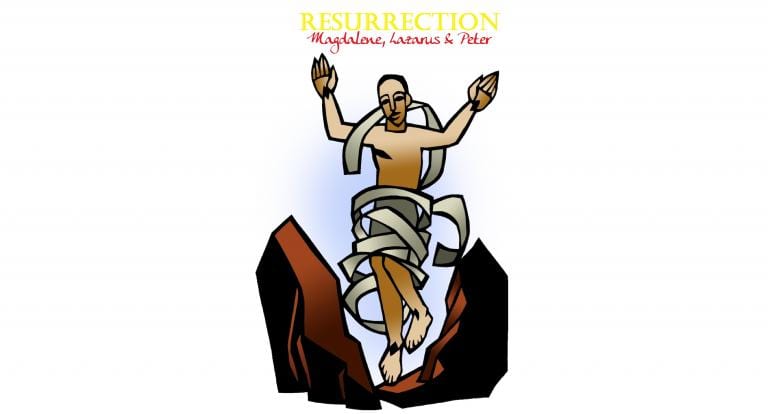
Modified Clipart by Fellow Dying Inmate / KissClipart.com
Resurrection, the center of and defining mystery to us Easter People, is the beginning and commissioning to Beloved Disciples.
Resurrection may be difficult to see these days in the shadows of global pandemic and grotesque and dangerously incompetent government, but it is here and now. The resurrection is always here, always accessible, the NOW-life that does not pass away, available everywhere and always. This ever-present dawn of glorified scars defines Christianity even though all humankind has access to it as they stand up from time into NOW. Among our fellow dying human sisters and brothers, we Christians have a radically-undeserved privilege to call this NOW-life by name—Jesus.
But resurrection is not reanimation or resuscitation. The Risen Jesus does not a return to life. Resurrection is new life—life that does not pass away, life that is not hindered by what we Westerners recognize as space, time, matter and energy. In resurrection, Christ dies no more. Even though the Risen One is indeed the Crucified One, and even though all the space-and-time fragmented pieces of the Crucified are raised up by God, resurrection cannot be return.
Resurrection Accounts Agree to an Extent
Easter Sunday reads the Gospel called “John” and the story of the finding of the empty tomb (John 20:1-9). Three disciples are featured. The lowliest of these is dimwitted Peter (who in the appended John 21:15-23 will become the chosen shepherd). The two special followers of Jesus who shine in John 20 are the commissioned Mary Magdalene (the only real apostle in the Fourth Gospel) and the Beloved Disciple, Lazarus.
Every Gospel explains that certain women go to Jesus’ grave on the first day of the week to anoint his corpse. They all agree that they discover the tomb is empty. All agree that an angel (singular) or angels (plural) communicate that Jesus has been raised from the dead. But in “John” this proclamation is not given to women (plural), but to a woman, singular—the Magdalene.
Resurrection and the Problem of the Empty Tomb
That Jesus’ tomb was empty was a huge problem in ways 21st century Gospel readers might not grasp. Consider this first-century ordinance from the Roman emperor—
Ordinance of Caesar: It is my pleasure that graves and tombs—whoever has made them as a pious service for ancestors or children or members of their house—that these remain unmolested in perpetuity. But if any person lay information that another either has destroyed them, or has in any other way cast out the bodies which have been buried there, or with malicious deception has transferred them to other places, to the dishonor of those buried there or has removed the headstones or other stones, in such a case I command that a trial be instituted, protecting the pious services of mortals, just as if they were concerned with the gods. For beyond all else it shall be obligatory to honor those who have been buried. Let no one remove them for any reason. If anyone does so, however, it is my will that he shall suffer capital punishment on the charge of tomb robbery. (from Bruce M. Metzger’s “The Nazareth Inscription Once Again,” in “New Testament Studies: Philological, Versional, and Patristic,” p. 77)
This ordinance had been published in the Galilee, perhaps prior to Jesus’ death. Were Jesus’ friends to have hidden his body, they would be facing capital punishment. Still an empty tomb proves only an empty tomb.
The Story in John 20:1-9
In the narrative of the Fourth Gospel, we only just met Mary Magdalene at the Cross (John 19:25). She was one of the women there—nothing else is told about her, who she was, why she was there witnessing Jesus “lifted up.” Now, “John” gives us a bizarre detail as far as Mediterranean culture goes—Mary goes unaccompanied to the tomb early on the first day of the week. More on that later.
Finding the stone rolled away and tomb empty, Mary runs to Peter and “the other disciple,” that being “the one whom Jesus loved” (John 20:2). If we are following carefully the Gospel called “John,” this “beloved disciple” must surely be Lazarus (John 11:3-5; see also 1:35-40; 13:23-25; 18:15-16; 19:25-27; 20:2-10; 21:7; 21:20-24).
Mary Magdalene informs Peter and Lazarus that “they” (outsiders to the Jesus group) took the Lord from the tomb and that “we” (Jesus group insiders) don’t know where they hid the body (John 20:2). Scholars Bruce Malina and Richard Rohrbaugh explain that this language of “they” and “we” is typical boundary marking of Mediterranean divinding insiders from outsiders, ingroup people from the outgroup.
Running to Discover…?
So both Lazarus and Peter head off (John 20:3) running to the tomb. Lazarus outruns Peter and reaches the tomb first (John 20:4). Yet he does not enter it—he just bends down and sees the burial cloths there (John 20:5).
When Peter arrives, unlike Lazarus, he does enter the tomb and sees the burial cloths also (John 20:6). He also sees the face-cloth folded up in a place separate from the other burial cloths (John 20:7). However, even though Peter sees this, of the two men, only Lazarus sees and believes that God has done something wondrous here (John 20:8). But as far as what the meaning of the empty tomb can be, both men cannot say of understand the link between it and the Scriptures (John 20:9).
Given all of this, the unknown, anonymous author of the document we call “John” means to say that Peter is clueless. Never does Peter even once consider resurrection. But the Beloved Disciple Lazarus is different. He believes. And this should not surprise anyone, given how God saved him from death and the grave. If anyone would believe, it would be Lazarus!
In verse 10 we are told that these two men “returned home.” “Home” would have to be in or near Jerusalem, as they and Mary Magdalene could easily run to and from the tomb.
Gospel Interpretations of Resurrection
As we have said repeatedly on this blog, the Gospels are not 21st century, fact-precise biographies. There exist real differences in how each reports and interprets the resurrection. Indeed, as John Pilch explained, they give us no, single, unified picture of resurrection.
Isn’t it fascinating that the Gospel reading from Easter Sunday (John 20:1-9) lacks any resurrection appearances! It lacks even an angelic proclamation! All we get is an empty tomb, bewilderment, and one who believes and yet does not have full understanding. Peter is clueless, in the dark (John 20:6-10)—but chapter 21 is coming. Mary Magdalene grieves the body of Jesus having been stolen, but she will soon shine in her being commissioned (John 20:11-18). The Beloved Lazarus, the most important figure after Jesus in the Johannine Jesus group believes Jesus is risen (John 11:3-5; see also 1:35-40; 13:23-25; 18:15-16; 19:25-27; 20:2-10; 21:7; 21:20-24).
Faith comes through hearing. What would the hearers do listening to this story told in the first century? Who will they be like—clueless Peter? Mary Magdalene, symbol of the grieving community? Or Lazarus who sees and believes? How will they grapple with this account of the empty tomb and the resurrection? How will we?
Concerning the Magdalene and More To Come…
That the Fourth Gospel would depict Mary Magdalene outdoors unaccompanied is strange, anomalous behavior in the Mediterranean cultural world of the Bible. There is a lot more left to the story of this very important and special figure. We will cover that, and John 20:11-18, next.
Previous Post

April 10, 2020
Hero of Good Friday
Next Post

April 15, 2020 Magdalene in "John": Herald of the Resurrection
Browse Our Archives
Select a Category Uncategorized
Select a Month August 2021 July 2021 June 2021 May 2021 April 2021 March 2021 February 2021 January 2021 December 2020 November 2020 October 2020 September 2020 August 2020 July 2020 June 2020 May 2020 April 2020 March 2020 February 2020 January 2020 December 2019 November 2019 October 2019 September 2019 August 2019
Follow Us!
TAKE THE
Religious Wisdom Quiz
What Christian group believes in baptism for the dead?
Select your answer to see how you score.
Pentecostals Anglicans Presbyterians Latter-day Saints
Support this
Column


Related posts from Messy Inspirations

Understanding Apocalypse & Its Creatures



TRENDING AT PATHEOS Catholic

The Parable Of The Sower And The Word...
One of Christ’s most famous parables is that of the sower who...

Rejecting Doom: Christian Hope And Human Action
Christianity is a religion of hope. We are to have hope and...

Why I Choose the Eucharist Over the Sermon
Choose the Eucharist, Not the Sermon What are we supposed to get...

5 Design Elements Found in Spiritually Rooted Homes
Putting Spirituality Into Home Decor Our homes are more than our living...

Credo: A Story of God Told with the...
About 10 years ago, I began to imagine a personal "Credo" that...

The Anatomy of Divine Revelation in Catholic Thought
The claim that God has made Himself known to human beings is...
view all Catholic blogs
Ad-Free & Subscriber Log-In Subscription Support
- About Us
- 2026 Calendar
- Videos
- Podcasts
- Library of World Religions
- Faith In Media Tracker
- Advertise With Us
- Write for Us
- Privacy Policy
- Terms of Service
- Do Not Sell My Data
- Contact Us
- Radiant Digital
- Manage Newsletter Subscriptions
- Unsubscribe From Notifications
- Sitemap
Copyright 2008-2026, Patheos. All rights reserved.
Subscription Support Ad-Free & Subscriber Log-In
Follow Patheos