
BuddhistCatholicContemplativeEvangelicalGeneral ChristianHinduJewishLatter-day SaintMuslimNew VisionsProgressive Christian
Beliefs
- Buddhist
- Catholic
- Contemplative
- Evangelical
- General Christian
- Hindu
- Jewish
- Latter-day Saint
- More Voices
- Muslim
- New Visions
- Pagan
- Progressive Christian
Topics
- Religion News
- Food and Religion
- Sports and Religion
- Religious Art
- Religious Music and Entertainment
- Religious Events
- History and Religion
- Style and Religion
- Politics and Religion
- Women in Religion
- Recreation Outdoors and Religion
- Business Finance and Religion
- Careers Workplace and Religion
- Education and Religion
- Family Parenting and Religion
- Health Fitness and Religion
- Home and Religion
- Relationships and Religion
- Technology and Religion
- Travel and Religion
Columnists
- Buddhist Columnists
- Business Finance and Religion Columnists
- Careers Workplace and Religion Columnists
- Catholic Columnists
- Contemplative Columnists
- Education and Religion Columnists
- Evangelists Columnists
- Family Parenting and Religion Columnists
- General Christian Columnists
- Health Fitness and Religion Columnists
- Hindu Columnists
- History and Religion Columnists
- Home and Religion Columnists
- Jewish Columnists
- More Voices Columnists
- Latter Day Columnists
- Muslim Columnists
- New Visions Columnists
- Nonreligious Columnists
- Pagan Columnists
- Politics and Religion Columnists
- Progressive Columnists
- Recreation Outdoors and Religion Columnists
- Relationships and Religion Columnists
- Religion News Columnists
- Religious Art Columnists
- Religious Events Columnists
- Religious Music and Entertainment Columnists
- Sports and Religion Columnists
- Style and Religion Columnists
- Technology and Religion Columnists
- Travel and Religion Columnists
- Women in Religion Columnists
Resource Library
- 2026 Calendar
- Library of World Religions
- The 100 Most Holy Places on Earth
- Patheos Answers
- Podcasts
- Videos
- Faith Leaders Database
- Anglican Episcopalian
- Bahai
- Baptist
- Buddhism
- Christianity
- Confucianism
- Eastern Orthodoxy
- Hinduism
- Holiness and Pentecostal
- ISKCON
- Islam
- Judaism
- Lutheran
- Methodist
- The Church of Jesus Christ of Latter-day Saints
- New Age
- Paganism
- Presbytarian and Reformed
- Protestantism
- Religion Behind the Scenes
- Roman Catholic
- Scientology
- Shia Islam
- Sikhism
- Sufism
- Sunni Islam
- Taoism
- Zen
- See all religions
Research Tools
 Ad-Free & Subscriber Log-In Subscription Support
Ad-Free & Subscriber Log-In Subscription Support
Follow Patheos 

- Trending:
- Forgiveness
- |
- Marriage
- |
- Consciousness
- |
- Death Penalty
- |
- Election
- |
- Halloween
 Messy Inspirations
- Home
- Catholic
- Hero of Good Friday
Hero of Good Friday
Last updated on: April 10, 2020 at 11:34 pm by Fellow Dying Inmate
Hero of Good Friday 2020-04-10T23:34:02-04:00 Fellow Dying Inmate
Patheos Explore the world's faith through different perspectives on religion and spirituality! Patheos has the views of the prevalent religions and spiritualities of the world.
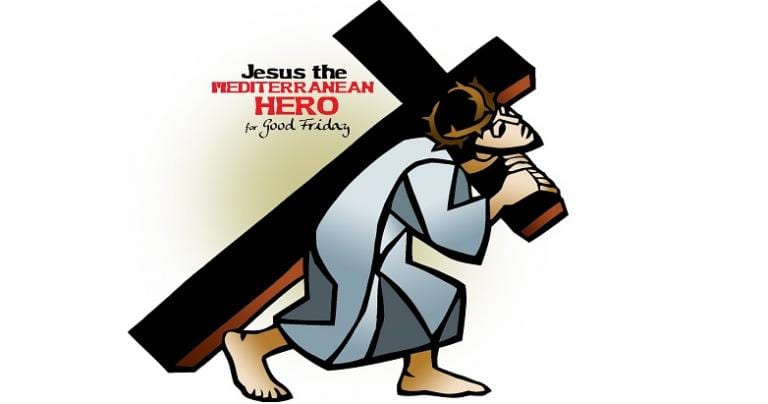
Modified Clipart by Fellow Dying Inmate / KissClipart.com
Hero of Good Friday, Jesus and his sufferings are presented according to cultural values that clash greatly with Western understandings.
Hero—from the Greek ἥρως (hērōs)—is the great champion, the defender, the protector. But what does he champion, defend, and protect? What does he safeguard?
Gilgamesh, Heracles, Achilles, Joan of Arc, Oda Nobunaga, Hua Mulan, Superman, Wonder Woman, Batman, and Captain America are all culturally-specific heroes, that is, champions, defenders, and protectors. Often what they champion and defend are cultural values—indeed, each hero is remembered as the symbol of such. The hero becomes the spokesperson for what is most valued by a given society. In many ways, Jesus, as presented in the Gospel Passion Narratives, can be considered also as a hero.
From Zero to Hero
When Emperor Constantine converted, almost overnight, the small Body of Christ which had before evangelized slowly suddenly ballooned in members. Up until the 300s, disciples of Jesus were overwhelmingly Israelite. But then, within the blink of an eye, things had drastically changed. Now the Church was almost completely non-Israelite. How did this happen?
To understand why this happened consider the difference between homophilous and heterophilous communication. Before the fourth century, the Jesus groups communicated the Gospel in predominantly homophilous ways—i.e., horizontally. That means the Gospel was shared with like-minded people of common ethnic identification, at the same socio-economic level, almost identical understandings and beliefs, etc. Because homophilous communication spreads languidly, the Body of Christ grew at a snail’s pace for centuries.
Heterophilous Spread
But after Constantine, Christianity was off to the races via heterophilous communication—i.e., vertically. To evangelize heterophilously means to work with those outside your education, social status, beliefs. And unlike homophilous communication, the results of heterophilous evangelization spreads like wildfire. This is because when king or emperor converts, all the people do likewise. Thus the ethnic makeup of the Church changed almost immediately with Constantine. But before and for a good while after this, the Body of Christ remained Mediterranean throughout.
Simple math sheds light on the historical record and cultural data. About 220 bishops attended Constantine’s Council of Nicea (325 CE) to which all had been summoned. Anthropologists inform us that without mass media communication a person cannot maintain a social network greater than four thousand people. Therefore, 880,000 is the maximum number of believers by the beginning of the fourth century. This reveals an annual growth rate of 2.5 percent. Hence, we can know that before Constantine’s conversion, the Body of Christ operated via homophilous communication.
The Evolution of Good Friday
What would the new imperial Christianity, established as the state religion, do with all these new people pouring in? New pastoral and catechetical needs arose for the new Christians who were oblivious to Israelite traditions and understandings, as well as the Gospel reports and Passion narratives!
The Pascha and Good Friday evolved with the birth of Christianity in the fourth century to deal with these problems. The liturgical celebration of Good Friday developed to meet the needs of the growing mass of Jerusalem pilgrims and converts to Christianity. Common ground in Mediterranean social values helped paved roads of understanding.
Mediterranean Good Friday
Despite the major changes that occurred between the earlier, mostly Israelite Jesus groups lasting till 325 CE, and the Church of Imperial Christianity following that, things were still very Mediterranean. Hence Mediterranean cultural values remained as the primary lens used to interpret the historicized faith-festivals of the Pascha and the Great Friday/Good Friday. Common Mediterranean culture was the link behind the Scripture readings of Good Friday.
Israel, the Faithful Servant and Hero
On Good Friday Latin rite Catholics read from Isaiah 40—55, specifically, 52:13—53:12. This is a “song” tradition has called that of the “suffering servant” (the Mediterranean hero of Isaiah 40—55). But the Context Group of biblical scholars explains that it would be more precise to refer to the speaker of the hymn as “the faithful servant who willingly suffers.” This servant (Isaiah 42:1-4) is not really an individual hero, but rather is Biblical Israel dressed up as a sick person. Israel, captive, hopefully will recognize itself in this sick but faithful servant who, in undying loyalty as Mediterranean hero, willingly suffers (Isaiah 49:3; cf. 1:4-6).
Although utterly humiliated, Israel the sick but loyal servant, the hero, is saved by God. Israel had shamed (sinned against) the God of Israel. To get even, Israel the servant and hero, suffers. But Israel’s loyalty impressed God seen via Mediterranean cultural lenses—the sufferings became like a sin offering offsetting the offense. God therefore restored the humiliated hero, Israel.
To any Mediterranean male reading or hearing these Isaian songs, the faithful servant would be a cultural hero. To a Christian Mediterranean, such a cultural hero would be a good prefigurement of Jesus, the Mediterranean hero who gave everything in loyalty, who died shamefully crushed in humiliation, but ultimately, was vindicated by God.
WARNING: Good Friday Antisemitism
Christians need to escape the error of supercessionism and the evils of antisemitism. The Isaian songs (Isaiah 40—55) offer a treasure that both Christians and Jews in their lived experience can continue to draw from. There are many branches on the Abrahamic tree and all draw from the same roots. Thank God we removed the disgusting “faithless Jews” (“perfidis Judæis”) stain from our Good Friday petitions! Sadly, grappling over the issue has continued.
Our abysmal translations of the Gospel called “John” don’t help. On Good Friday again and again English parishes read “Jew” and “Jews” in the Passion Narrative (John 18:1—19:42). To say why it should always read JUDAEAN or JUDAEANS, and never “Jew” or “Jews,” please read the scholarly tour de force by John Elliott here.
Jesus—Mediterranean Son and Hero
Turning to the Second Reading for Good Friday (Hebrews 4:14-16, 5:7-9), read carefully those latter verses (Hebrews 5:7-9). Look at how they marry so well with the same cultural understanding of the first reading, Isaiah 52:13—53:12. What is being described here is not a clever American hero but rather a model for raising Mediterranean sons. John Pilch’s translation of verse 8-9 improves the inappropriate “son though he was” of the NABRE—
“Precisely because he was son, Jesus learned obedience from what he suffered. He offered prayers and supplication with loud cries and tears to God, who was able to save him from death, and he was heard because of his reverence.”
This rhymes with what “Mark” informed us in his Passion Narrative (Mark 14:32-36)—
“Abba, Father, all things are possible to you. Take this cup away from me, but not what I will but what you will.”
How to Raise Sons and Heroes, the Bible Way
Now consider these verses in light of inspired folk wisdom from Scripture about the raising of Israelite boys—Proverbs 13:24; 19:18; 22:15; 23:13-14; 29:15, 17, 19; and Sirach 30:1-13. For a male to stoically endure physical punishment without complaining is highly admired in Mediterranean culture.
Because of the fiercely gender-divided biblical world with father and all male role models mostly absent in their prepubescent years, MENA males necessarily are haunted their entire lives with a gender ambiguity. Therefore they must forever prove their Mediterranean manhood. This helps explain Middle Eastern and Mediterranean hyper-ethnomasculinity promoted in the Good Friday readings and parental advice from Proverbs and Ben Sira.
So, in a mixture of love and violence, Mediterranean manhood was literally beaten into Israelite postpubescent sons by their fathers. This was to condition them to being unquestionably male in this cultural sense, even to be able to languish on a cross for six hours without complaining. Fourth century non-Israelite Mediterranean male converts would find this congenial to their upbringing as well.
Fellow Western Christians if we are really honest with these readings and drop our pietism and devotional sentiments just for a moment, it’s perfectly fine to feel repulsion at the resulting image. Should someone from the United States follow the advice from Proverbs or Sirach, psychopathology might be cultivated, and criminal charges ought to soon follow.
American vs Mediterranean
John Pilch and others ask us to imagine an American daddy physically punishing his son. The ideal Mediterranean son finds honor in having his back whipped bloody and even turns over offering the front side! Can you imagine an American daddy desiring or finding honor in his son’s humiliating and violent death?
And what American hero—Luke Skywalker, Captain Kirk, Indiana Jones, Spider-man, etc.—wouldn’t try and use his smarts and cleverness to escape such a grisly fate and live to fight another day? Taken honestly, the Good Friday readings communicate sentiments foreign and frankly repugnant to our cultural world.
The Upbringing of the Hero Jesus
What are we to do with the various Passion stories and other readings from Palm Sunday and Good Friday? We Christians ought to take the IN of IN+spiration and IN+carnation very seriously. The inspired Scriptures are Mediterranean documents reflecting Mediterranean values—Mediterranean culture is the first interpretation of Scripture. And since IN+carnation happens in, MENA personality Jesus must be understood as being very much a man of his cultural world and not ours.
Seen that way, how could Joseph and Mary not have followed the advice of Proverbs and Sirach in rearing Jesus? If you balk at that, better check for Western ethnocentricism in your devotional understandings. Are you demanding that to be holy the Holy Family must be enlightened Americans? I would think that outrageous yet typical. Americans will not tolerate a Jesus who will not buy American cultural values.
Would it be irrational to think that the historical Jesus who likely had memorized the text of Isaiah in similar fashion to how Middle Easterner peasants still memorize the Quran, wouldn’t cherish the image of Isaiah’s faithful servant? Would he not, on the Cross, have found comfort from this model as he languished without complaining?
Shame or Gratitude on Good Friday?
Should we be ashamed of our Israelite ancestors in the faith of the first century or the non-Israelite Mediterranean converts in the fourth? Should we be embarrassed that they would assuredly share the admiration for the manly hero Jesus held by the Centurion in Mark 15:39?
There’s so much to ponder here. With Pilch and the Context Group I am grateful for our Mediterranean ancestors in the faith. Why would I be ashamed of previous dying inmates who grappled to understand Holy and Absolute Mystery in their midst the best way they could? With Pilch and friends I think we should be grateful for trying to put into words what can never be domesticated by human language. They continue to help us better understand Jesus our savior.
That said, we cannot pretend to be ancient Mediterraneans. We cannot interpret pain and suffering the same ways they did. Medically, we strive to eliminate or assuage suffering. What becomes then of “redemptive suffering” in light of these real cultural differences?
For Lent and always, metanoia. Stay safe my friends.
Previous Post

April 8, 2020
Judas—Uncertainties about the Traitor
Next Post

April 13, 2020 Resurrection: Lazarus, Beloved Disciple, Believes
Browse Our Archives
Select a Category Uncategorized
Select a Month August 2021 July 2021 June 2021 May 2021 April 2021 March 2021 February 2021 January 2021 December 2020 November 2020 October 2020 September 2020 August 2020 July 2020 June 2020 May 2020 April 2020 March 2020 February 2020 January 2020 December 2019 November 2019 October 2019 September 2019 August 2019
Follow Us!
TAKE THE
Religious Wisdom Quiz
What does "Emmanuel" mean?
Select your answer to see how you score.
God is Righteous God with Us God is Judge God is Peace
Support this
Column


Related posts from Messy Inspirations

Understanding Apocalypse & Its Creatures



TRENDING AT PATHEOS Catholic

Rejecting Doom: Christian Hope And Human Action
Christianity is a religion of hope. We are to have hope and...

It’s What Comes From Within Which Matters
One of the most difficult things for us to understand is why...

Why I Choose the Eucharist Over the Sermon
Choose the Eucharist, Not the Sermon What are we supposed to get...

5 Design Elements Found in Spiritually Rooted Homes
Putting Spirituality Into Home Decor Our homes are more than our living...

Credo: A Story of God Told with the...
About 10 years ago, I began to imagine a personal "Credo" that...

The Anatomy of Divine Revelation in Catholic Thought
The claim that God has made Himself known to human beings is...
view all Catholic blogs
Ad-Free & Subscriber Log-In Subscription Support
- About Us
- 2026 Calendar
- Videos
- Podcasts
- Library of World Religions
- Faith In Media Tracker
- Advertise With Us
- Write for Us
- Privacy Policy
- Terms of Service
- Do Not Sell My Data
- Contact Us
- Radiant Digital
- Manage Newsletter Subscriptions
- Unsubscribe From Notifications
- Sitemap
Copyright 2008-2026, Patheos. All rights reserved.
Subscription Support Ad-Free & Subscriber Log-In
Follow Patheos