
BuddhistCatholicContemplativeEvangelicalGeneral ChristianHinduJewishLatter-day SaintMuslimNew VisionsProgressive Christian
Beliefs
- Buddhist
- Catholic
- Contemplative
- Evangelical
- General Christian
- Hindu
- Jewish
- Latter-day Saint
- More Voices
- Muslim
- New Visions
- Pagan
- Progressive Christian
Topics
- Religion News
- Food and Religion
- Sports and Religion
- Religious Art
- Religious Music and Entertainment
- Religious Events
- History and Religion
- Style and Religion
- Politics and Religion
- Women in Religion
- Recreation Outdoors and Religion
- Business Finance and Religion
- Careers Workplace and Religion
- Education and Religion
- Family Parenting and Religion
- Health Fitness and Religion
- Home and Religion
- Relationships and Religion
- Technology and Religion
- Travel and Religion
Columnists
- Buddhist Columnists
- Business Finance and Religion Columnists
- Careers Workplace and Religion Columnists
- Catholic Columnists
- Contemplative Columnists
- Education and Religion Columnists
- Evangelists Columnists
- Family Parenting and Religion Columnists
- General Christian Columnists
- Health Fitness and Religion Columnists
- Hindu Columnists
- History and Religion Columnists
- Home and Religion Columnists
- Jewish Columnists
- More Voices Columnists
- Latter Day Columnists
- Muslim Columnists
- New Visions Columnists
- Nonreligious Columnists
- Pagan Columnists
- Politics and Religion Columnists
- Progressive Columnists
- Recreation Outdoors and Religion Columnists
- Relationships and Religion Columnists
- Religion News Columnists
- Religious Art Columnists
- Religious Events Columnists
- Religious Music and Entertainment Columnists
- Sports and Religion Columnists
- Style and Religion Columnists
- Technology and Religion Columnists
- Travel and Religion Columnists
- Women in Religion Columnists
Resource Library
- 2026 Calendar
- Library of World Religions
- The 100 Most Holy Places on Earth
- Patheos Answers
- Podcasts
- Videos
- Faith Leaders Database
- Anglican Episcopalian
- Bahai
- Baptist
- Buddhism
- Christianity
- Confucianism
- Eastern Orthodoxy
- Hinduism
- Holiness and Pentecostal
- ISKCON
- Islam
- Judaism
- Lutheran
- Methodist
- The Church of Jesus Christ of Latter-day Saints
- New Age
- Paganism
- Presbytarian and Reformed
- Protestantism
- Religion Behind the Scenes
- Roman Catholic
- Scientology
- Shia Islam
- Sikhism
- Sufism
- Sunni Islam
- Taoism
- Zen
- See all religions
Research Tools
 Ad-Free & Subscriber Log-In Subscription Support
Ad-Free & Subscriber Log-In Subscription Support
Follow Patheos 

- Trending:
- Forgiveness
- |
- Marriage
- |
- Consciousness
- |
- Death Penalty
- |
- Election
- |
- Halloween
 Messy Inspirations
- Home
- Catholic
- Appearances of the Risen Jesus: Emmaus and Beyond
Appearances of the Risen Jesus: Emmaus and Beyond
Last updated on: April 28, 2020 at 1:20 pm by Fellow Dying Inmate
Appearances of the Risen Jesus: Emmaus and Beyond 2020-04-28T13:20:41-04:00 Fellow Dying Inmate
Patheos Explore the world's faith through different perspectives on religion and spirituality! Patheos has the views of the prevalent religions and spiritualities of the world.
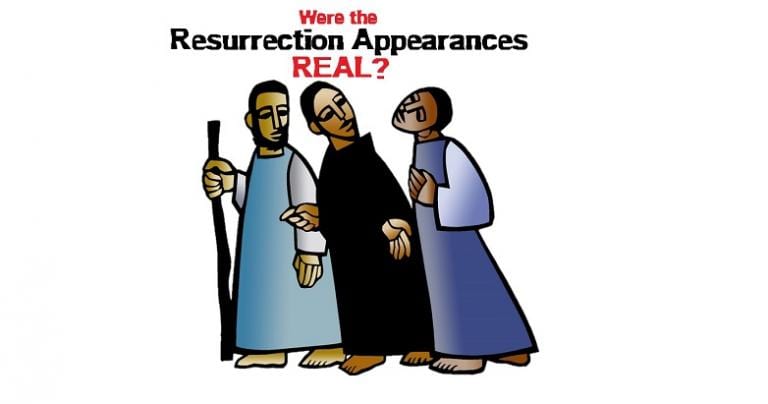
Modified Clipart by Fellow Dying Inmate / KissClipart.com
Appearances of Jesus risen and alive—like in the Emmaus story—vary among the Gospels, but insights from culturally sensitive investigation opens exciting possibilities.
Appearances of the Risen Lord are reported in the Gospels, documents that evolved and were not 21st century Western fact-precise biographies. What should modern American readers make of these accounts? Are these appearances literary creations, at best, fables meant to teach readers a message, at worst, fake news? Or are they exact representations of what literally happened, fact-precise accounts? Could they instead be reports of psychological delusions, products of the human brain coping with despair?
Catholics and other Christians confess the reality of the Resurrection. It’s not an idea, or just a good story, or pathological fantasy. Paul bet his life on the resurrection (1 Corinthians 15:12-19). He experienced the Risen One real and alive. This was a real resurrection appearance to Paul, who speaks also of appearances to Kephas and to the Twelve, and appearances to James and to 500 believers (1 Corinthians 15:5-7). Are these appearances real? Made up? Delusions?
This past Sunday the Gospel (Luke 24:13-35) reading tells about one of the risen Jesus’ appearances to two disciples on the way to a place called Emmaus. Please watch the video below.
Reality of the Appearances
Did appearances of Jesus like that actually happen? Or did two disciples report they saw Jesus appear to them, but lied, made the story up? Could it be that they were honest about their experience, but delusional, their minds broken by grief? Or did the author we call “Luke” invent this story for theological purposes?
Imagine a legal trial. Jurors assemble to listen carefully to the evidence and reach a verdict. Ideally, throughout the trial process, the jury will follow the multiple scenario approach (or the theory-evidence coordination model). In other words, they should pay careful attention to the (often conflicting) evidence presented, imagine multiple plausible scenarios, and then select that scenario which best corresponds with the most consistent and least discrepant evidence. Because of that most probable scenario, the jury arrives at a suitable verdict.
Generally speaking, juries that follow this model simultaneously accept that other judgements are possible while being confident with their own verdict.
But this ideal situation does not always happen, whether in courtroom discernment or that from ordinary life. A good number of people, sometimes immediately following opening arguments or initial presentation of evidence, arrive at a single scenario constructed to explain everything. Thus any subsequent information that conflicts this one dominant scenario gets rejected while any information that fits is retained. Terrifyingly, such jurors who follow this single-scenario approach tend to be immutably certain and are closed off to any other possible interpretations.
Right Scenario of the Resurrection Appearances Reports
All this applies to biblical studies, to exegetes and theologians, as well as to jurors. Academia is not immune to rushing to premature and uninformed judgment. We can see this predilection in a dogged reliance on single scenarios proposed by scholars to explain (or explain away) the resurrection appearances recorded in New Testament documents. A good number of scholars select the scenario that suits their predispositions, and they fix themselves to it, despite all contrary evidence.
However many proposed theological explanations of these resurrection appearances are anachronistic and ethnocentric. From various exegetes come explanations including literary invention (i.e., it never happened), hysterical delusion, or psychological condition (e.g., Peter had an overactive guilt complex coupled by failed mourning, while Paul had a “Christ complex”). The psychological explanations offered also are ethnocentric to our cultural world and therefore impossible.
For instance, how many ancient, anti-introspective personalities (e.g., all biblical figures) suffered psychological guilt? Answer: ZERO. Peter never had a guilty feeling once in his life, including after his denials. Shame? You bet. But never guilt. As scholar John Pilch explained, whether medical or psychological, Western science is so monocultural it is rendered useless when applied to other cultures.
Thinking Rightly about the Appearances
How do we reject these inappropriate single-scenario interpretations so inviting to our scientifically-sophisticated and science-obsessed culture? How can we reach a culturally plausible scenario for the resurrection appearances? What would be the preferred approach to interpreting the reported phenomena in resurrection appearance stories like the Emmaus reading in Luke 24:13-35?
Certainly we should be cautious not to turn Biblical authors or characters into Americans. But that’s a feat trickier than it sounds. Wouldn’t avoiding such foolishness have to come by way of combining things Mediterranean anthropology with cultural psychology appropriate to model personalities from that cultural continent?
What would such a combo do when applied to the Emmaus story where the risen Jesus is perceived as a stranger and fellow traveler? Or when he is mistaken to be a gardener (John 20:15)? What does it tell us of the report where the risen Jesus is thought to be a stranger on the beach (John 21:4)? Or a ghost (Luke 24:37, 41)?
Learning with clarity about what people do and say and how they do so comes easy. Reporting that so-and-so did this or that isn’t difficult. In contrast, learning what they mean by these acts however, is difficult, particularly when the doer hails from an alien culture. Language—whether in wordings or behavior—derives its meaning from social systems. Without recourse to a social system, either my own or that of my informants, understanding is rendered impossible.
Getting Serious and Respectful with our Readings
Whenever expressing or communicating, natives take for granted their social system. Because this is so, the native presumes that everyone with whom they interact is one with them in understanding how the world works. You would be wise to consider New Testament authors as natives indigenous to a vastly different cultural world of meaning than ours!
Natives describing human behavior from their own point of view is called by anthropologists an emic description. The term emic comes from phonemic, distinguishing meaning from what a speaker says. Seen this way, the 27 New Testament documents are a treasure chest filled with emic data.
Outsider Observations
When an outside observer studies cultures, such as when a 21st century American reads the 1st century Mediterranean library called “Bible,” they need a model of how the world works. This model ought to include both the cultural world of the observer (American) and that very different cultural world of the observed (ancient Mediterranean). The model’s usefulness depends on it being articulate, non-impressionistic, and independently verifiable.
So the observer (American Gospel reader) describes what she thinks is going on in. Her descriptions are derived from her working model. Anthropologists call these descriptions etic. The word etic is derived from phonetic, referring to what something spoken sounds like to a listener.
Understanding what Accounts of Appearances Mean
Philosophically speaking, to rightly articulate the emic in an etic way means the outside observer is understanding the native insider. This cross-cultural comparison forms the bridge of understanding. Respectful Bible reading demands this along with much care to achieve it. But failed etic choices—the resurrection accounts were literary inventions, manipulative fake news, or psychological delusions produced by hysterics or depression—must be weeded out.
As in the courtroom, rightly reading and interpreting Gospel stories, necessarily a form of cross-cultural communication, demands that we imagine an appropriate reading scenario. Psychological anthropology, Mediterranean anthropology, and cognitive neuroscience offer us fascinating insights that are culturally sensitive and respectful. They document that Mediterranean penchant for regular and routine experiences in altered states of consciousness, ethnocentrically dismissed as pathological by Western observers. Reports of such experiences in alternate reality fill the Bible, from Genesis to Revelation. Can these help us understand the resurrection appearances?
In an altered state of consciousness, we humans experience changes in sensations and emotions, perception and cognition. Feeling, perceiving, and thinking are altered. Our relationship with our self (a construct), our body, our sense of identity, and everything and everyone else is transformed. Awareness opens, and we become able to see by glimpses alternate reality, the Real hidden and obfuscated by our culturally conditioned pragmatic consciousness. This is especially true of Western cultures that according to cultural psychologist Arthur Kleinman, deliberately block and dismiss as pathological these experiences.
Altered States of Consciousness?
What if Jesus’ contemporaries truly experienced him risen and alive but by way of altered states of consciousness experiences, a capacity for which God hardwired all human beings? And what if, besides alleviating grief, such experiences also helped the earliest believers better understand Jesus’ life and teaching, and where Jesus’ current whereabouts in the Realm of God? What if they gave them new directions? Over several posts we will explore fascinating Eastertide possibilities.
altered states of consciousness
Appearances of the Risen Jesus
Previous Post

April 24, 2020
Disinfectant Cure-all, Trump, & Co-Authoring our Future
Next Post
May 1, 2020 ASC & Biblical Wonders: Etic VS Emic
Browse Our Archives
Select a Category Uncategorized
Select a Month August 2021 July 2021 June 2021 May 2021 April 2021 March 2021 February 2021 January 2021 December 2020 November 2020 October 2020 September 2020 August 2020 July 2020 June 2020 May 2020 April 2020 March 2020 February 2020 January 2020 December 2019 November 2019 October 2019 September 2019 August 2019
Follow Us!
TAKE THE
Religious Wisdom Quiz
What does "Satan" mean in Hebrew?
Select your answer to see how you score.
Destroyer Adversary Evil One Deceiver
Support this
Column


Related posts from Messy Inspirations

Understanding Apocalypse & Its Creatures



TRENDING AT PATHEOS Catholic

Rejecting Doom: Christian Hope And Human Action
Christianity is a religion of hope. We are to have hope and...

It’s What Comes From Within Which Matters
One of the most difficult things for us to understand is why...

Why I Choose the Eucharist Over the Sermon
Choose the Eucharist, Not the Sermon What are we supposed to get...

5 Design Elements Found in Spiritually Rooted Homes
Putting Spirituality Into Home Decor Our homes are more than our living...

Credo: A Story of God Told with the...
About 10 years ago, I began to imagine a personal "Credo" that...

The Anatomy of Divine Revelation in Catholic Thought
The claim that God has made Himself known to human beings is...
view all Catholic blogs
Ad-Free & Subscriber Log-In Subscription Support
- About Us
- 2026 Calendar
- Videos
- Podcasts
- Library of World Religions
- Faith In Media Tracker
- Advertise With Us
- Write for Us
- Privacy Policy
- Terms of Service
- Do Not Sell My Data
- Contact Us
- Radiant Digital
- Manage Newsletter Subscriptions
- Unsubscribe From Notifications
- Sitemap
Copyright 2008-2026, Patheos. All rights reserved.
Subscription Support Ad-Free & Subscriber Log-In
Follow Patheos