
BuddhistCatholicContemplativeEvangelicalGeneral ChristianHinduJewishLatter-day SaintMuslimNew VisionsProgressive Christian
Beliefs
- Buddhist
- Catholic
- Contemplative
- Evangelical
- General Christian
- Hindu
- Jewish
- Latter-day Saint
- More Voices
- Muslim
- New Visions
- Pagan
- Progressive Christian
Topics
- Religion News
- Food and Religion
- Sports and Religion
- Religious Art
- Religious Music and Entertainment
- Religious Events
- History and Religion
- Style and Religion
- Politics and Religion
- Women in Religion
- Recreation Outdoors and Religion
- Business Finance and Religion
- Careers Workplace and Religion
- Education and Religion
- Family Parenting and Religion
- Health Fitness and Religion
- Home and Religion
- Relationships and Religion
- Technology and Religion
- Travel and Religion
Columnists
- Buddhist Columnists
- Business Finance and Religion Columnists
- Careers Workplace and Religion Columnists
- Catholic Columnists
- Contemplative Columnists
- Education and Religion Columnists
- Evangelists Columnists
- Family Parenting and Religion Columnists
- General Christian Columnists
- Health Fitness and Religion Columnists
- Hindu Columnists
- History and Religion Columnists
- Home and Religion Columnists
- Jewish Columnists
- More Voices Columnists
- Latter Day Columnists
- Muslim Columnists
- New Visions Columnists
- Nonreligious Columnists
- Pagan Columnists
- Politics and Religion Columnists
- Progressive Columnists
- Recreation Outdoors and Religion Columnists
- Relationships and Religion Columnists
- Religion News Columnists
- Religious Art Columnists
- Religious Events Columnists
- Religious Music and Entertainment Columnists
- Sports and Religion Columnists
- Style and Religion Columnists
- Technology and Religion Columnists
- Travel and Religion Columnists
- Women in Religion Columnists
Resource Library
- 2026 Calendar
- Library of World Religions
- The 100 Most Holy Places on Earth
- Patheos Answers
- Podcasts
- Videos
- Faith Leaders Database
- Anglican Episcopalian
- Bahai
- Baptist
- Buddhism
- Christianity
- Confucianism
- Eastern Orthodoxy
- Hinduism
- Holiness and Pentecostal
- ISKCON
- Islam
- Judaism
- Lutheran
- Methodist
- The Church of Jesus Christ of Latter-day Saints
- New Age
- Paganism
- Presbytarian and Reformed
- Protestantism
- Religion Behind the Scenes
- Roman Catholic
- Scientology
- Shia Islam
- Sikhism
- Sufism
- Sunni Islam
- Taoism
- Zen
- See all religions
Research Tools
 Ad-Free & Subscriber Log-In Subscription Support
Ad-Free & Subscriber Log-In Subscription Support
Follow Patheos 

- Trending:
- Forgiveness
- |
- Marriage
- |
- Consciousness
- |
- Death Penalty
- |
- Election
- |
- Halloween
 Messy Inspirations
- Home
- Catholic
- Affirm and Deny: Seeking a Mature Articulation of Faith
Affirm and Deny: Seeking a Mature Articulation of Faith
Last updated on: February 17, 2020 at 8:36 pm by Fellow Dying Inmate
Affirm and Deny: Seeking a Mature Articulation of Faith 2020-02-17T20:36:36-04:00 Fellow Dying Inmate
Patheos Explore the world's faith through different perspectives on religion and spirituality! Patheos has the views of the prevalent religions and spiritualities of the world.
Image by sspiehs3 from Pixabay
Affirm! Deny! and Grow! How does a sophisticated articulation of faith happen and relate to theology?
“Affirm the faith! Teach the faith!” But faith never exists in a ziplock bag, sealed away in a theologically-pure state. “Stop theologizing! Just teach THE Faith!” Any attempt to teach “the Faith” necessarily mixes into it theology, God-talk.
But we have good and bad theologies, mature and not-so-mature theologies. Affirmations and statements of assent to the Tradition need not be poor theologically speaking. By that I mean the typical and expected theological boilerplate served up by parroting verbal orthodoxy.
Living the faith is more than saying all the right or popular things we do Sundays in our “clubhouse.” What are signs of a growing, maturing faith? Is there understanding to what is being said and how it relates to everything else? Is it being lived consistently? Where is the praxis? Is discipleship springing from this? Where is the empathy and compassion for others?
To Affirm More than Mere Verbal Orthodoxy
This is not to make verbal orthodoxy irrelevant. God-talk, no matter how limited, is necessary. We must employ words. Yes, we Catholics must affirm the existence of God and the supernatural order. Surely we must affirm God’s presence and saving actions in history. Of course we must affirm the wonders of God’s saving love. Certainly we must accept the truth of the Scriptures and not take them to be void of all historicity.
But let’s go a bit deeper and clear up some mistaken ideas…
To Affirm, Not Deny
Consider:
-
To affirm that prior to Origen (d. 253) the Church did not distinguish between “natural” and “supernatural”—and therefore the distinction “supernatural” is unknown to the Scriptures—is not, necessarily, to deny a supernatural order.
-
To affirm that no inspired author of the Scriptures saw God as “intervening” in history (could they imagine God absent sometimes?) does not necessarily demand a denial that God does so in Revelation.
-
To affirm that “miracle,” meaning “a violation of the physical laws governing the universe” is a post-Enlightenment word does not necessarily deny the possibilities and existence of “signs,” “wonders,” “marvels,” “mighty deeds,” and “works.”
-
To affirm that the Bible is all true but only some of it happened is not necessarily a denial that faith and historical truth are compatible, or that faith and reason are consonant.
-
To affirm that the Gospels and the rest of Sacred Scripture were not 21st century Western historical or biographical works does not necessarily constitute a denial of their historical value or their salvific inerrancy and truth.
Keep Em Simple, Stupid!
But many would disagree. And many of these who would disagree ascribe to popular pre-critical views of the Church. Sadly, these are still held by many 21st century Catholic Christians and promoted through much of popular Catholic media. They proliferate among young, privileged U.S. Catholics.
Some would have us believe that all the Catholic doctrines and practices are right there looking at us from the Biblical page. They give us schemes to prooftext the Bible, fishing for proofs that our tradition is the one, true, and only. They turn the Scriptures into a big a connect-the-dots game for Bible Wars that “prove” our tradition, Catholic Christians. This is a huge problem with popular Catholic authors and speakers.
These people want to believe that everything is obvious and clear. Because that’s how their God must be, and that is how life must be. Clear. Obvious. Ready-made. Never vague. Never confusing. That’s how they play both life and religion.
Not So Clear
But things are not clear and obvious. Even though we affirm as Christians that in Jesus God has been so definitively and manifestly disclosed doesn’t mean we are free from ambiguities. We never will be. Even the possibility of error always lurks in secondary matters of belief! Holy and Absolute Mystery disclosed in Revelation still is Mystery.
Words are useful but to a point. No matter how solemn or sacred or official the language, no words or sentences can ever box up and domesticate Holy Mystery. And all our God-talk is culturally-specific anthropomorphic analogy. That’s true also for all the God-talk found in our Bible. Being inspired does not change that.
To Affirm Our Messy Baggage
In the Hebrew Scriptures, we find God-talk and a theological image of God rooted in the social structure of Israelite monarchy. Ancient Israelite monarchy was confined to a single ethnic group. Therefore, it was a monarchy of one people among many monarchies of many different peoples. Thus the image of God we find most often in the Bible is one of henotheism rather than monotheism.
Why is this? St. Thomas Aquinas and his peers shout to us the answer:
All theology is analogy; all analogy is rooted in human experience.
And to this Medieval Catholic (and catholic!) wisdom, we ought to add a great insight from the social sciences:
All human experience is culturally-specific.
Affirm the Fitting Analogy
So what do we need in order to have a fitting analogy for ONLY One God? Recall that the roots of God-talk about God lie in Israelite monarchy. So one emperor, or king of kings, should suffice. This makes sense as theology or God-talk is culturally-specific anthropomorphic (and anthropopathic!) analogy. But before such an emperor arrives on the scene, how can you have monotheistic God-talk? There’s no analogue!
By the way: none of this excludes the reality that God, Holy and Absolute Mystery, is being disclosed and better understood. But that’s the thing with Mystery! There’s always something you get, and always something you don’t get. And the words, while useful, are always in danger of being turned into mental and emotional idols. And I’m talking killer-idols.
Henotheism?!
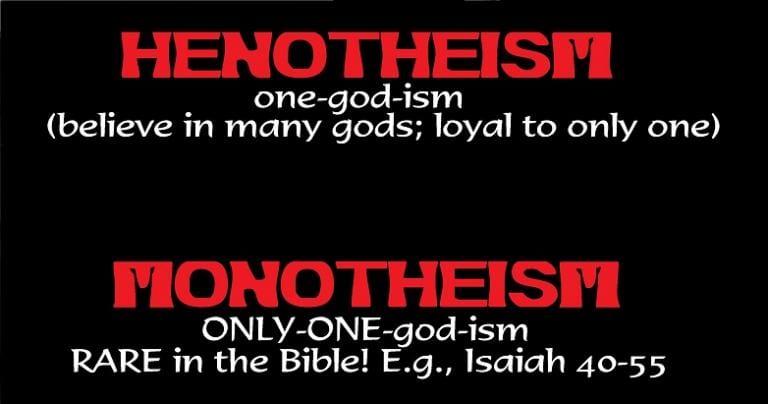
Henotheism is the predominant view of Scripture. It means “ONE-GOD-ISM.” Contrast that with monotheism which means “ONLY-ONE-GOD-ISM.” Henotheism refers to having loyalty to one God among a large number of gods. It means each ethnic group or even each subgroup gave allegiance to its own supreme God, without denying the existence of other groups and their deities.
Fellow Dying Inmate / All rights reserved
Since the king of Israel was but one king among many kings, so too the God of Israel was seen as only one god (even if supreme) among many gods of other peoples. This is henotheism. Henotheism is the predominant theological image of God one finds throughout Hebrew Scriptures and New Testament.
Take the label “the chosen people.” This replicates a henotheistic conception of God. It spells out one God with preeminence over other gods with one people having preeminence over other peoples. In this case, at the roots of the Abrahamic Tree, we see the God of Israel named YHWH or Elohim or Adonai (Lord) or YHWH/Elohim.
Note the henotheistic commandment demanding that Israel “shall have no other gods before me” (Exodus 20:3; Deuteronomy 5:7). See how it insists on precedence and preeminence for the God of Israel, and not uniqueness?
To Affirm Monotheism
Perhaps the first social structure to serve as an analogy for a monotheistic God was the Persian Empire. How did monotheism, both as a practical political-religious orientation and as an abstract philosophical system, come to permeate some ancient Middle Eastern peoples? It happened through a monarchy that embraced and dominated the whole world. What empire did that? The first was Persia. Like the Persian Zoroaster, the Persian experience of Israel assisted its prophets to see the oneness and uniqueness of God.
But it didn’t stick. That’s why you only see what is perhaps true monotheism in the few pages of Deutero-Isaiah (chapters 40—55). This was because of what followed, namely the “catholic” experience of Alexander of Macedon and the fragmentation of his empire. Once shattered into pieces, what remained in the Hellenized world was the return to familiar “henotheistic” monarchies. Hence there was a reversion to henotheism.
Persia established Yehud (later Judea) and the Torah in its current form. But after Persia, no social structure existed to serve as an analogy for a monotheistic God. That wouldn’t happen until the Roman Empire. And even then, the New Testament is primarily a henotheistic library.
Christians Affirm Monotheism
Now make no mistake. As Christians, we Catholics are monotheists. Indeed, we are Trinitarian monotheists. We are in continuity with the early Jesus groups of Israel and the Jesus Movement. But they were henotheistic communities (and therefore were neither Jews nor Christians).
As Catholics we affirm continuity with Jesus and the apostles. But this must be a continuity within development (analogous to an oak growing out from an acorn). The Spirit guides us through this evolution, but never coerces it, never dictates to us. God is not a micromanaging control freak. So should we expect our Trinitarian monotheism spelled out and espoused by our Israelite ancestors in the faith?
Yet many of us Catholics have so much baggage left over from Pre-Vatican II times. And with it, they make so many wrong assumptions about how things must be. They have confused something good, a child-like faith, with something terrible, childish beliefs. One we are called to live out. The other? Never. More on this soon…
Previous Post
February 16, 2020
Righteousness & the Sermon on the Mount
Next Post

February 20, 2020 Canon Matters—Mark 8 VS Matthew 16
Browse Our Archives
Select a Category Uncategorized
Select a Month August 2021 July 2021 June 2021 May 2021 April 2021 March 2021 February 2021 January 2021 December 2020 November 2020 October 2020 September 2020 August 2020 July 2020 June 2020 May 2020 April 2020 March 2020 February 2020 January 2020 December 2019 November 2019 October 2019 September 2019 August 2019
Follow Us!
TAKE THE
Religious Wisdom Quiz
A plant grew overnight to shade me, then withered, making me angry enough to die. What lesson did God teach through this?
Select your answer to see how you score.
Our need for Humility Trust in God God's compassion for people God's Patience with us
Support this
Column


Related posts from Messy Inspirations

Understanding Apocalypse & Its Creatures



TRENDING AT PATHEOS Catholic

Rejecting Doom: Christian Hope And Human Action
Christianity is a religion of hope. We are to have hope and...

It’s What Comes From Within Which Matters
One of the most difficult things for us to understand is why...

Why I Choose the Eucharist Over the Sermon
Choose the Eucharist, Not the Sermon What are we supposed to get...

5 Design Elements Found in Spiritually Rooted Homes
Putting Spirituality Into Home Decor Our homes are more than our living...

Credo: A Story of God Told with the...
About 10 years ago, I began to imagine a personal "Credo" that...

The Anatomy of Divine Revelation in Catholic Thought
The claim that God has made Himself known to human beings is...
view all Catholic blogs
Ad-Free & Subscriber Log-In Subscription Support
- About Us
- 2026 Calendar
- Videos
- Podcasts
- Library of World Religions
- Faith In Media Tracker
- Advertise With Us
- Write for Us
- Privacy Policy
- Terms of Service
- Do Not Sell My Data
- Contact Us
- Radiant Digital
- Manage Newsletter Subscriptions
- Unsubscribe From Notifications
- Sitemap
Copyright 2008-2026, Patheos. All rights reserved.
Subscription Support Ad-Free & Subscriber Log-In
Follow Patheos