
BuddhistCatholicContemplativeEvangelicalGeneral ChristianHinduJewishLatter-day SaintMuslimNew VisionsProgressive Christian
Beliefs
- Buddhist
- Catholic
- Contemplative
- Evangelical
- General Christian
- Hindu
- Jewish
- Latter-day Saint
- More Voices
- Muslim
- New Visions
- Pagan
- Progressive Christian
Topics
- Religion News
- Food and Religion
- Sports and Religion
- Religious Art
- Religious Music and Entertainment
- Religious Events
- History and Religion
- Style and Religion
- Politics and Religion
- Women in Religion
- Recreation Outdoors and Religion
- Business Finance and Religion
- Careers Workplace and Religion
- Education and Religion
- Family Parenting and Religion
- Health Fitness and Religion
- Home and Religion
- Relationships and Religion
- Technology and Religion
- Travel and Religion
Columnists
- Buddhist Columnists
- Business Finance and Religion Columnists
- Careers Workplace and Religion Columnists
- Catholic Columnists
- Contemplative Columnists
- Education and Religion Columnists
- Evangelists Columnists
- Family Parenting and Religion Columnists
- General Christian Columnists
- Health Fitness and Religion Columnists
- Hindu Columnists
- History and Religion Columnists
- Home and Religion Columnists
- Jewish Columnists
- More Voices Columnists
- Latter Day Columnists
- Muslim Columnists
- New Visions Columnists
- Nonreligious Columnists
- Pagan Columnists
- Politics and Religion Columnists
- Progressive Columnists
- Recreation Outdoors and Religion Columnists
- Relationships and Religion Columnists
- Religion News Columnists
- Religious Art Columnists
- Religious Events Columnists
- Religious Music and Entertainment Columnists
- Sports and Religion Columnists
- Style and Religion Columnists
- Technology and Religion Columnists
- Travel and Religion Columnists
- Women in Religion Columnists
Resource Library
- 2026 Calendar
- Library of World Religions
- The 100 Most Holy Places on Earth
- Patheos Answers
- Podcasts
- Videos
- Faith Leaders Database
- Anglican Episcopalian
- Bahai
- Baptist
- Buddhism
- Christianity
- Confucianism
- Eastern Orthodoxy
- Hinduism
- Holiness and Pentecostal
- ISKCON
- Islam
- Judaism
- Lutheran
- Methodist
- The Church of Jesus Christ of Latter-day Saints
- New Age
- Paganism
- Presbytarian and Reformed
- Protestantism
- Religion Behind the Scenes
- Roman Catholic
- Scientology
- Shia Islam
- Sikhism
- Sufism
- Sunni Islam
- Taoism
- Zen
- See all religions
Research Tools
 Ad-Free & Subscriber Log-In Subscription Support
Ad-Free & Subscriber Log-In Subscription Support
Follow Patheos 

- Trending:
- Forgiveness
- |
- Marriage
- |
- Consciousness
- |
- Death Penalty
- |
- Election
- |
- Halloween
 Messy Inspirations
- Home
- Catholic
- Magi—Three Kings Revisited
Magi—Three Kings Revisited
Last updated on: January 4, 2020 at 12:45 pm by Fellow Dying Inmate
Magi—Three Kings Revisited 2020-01-04T12:45:39-04:00 Fellow Dying Inmate
Patheos Explore the world's faith through different perspectives on religion and spirituality! Patheos has the views of the prevalent religions and spiritualities of the world.
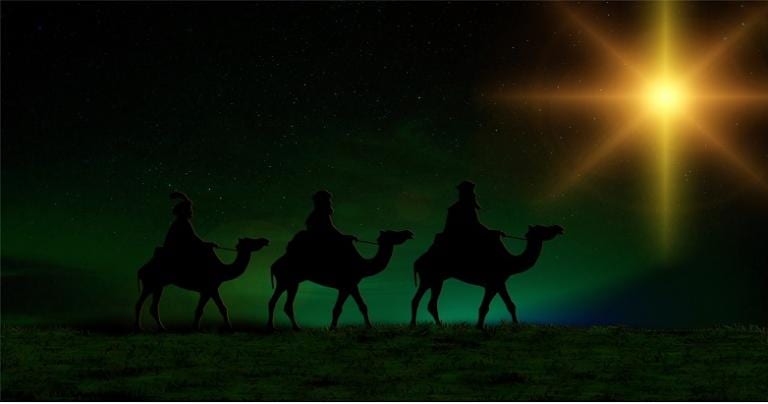
Image by Gerd Altmann from Pixabay
Magi in “Matthew,” often thought in spurious familiarity as “Three Kings,” showcase many layers of history and symbolism that contributes to the Feast of Epiphany.
Magi figure prominently in the Feast of “Three Kings,” or “Epiphany.” This is a beloved part of Christmas. For many Catholics, this is the true Christmas, the day gifts are opened. Beautiful traditions surround this Feast. But who were the Magi? What were they about? How many Magi were there?
Throughout December until now, Messy Inspirations has provided its readers with various essays about the Gospel origins of Christmas, the Infancy Narratives of Matthew 1—2 and Luke 1—2. The purpose behind these posts has not been to harm or dislodge the faithful, but to challenge growth into a better appreciation of the reality of the Lord Jesus, his poverty, his humble origins. Christians must take the “in” of Incarnation seriously.
The beloved hymn, “WE THREE KINGS OF ORIENT ARE,” is forever wed to this Feast. At liturgies everywhere this Sunday, congregations will sing out its cherished verses, often as an entrance hymn. Given everything we have been learning on this blog, I thought of adding some extra lines to the old song, with notes scattered in between to help us grow some more. Here is a video presentation to the old hymn to help you sing along…
We Three Kings, Part Two (as in Vatican II)
(Try to sing along with the traditional melody…)
“Luke” and “Matthew” mixed up a lot Magi-kings at manger were not Fifty years, many tears Vatican II…WHAT?
OOOOOOO NOOOOOOO! Stories different, Stories blurred Harmonized into the absurd Sentimental, eisegetical Devotionally pictured.
“Mixed up…”—
We do it all the time, despite since ancient times rejecting Tatian’s Diatesseron.
The Magi (NOT kings)—
These men, not necessarily three in number, are only found in “Matthew,” not “Luke” (where manger is to be found; in “Matthew” Jesus is born in a house, and no manger is mentioned). Biblical scholarship informs us that while they do share common material and traditions, “Matthew” never read “Luke” and “Luke” never read “Matthew.”
The term μάγοι in Matthew 2:1-12 should just be translated Magi, as the New American Bible, Revised Edition, New International Version, and New American Standard Bible, have it. “Wise men”—found in the King James Version, New Jerusalem Bible, Revised Standard Version, and New Revised Standard Version—is not specific enough. To translate μάγοι as “kings” is completely wrong. To call these men “astrologers” is only partly correct, says John Pilch.
There were three gifts, not three Magi. Eastern traditions remember twelve Magi. More below on the Magi.
“Fifty years”—
Vatican II, the most important Christian event in recent memory (and of which most U.S. Catholics are oblivious) ended in 1965.
Christology is way too high Chalcedon unknown by Magi No Godman reflection till Resurrection Why would God be some guy?
OOOOOOO NOOOOOOO! Stories different, Stories blurred Harmonized into the absurd Sentimental, eisegetical Devotionally pictured.
Christology is way too high—
Assuming that the Magi (or any other human) knew that Jesus was the Incarnate Son of God prior to the Resurrection is anachronism and wrong. No one reflected on Jesus being divine in any way until after his Resurrection. It would take centuries for the Church’s Christological understanding, guided (not coerced) by the Holy Spirit, to evolve (see compromise formula of Council of Chalcedon, 451). No matter how highly esteemed the prepaschal Jesus was, no one would think he was the God of Israel, the One enthroned above the highest sky vault.
Hebrew has no future tense Nostradamus does not make sense Gospel maybe AD 80 Eight decades after events.
OOOOOOO NOOOOOOO! Stories different, Stories blurred Harmonized into the absurd Sentimental, eisegetical Devotionally pictured.
Hebrew and Aramaic really don’t have tense at all—
Action is either completed or incomplete. Peasants in all cultures are intensely focused on the present and don’t go further ahead in time than the forthcoming. Scratching out a subsistence level of survival, they don’t have leisure time to speculate on “future-time.”
Nostradamus does not make sense—
Biblical prophets, such as those “Matthew” cites in his text, were experts in God’s will for the here-and-now—they weren’t predicting the future, but expressing the forthcoming already in process in their present (think how a present pregnancy leads to a forthcoming birth). Isaiah did not peer through time-travel binoculars looking at the birth of Jesus centuries on when he spoke of a maiden with child—he was speaking to Ahaz about their present crisis with the Assyrian Empire (ca 700 BCE).
Gospel maybe 80AD—
Scholars inform us that “Matthew” was written probably in the 80s; its infancy narrative (Matthew 1—2) could not have apostolic witness (see Raymond Brown, Birth of the Messiah).
Sixteen Documents for your eyes And PBC texts are a big surprise Will you read them? Will you read them? Neglecting them most unwise…
OOOOOOO NOOOOOOO! Stories different, Stories blurred Harmonized into the absurd Sentimental, eisegetical Devotionally pictured.
Sixteen Documents—
Startling reflections concerning what the Church ACTUALLY teaches about revelation, inspiration, and sacred Scripture are found in Vatican II’s Documents, particularly the Dogmatic Constitution on Divine Revelation, and the Pontifical Biblical Commission documents (The Historical Truth of the Gospels and Interpretation of the Bible in the Church).
Stories different—
You cannot harmonize into a 21st century historically accurate “Life of Christ” biography Matthew 1—2 with Luke 1—2. These accounts were not written for that purpose. The Bible is all true and some of it actually happened.
Sentimental—
Feelings are NECESSARY but should never be our exclusive vehicle to God.
Eisegetical—
The opposite of exegesis is eisegesis, reading things into the Biblical text rather than what it actually says, a big no-no.
Devotionally pictured—
Devotions are a great help, but should not be an escape from critical reflection.
More on the Magi
We have spoken before about how “Matthew,” like “Luke,” embellished and created stories surrounding the birth of Jesus. This was nothing unusual. Ancient biographers like Plutarch routinely crafted extraordinary origin stories full of special and remarkable occurrence for great and famous people. Scholars like John Pilch, Richard Rohrbaugh, and Bruce Malina explain that the story of the Magi visiting Bethlehem we are getting in Matthew 2:1-12 is an amalgamation of fact and fiction.
According to Pilch, the Magi ranked high in the honor scale of the social world of Jesus. They were political-religious advisers to Median and Persian kings. Strabo and Xenophon inform us that the Magi were adept at bartering favors with alternate reality—they brokered favors with Ahura Mazdah for the King of Kings, the Persian Ruler. Pilch explains that they even successful in staging a coup and replaced the Great King, making them a perennial threat and force to be reckoned with inside the Persian Empire.
The Historical Magi and Nero
Eventually Rome began to dominate the Mediterranean. Pilch explains that the Magi encouraged resistance against the Roman Empire and all Western influences. Just thirty-six years after the Crucifixion of Jesus, in 66 CE, the Romans rejected the son of Herod to rule Armenia. In their place, they accepted a Parthian candidate, Tiridates.
To receive his crown from Nero in Rome, Tiridates traveled there to publicly do the Emperor homage. His journey took nine-months. In Tiridates’ entourage came three of the neighboring Parthian rulers. Also there were a multitude of horsemen and Romans, slaves, relatives, and plenty of Magi. The whole trip was paid for by Rome. When they left Rome, they chose a different route (cf. Matthew 2:12).
Pilch explains that everyone in the first century Mediterranean knew about this event when it transpired. Afterward, everyone remembered it. It was impossible for the author we call “Matthew” to not know the story.
Matthean Creativity and Splicing
Imagine this: someone, in some Jesus group, before “Matthew” (but after “Mark”), perhaps created a story spinning things about the Magi and Jesus. Instead of going to honor Nero, they go to honor Jesus. Pilch explains that in this original story, the Magi chart Jesus’ horoscope, are guided by his star, discover him and do him honors, then leave. Pilch says that “Matthew” possibly reshaped this story, and edited it into his Infancy Narrative.
Our Christian tradition and liturgy are rich with images, deep symbolism, and centuries of recontextualizations. “Epiphany” or “Three Kings,” as we have it, is a treasury of this process. Many lenses have contributed to the meaning of this feast. This goes on through the ages. Happy “Three Kings.”
Previous Post

January 3, 2020
Celestial VIP—Christmas Stars and How to Write Them
Next Post

January 6, 2020 Comedian Ricky Gervais and Costly Grace
Browse Our Archives
Select a Category Uncategorized
Select a Month August 2021 July 2021 June 2021 May 2021 April 2021 March 2021 February 2021 January 2021 December 2020 November 2020 October 2020 September 2020 August 2020 July 2020 June 2020 May 2020 April 2020 March 2020 February 2020 January 2020 December 2019 November 2019 October 2019 September 2019 August 2019
Follow Us!
TAKE THE
Religious Wisdom Quiz
Which letter addresses the "fruit of the Spirit"?
Select your answer to see how you score.
Colossians Galatians Hebrews Romans
Support this
Column


Related posts from Messy Inspirations

Understanding Apocalypse & Its Creatures



TRENDING AT PATHEOS Catholic

The Parable Of The Sower And The Word...
One of Christ’s most famous parables is that of the sower who...

Rejecting Doom: Christian Hope And Human Action
Christianity is a religion of hope. We are to have hope and...

Why I Choose the Eucharist Over the Sermon
Choose the Eucharist, Not the Sermon What are we supposed to get...

5 Design Elements Found in Spiritually Rooted Homes
Putting Spirituality Into Home Decor Our homes are more than our living...

Credo: A Story of God Told with the...
About 10 years ago, I began to imagine a personal "Credo" that...

The Anatomy of Divine Revelation in Catholic Thought
The claim that God has made Himself known to human beings is...
view all Catholic blogs
Ad-Free & Subscriber Log-In Subscription Support
- About Us
- 2026 Calendar
- Videos
- Podcasts
- Library of World Religions
- Faith In Media Tracker
- Advertise With Us
- Write for Us
- Privacy Policy
- Terms of Service
- Do Not Sell My Data
- Contact Us
- Radiant Digital
- Manage Newsletter Subscriptions
- Unsubscribe From Notifications
- Sitemap
Copyright 2008-2026, Patheos. All rights reserved.
Subscription Support Ad-Free & Subscriber Log-In
Follow Patheos