
BuddhistCatholicContemplativeEvangelicalGeneral ChristianHinduJewishLatter-day SaintMuslimNew VisionsProgressive Christian
Beliefs
- Buddhist
- Catholic
- Contemplative
- Evangelical
- General Christian
- Hindu
- Jewish
- Latter-day Saint
- More Voices
- Muslim
- New Visions
- Pagan
- Progressive Christian
Topics
- Religion News
- Food and Religion
- Sports and Religion
- Religious Art
- Religious Music and Entertainment
- Religious Events
- History and Religion
- Style and Religion
- Politics and Religion
- Women in Religion
- Recreation Outdoors and Religion
- Business Finance and Religion
- Careers Workplace and Religion
- Education and Religion
- Family Parenting and Religion
- Health Fitness and Religion
- Home and Religion
- Relationships and Religion
- Technology and Religion
- Travel and Religion
Columnists
- Buddhist Columnists
- Business Finance and Religion Columnists
- Careers Workplace and Religion Columnists
- Catholic Columnists
- Contemplative Columnists
- Education and Religion Columnists
- Evangelists Columnists
- Family Parenting and Religion Columnists
- General Christian Columnists
- Health Fitness and Religion Columnists
- Hindu Columnists
- History and Religion Columnists
- Home and Religion Columnists
- Jewish Columnists
- More Voices Columnists
- Latter Day Columnists
- Muslim Columnists
- New Visions Columnists
- Nonreligious Columnists
- Pagan Columnists
- Politics and Religion Columnists
- Progressive Columnists
- Recreation Outdoors and Religion Columnists
- Relationships and Religion Columnists
- Religion News Columnists
- Religious Art Columnists
- Religious Events Columnists
- Religious Music and Entertainment Columnists
- Sports and Religion Columnists
- Style and Religion Columnists
- Technology and Religion Columnists
- Travel and Religion Columnists
- Women in Religion Columnists
Resource Library
- 2026 Calendar
- Library of World Religions
- The 100 Most Holy Places on Earth
- Patheos Answers
- Podcasts
- Videos
- Faith Leaders Database
- Anglican Episcopalian
- Bahai
- Baptist
- Buddhism
- Christianity
- Confucianism
- Eastern Orthodoxy
- Hinduism
- Holiness and Pentecostal
- ISKCON
- Islam
- Judaism
- Lutheran
- Methodist
- The Church of Jesus Christ of Latter-day Saints
- New Age
- Paganism
- Presbytarian and Reformed
- Protestantism
- Religion Behind the Scenes
- Roman Catholic
- Scientology
- Shia Islam
- Sikhism
- Sufism
- Sunni Islam
- Taoism
- Zen
- See all religions
Research Tools
 Ad-Free & Subscriber Log-In Subscription Support
Ad-Free & Subscriber Log-In Subscription Support
Follow Patheos 

- Trending:
- Forgiveness
- |
- Marriage
- |
- Consciousness
- |
- Death Penalty
- |
- Election
- |
- Halloween
 Messy Inspirations
- Home
- Catholic
- Different Jesus Birth Stories
Different Jesus Birth Stories
Last updated on: December 12, 2019 at 1:25 pm by Fellow Dying Inmate
Different Jesus Birth Stories 2019-12-12T13:25:43-04:00 Fellow Dying Inmate
Patheos Explore the world's faith through different perspectives on religion and spirituality! Patheos has the views of the prevalent religions and spiritualities of the world.
Bev / Pixabay.com
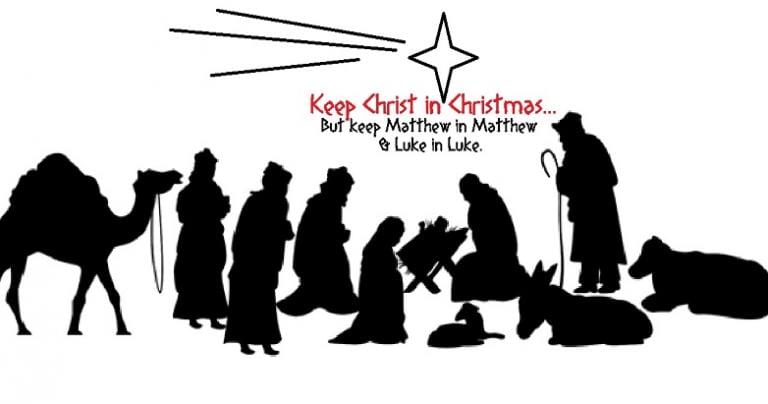
Different accounts of Jesus birth and infancy—the Christmas stories found in Matthew 1—2 and Luke 1—2—are irreconcilable and beyond reasonable harmonization.
Last time we explored why it was highly unlikely that the two accounts of Jesus’ birth and infancy originated with Mary or Joseph. There we repeated something often claimed in this series of posts, namely that the two Infancy Narratives of “Matthew” and “Luke” are very different. Why do Biblical scholars, such as Raymond E. Brown, regard the Infancy Narratives of Matthew 1—2 and Luke 1—2 as being so different? What makes them so different? Let’s examine each of these differences carefully.
A Different Reading
In the Matthean birth story, Joseph and Mary live in a house in Bethlehem (Matthew 2:11). Now I know what many of you reading this are thinking. “A house? That’s different! I never heard that before!” Right. It’s because you’ve watched many movies, and prayed many Rosaries, looked at many Manger Scenes, been to many Christmas pageants, and seen Hallmark cards and much religious artwork. And none of these presented Mary or Joseph living in a house in Bethlehem. Of course it sounds different!
But that’s exactly what “Matthew” tells us. In this Gospel, Joseph and Mary are natives of Bethlehem. They aren’t visiting Bethlehem—there is no census in “Matthew.” They originate there. So, naturally they stay in Bethlehem until the child is nearly two years old (2:16). When Herod tries to murder their young child they flee to Egypt. The only reason they cannot go back to their hometown Bethlehem after old man Herod is dead is out of fear of what Herod’s son will do. Consequently, they go from Egypt to Galilee, to a “city” (??!!) called Nazareth. The implication is that they have never been there before (2:22-23).
It’s right there in the text of “Matthew.” Why have we never seen it before? Might I suggest it could very well be because all of the Christmas devotions and observances have done the work for us? The net effect of these highly impactful and sentimental influences is that, were we to actually read Matthew 1—2, our brains would plug things into our reading that aren’t there!
Different Hometown and House
Matthew 2:10-11—
They were overjoyed at seeing the star, and on entering the house they saw the child with Mary his mother. They prostrated themselves and did him homage. Then they opened their treasures and offered him gifts of gold, frankincense, and myrrh.
According to the Matthean infancy narrative, Joseph and Mary are natives to Bethlehem! They live in their house there! Houses would be part of patriarchal compounds with as many as 50 to 100 people. There is no Lukan manger mentioned, and definitely no stables! The author “Matthew” expects his audience to understand this, being that he writes for people equipped with culturally-appropriate auxiliary background information. We Western Christians, reading with spurious familiarity, are blind to this.
“Matthew” has no idea some other author we name “Luke” is writing another account of Jesus’ birth and youth. There is no way he is leaving out biographical details for another writer to fill in. Also, his text cannot be a narrative jigsaw puzzle piece to fitted into a greater whole comprised of other Gospels—no way “Matthew” intended that! But onward we go treating all of them as such.
Different Times
Matthew 2:16—
When Herod realized that he had been deceived by the magi, he became furious. He ordered the massacre of all the boys in Bethlehem and its vicinity two years old and under, in accordance with the time he had ascertained from the magi.
Notice that the family remains in Bethlehem, their hometown, until the child is approximately two years old. This is very different than what we are told about Jesus’ birth and infancy in “Luke.”
Different Reasons for Going to Nazareth
Matthew 2:22-23—
But when [Joseph] heard that Archelaus was ruling over Judea in place of his father Herod, he was afraid to go back there. And because he had been warned in a dream, he departed for the region of Galilee. He went and dwelt in a town called Nazareth, so that what had been spoken through the prophets might be fulfilled, “He shall be called a Nazorean.”
Again, according to “Matthew” the family’s real home is Bethlehem. The only reason they cannot go back there after the flight to Egypt is their fear of Herod’s son! So, consequently, they travel into Galilee, to a “city” called Nazareth. The narrative implies that they have never been there before.
Notice how “Matthew” deals with Jesus being associated with a lowly, nothing-place such as the hamlet called Nazareth. “Matthew” was embarrassed of Jesus’ lowly Galilean origins. So what does “Matthew” do? He emphasizes his Davidic heritage. Bethlehem was called “the city of David” his origin village.
How is “Luke” Different?
In the Infancy Narrative of “Luke,” Mary and Joseph live in Nazareth. This implies they were born there and lived there entire lives there. They go to Bethlehem only because of a census (1:26; 2:4). But “Matthew” says nothing about any census!
There is no long stay in Bethlehem according to “Luke!” After the child Jesus is born, before they head back to Nazareth, the family pays a visit to Jerusalem. By the way according to “Luke” King Herod isn’t even a problem! Following their visit to the Temple City they quickly return to Nazareth, their home, and stay there (2:39).
So there are no references in “Luke” of the family being in Bethlehem for almost two years after the birth. There is nothing about magi coming to Jerusalem and to Bethlehem and turning the world upside down there. “Luke” is silent about any slaughter of the innocents in Bethlehem. He lacks anything about the flight into Egypt.
Different Village of Origin
Luke 1:26-27; 2:4-5—
In the sixth month, the angel Gabriel was sent from God to a town of Galilee called Nazareth, to a virgin betrothed to a man named Joseph, of the house of David, and the virgin’s name was Mary… And Joseph too went up from Galilee from the town of Nazareth to Judea, to the city of David that is called Bethlehem, because he was of the house and family of David, to be enrolled with Mary, his betrothed, who was with child.
It is pretty clear here that “Luke” presents Mary and Joseph as being natives of Nazareth, not Bethlehem. Despite what “Matthew” claims, “Luke” says Nazareth is their true home. They never would have been in Bethlehem at all except for the census.
Different Journeys Home
Luke 2:22; 39—
When the days were completed for their purification according to the law of Moses, they took him up to Jerusalem to present him to the Lord…When they had fulfilled all the prescriptions of the law of the Lord, they returned to Galilee, to their own town of Nazareth
Look carefully here. “Luke” tells his audience that after the birth of Jesus, Mary and Joseph visit Jerusalem to present Jesus at the Temple. Wait a minute!—that’s where Herod the Great lives, the one “Matthew” tells us desires Jesus dead! Why is there no threat of Baby Jesus being killed by Herod in “Luke”!
No sweat, the Holy Family has a peaceful visit to the Temple. This is followed in “Luke” by their return to Nazareth where they remain. Notice “Luke” knows nothing about any trips to Egypt, or returns from Egypt?
“Luke” simply doesn’t have any room for a murder spree of infants or an adventure in Egypt-lang. Unlike “Luke,” Matthew 1—2 is a tale of terror.
Two Completely Different Stories?
These narratives are simply not reconcilable. They cannot be harmonized except by the mental gymnastics of fundamentalists.
But they both present treasuries of the meaningfulness of Jesus. And they also have several common points about the Lord. We will explore these next time.
Previous Post

December 5, 2019
Memoirs of Mary—Jesus’ Infancy Stories?
Next Post

December 10, 2019 History or Not? Discrepancies in Jesus' Birth Stories
Browse Our Archives
Select a Category Uncategorized
Select a Month August 2021 July 2021 June 2021 May 2021 April 2021 March 2021 February 2021 January 2021 December 2020 November 2020 October 2020 September 2020 August 2020 July 2020 June 2020 May 2020 April 2020 March 2020 February 2020 January 2020 December 2019 November 2019 October 2019 September 2019 August 2019
Follow Us!
TAKE THE
Religious Wisdom Quiz
What material was the Ark of the Covenant made from?
Select your answer to see how you score.
Cypress Acacia wood Gold Silver
Support this
Column


Related posts from Messy Inspirations

Understanding Apocalypse & Its Creatures



TRENDING AT PATHEOS Catholic

Rejecting Doom: Christian Hope And Human Action
Christianity is a religion of hope. We are to have hope and...

It’s What Comes From Within Which Matters
One of the most difficult things for us to understand is why...

Why I Choose the Eucharist Over the Sermon
Choose the Eucharist, Not the Sermon What are we supposed to get...

5 Design Elements Found in Spiritually Rooted Homes
Putting Spirituality Into Home Decor Our homes are more than our living...

Credo: A Story of God Told with the...
About 10 years ago, I began to imagine a personal "Credo" that...

The Anatomy of Divine Revelation in Catholic Thought
The claim that God has made Himself known to human beings is...
view all Catholic blogs
Ad-Free & Subscriber Log-In Subscription Support
- About Us
- 2026 Calendar
- Videos
- Podcasts
- Library of World Religions
- Faith In Media Tracker
- Advertise With Us
- Write for Us
- Privacy Policy
- Terms of Service
- Do Not Sell My Data
- Contact Us
- Radiant Digital
- Manage Newsletter Subscriptions
- Unsubscribe From Notifications
- Sitemap
Copyright 2008-2026, Patheos. All rights reserved.
Subscription Support Ad-Free & Subscriber Log-In
Follow Patheos