
BuddhistCatholicContemplativeEvangelicalGeneral ChristianHinduJewishLatter-day SaintMuslimNew VisionsProgressive Christian
Beliefs
- Buddhist
- Catholic
- Contemplative
- Evangelical
- General Christian
- Hindu
- Jewish
- Latter-day Saint
- More Voices
- Muslim
- New Visions
- Pagan
- Progressive Christian
Topics
- Religion News
- Food and Religion
- Sports and Religion
- Religious Art
- Religious Music and Entertainment
- Religious Events
- History and Religion
- Style and Religion
- Politics and Religion
- Women in Religion
- Recreation Outdoors and Religion
- Business Finance and Religion
- Careers Workplace and Religion
- Education and Religion
- Family Parenting and Religion
- Health Fitness and Religion
- Home and Religion
- Relationships and Religion
- Technology and Religion
- Travel and Religion
Columnists
- Buddhist Columnists
- Business Finance and Religion Columnists
- Careers Workplace and Religion Columnists
- Catholic Columnists
- Contemplative Columnists
- Education and Religion Columnists
- Evangelists Columnists
- Family Parenting and Religion Columnists
- General Christian Columnists
- Health Fitness and Religion Columnists
- Hindu Columnists
- History and Religion Columnists
- Home and Religion Columnists
- Jewish Columnists
- More Voices Columnists
- Latter Day Columnists
- Muslim Columnists
- New Visions Columnists
- Nonreligious Columnists
- Pagan Columnists
- Politics and Religion Columnists
- Progressive Columnists
- Recreation Outdoors and Religion Columnists
- Relationships and Religion Columnists
- Religion News Columnists
- Religious Art Columnists
- Religious Events Columnists
- Religious Music and Entertainment Columnists
- Sports and Religion Columnists
- Style and Religion Columnists
- Technology and Religion Columnists
- Travel and Religion Columnists
- Women in Religion Columnists
Resource Library
- 2026 Calendar
- Library of World Religions
- The 100 Most Holy Places on Earth
- Patheos Answers
- Podcasts
- Videos
- Faith Leaders Database
- Anglican Episcopalian
- Bahai
- Baptist
- Buddhism
- Christianity
- Confucianism
- Eastern Orthodoxy
- Hinduism
- Holiness and Pentecostal
- ISKCON
- Islam
- Judaism
- Lutheran
- Methodist
- The Church of Jesus Christ of Latter-day Saints
- New Age
- Paganism
- Presbytarian and Reformed
- Protestantism
- Religion Behind the Scenes
- Roman Catholic
- Scientology
- Shia Islam
- Sikhism
- Sufism
- Sunni Islam
- Taoism
- Zen
- See all religions
Research Tools
 Ad-Free & Subscriber Log-In Subscription Support
Ad-Free & Subscriber Log-In Subscription Support
Follow Patheos 

- Trending:
- Forgiveness
- |
- Marriage
- |
- Consciousness
- |
- Death Penalty
- |
- Election
- |
- Halloween
 Mercy Not Sacrifice
-
More
- Home
- Progressive Christian
- The Battle For Eucharist
The Battle For Eucharist
Last updated on: March 31, 2020 at 9:39 pm by Morgan Guyton
The Battle For Eucharist 2020-03-31T21:39:26-05:00 Morgan Guyton
Patheos Explore the world's faith through different perspectives on religion and spirituality! Patheos has the views of the prevalent religions and spiritualities of the world.
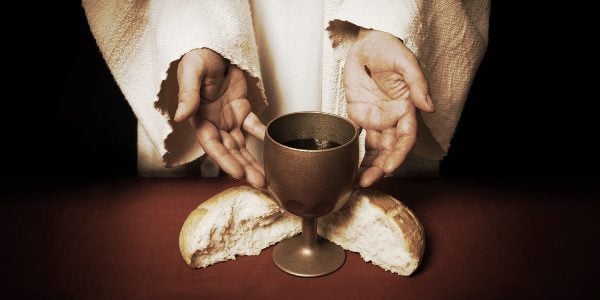
There was a scandal in early Methodism about Eucharist at some point. I don’t have the date or the exact quotes. Maybe it wasn’t even a scandal; maybe just a clarification. But John Wesley, the founder of United Methodism, once said something like if people who aren’t yet baptized want to receive the body and blood of Christ, who am I to get in the way of their salvation?
I think I’m mixing some of his words with some of Pope Francis’s words. In any case, millions (or at least hundreds of thousands?) of Europeans once died in ferocious wars over disputes about Eucharist during the Protestant Reformation. Is it literally, physically Jesus’ body? Or is Jesus just speaking metaphorically? Is it solely about obeying Jesus’ command to memorialize his last supper or are we receiving the life that Jesus says in John 6:53 we can only receive by eating his flesh and drinking his blood? Do we have to use Aquinas’ specific scholastic language for it or is it good enough to say that it is somehow mysteriously Jesus fully present?
I’m going to call it Eucharist instead of Holy Communion or the Lord’s Supper because Eucharist is a Greek verb meaning thanksgiving and that’s what it’s about. It’s recognizing that God can take Hawaiian bread and grape juice or crappy wine and turn it into Jesus’ body and blood. Not only that, but in fact every single created thing is a sacrament and when we receive all created things eucharistically as a gift from God, we live the way humans were meant to live. And if you don’t like that theology, take up your argument with Augustine and Alexander Schmemann, because I didn’t invent it.
Sacraments are signs that point to the deeper reality of God’s presence everywhere. They are “I love you’s” given to us by God. Some of the “I love you’s” have specific meaning because they have been instituted by church tradition and when we partake of them we are anchored in that tradition. But my flowers say I love you from God as does my basil and cilantro. The sand that I poured to mark the labyrinth God told me to build in my backyard says I love you from God as does the fountain I put in the center.
Tradition is valid and important. I’m a radical who undervalues it and I need conservatives to hold onto it and push back against my radicalism so that I don’t run amok and start blessing Cheetos and Fanta and telling people that Jesus’ body can take literally any form. Because anything that is everything basically becomes nothing. There is validity to marking a difference between sacred and common, because without designated sacred things, everything is just a cheap trinket that capitalism can monetize. Not that I’m trying to dis the youth pastors who do Cheeto and Fanta communions; I don’t understand it; I’m sure God uses it somehow.
To be entirely honest, I believe that the Host offered by the Roman church has a kind of power that my chunk of Hawaiian bread seems to lack when I break it and say, “This is my body broken for you.” Maybe every priest doubts his own worthiness and there’s a doctrine called ex opere operato that officially declares that no priest’s unworthiness can sabotage God’s power.
But when I go to the National Shrine of the Immaculate Conception in Washington, DC, I weep every time I hear Monseñor Rossi sing in his lovely baritone voice, “Through him and with him and in him, in the unity of the Holy Spirit, all honor and glory is yours, Almighty Father, for ever and ever.” And before I go forward for the Eucharist that is illegal for me to take as a Protestant, I say in unison with the whole congregation, “Lord, I am not worthy that you should enter under my roof, but only say the word and my soul shall be healed.” And when I kneel trembling and open my mouth for the priest to put the Host on my tongue, always wondering if he’s going to figure me out and deny me at the last minute, the glory that I receive when I feel the wafer in my mouth is more than anything I can ever imagine giving to another person.
When all of this coronavirus nightmare is over, I will make a pilgrimage to the National Shrine. I will probably spend an hour with my face on the ground in the back prostrating myself to the giant Jesus in the front whose eyes wept one time when I looked closely at them. Because I am home in that room with my face on the ground in a way that I am not in most other places. I will go into the Chapel of the Blessed Sacrament where the uncreated light fills the room and I will speak in the secret love language that the Holy Spirit gave me to utter my groans with. Maybe one day I will get to go to Jerusalem and I will get to put my face on the stone of the Chapel of the Holy Sepulcher. But short of that, the National Shrine is the holiest place I have ever known.
What I’m about to say may make all of this seem like a disingenuous preface I put out for the sake of argument. But I really believe that despite the acuteness with which I have experienced sacredness that has been channeled through very strict, specific traditional practices, I am most compelled by the pragmatic conception of holiness that seems to be the part of both Jesus and the Apostle Paul’s message that their patriarchal handlers throughout the centuries have consistently missed.
Jesus says if your ox falls in a ditch on the Sabbath, you pull it out and you don’t get your panties in a wad about supposedly violating a commandment. Paul says that he is convinced that nothing is unclean in itself, only doing what we think is unclean because it’s unclean. If Jesus and Paul are right and if ex opere operate is in fact valid doctrine, then why would blessing crackers and grape juice over the internet somehow be worse than the drunken priest in Graham Greene’s The Power and The Glory forgetting half the words of the liturgy?
It’s really hard not to see all the hand-wringing over online communion as just a form of theological masturbation and performative grandstanding. And yes, the fact that I have crawled multiple times on my hands and knees from the back of the National Shrine to the altar saying in complete desperation, “Lord Jesus Christ, Son Of God, have mercy on me, a sinner” gives me at least some authority to say that.
Do we really believe what Jesus says in John 6:53? “Very truly, I tell you, unless you eat the flesh of the Son of Man and drink his blood, you have no life in you.” If we actually believe that, then we need to get Jesus’ flesh and blood into us as often as possible. John Wesley preached a sermon called “The Duty of Constant Communion” specifically about this.
If communion is all just pageantry for us to use as a backdrop for our orthodoxy battles and ordination papers, then by all means, let’s not do it again. Ever. Because after this pandemic is over, many people are never again going to sit in a church pew. And among the few who will come back into the pews, many will object to having a single loaf or cup. Communion by intinction is utterly dead in the water now. It’s going to be shotglasses and crackers for all of us from now on, probably.
And I will probably rebel against this if I ever serve in an ordained capacity in a church again. Because there’s nothing more repugnant to me as an ex-Baptist than single-serving Jesus. It defeats the whole point of the ritual to have salvation prepackaged in individual portions. We are saved by becoming the body of Christ and being incorporated into one another with him as the head. Atonement is utterly participatory and the fundamental misdeed that is being corrected is the mistrust of God that the serpent conned Adam and Eve into bequeathing to humanity.
When we receive a piece of bread that has been torn by another human, we are trusting that whatever germs they have will not kill us and even if they do, we will live eternally because Jesus is in that piece of bread. The miraculous rite that is the lifeblood of the apostolic church must not be defeated by the combination of the coronavirus and crotchety theologians waving their orthodoxy around.
If we’re not going to do online communion, then we should gather in the flesh without washing our hands to see what God does for us if we tear bread and put it in each other’s mouths and pass a single cup of real wine around to swig from. Since I am a pragmatic mystic, I think online communion is the better choice.
Previous Post

March 30, 2020
Zen and God's Grace
Next Post

April 2, 2020 Video Game (A Poem About Still Being In Middle School)
Browse Our Archives
Select a Category Advent Beauty Will Save the World Bible Big Picture: Ephesians Bloggers Book Christian salvation and the Beautitudes Culture Daily Office Danceable Homiletics Deadly Sins Deep Roots: Genesis Devotions Dominican Republic May 2011 El Principio Misericordia (The Mercy Principle) Five verses God tattooed on my heart Fundraising FutureGospel Good Biblical Words Henri Nouwen Interview Jennings' Christian Imagination Jesus inside the beltway Jesus Is My Candidate Jesus vs the Pharisees Jesus vs. Plato Journey to Eternity Looking Back on 2012 Love Actually Monday Merton Monday Merton Music Occupy the manger On Earth As It Is In Heaven Original Sin Podcast Poetry Politics Prayer Psalm 119 Radical Jesus 101 Reviews Sermon on the Mount Sermons Spanish Bible study Special Series Spiritual but not religious Synchroblog Theology Things that made me think Thomas a Kempis Ugliness Into Beauty Uncategorized Viaje Dominicano 2013 Walking in the Valley (Lent) Welcome: It's More than a Mat Wild Goose 2013 Wrestling
Select a Month March 2022 January 2022 December 2021 September 2021 April 2021 September 2020 August 2020 July 2020 June 2020 May 2020 April 2020 March 2020 February 2020 January 2020 December 2019 November 2019 October 2019 September 2019 August 2019 June 2019 May 2019 April 2019 March 2019 February 2019 January 2019 December 2018 November 2018 October 2018 September 2018 August 2018 July 2018 June 2018 May 2018 April 2018 March 2018 February 2018 January 2018 December 2017 November 2017 October 2017 September 2017 August 2017 July 2017 June 2017 May 2017 April 2017 March 2017 February 2017 January 2017 December 2016 November 2016 October 2016 September 2016 August 2016 July 2016 June 2016 May 2016 April 2016 March 2016 February 2016 January 2016 December 2015 November 2015 October 2015 September 2015 August 2015 July 2015 June 2015 May 2015 April 2015 February 2015 January 2015 December 2014 November 2014 October 2014 September 2014 August 2014 July 2014 June 2014 May 2014 April 2014 March 2014 February 2014 January 2014 December 2013 November 2013 October 2013 September 2013 August 2013 July 2013 June 2013 May 2013 April 2013 March 2013 February 2013 January 2013 December 2012 November 2012 October 2012 September 2012 August 2012 July 2012 June 2012 May 2012 April 2012 February 2012 January 2012 December 2011 November 2011 October 2011 September 2011 August 2011 July 2011 June 2011 May 2011
Follow Us!
TAKE THE
Religious Wisdom Quiz
Who leaped for joy after being healed at the Temple gate (by Peter, in Jesus' name)?
Select your answer to see how you score.
A rich man A Pharisee A blind man A lame man
Related posts from Mercy Not Sacrifice


When God's A Cop, Every Cop Is God

Why Kevin DeYoung's "Culture War Strategy" Fails

Why True Christianity Is Anarchist
TRENDING AT PATHEOS Progressive Christian

What Being a Modern-Day Apostle Means to Me
In my last column, I discussed the ins and outs of modern-day...

Did Ancient China Once Worship the God of...
Across human history, a common thread weaves through the origins of the...

Love Your Neighbor – Including Earth-Kin: Lev. 19,...
God’s command to love your neighbor means acting in an ethical and...

Lead a Church Study of “Jesus and Lao...
Guest writer Jack Thomas (The Irreverent Reverend) reflects on leading his church...

Pastoral Wisdom for Responding to Sermon Pushback
Getting sermon pushback on your social justice sermon? Learn practical, Proverbs-based strategies...

Principles for Understanding the Apostolic Ministry Today
Whenever people discover that my formal ministry title is "apostle," as in...
view all Progressive Christian blogs
Ad-Free & Subscriber Log-In Subscription Support
- About Us
- 2026 Calendar
- Videos
- Podcasts
- Library of World Religions
- Faith In Media Tracker
- Advertise With Us
- Write for Us
- Privacy Policy
- Terms of Service
- Do Not Sell My Data
- Contact Us
- Radiant Digital
- Manage Newsletter Subscriptions
- Unsubscribe From Notifications
- Sitemap
Copyright 2008-2026, Patheos. All rights reserved.
Subscription Support Ad-Free & Subscriber Log-In
Follow Patheos