
BuddhistCatholicContemplativeEvangelicalGeneral ChristianHinduJewishLatter-day SaintMuslimNew VisionsProgressive Christian
Beliefs
- Buddhist
- Catholic
- Contemplative
- Evangelical
- General Christian
- Hindu
- Jewish
- Latter-day Saint
- More Voices
- Muslim
- New Visions
- Pagan
- Progressive Christian
Topics
- Religion News
- Food and Religion
- Sports and Religion
- Religious Art
- Religious Music and Entertainment
- Religious Events
- History and Religion
- Style and Religion
- Politics and Religion
- Women in Religion
- Recreation Outdoors and Religion
- Business Finance and Religion
- Careers Workplace and Religion
- Education and Religion
- Family Parenting and Religion
- Health Fitness and Religion
- Home and Religion
- Relationships and Religion
- Technology and Religion
- Travel and Religion
Columnists
- Buddhist Columnists
- Business Finance and Religion Columnists
- Careers Workplace and Religion Columnists
- Catholic Columnists
- Contemplative Columnists
- Education and Religion Columnists
- Evangelists Columnists
- Family Parenting and Religion Columnists
- General Christian Columnists
- Health Fitness and Religion Columnists
- Hindu Columnists
- History and Religion Columnists
- Home and Religion Columnists
- Jewish Columnists
- More Voices Columnists
- Latter Day Columnists
- Muslim Columnists
- New Visions Columnists
- Nonreligious Columnists
- Pagan Columnists
- Politics and Religion Columnists
- Progressive Columnists
- Recreation Outdoors and Religion Columnists
- Relationships and Religion Columnists
- Religion News Columnists
- Religious Art Columnists
- Religious Events Columnists
- Religious Music and Entertainment Columnists
- Sports and Religion Columnists
- Style and Religion Columnists
- Technology and Religion Columnists
- Travel and Religion Columnists
- Women in Religion Columnists
Resource Library
- 2026 Calendar
- Library of World Religions
- The 100 Most Holy Places on Earth
- Patheos Answers
- Podcasts
- Videos
- Faith Leaders Database
- Anglican Episcopalian
- Bahai
- Baptist
- Buddhism
- Christianity
- Confucianism
- Eastern Orthodoxy
- Hinduism
- Holiness and Pentecostal
- ISKCON
- Islam
- Judaism
- Lutheran
- Methodist
- The Church of Jesus Christ of Latter-day Saints
- New Age
- Paganism
- Presbytarian and Reformed
- Protestantism
- Religion Behind the Scenes
- Roman Catholic
- Scientology
- Shia Islam
- Sikhism
- Sufism
- Sunni Islam
- Taoism
- Zen
- See all religions
Research Tools
 Ad-Free & Subscriber Log-In Subscription Support
Ad-Free & Subscriber Log-In Subscription Support
Follow Patheos 

- Trending:
- Forgiveness
- |
- Marriage
- |
- Consciousness
- |
- Death Penalty
- |
- Election
- |
- Halloween
 Mercy Not Sacrifice
-
More
- Home
- Progressive Christian
- Resisting Harm Is What Holiness Is For
Resisting Harm Is What Holiness Is For
Last updated on: February 1, 2020 at 8:32 pm by Morgan Guyton
Resisting Harm Is What Holiness Is For 2020-02-01T20:32:38-05:00 Morgan Guyton
Patheos Explore the world's faith through different perspectives on religion and spirituality! Patheos has the views of the prevalent religions and spiritualities of the world.
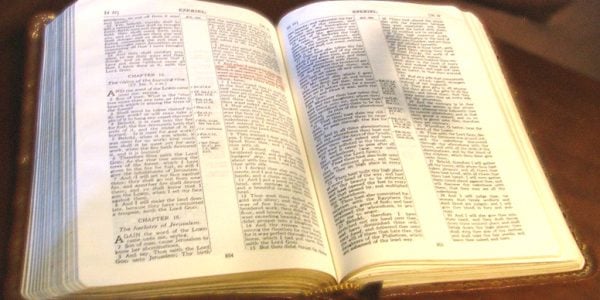
“Bible with Cross Shadow,” David Campbell, Flickr C.C.
One way to talk about the tragic division in contemporary American Christianity is to say that it has pitted the ideas of love of God and love of neighbor against each other. Team Family Values tends to define sin and morality in the vertical terms of our relationship with God while Team Social Justice tends to define sin and morality in the horizontal terms of our relationships with other humans. When I read the Bible, I come away with the understanding that we can’t be right with God without being right with our neighbor and vice-versa. When we make objects god other than God (idolatry), we are disordered in such a way that we mistreat others (injustice).
In the United Methodist Church right now, one faction talks a lot about seeking holiness while the other faction is talking about resisting harm. And I would say that unless you are seeking holiness, you cannot resist harm, and unless you are resisting harm, the holiness you are seeking is a false holiness. That is to say that I cause harm to others to the degree that I lack holiness. And whatever holiness I gain that doesn’t reduce my harm to others isn’t actually holiness (see also 1 Corinthians 13:1-3).
My theological understanding continues to be definitely shaped by an incredibly radical interpretation of Hebrew scripture that Jesus makes in an early conversation with the religious authorities. When they attack him for partying with a bunch of sinful people, he says, “Go and learn what this means, ‘I desire mercy, not sacrifice.’ For I have come to call not the righteous but sinners” (Matthew 9:13).
In this verse, Jesus is quoting Hosea 6:6. What’s significant is that Jesus changes the meaning of the passage through how he applies it. What God says in Hosea 6:6 is “I desire steadfast love and not sacrifice, the knowledge of God rather than burnt offerings.” So if an evangelical youth group were studying this together, then a very reasonable, straightforward interpretation could be “God doesn’t want your good deeds; he wants you to read your Bible every day and really get to know him.”
Hosea 6:6 uses the Hebrew word chesed that can be translated as the Greek eleos or “mercy,” but it’s usually translated as “steadfast love,” because in the passage, God is asking for the Israelites to give him their steadfast love instead of just making perfunctory, dutiful sacrifices. It wouldn’t make any sense for him to be asking his people for mercy. He’s God; they’re the ones who need his mercy.
There is nothing in the context of the Hosea passage that suggests that God wants his people to be merciful to each other; he wants them to be loyal to him. So when Jesus interprets chesed as mercy for each other rather than loyalty to God, what he’s saying in effect is that the way to be loyal to God is to be merciful to each other. In other words, Jesus is saying that what God desires more than meticulous rule-following that shows respect for his authority is having mercy for people who suck at following rules. There is no exegetical basis for Jesus to make Hosea 6:6 logically related to God calling sinners instead of righteous people. It’s a non-sequitur, unless we understand that Jesus is saying God prefers flawed, merciful people to meticulously loyal, self-righteous people.
It seems like those who talk about holiness all the time often understand holiness in terms of sacrifice rather than mercy. Holiness means proving to God that I really put him before everything else, that I’m not in any way soft in my discipline and religious zeal. There is nothing more exhausting than living a life of trying to prove your zeal to God or other people. It makes people toxic and self-righteous. This self-justifying zeal is what caused the religious authorities to loathe and ultimately crucify Jesus. It’s also what Jesus’ sacrifice on the cross is supposed to liberate Christians from. If we are justified by his blood, then we are not justified by our correct beliefs or behavior. Jesus’ justification saves us from trying to justify ourselves.
It’s only when we understand that God wants mercy rather than sacrifice that we can pursue holiness in the right way. The perfection God wants from us is to be perfectly loving, to be so utterly trusting in his mercy that we channel and embody his mercy towards other people. It’s not about striving to speak and act correctly; it’s about surrendering to God’s mercy and letting it take us over.
When holiness has the goal of mercy, that dissolves the impetus for trying to prove that you’re adequately zealous for God’s authority by taking a “tough stance” on gay marriage or whatever other perceived “secular humanist” cause you think you’re supposed to define yourself against. Mercy is the thing about Christianity that goes against the grain of the world’s ways, not patriarchal gender norms or austerity for its own sake. It’s not that mercy needs to be “balanced” with holiness (not every truth has to consist in two binary terms held “in tension”); mercy is the fulfillment of holiness. Every refinement that God makes to my character through the means of grace he gives me has the purpose of polishing me into the best possible vessel of his mercy. My sin is a problem because it makes me less merciful, and that’s the part that makes God mad. When the holiness zealots become zealous for mercy, then Christianity’s true beauty will shine forth.
Previous Post

January 24, 2020
Sin and the Rules of the Market
Next Post

February 7, 2020 If Shakira's Tongue Causes Your Eye To Sin, Cut Your Eyeball Out
Browse Our Archives
Select a Category Advent Beauty Will Save the World Bible Big Picture: Ephesians Bloggers Book Christian salvation and the Beautitudes Culture Daily Office Danceable Homiletics Deadly Sins Deep Roots: Genesis Devotions Dominican Republic May 2011 El Principio Misericordia (The Mercy Principle) Five verses God tattooed on my heart Fundraising FutureGospel Good Biblical Words Henri Nouwen Interview Jennings' Christian Imagination Jesus inside the beltway Jesus Is My Candidate Jesus vs the Pharisees Jesus vs. Plato Journey to Eternity Looking Back on 2012 Love Actually Monday Merton Monday Merton Music Occupy the manger On Earth As It Is In Heaven Original Sin Podcast Poetry Politics Prayer Psalm 119 Radical Jesus 101 Reviews Sermon on the Mount Sermons Spanish Bible study Special Series Spiritual but not religious Synchroblog Theology Things that made me think Thomas a Kempis Ugliness Into Beauty Uncategorized Viaje Dominicano 2013 Walking in the Valley (Lent) Welcome: It's More than a Mat Wild Goose 2013 Wrestling
Select a Month March 2022 January 2022 December 2021 September 2021 April 2021 September 2020 August 2020 July 2020 June 2020 May 2020 April 2020 March 2020 February 2020 January 2020 December 2019 November 2019 October 2019 September 2019 August 2019 June 2019 May 2019 April 2019 March 2019 February 2019 January 2019 December 2018 November 2018 October 2018 September 2018 August 2018 July 2018 June 2018 May 2018 April 2018 March 2018 February 2018 January 2018 December 2017 November 2017 October 2017 September 2017 August 2017 July 2017 June 2017 May 2017 April 2017 March 2017 February 2017 January 2017 December 2016 November 2016 October 2016 September 2016 August 2016 July 2016 June 2016 May 2016 April 2016 March 2016 February 2016 January 2016 December 2015 November 2015 October 2015 September 2015 August 2015 July 2015 June 2015 May 2015 April 2015 February 2015 January 2015 December 2014 November 2014 October 2014 September 2014 August 2014 July 2014 June 2014 May 2014 April 2014 March 2014 February 2014 January 2014 December 2013 November 2013 October 2013 September 2013 August 2013 July 2013 June 2013 May 2013 April 2013 March 2013 February 2013 January 2013 December 2012 November 2012 October 2012 September 2012 August 2012 July 2012 June 2012 May 2012 April 2012 February 2012 January 2012 December 2011 November 2011 October 2011 September 2011 August 2011 July 2011 June 2011 May 2011
Follow Us!
TAKE THE
Religious Wisdom Quiz
True or False: Elijah defeated 400 prophets of Baal on Mount Carmel.
Select your answer to see how you score.
TRUE FALSE
Related posts from Mercy Not Sacrifice

Why Does The Knowledge of Good And Evil...


When God's A Cop, Every Cop Is God

TRENDING AT PATHEOS Progressive Christian

What Being a Modern-Day Apostle Means to Me
In my last column, I discussed the ins and outs of modern-day...

Did Ancient China Once Worship the God of...
Across human history, a common thread weaves through the origins of the...

Love Your Neighbor – Including Earth-Kin: Lev. 19,...
God’s command to love your neighbor means acting in an ethical and...

Lead a Church Study of “Jesus and Lao...
Guest writer Jack Thomas (The Irreverent Reverend) reflects on leading his church...

Pastoral Wisdom for Responding to Sermon Pushback
Getting sermon pushback on your social justice sermon? Learn practical, Proverbs-based strategies...

Principles for Understanding the Apostolic Ministry Today
Whenever people discover that my formal ministry title is "apostle," as in...
view all Progressive Christian blogs
Ad-Free & Subscriber Log-In Subscription Support
- About Us
- 2026 Calendar
- Videos
- Podcasts
- Library of World Religions
- Faith In Media Tracker
- Advertise With Us
- Write for Us
- Privacy Policy
- Terms of Service
- Do Not Sell My Data
- Contact Us
- Radiant Digital
- Manage Newsletter Subscriptions
- Unsubscribe From Notifications
- Sitemap
Copyright 2008-2026, Patheos. All rights reserved.
Subscription Support Ad-Free & Subscriber Log-In
Follow Patheos