
BuddhistCatholicContemplativeEvangelicalGeneral ChristianHinduJewishLatter-day SaintMuslimNew VisionsProgressive Christian
Beliefs
- Buddhist
- Catholic
- Contemplative
- Evangelical
- General Christian
- Hindu
- Jewish
- Latter-day Saint
- More Voices
- Muslim
- New Visions
- Pagan
- Progressive Christian
Topics
- Religion News
- Food and Religion
- Sports and Religion
- Religious Art
- Religious Music and Entertainment
- Religious Events
- History and Religion
- Style and Religion
- Politics and Religion
- Women in Religion
- Recreation Outdoors and Religion
- Business Finance and Religion
- Careers Workplace and Religion
- Education and Religion
- Family Parenting and Religion
- Health Fitness and Religion
- Home and Religion
- Relationships and Religion
- Technology and Religion
- Travel and Religion
Columnists
- Buddhist Columnists
- Business Finance and Religion Columnists
- Careers Workplace and Religion Columnists
- Catholic Columnists
- Contemplative Columnists
- Education and Religion Columnists
- Evangelists Columnists
- Family Parenting and Religion Columnists
- General Christian Columnists
- Health Fitness and Religion Columnists
- Hindu Columnists
- History and Religion Columnists
- Home and Religion Columnists
- Jewish Columnists
- More Voices Columnists
- Latter Day Columnists
- Muslim Columnists
- New Visions Columnists
- Nonreligious Columnists
- Pagan Columnists
- Politics and Religion Columnists
- Progressive Columnists
- Recreation Outdoors and Religion Columnists
- Relationships and Religion Columnists
- Religion News Columnists
- Religious Art Columnists
- Religious Events Columnists
- Religious Music and Entertainment Columnists
- Sports and Religion Columnists
- Style and Religion Columnists
- Technology and Religion Columnists
- Travel and Religion Columnists
- Women in Religion Columnists
Resource Library
- 2026 Calendar
- Library of World Religions
- The 100 Most Holy Places on Earth
- Patheos Answers
- Podcasts
- Videos
- Faith Leaders Database
- Anglican Episcopalian
- Bahai
- Baptist
- Buddhism
- Christianity
- Confucianism
- Eastern Orthodoxy
- Hinduism
- Holiness and Pentecostal
- ISKCON
- Islam
- Judaism
- Lutheran
- Methodist
- The Church of Jesus Christ of Latter-day Saints
- New Age
- Paganism
- Presbytarian and Reformed
- Protestantism
- Religion Behind the Scenes
- Roman Catholic
- Scientology
- Shia Islam
- Sikhism
- Sufism
- Sunni Islam
- Taoism
- Zen
- See all religions
Research Tools
 Ad-Free & Subscriber Log-In Subscription Support
Ad-Free & Subscriber Log-In Subscription Support
Follow Patheos 

- Trending:
- Forgiveness
- |
- Marriage
- |
- Consciousness
- |
- Death Penalty
- |
- Election
- |
- Halloween
 Mercy Not Sacrifice
-
More
- Home
- Progressive Christian
- Why Isn’t Perfection In Love Good Enough For Wesleyan Theology?
Why Isn’t Perfection In Love Good Enough For Wesleyan Theology?
Last updated on: November 13, 2019 at 12:50 pm by Morgan Guyton
Why Isn’t Perfection In Love Good Enough For Wesleyan Theology? 2019-11-13T12:50:02-05:00 Morgan Guyton
Patheos Explore the world's faith through different perspectives on religion and spirituality! Patheos has the views of the prevalent religions and spiritualities of the world.
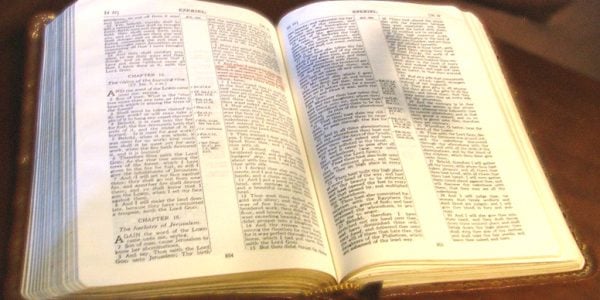
“Bible with Cross Shadow,” David Campbell, Flickr C.C.
As United Methodism approaches our denominational apocalypse at the May 2020 General Conference, I’ve come across a lot of hand-wringing about our theological identity, namely that we don’t have a clear identity and that’s the whole problem. I understand the angst; Methodism for the next several months will continue to be the largest remaining Protestant mainline denomination that hasn’t split between conservatives and progressives. But this past February, I went on a lay-led Cursillo retreat with a mostly conservative crowd of Louisiana Methodists who convinced me that a simple, practical understanding of Christian salvation as the process of being perfected in love is actually an adequately coherent theological foundation for Wesleyan Christianity.
John Wesley was not a systematic theologian. The only doctrine that can really be attributed to him uniquely is the doctrine of Christian perfection, which holds that the ultimate goal of Christian salvation and discipleship is for Christians to replace the sin in their hearts with perfect love of God and neighbor. Wesley’s primary legacy is the practical means of grace he promoted for Christians to perfect their love. Wesleyan spirituality is the practical holiness of pursuing God’s perfecting love through all the means of grace.
Every Methodist clergy who seeks ordination is asked whether they seek perfection in love and hope to be made perfect in this lifetime. Everyone always says yes of course (with their fingers perhaps visibly or invisibly crossed). And at one time, these scandalous questions were actually taken seriously as our key Wesleyan theological distinction (before the culture wars bifurcated the church into a debate between generic Calvinist evangelical theology and liberal social gospel theology). Of course, the rigid moralistic pietism in some corners of the holiness movement which is part of our Wesleyan legacy took the love out of the perfection, turning it into a miserly fortress of rules prohibiting things like dancing and card games. But when the goal is actually to love perfectly, that’s a very beautiful thing.
Now, it’s of course very important to heavily qualify this with the understanding that pursuing any kind of perfection as our means of self-justification is utterly toxic. We cannot be perfected in love by God if we’re trying to make ourselves perfect, because that means we’re sabotaging God’s love with our need to get credit and be in control. That’s why the justification Jesus offers for our sins on the cross is the prerequisite to the sanctification the Holy Spirit wants to instill in our hearts. We cannot be sanctified by God if we are trying to justify ourselves, any more than a motorcycle could be pedaled by foot like a bicycle at the same time that the motor is spinning the wheel.
I will say that I don’t think justification is a clean, linear process, because I’m still quite a self-sabotaging, self-righteous brat even though Jesus has been trying to prove to me my whole life that I really can lay down my sins at his cross and stop trying to argue that I’m right. But I think that despite the incompleteness of my justification, God has been able to get some work done on my sanctification in the meantime. And I think the sanctification gets easier the more I’ve embraced his justification on my behalf.
In any case, there are a lot of things that matter about Christian theology, but to a Wesleyan, they matter for a specific reason: insofar as they relate to Christians’ ability to be perfected in God’s love. That’s why the meaning of Jesus’ cross and resurrection matters. That’s why biblical teachings matter. That’s why holiness matters. Because God wants to perfect our love, and bad theology can sabotage God’s process (whether the theology is bad because it’s overly compromised by secular thinking or overly pretentious or overly reactive to secular compromise or for a different reason).
Perfection in love should shape how we think about questions of holiness and how we interpret biblical teaching. Sin is that which sabotages God’s perfection of our love. Holiness is that which promotes God’s perfection of our love. If this is indeed our emphasis as Wesleyans, that means that interpreting holiness as authoritarian compliance with opaque biblical legalism (a.k.a. generic evangelical sola scriptura) is alien to actual Wesleyan theology. A Wesleyan theological ethics doesn’t just say these are the rules; I don’t make them or question them. It insists on discerning how various actions impede or enhance the movement of God’s love in our hearts as its principal rubric. We are virtue ethicists, not deontological ones. We believe in the authority of love, not in authority for its own sake.
I’m not so naive to think that understanding our core Wesleyan legacy as the pursuit of perfection in love will suddenly resolve all of our debates. But I do wish that all of us in our various ways would stop trying to prove that we’re something we have never been. Just because the Calvinists build cathedrals out of their dogma doesn’t mean that we have to follow their lead. Just because Karl Barth tells us Christianity is supposed to be strange doesn’t mean that we should be contemptuous of theological sensibilities that seem too pedestrian, straightforward, and practical.
My hope is that after the multiplication of United Methodist has taken place, there will somehow be an expression of Wesleyanism that breaks through the noise and says we just want to love more perfectly and that’s why we pray, sing, preach, study, serve, protest, and chase after Jesus every way we can.
Check out my book How Jesus Saves the World From Us!
Previous Post

October 30, 2019
"Let It Fall"
Next Post

December 5, 2019 The Conservative Insight I Cannot Reject
Browse Our Archives
Select a Category Advent Beauty Will Save the World Bible Big Picture: Ephesians Bloggers Book Christian salvation and the Beautitudes Culture Daily Office Danceable Homiletics Deadly Sins Deep Roots: Genesis Devotions Dominican Republic May 2011 El Principio Misericordia (The Mercy Principle) Five verses God tattooed on my heart Fundraising FutureGospel Good Biblical Words Henri Nouwen Interview Jennings' Christian Imagination Jesus inside the beltway Jesus Is My Candidate Jesus vs the Pharisees Jesus vs. Plato Journey to Eternity Looking Back on 2012 Love Actually Monday Merton Monday Merton Music Occupy the manger On Earth As It Is In Heaven Original Sin Podcast Poetry Politics Prayer Psalm 119 Radical Jesus 101 Reviews Sermon on the Mount Sermons Spanish Bible study Special Series Spiritual but not religious Synchroblog Theology Things that made me think Thomas a Kempis Ugliness Into Beauty Uncategorized Viaje Dominicano 2013 Walking in the Valley (Lent) Welcome: It's More than a Mat Wild Goose 2013 Wrestling
Select a Month March 2022 January 2022 December 2021 September 2021 April 2021 September 2020 August 2020 July 2020 June 2020 May 2020 April 2020 March 2020 February 2020 January 2020 December 2019 November 2019 October 2019 September 2019 August 2019 June 2019 May 2019 April 2019 March 2019 February 2019 January 2019 December 2018 November 2018 October 2018 September 2018 August 2018 July 2018 June 2018 May 2018 April 2018 March 2018 February 2018 January 2018 December 2017 November 2017 October 2017 September 2017 August 2017 July 2017 June 2017 May 2017 April 2017 March 2017 February 2017 January 2017 December 2016 November 2016 October 2016 September 2016 August 2016 July 2016 June 2016 May 2016 April 2016 March 2016 February 2016 January 2016 December 2015 November 2015 October 2015 September 2015 August 2015 July 2015 June 2015 May 2015 April 2015 February 2015 January 2015 December 2014 November 2014 October 2014 September 2014 August 2014 July 2014 June 2014 May 2014 April 2014 March 2014 February 2014 January 2014 December 2013 November 2013 October 2013 September 2013 August 2013 July 2013 June 2013 May 2013 April 2013 March 2013 February 2013 January 2013 December 2012 November 2012 October 2012 September 2012 August 2012 July 2012 June 2012 May 2012 April 2012 February 2012 January 2012 December 2011 November 2011 October 2011 September 2011 August 2011 July 2011 June 2011 May 2011
Follow Us!
TAKE THE
Religious Wisdom Quiz
How was the New Covenant different from the Old Covenant?
Select your answer to see how you score.
It would be written on their hearts It was only for priests It abolished God’s law It required more sacrifices
Related posts from Mercy Not Sacrifice

Why Kevin DeYoung's "Culture War Strategy" Fails

Why True Christianity Is Anarchist

Can We Have a Queer, Erotic God?

Love Letter to A Diva God (A Poem...
TRENDING AT PATHEOS Progressive Christian

What Being a Modern-Day Apostle Means to Me
In my last column, I discussed the ins and outs of modern-day...

Did Ancient China Once Worship the God of...
Across human history, a common thread weaves through the origins of the...

Love Your Neighbor – Including Earth-Kin: Lev. 19,...
God’s command to love your neighbor means acting in an ethical and...

Lead a Church Study of “Jesus and Lao...
Guest writer Jack Thomas (The Irreverent Reverend) reflects on leading his church...

Pastoral Wisdom for Responding to Sermon Pushback
Getting sermon pushback on your social justice sermon? Learn practical, Proverbs-based strategies...

Principles for Understanding the Apostolic Ministry Today
Whenever people discover that my formal ministry title is "apostle," as in...
view all Progressive Christian blogs
Ad-Free & Subscriber Log-In Subscription Support
- About Us
- 2026 Calendar
- Videos
- Podcasts
- Library of World Religions
- Faith In Media Tracker
- Advertise With Us
- Write for Us
- Privacy Policy
- Terms of Service
- Do Not Sell My Data
- Contact Us
- Radiant Digital
- Manage Newsletter Subscriptions
- Unsubscribe From Notifications
- Sitemap
Copyright 2008-2026, Patheos. All rights reserved.
Subscription Support Ad-Free & Subscriber Log-In
Follow Patheos