
BuddhistCatholicContemplativeEvangelicalGeneral ChristianHinduJewishLatter-day SaintMuslimNew VisionsProgressive Christian
Beliefs
- Buddhist
- Catholic
- Contemplative
- Evangelical
- General Christian
- Hindu
- Jewish
- Latter-day Saint
- More Voices
- Muslim
- New Visions
- Pagan
- Progressive Christian
Topics
- Religion News
- Food and Religion
- Sports and Religion
- Religious Art
- Religious Music and Entertainment
- Religious Events
- History and Religion
- Style and Religion
- Politics and Religion
- Women in Religion
- Recreation Outdoors and Religion
- Business Finance and Religion
- Careers Workplace and Religion
- Education and Religion
- Family Parenting and Religion
- Health Fitness and Religion
- Home and Religion
- Relationships and Religion
- Technology and Religion
- Travel and Religion
Columnists
- Buddhist Columnists
- Business Finance and Religion Columnists
- Careers Workplace and Religion Columnists
- Catholic Columnists
- Contemplative Columnists
- Education and Religion Columnists
- Evangelists Columnists
- Family Parenting and Religion Columnists
- General Christian Columnists
- Health Fitness and Religion Columnists
- Hindu Columnists
- History and Religion Columnists
- Home and Religion Columnists
- Jewish Columnists
- More Voices Columnists
- Latter Day Columnists
- Muslim Columnists
- New Visions Columnists
- Nonreligious Columnists
- Pagan Columnists
- Politics and Religion Columnists
- Progressive Columnists
- Recreation Outdoors and Religion Columnists
- Relationships and Religion Columnists
- Religion News Columnists
- Religious Art Columnists
- Religious Events Columnists
- Religious Music and Entertainment Columnists
- Sports and Religion Columnists
- Style and Religion Columnists
- Technology and Religion Columnists
- Travel and Religion Columnists
- Women in Religion Columnists
Resource Library
- 2026 Calendar
- Library of World Religions
- The 100 Most Holy Places on Earth
- Patheos Answers
- Podcasts
- Videos
- Faith Leaders Database
- Anglican Episcopalian
- Bahai
- Baptist
- Buddhism
- Christianity
- Confucianism
- Eastern Orthodoxy
- Hinduism
- Holiness and Pentecostal
- ISKCON
- Islam
- Judaism
- Lutheran
- Methodist
- The Church of Jesus Christ of Latter-day Saints
- New Age
- Paganism
- Presbytarian and Reformed
- Protestantism
- Religion Behind the Scenes
- Roman Catholic
- Scientology
- Shia Islam
- Sikhism
- Sufism
- Sunni Islam
- Taoism
- Zen
- See all religions
Research Tools
 Ad-Free & Subscriber Log-In Subscription Support
Ad-Free & Subscriber Log-In Subscription Support
Follow Patheos 

- Trending:
- Forgiveness
- |
- Marriage
- |
- Consciousness
- |
- Death Penalty
- |
- Election
- |
- Halloween
 Mercy Not Sacrifice
-
More
- Home
- Progressive Christian
- Democratized Theology vs. Theology of the Demos (Mob)
Democratized Theology vs. Theology of the Demos (Mob)
Last updated on: May 8, 2019 at 8:11 pm by Morgan Guyton
Democratized Theology vs. Theology of the Demos (Mob) 2019-05-08T20:11:58-05:00 Morgan Guyton
Patheos Explore the world's faith through different perspectives on religion and spirituality! Patheos has the views of the prevalent religions and spiritualities of the world.
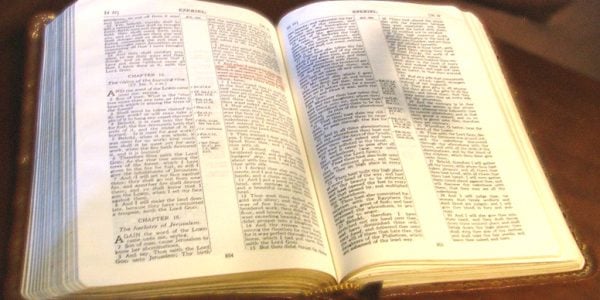
“Bible with Cross Shadow,” David Campbell, Flickr C.C.
I should have known that I was going to get snarky replies from conservative evangelicals when I said that Rachel Held Evans democratized theology. They said all the predictable things about ordinary people being totally depraved and untrustworthy interpreters of the Bible (with the exception of those who have infallibly interpreted scripture the way they have). Their criticism did help me realize that I need to further refine how I articulate the concept of democratized theology.
Talking about theology as a democracy raises a lot of questions. Does that mean it’s a majority rules process like the United Methodist Church General Conference? For example, could a majority of white Christians decide that they want to paint their God in the image of Donald Trump whom they voted to be president? In Greek, the word demos means mob, so the original definition of democracy was literally “the rule of the mob,” which is certainly what our country’s democracy as well as United Methodist church politics have come to feel like.
Still I want to contend that there are two very different phenomena which I’m going to label democratized theology and theology of the demos. Here’s how I would contrast their differences.
I. Democratized Theology
A Christian community defined by democratized theology is a space in which each individual believer is trained to think theologically for themselves and there is not an expectation for everyone to come to the same conclusions because there is not a sense that having an imperfect grasp of doctrine has eternally catastrophic consequences. The Bible is seen as a resource for helping people to grow in their intimacy with Christ with the understanding that God can use the same verse to speak differently to different people. Worrying about who or what has authority is simply not part of the thought process in such a community, because the assumption is that God reveals himself generously to those who earnestly seek him.
In a space of democratized theology, each person’s voice is understood to be indispensable and important to the community’s wisdom as a whole. To try to force everyone into a uniform set of beliefs would be to diminish the community’s wisdom by silencing the more diminutive voices. On the contrary, democratized theology seeks especially the most marginalized voices because their perspective hasn’t been heard and needs to be heard in order to have a fuller perspective on the truth.
One way to illustrate how truth is understood in a democratized theology is to think about a symphony in which there is an entire orchestra of instruments. The truth is not what the trumpets play or what the violins; it’s the entire symphony when all the sections of the orchestra are brought together. Truth is not uniform; it’s a harmonious diversity of perspectives that are held in tension with one another. That doesn’t mean that the trumpets and the violins can play two entirely different songs, but it does mean they should be expected to play different notes in the same song.
Democratized theology recognizes the value of specialized scholarship because it provides resources for helping each member of the community interpret the truth more effectively. At the same time, democratized theology does not simply defer to the scholars because people who aren’t specifically theologically trained can bring a fresh perspective that a scholar who has been immersed in esoteric conversation for years can no longer see. Nobody’s interpretation is invalidated on the basis of not having engaged all the authoritative scholars in conversation (or not having read every single article/book by a scholar before responding to a stand-alone idea the scholar has put out there). A new blogger who has new ideas (or ideas that aren’t new at all) is encouraged and supported in their theological journey rather than being shot down and dismissed for the audacity of speaking up.
II. Theology of the Demos
A theology of the demos has the expectation that everyone in a community submit to uniform agreement about theological doctrine. The demos maintains itself through continually making comparisons between people inside the demos (who are superior, orthodox, going to heaven, etc) and people outside of it (who are depraved, heretical, going to hell, etc). In this interest, a theology of the demos gives the loudest amplification to the theological points where clear lines have developed between insiders and outsiders, and a competition develops to demonstrate the greatest zeal in articulating the most provocative, radical formulation of the insider view.
This continual comparison between insiders and outsiders generally crystallizes into a singular scapegoat whose opposition becomes the litmus test for measuring the “orthodoxy” of insiders. How the demos determines who’s in and who’s out is measured by how firmly committed the person is to opposing the scapegoat. If someone starts to cave in their opposition to the scapegoat, they have begun descending the “slippery slope.”
A critical part of the demos is the authoritarian demagogue who is their lightning rod. It might seem that the demagogue is the one who has power, but that’s an oversimplification. In Hannah Arendt’s Origins of Totalitarianism, she explains how the demos basically creates the demagogue who emerges to lead it. A demagogue cannot seize power unless a demos already exists to empower him.
The subtlety is that the demagogue has to tell the demos what they want to hear without allowing them to realize that the authority to which they are submitting is their own self-affirmation, because part of the glue that holds the demos together and gives it emotional security is the notion that its members are submitting themselves to a greater authority who will tell them what to do and protect them from error. Thus, the demagogue must speak in ways that evoke a sense of heroic sacrifice without actually demanding sacrifice of his listeners, whose act of listening to a tough-sounding message is the sacrifice that validates them.
A critically important paradox about the demos is that it’s authoritarian and populist at the same time, which is to say that it wants to believe it is an orderly hierarchy with a wise leader rather than a mob with a self-validating demagogue. We see this paradox at play in the way that the demos uses scholarship opportunistically. When someone with a Ph.D. affirms the priorities of the demos, that Ph.D. is weaponized in debate as a trump card (e.g. N.T. Wright in the sexuality debate). But when Ph.D. scholars contradict the demos, they are out of touch, irrelevant, and improperly trained.
The same goes for official church authority figures. It’s been remarkable to see how much scorn the traditionalist Methodists have heaped onto our bishops, since one would think that authentic conservatism would be innately deferential to the wisdom of bishops and the apostolic process by which they were consecrated. But a populist demos views authority figures as only relevant and worthy of authority insofar as they enforce the will of the demos.
Even a hierarchical Christian tradition like Roman Catholicism can become a de facto demos. We see this in the way that radical right-wing Catholics have been sharpening their knives to take out Pope Francis for being a heretic since he hasn’t proved himself to be adequately firm in condemning remarried divorcees and gays. He is about as safe and securely in power as King Joffrey at his wedding banquet in Game of Thrones.
No traditionalist Catholic is clamoring to exclude military leaders from the Eucharist when they violate the church’s teaching on just war, nor to exclude business owners when they pollute the world or oppress their workers in violation of whatever papal encyclicals have said on those topics. The only ways to get excommunicated today if you’re Catholic are to be gay, support women priests, be involved in an abortion, or remarry as a divorcee. That’s why it appears to me that neither the pope nor church teaching itself are actually authorities in the Roman church, but the underlying demos that will erupt in violence if there is ever a shift on gays, women priests, abortions, or remarriage.
In any case, what I have done here is to describe tendencies. Obviously there are many people with sincere motives and authentic spiritual journeys in churches that tend more towards a democratized space and those that look more like a demos. I’m sure that authoritarian Christians would frame all of this very differently. But as I said in my original post about Rachel Held Evans, I think the democratization of theology allows individual Christians to develop deeper, more authentic intimacy with Christ than theology that emerges within a demos where everyone is performing “orthodoxy” for each other to avoid getting kicked out.
Previous Post

May 7, 2019
Patriarchy, the Reluctant Ruler, and the Mad Queen (GOT Spoilers!)
Next Post

May 21, 2019 Why I Stan For Bran the Disabled King in #GameOfThrones
Browse Our Archives
Select a Category Advent Beauty Will Save the World Bible Big Picture: Ephesians Bloggers Book Christian salvation and the Beautitudes Culture Daily Office Danceable Homiletics Deadly Sins Deep Roots: Genesis Devotions Dominican Republic May 2011 El Principio Misericordia (The Mercy Principle) Five verses God tattooed on my heart Fundraising FutureGospel Good Biblical Words Henri Nouwen Interview Jennings' Christian Imagination Jesus inside the beltway Jesus Is My Candidate Jesus vs the Pharisees Jesus vs. Plato Journey to Eternity Looking Back on 2012 Love Actually Monday Merton Monday Merton Music Occupy the manger On Earth As It Is In Heaven Original Sin Podcast Poetry Politics Prayer Psalm 119 Radical Jesus 101 Reviews Sermon on the Mount Sermons Spanish Bible study Special Series Spiritual but not religious Synchroblog Theology Things that made me think Thomas a Kempis Ugliness Into Beauty Uncategorized Viaje Dominicano 2013 Walking in the Valley (Lent) Welcome: It's More than a Mat Wild Goose 2013 Wrestling
Select a Month March 2022 January 2022 December 2021 September 2021 April 2021 September 2020 August 2020 July 2020 June 2020 May 2020 April 2020 March 2020 February 2020 January 2020 December 2019 November 2019 October 2019 September 2019 August 2019 June 2019 May 2019 April 2019 March 2019 February 2019 January 2019 December 2018 November 2018 October 2018 September 2018 August 2018 July 2018 June 2018 May 2018 April 2018 March 2018 February 2018 January 2018 December 2017 November 2017 October 2017 September 2017 August 2017 July 2017 June 2017 May 2017 April 2017 March 2017 February 2017 January 2017 December 2016 November 2016 October 2016 September 2016 August 2016 July 2016 June 2016 May 2016 April 2016 March 2016 February 2016 January 2016 December 2015 November 2015 October 2015 September 2015 August 2015 July 2015 June 2015 May 2015 April 2015 February 2015 January 2015 December 2014 November 2014 October 2014 September 2014 August 2014 July 2014 June 2014 May 2014 April 2014 March 2014 February 2014 January 2014 December 2013 November 2013 October 2013 September 2013 August 2013 July 2013 June 2013 May 2013 April 2013 March 2013 February 2013 January 2013 December 2012 November 2012 October 2012 September 2012 August 2012 July 2012 June 2012 May 2012 April 2012 February 2012 January 2012 December 2011 November 2011 October 2011 September 2011 August 2011 July 2011 June 2011 May 2011
Follow Us!
TAKE THE
Religious Wisdom Quiz
I hid two spies on my roof and tied a scarlet cord in my window to save my family. Who am I?
Select your answer to see how you score.
Ruth Tamar Rahab Deborah
Related posts from Mercy Not Sacrifice

When God's A Cop, Every Cop Is God

The Serpent's Fruit (In Poetic Form)

Why True Christianity Is Anarchist
The Book (A Poem About Hegemony)
TRENDING AT PATHEOS Progressive Christian

What Being a Modern-Day Apostle Means to Me
In my last column, I discussed the ins and outs of modern-day...

Did Ancient China Once Worship the God of...
Across human history, a common thread weaves through the origins of the...

Love Your Neighbor – Including Earth-Kin: Lev. 19,...
God’s command to love your neighbor means acting in an ethical and...

Lead a Church Study of “Jesus and Lao...
Guest writer Jack Thomas (The Irreverent Reverend) reflects on leading his church...

Pastoral Wisdom for Responding to Sermon Pushback
Getting sermon pushback on your social justice sermon? Learn practical, Proverbs-based strategies...

Principles for Understanding the Apostolic Ministry Today
Whenever people discover that my formal ministry title is "apostle," as in...
view all Progressive Christian blogs
Ad-Free & Subscriber Log-In Subscription Support
- About Us
- 2026 Calendar
- Videos
- Podcasts
- Library of World Religions
- Faith In Media Tracker
- Advertise With Us
- Write for Us
- Privacy Policy
- Terms of Service
- Do Not Sell My Data
- Contact Us
- Radiant Digital
- Manage Newsletter Subscriptions
- Unsubscribe From Notifications
- Sitemap
Copyright 2008-2026, Patheos. All rights reserved.
Subscription Support Ad-Free & Subscriber Log-In
Follow Patheos