
BuddhistCatholicContemplativeEvangelicalGeneral ChristianHinduJewishLatter-day SaintMuslimNew VisionsProgressive Christian
Beliefs
- Buddhist
- Catholic
- Contemplative
- Evangelical
- General Christian
- Hindu
- Jewish
- Latter-day Saint
- More Voices
- Muslim
- New Visions
- Pagan
- Progressive Christian
Topics
- Religion News
- Food and Religion
- Sports and Religion
- Religious Art
- Religious Music and Entertainment
- Religious Events
- History and Religion
- Style and Religion
- Politics and Religion
- Women in Religion
- Recreation Outdoors and Religion
- Business Finance and Religion
- Careers Workplace and Religion
- Education and Religion
- Family Parenting and Religion
- Health Fitness and Religion
- Home and Religion
- Relationships and Religion
- Technology and Religion
- Travel and Religion
Columnists
- Buddhist Columnists
- Business Finance and Religion Columnists
- Careers Workplace and Religion Columnists
- Catholic Columnists
- Contemplative Columnists
- Education and Religion Columnists
- Evangelists Columnists
- Family Parenting and Religion Columnists
- General Christian Columnists
- Health Fitness and Religion Columnists
- Hindu Columnists
- History and Religion Columnists
- Home and Religion Columnists
- Jewish Columnists
- More Voices Columnists
- Latter Day Columnists
- Muslim Columnists
- New Visions Columnists
- Nonreligious Columnists
- Pagan Columnists
- Politics and Religion Columnists
- Progressive Columnists
- Recreation Outdoors and Religion Columnists
- Relationships and Religion Columnists
- Religion News Columnists
- Religious Art Columnists
- Religious Events Columnists
- Religious Music and Entertainment Columnists
- Sports and Religion Columnists
- Style and Religion Columnists
- Technology and Religion Columnists
- Travel and Religion Columnists
- Women in Religion Columnists
Resource Library
- 2026 Calendar
- Library of World Religions
- The 100 Most Holy Places on Earth
- Patheos Answers
- Podcasts
- Videos
- Faith Leaders Database
- Anglican Episcopalian
- Bahai
- Baptist
- Buddhism
- Christianity
- Confucianism
- Eastern Orthodoxy
- Hinduism
- Holiness and Pentecostal
- ISKCON
- Islam
- Judaism
- Lutheran
- Methodist
- The Church of Jesus Christ of Latter-day Saints
- New Age
- Paganism
- Presbytarian and Reformed
- Protestantism
- Religion Behind the Scenes
- Roman Catholic
- Scientology
- Shia Islam
- Sikhism
- Sufism
- Sunni Islam
- Taoism
- Zen
- See all religions
Research Tools
 Ad-Free & Subscriber Log-In Subscription Support
Ad-Free & Subscriber Log-In Subscription Support
Follow Patheos 

- Trending:
- Forgiveness
- |
- Marriage
- |
- Consciousness
- |
- Death Penalty
- |
- Election
- |
- Halloween
 Mercy Not Sacrifice
-
More
- Home
- Progressive Christian
- Can Wesleyanism Evolve Or Does It Belong To The 18th Century?
Can Wesleyanism Evolve Or Does It Belong To The 18th Century?
Last updated on: October 31, 2018 at 9:30 am by Morgan Guyton
Can Wesleyanism Evolve Or Does It Belong To The 18th Century? 2018-10-31T09:30:38-05:00 Morgan Guyton
Patheos Explore the world's faith through different perspectives on religion and spirituality! Patheos has the views of the prevalent religions and spiritualities of the world.
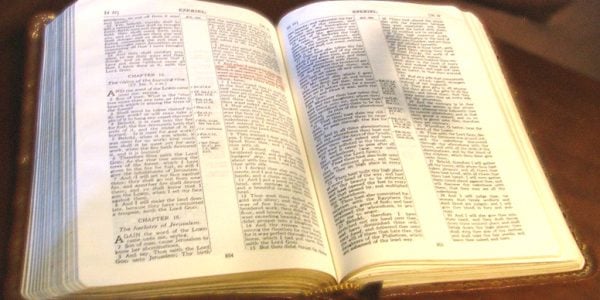
“Bible with Cross Shadow,” David Campbell, Flickr C.C.
The continuous meta-debate within the United Methodist debate is to ask: what are we really debating about? There are many ways to answer that question, some more deceitful and cynical than others. I would propose that one way to understand our disagreement is that it’s a question of whether John Wesley’s 18th century theological presuppositions are permanently normative for United Methodism. Does whatever the Methodist historians tell us about what John Wesley believed have to be what we believe also? Or is it valid to see Wesleyan thought as something that inherently evolves beyond what John Wesley could have imagined?
This question is analogous to a question I often ask about scripture. When Jesus or the apostle Paul make innovative interpretations of Hebrew scripture that are nothing like the grammatical-historical exegesis of modern evangelicalism, am I allowed to emulate Jesus and Paul’s interpretive methodology or do they get to do things I don’t get to do on account of their words being inside the canon while my words are not?
The most prominent example of Jesus’ innovative exegesis is the scripture from which my blog title is taken. In Hosea 6:6, God says, “I desire steadfast love not sacrifice, the knowledge of God rather than burnt offerings.” The original context of Hosea 6 has to do with Israel’s lack of loyalty to God, so God is asking for steadfast love for himself.
But when Jesus quotes Hosea 6:6 in Matthew 9:13, telling his religious critics to “go and find out what this means: ‘I desire mercy not sacrifice.'” he uses Hosea 6:6 as a justification for “eating and drinking with sinners,” applying the hesed (mercy/steadfast love) to the sinners instead of God. There’s no grammatical historical justification for Jesus’ interpretive move: he simply defines steadfast love for God AS mercy for sinners.
So am I allowed to emulate what Jesus did there when I interpret scripture? Likewise the apostle Paul’s letters are filled with wild midrashic uses of the Hebrew scripture that would have earned him an automatic F on any evangelical seminary term paper. There’s nothing wrong with Paul or Jesus’ interpretive style if scripture is poetry meant to inspire more poetry. It’s only when we impose a grammatical historical approach to biblical interpretation that it becomes problematic (outside of the closed canon).
Now getting back to John Wesley, I think it’s fair to say that a primary driving force in his theological formation was the search for a Christian gospel that wasn’t ugly. His 18th century theological context was predominated by 5-point Calvinism, which he opposed vociferously. A single sentence from his sermon “Free Grace” summarizes his objection and his basic principle for interpreting scripture: “No Scripture can mean that God is not love, or that his mercy is not over all his works.” The two verses that are cited here, 1 John 4:7 and Psalm 145:9, became cornerstone theological principles in Wesleyan thought which are part of what develops into the doctrine of prevenient grace that says God is always and everywhere proactively reaching out to every human with his love, regardless of where they are in their knowledge of God.
Prevenient grace is a theological slippery slope if there ever was one. Because if we make the assumption that God is radically proactive with his love, then it becomes harder to maintain that this kind of God is waiting with his arms folded for humans to grasp a particular theological doctrine or recite a particular catechism before he will move them from the damned column to the saved column.
How can a God who loves preveniently be stingy about the justifying grace that he parcels out? If God is preveniently, proactively loving, then surely justification describes a realization that needs to happen on our side of things rather than a forensic declaration that God only issues if we respond to him according to a prescribed formula. And if there isn’t a prescribed formula (which would be works righteousness) that is required for justification to take place, how many humans “accidentally” stumble into their justification without having grasped the role of Jesus’ cross in conquering their sin?
Prevenient grace makes it reasonable to question whether God is moving preveniently to draw humans into his grace through means that go beyond explicitly Christian evangelism, possibly even within other religious systems. Prevenient grace makes it reasonable to surmise that God is a pragmatist who wants to use all means available to make humanity into his merciful family. Prevenient grace puts the burden on those who want to maintain a doctrine of Christian exclusivity to justify their doctrine more holistically and robustly than simply quoting Jesus saying, “No one comes to the Father but through me.” Because what if Jesus is himself subversively using Buddhist teaching to bring people in very different cultures to the Father who will never interact directly with a Christian?
It’s because of this thread of prevenient grace that the theology of recently popular contemplative Christian author Henri Nouwen becomes compatible with Wesleyan thought to the point that progressive 21st century Methodism is more Nouwenian than it is Wesleyan. Nouwen had the audacity to claim that God is the voice in the universe that says yes to us with the primary purpose of convincing us that he loves us and delights in us. This completely changes the center of gravity of the Christian gospel. Instead of “fleeing the wrath to come” (in Wesley’s terms) through anxiously trying to accept Jesus’ sacrifice for my sins authentically enough to convince a punitive God not to damn me, I flee the wrath of my own self-hatred by searching desperately for the voice that delights in me.
In the mostly gay United Methodist church I first attended, the first book I read was Henri Nouwen’s Life of the Beloved. Nouwen’s premise completely changed the way I looked at the gospel. Nouwen describes the Christian spiritual journey as a process of “becoming the beloved of God,” which was good news to a severely depressed young adult in a way that having a Disneyland afterlife if I believed in Jesus hard enough wasn’t. I wasn’t exposed to any direct works of John Wesley until I went to seminary 8 years after becoming United Methodist. But I kept on coming across Henri Nouwen in every United Methodist church I attended.
In other fields of thought, there’s a recognition and expectation that a particular school started by a particular thinker is supposed to evolve over time. In the online counseling program I’m in, there is a lot of reverence for the mid-twentieth century psychologist Carl Rogers. But nobody would expect any psychologist today to stick exclusively to Rogers’ theories for counseling out of loyalty to him. The way you express your loyalty to great thinkers is to build off of their theories and go beyond where they were able to go. Rogers couldn’t have anticipated Susan Johnson’s Emotionally Focused Therapy (EFT) that has emerged over the last decade, but he would absolutely approve of it.
To call someone innovative was an insult in 18th century Christian theology because it meant that you were making up something new without ample justification in Christian tradition. Now being innovative simply means that you’re faithfully using the mind God gave you to discover new ways of doing things that were out of reach to those who came before you. But is Christian theology inevitably different than other fields of thought? For John Wesley, the word “primitive” was as much of a compliment as the word “innovative” was an insult. A “primitive Christian” for Wesley was one whose lifestyle matched that of the early church. I certainly agree that emulating the Acts 2 church where all things were shared in common is a worthy goal, but does that mean that I also must adopt 1st century understandings of things like biology and cosmology?
So let’s make this very specific. Are the Articles of Religion at the beginning of the Book of Discipline normatively binding theology for all United Methodists or are they simply a historical reference? Do United Methodists have to believe that the “sacrifice” the Roman Catholic priest references during mass is “a blasphemous fable and dangerous deceit” (Article 20)? Is the Roman Catholic doctrine of transubstantiation “repugnant to the plain words of scripture” (Article 18)? Are “Romish doctrines” surrounding purgatory, the veneration of saints, the adoration of Eucharist, and the use of icons for prayer likewise “repugnant to the Word of God” (Article 14)? Is speaking in tongues during worship “repugnant to the Word of God” (Article 15)? Ecumenism with either Roman Catholics or Pentecostals becomes quite difficult if our Articles of Religion are a binding theological norm.
And here’s a very specific point of contention that demarcates the fault-line in our great debate: Article 7 on original sin. How we understand original sin determines how we understand biology and what we say about people who seem to be created very differently than others. Are we born into a sinful world that corrupts us or are we born with deformed bodies and souls that are innately already corrupted? Article 7 says the latter. Not only are we innately deformed but we are “inclined to evil and that continually.”
Here’s why I have a problem with that. Because I read a 16th century Spanish theological treatise in seminary that justified enslaving and massacring natives in the New World on the basis of their total depravity, which is what the Spaniards did, wiping entire nations of people off the face of the earth. Because Frederick Douglass reported how white slave masters in the South would read Bible verses about total depravity to their slaves before they whipped them. Because James Dobson and other fundamentalist Christian psychologists today continue to promote abusive, permanently psychologically damaging parenting approaches on the basis of believing in children’s continual inclination to evil.
The doctrine of total depravity has a long, well-documented track record throughout the history of European colonialism of becoming the total depravity of whatever nation we want to “civilize” (conquer, enslave, pillage of natural resources, etc). The difference between John Wesley’s 18th century context and my own is that I live in an age that has had its eyes opened to the devastating sin of colonialism, which was justified every step of the way by supposedly orthodox Christian theology.
Theodor Adorno once said, “There can be no poetry after Auschwitz.” I would say there can be no Christian orthodoxy after colonialism that doesn’t have an answer for colonialism. What direction would John Wesley’s theology go if he had to answer for colonialism as part of his theological formation and he was operating under the premise that God is love and his mercy is over all his works?
That doesn’t mean that I simply chuck the doctrine of original sin, but colonialism forces me to scrutinize it, which has resulted in my hypothesis that original sin is a toxic heresy when it is understand as a biological condition and a valuable cornerstone of our faith when it is understood socially. Understood as a biological condition, original sin was part of the foundation of modern Western racism insofar as “white” people were Christians who had been redeemed from their original state of nature through salvation, while “colored” people were heathens who needed white Christians to deliver them from their barbaric continual inclination to evil. Understood socially, original sin is simply the recognition that hurting people hurt other people, parents pass on their unresolved trauma to their children, and all of humanity is caught in a cycle of brokenness.
A nihilistic understanding of human biology provides the justification for genocide and slavery; understanding humans as divine jewels who have been buried in the filth of sinful social scripts and cycles of violence provides the foundation for the hope that we can be redeemed. A nihilistic biology says that people who call themselves gay or transgender are simply expressing their biological deformity that can be instantaneously overridden through “new creation” if they believe in Jesus emphatically enough. A doctrine of sin that believes God continues to create each individual human perfectly says to gay or transgender people let’s find the best version of who you are in your beautiful queer uniqueness.
What would John Wesley say if he were sitting in a 21st century theological panel discussion with a black liberation theologian and a transgender Christian? What would he say to the 19th century Methodist pastor from South Carolina who used Wesleyan theology to write Duty of a Christian Master as pro-slavery propaganda? Would John Wesley view the doctrinal priorities and stances of today’s evangelical United Methodists analogously to those of the 18th century Calvinists he battled against or is that analogy unfair? Since he was committed to preaching a gospel that made sense evangelistically to the people who were hearing it, would he tailor his message to the existential ethos of our time or would he say there is only one gospel and it cannot be tailored?
I don’t believe that the revival United Methodism needs is a static facsimile of 18th century theology. I don’t think it’s a crisis for the Wesleyan stream of Christian theology to be diverse and muddy because of its innately pragmatic theological ethos. I think that if John Wesley were alive today, he would put Henri Nouwen on his recommended author list right next to William Law and Thomas A Kempis. And I think he would tell the “holiness” crowd in United Methodism today to lighten up on their performative piety and focus on cultivating their mercy.
Check out my book How Jesus Saves the World From Us!
Previous Post

October 29, 2018
Anti-Semitism Is Not Satire, Babylon Bee
Next Post

November 2, 2018 I Am Cain (a poem)
Browse Our Archives
Select a Category Advent Beauty Will Save the World Bible Big Picture: Ephesians Bloggers Book Christian salvation and the Beautitudes Culture Daily Office Danceable Homiletics Deadly Sins Deep Roots: Genesis Devotions Dominican Republic May 2011 El Principio Misericordia (The Mercy Principle) Five verses God tattooed on my heart Fundraising FutureGospel Good Biblical Words Henri Nouwen Interview Jennings' Christian Imagination Jesus inside the beltway Jesus Is My Candidate Jesus vs the Pharisees Jesus vs. Plato Journey to Eternity Looking Back on 2012 Love Actually Monday Merton Monday Merton Music Occupy the manger On Earth As It Is In Heaven Original Sin Podcast Poetry Politics Prayer Psalm 119 Radical Jesus 101 Reviews Sermon on the Mount Sermons Spanish Bible study Special Series Spiritual but not religious Synchroblog Theology Things that made me think Thomas a Kempis Ugliness Into Beauty Uncategorized Viaje Dominicano 2013 Walking in the Valley (Lent) Welcome: It's More than a Mat Wild Goose 2013 Wrestling
Select a Month March 2022 January 2022 December 2021 September 2021 April 2021 September 2020 August 2020 July 2020 June 2020 May 2020 April 2020 March 2020 February 2020 January 2020 December 2019 November 2019 October 2019 September 2019 August 2019 June 2019 May 2019 April 2019 March 2019 February 2019 January 2019 December 2018 November 2018 October 2018 September 2018 August 2018 July 2018 June 2018 May 2018 April 2018 March 2018 February 2018 January 2018 December 2017 November 2017 October 2017 September 2017 August 2017 July 2017 June 2017 May 2017 April 2017 March 2017 February 2017 January 2017 December 2016 November 2016 October 2016 September 2016 August 2016 July 2016 June 2016 May 2016 April 2016 March 2016 February 2016 January 2016 December 2015 November 2015 October 2015 September 2015 August 2015 July 2015 June 2015 May 2015 April 2015 February 2015 January 2015 December 2014 November 2014 October 2014 September 2014 August 2014 July 2014 June 2014 May 2014 April 2014 March 2014 February 2014 January 2014 December 2013 November 2013 October 2013 September 2013 August 2013 July 2013 June 2013 May 2013 April 2013 March 2013 February 2013 January 2013 December 2012 November 2012 October 2012 September 2012 August 2012 July 2012 June 2012 May 2012 April 2012 February 2012 January 2012 December 2011 November 2011 October 2011 September 2011 August 2011 July 2011 June 2011 May 2011
Follow Us!
TAKE THE
Religious Wisdom Quiz
Which book directly follows Joshua?
Select your answer to see how you score.
Leviticus Numbers Judges Ruth
Related posts from Mercy Not Sacrifice

Donald Trump And The Exorcism Of White America

When God's A Cop, Every Cop Is God


"All People Are Holy": The Theology Of Alexandria...
TRENDING AT PATHEOS Progressive Christian

What Being a Modern-Day Apostle Means to Me
In my last column, I discussed the ins and outs of modern-day...

Did Ancient China Once Worship the God of...
Across human history, a common thread weaves through the origins of the...

Love Your Neighbor – Including Earth-Kin: Lev. 19,...
God’s command to love your neighbor means acting in an ethical and...

Lead a Church Study of “Jesus and Lao...
Guest writer Jack Thomas (The Irreverent Reverend) reflects on leading his church...

Pastoral Wisdom for Responding to Sermon Pushback
Getting sermon pushback on your social justice sermon? Learn practical, Proverbs-based strategies...

Principles for Understanding the Apostolic Ministry Today
Whenever people discover that my formal ministry title is "apostle," as in...
view all Progressive Christian blogs
Ad-Free & Subscriber Log-In Subscription Support
- About Us
- 2026 Calendar
- Videos
- Podcasts
- Library of World Religions
- Faith In Media Tracker
- Advertise With Us
- Write for Us
- Privacy Policy
- Terms of Service
- Do Not Sell My Data
- Contact Us
- Radiant Digital
- Manage Newsletter Subscriptions
- Unsubscribe From Notifications
- Sitemap
Copyright 2008-2026, Patheos. All rights reserved.
Subscription Support Ad-Free & Subscriber Log-In
Follow Patheos