
BuddhistCatholicContemplativeEvangelicalGeneral ChristianHinduJewishLatter-day SaintMuslimNew VisionsProgressive Christian
Beliefs
- Buddhist
- Catholic
- Contemplative
- Evangelical
- General Christian
- Hindu
- Jewish
- Latter-day Saint
- More Voices
- Muslim
- New Visions
- Pagan
- Progressive Christian
Topics
- Religion News
- Food and Religion
- Sports and Religion
- Religious Art
- Religious Music and Entertainment
- Religious Events
- History and Religion
- Style and Religion
- Politics and Religion
- Women in Religion
- Recreation Outdoors and Religion
- Business Finance and Religion
- Careers Workplace and Religion
- Education and Religion
- Family Parenting and Religion
- Health Fitness and Religion
- Home and Religion
- Relationships and Religion
- Technology and Religion
- Travel and Religion
Columnists
- Buddhist Columnists
- Business Finance and Religion Columnists
- Careers Workplace and Religion Columnists
- Catholic Columnists
- Contemplative Columnists
- Education and Religion Columnists
- Evangelists Columnists
- Family Parenting and Religion Columnists
- General Christian Columnists
- Health Fitness and Religion Columnists
- Hindu Columnists
- History and Religion Columnists
- Home and Religion Columnists
- Jewish Columnists
- More Voices Columnists
- Latter Day Columnists
- Muslim Columnists
- New Visions Columnists
- Nonreligious Columnists
- Pagan Columnists
- Politics and Religion Columnists
- Progressive Columnists
- Recreation Outdoors and Religion Columnists
- Relationships and Religion Columnists
- Religion News Columnists
- Religious Art Columnists
- Religious Events Columnists
- Religious Music and Entertainment Columnists
- Sports and Religion Columnists
- Style and Religion Columnists
- Technology and Religion Columnists
- Travel and Religion Columnists
- Women in Religion Columnists
Resource Library
- 2026 Calendar
- Library of World Religions
- The 100 Most Holy Places on Earth
- Patheos Answers
- Podcasts
- Videos
- Faith Leaders Database
- Anglican Episcopalian
- Bahai
- Baptist
- Buddhism
- Christianity
- Confucianism
- Eastern Orthodoxy
- Hinduism
- Holiness and Pentecostal
- ISKCON
- Islam
- Judaism
- Lutheran
- Methodist
- The Church of Jesus Christ of Latter-day Saints
- New Age
- Paganism
- Presbytarian and Reformed
- Protestantism
- Religion Behind the Scenes
- Roman Catholic
- Scientology
- Shia Islam
- Sikhism
- Sufism
- Sunni Islam
- Taoism
- Zen
- See all religions
Research Tools
 Ad-Free & Subscriber Log-In Subscription Support
Ad-Free & Subscriber Log-In Subscription Support
Follow Patheos 

- Trending:
- Forgiveness
- |
- Marriage
- |
- Consciousness
- |
- Death Penalty
- |
- Election
- |
- Halloween
 Mercy Not Sacrifice
-
More
- Home
- Progressive Christian
- No, The Bible Does Not Condemn Domestic Violence
No, The Bible Does Not Condemn Domestic Violence
Last updated on: May 3, 2018 at 8:00 am by Morgan Guyton
No, The Bible Does Not Condemn Domestic Violence 2018-05-03T00:26:59-05:00 Morgan Guyton
Patheos Explore the world's faith through different perspectives on religion and spirituality! Patheos has the views of the prevalent religions and spiritualities of the world.

“Bible with Cross Shadow,” David Campbell, Flickr C.C.
For those of you who have been following the drama around fundamentalist seminary president Paige Patterson’s counsel to women to stay in abusive marriages rather than divorce, I’m about to say something shocking. Paige Patterson is right. The Bible condemns divorce except in cases of adultery and a very specific form of abandonment; it does not give an out for domestic violence.
In response to the Paige Patterson drama, nice guy fundamentalist Russell Moore tried his best to make the Bible allow divorce for domestic violence, but he had to engage in ridiculously dishonest eisegetical gymnastics to do so. The hard truth is that the biblical inerrantist worldview of both Paige Patterson and Russell Moore does not allow an understanding that domestic violence is a valid reason to leave a marriage. Paige Patterson is being consistent and faithful to his worldview while Russell Moore is trying to cheat and make it more palatable to modern society.
In Mark 10, the Pharisees try to test Jesus by asking him a question about divorce. Under the Mosaic law, all a man had to do to divorce a woman was write a certificate of divorce and send her away. Presumably the certificate of divorce is the woman’s proof that she’s not committing adultery if she tries to remarry. In response to the Pharisees’ inquiry, Jesus says, “Anyone who divorces his wife and marries another woman commits adultery against her. And if she divorces her husband and marries another man, she commits adultery” (Mark 10:11-12). In Matthew’s account of the same conversation, Jesus offers the caveat “except for sexual immorality” (Matthew 19:9).
The only other place in the New Testament that talks about divorce is 1 Corinthians 7. In 1 Corinthians 7:12-15, the apostle Paul gives instructions about marriages with non-believers. In verses 12-14, he says not to divorce a non-believer just because you’ve become a Christian. Then in verse 15, he says that “if the unbeliever [spouse] leaves, let it be so. The brother or the sister is not bound in such circumstances; God has called us to live in peace.”
In other words, if you become a Christian and your non-believing spouse walks away as a result, you are “not bound.” You can marry another Christian. So we might say that Paul declares divorce and remarriage to be permissible in the case of “abandonment.” But this abandonment has a very specific context: when a non-believing spouse leaves upon the believing spouse’s conversion.
Paul does not give explicit instructions on what you’re allowed to do if a Christian spouse leaves you. Can you remarry after that? It’s unclear that he would allow it because he says in 1 Corinthians 7:11 that anyone who divorces must remain unmarried or be reconciled to their estranged spouse. Does it even count as a divorce if your Christian spouse skips town or are you still officially married and thus adulterous if you try to marry someone else?
According to Paul’s logic in 1 Corinthians 7, the reason believers are “not bound” when non-believing spouses leaves them is not because they were abandoned but because their spouses were not believers. So a pure and consistent biblical inerrantist would have to say that only if you are abandoned by a non-believing spouse can you remarry and be absolutely sure that you’re not disobeying the Bible.
That’s why Paige Patterson takes the stance that he does. Unless there’s adultery or the abandonment of a non-believing spouse, divorce is always wrong, according to his biblical inerrantist reading of scripture. That’s why he and his fellow inerrantists say that abuse sometimes calls for separation but never divorce; the abused spouse can flee the violence but not remarry. Russell Moore doesn’t want this to be true because it’s embarrassing and distasteful, which is why he tweeted the following:
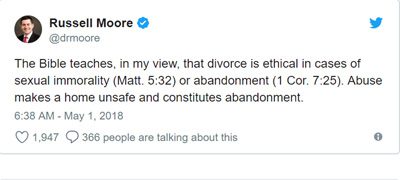
First of all, he didn’t get the chapter and verse right when he wrote 1 Corinthians 7:25. In that verse, Paul is saying something about virgins that has nothing to do with divorce. It’s verse 15 where Paul says that if a non-believing spouse leaves, you are not bound. Now you recall what I just shared with you about Paul’s teaching in that chapter. How in the world could anybody possibly claim that it has anything to do with domestic violence?
It doesn’t. Russell Moore thinks he can summarize 1 Corinthians 7:15 down to a single word — abandonment — and then interpret that word loosely to include an “unsafe home.” That’s why the fundamentalist trolls who came after Russell Moore were absolutely right to do so under their biblical inerrantist logic.
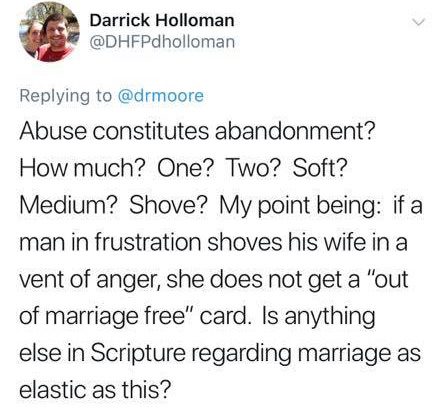
Darrick Holloman probably should have just stuck to a scriptural argument instead of giving people a reason to wonder how much he’s been beating his wife. All he had to say was Paul was never talking about abuse, you nitwit; he was talking about non-believers saying peace out when their spouses become Christians. In any case, Paige Patterson and Darrick Holloman are honest and consistent biblical inerrantists; Russell Moore is a fraud who’s trying to compromise the word of God in order to scratch the itching ears of Christians who don’t want to face its full harshness.
The problem is not that Paige Patterson has somehow misinterpreted the Bible while Russell Moore is giving a better interpretation. The problem is that biblical inerrancy is a toxic straightjacket that prevents Christians from being compassionate, reasonable people who love the way Jesus would want us to love. Now some have made the argument that Jesus’ agenda in attacking divorce was to protect women from being thrown away into a lifetime of poverty. In Jesus’ day, divorced women were extremely economically vulnerable. That’s the interpretation that Dallas Willard takes in the Divine Conspiracy. I like it, but it’s complete speculation and eisegesis. Jesus does not give us any supporting evidence in the immediate text.
The problem here is not that we need to interpret the Bible more accurately. The problem is that we need to actually believe the Christian gospel and read the Bible in a way that reflects that belief. According to the gospel, we are justified entirely by God’s grace poured out through Jesus Christ’s sacrifice for our sins on his cross. We receive that justification simply by trusting in it; that’s what faith is. Anything beyond that trust makes “faith” into a work.
People who try to turn the Bible into a legalistic rule-book reveal that they haven’t yet trusted that they are completely justified by God’s grace. This is why I hypothesize that justification by faith for many conservative evangelicals like Paige Patterson and Russell Moore is really earning salvation by believing hard things. Dogmatic hypervigilance reveals a complete lack of eternal spiritual security.
For someone who lives under grace, the Bible is not a drill sergeant to be obeyed, but a treasure map that draws us into deeper levels of intimacy with God. This is what 80% of the apostle Paul’s writing is about: things like the “depth and breadth and height and width” of God’s love (Ephesians 3:18). When biblical inerrantists read scripture, they brush aside all the fluffy poetry (i.e. most of the Bible) and focus exclusively on things that seem like commands (even if they aren’t actually universal commands but pastorally contextual exhortations for specific historical communities).
When I read Paul’s epistles, I mostly see a man furiously arguing against every attempt to turn God’s word into a source of personal political power through some kind of legalism. His biggest battles are against those who try to make the gospel harder than it has to be.
Paul has specific instructions for specific historical communities that always have something to teach us about how to connect with God. But they aren’t direct commands that he’s given to us two thousand years later; we are eavesdropping on his conversation with other people in order to learn secondarily from his teaching. What I’m interested in is gaining the intimacy with God that Paul had, not turning his words into laws that give me the ability to control other people as a pastor.
Any honest account of Paul’s sexual ethics has to start with the recognition that he actually wanted everyone to stay celibate so they could experience the profound mystical glory he had access to. If you read the whole chapter of 1 Corinthians 7, it’s clear that his understanding of sexual ethics is pragmatic, aesthetic, and mystical, not at all legalistic like the inerrantists want to make him.
When I read the stories about Jesus, I see a man who ferociously attacks religious leaders and stands up for the outsiders they condemn. Time and time again, Jesus jumps to the defense of prostitutes, tax collectors, and other unruly, improper people whenever they are attacked by the first century versions of Paige Patterson and Russell Moore. So on that basis though not on the basis of straightforward exegesis, I can say with a lot of confidence that yes, of course Jesus would tell us to leave any marriage where we’re being abused whether it’s physical, emotional, or spiritual.
The legalistic use of scripture under biblical inerrancy is the “filthy rags” the apostle Paul was talking about. As long as the fundamentalists continue to use biblical legalism to control their churches, it doesn’t matter how nice and reasonable they try to be; they will operate with a suffocated gospel that creates a culture where abuse is normalized. The Bible is a wonderful tool, but it is not a comprehensive rule-book for everything. It does not condemn domestic violence. But it doesn’t need to for those of us who actually know Jesus.
Check out my book How Jesus Saves the World From Us: 12 Antidotes to Toxic Christianity!
Please support our campus ministry NOLA Wesley as a monthly patron or one-time donor!
Previous Post

May 2, 2018
Is Jesus on the Psych Ward?
Next Post

May 8, 2018 Another Open Letter to the Wesleyan Covenant Association
Browse Our Archives
Select a Category Advent Beauty Will Save the World Bible Big Picture: Ephesians Bloggers Book Christian salvation and the Beautitudes Culture Daily Office Danceable Homiletics Deadly Sins Deep Roots: Genesis Devotions Dominican Republic May 2011 El Principio Misericordia (The Mercy Principle) Five verses God tattooed on my heart Fundraising FutureGospel Good Biblical Words Henri Nouwen Interview Jennings' Christian Imagination Jesus inside the beltway Jesus Is My Candidate Jesus vs the Pharisees Jesus vs. Plato Journey to Eternity Looking Back on 2012 Love Actually Monday Merton Monday Merton Music Occupy the manger On Earth As It Is In Heaven Original Sin Podcast Poetry Politics Prayer Psalm 119 Radical Jesus 101 Reviews Sermon on the Mount Sermons Spanish Bible study Special Series Spiritual but not religious Synchroblog Theology Things that made me think Thomas a Kempis Ugliness Into Beauty Uncategorized Viaje Dominicano 2013 Walking in the Valley (Lent) Welcome: It's More than a Mat Wild Goose 2013 Wrestling
Select a Month March 2022 January 2022 December 2021 September 2021 April 2021 September 2020 August 2020 July 2020 June 2020 May 2020 April 2020 March 2020 February 2020 January 2020 December 2019 November 2019 October 2019 September 2019 August 2019 June 2019 May 2019 April 2019 March 2019 February 2019 January 2019 December 2018 November 2018 October 2018 September 2018 August 2018 July 2018 June 2018 May 2018 April 2018 March 2018 February 2018 January 2018 December 2017 November 2017 October 2017 September 2017 August 2017 July 2017 June 2017 May 2017 April 2017 March 2017 February 2017 January 2017 December 2016 November 2016 October 2016 September 2016 August 2016 July 2016 June 2016 May 2016 April 2016 March 2016 February 2016 January 2016 December 2015 November 2015 October 2015 September 2015 August 2015 July 2015 June 2015 May 2015 April 2015 February 2015 January 2015 December 2014 November 2014 October 2014 September 2014 August 2014 July 2014 June 2014 May 2014 April 2014 March 2014 February 2014 January 2014 December 2013 November 2013 October 2013 September 2013 August 2013 July 2013 June 2013 May 2013 April 2013 March 2013 February 2013 January 2013 December 2012 November 2012 October 2012 September 2012 August 2012 July 2012 June 2012 May 2012 April 2012 February 2012 January 2012 December 2011 November 2011 October 2011 September 2011 August 2011 July 2011 June 2011 May 2011
Follow Us!
TAKE THE
Religious Wisdom Quiz
Who played instruments in Temple?
Select your answer to see how you score.
Levites Priests Kings Prophets
Related posts from Mercy Not Sacrifice


When God's A Cop, Every Cop Is God

Celebrity-Driven Church Is Not Safe For Kids

Why Kevin DeYoung's "Culture War Strategy" Fails
TRENDING AT PATHEOS Progressive Christian

What Being a Modern-Day Apostle Means to Me
In my last column, I discussed the ins and outs of modern-day...

Did Ancient China Once Worship the God of...
Across human history, a common thread weaves through the origins of the...

Love Your Neighbor – Including Earth-Kin: Lev. 19,...
God’s command to love your neighbor means acting in an ethical and...

Lead a Church Study of “Jesus and Lao...
Guest writer Jack Thomas (The Irreverent Reverend) reflects on leading his church...

Pastoral Wisdom for Responding to Sermon Pushback
Getting sermon pushback on your social justice sermon? Learn practical, Proverbs-based strategies...

Principles for Understanding the Apostolic Ministry Today
Whenever people discover that my formal ministry title is "apostle," as in...
view all Progressive Christian blogs
Ad-Free & Subscriber Log-In Subscription Support
- About Us
- 2026 Calendar
- Videos
- Podcasts
- Library of World Religions
- Faith In Media Tracker
- Advertise With Us
- Write for Us
- Privacy Policy
- Terms of Service
- Do Not Sell My Data
- Contact Us
- Radiant Digital
- Manage Newsletter Subscriptions
- Unsubscribe From Notifications
- Sitemap
Copyright 2008-2026, Patheos. All rights reserved.
Subscription Support Ad-Free & Subscriber Log-In
Follow Patheos