
BuddhistCatholicContemplativeEvangelicalGeneral ChristianHinduJewishLatter-day SaintMuslimNew VisionsProgressive Christian
Beliefs
- Buddhist
- Catholic
- Contemplative
- Evangelical
- General Christian
- Hindu
- Jewish
- Latter-day Saint
- More Voices
- Muslim
- New Visions
- Pagan
- Progressive Christian
Topics
- Religion News
- Food and Religion
- Sports and Religion
- Religious Art
- Religious Music and Entertainment
- Religious Events
- History and Religion
- Style and Religion
- Politics and Religion
- Women in Religion
- Recreation Outdoors and Religion
- Business Finance and Religion
- Careers Workplace and Religion
- Education and Religion
- Family Parenting and Religion
- Health Fitness and Religion
- Home and Religion
- Relationships and Religion
- Technology and Religion
- Travel and Religion
Columnists
- Buddhist Columnists
- Business Finance and Religion Columnists
- Careers Workplace and Religion Columnists
- Catholic Columnists
- Contemplative Columnists
- Education and Religion Columnists
- Evangelists Columnists
- Family Parenting and Religion Columnists
- General Christian Columnists
- Health Fitness and Religion Columnists
- Hindu Columnists
- History and Religion Columnists
- Home and Religion Columnists
- Jewish Columnists
- More Voices Columnists
- Latter Day Columnists
- Muslim Columnists
- New Visions Columnists
- Nonreligious Columnists
- Pagan Columnists
- Politics and Religion Columnists
- Progressive Columnists
- Recreation Outdoors and Religion Columnists
- Relationships and Religion Columnists
- Religion News Columnists
- Religious Art Columnists
- Religious Events Columnists
- Religious Music and Entertainment Columnists
- Sports and Religion Columnists
- Style and Religion Columnists
- Technology and Religion Columnists
- Travel and Religion Columnists
- Women in Religion Columnists
Resource Library
- 2026 Calendar
- Library of World Religions
- The 100 Most Holy Places on Earth
- Patheos Answers
- Podcasts
- Videos
- Faith Leaders Database
- Anglican Episcopalian
- Bahai
- Baptist
- Buddhism
- Christianity
- Confucianism
- Eastern Orthodoxy
- Hinduism
- Holiness and Pentecostal
- ISKCON
- Islam
- Judaism
- Lutheran
- Methodist
- The Church of Jesus Christ of Latter-day Saints
- New Age
- Paganism
- Presbytarian and Reformed
- Protestantism
- Religion Behind the Scenes
- Roman Catholic
- Scientology
- Shia Islam
- Sikhism
- Sufism
- Sunni Islam
- Taoism
- Zen
- See all religions
Research Tools
 Ad-Free & Subscriber Log-In Subscription Support
Ad-Free & Subscriber Log-In Subscription Support
Follow Patheos 

- Trending:
- Forgiveness
- |
- Marriage
- |
- Consciousness
- |
- Death Penalty
- |
- Election
- |
- Halloween
 Mercy Not Sacrifice
-
More
- Home
- Progressive Christian
- Unerasing the Pueblo Crucificado
Unerasing the Pueblo Crucificado
Last updated on: March 31, 2018 at 4:09 pm by Morgan Guyton
Unerasing the Pueblo Crucificado 2018-03-31T16:09:44-05:00 Morgan Guyton
Patheos Explore the world's faith through different perspectives on religion and spirituality! Patheos has the views of the prevalent religions and spiritualities of the world.
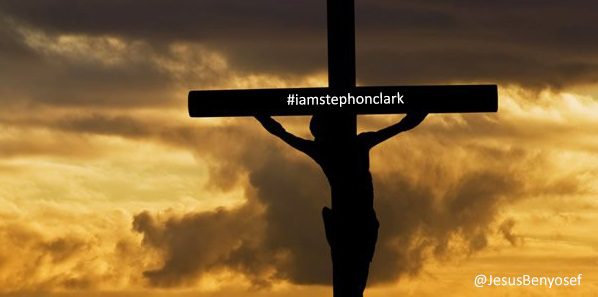
Today is Holy Saturday, the day Jesus spent in the grave. It’s a day on which we are invited to sit with the unresolved brokenness of our world. Yes, we will say Jesus is risen tomorrow, but today is a day for not looking away from the suffering of the people whose company Jesus consistently chose and whose needs he consistently prioritized: the pueblo crucificado.
Pueblo crucificado is a term I encountered in liberation theologian Jon Sobrino’s book El Principio Misericordia. It means the people who are being crucified, those to whom Jesus’ cross declares, “I see what they have done to you and I am being crucified with you.” The cross is at least as much about Jesus’ solidarity with his pueblo crucificado as it is about his atonement for those who do the crucifying. The reconciliation and atonement Jesus provides is for victims and perpretrators alike. Sadly, in many Christian accounts of sin, the victims are erased from the story and sin is treated as a victim-less crime against God’s rules. When victimhood is erased, we end up with an incomplete understanding of the sin that needs to be destroyed.
In Sobrino’s work, he brings to light what I see as a critical aspect of our salvation that gets brushed aside in the ahistorical, abstract way that Jesus’ cross is often theologized. That is that Jesus not only pays for our sin on the cross, but critically he exposes our sin so that we can be liberated from it. Too many Christians in a misguided affirmation of the sovereignty of God’s plan erase the fact that Jesus’ crucifixion was itself a sin. Jesus doesn’t say, “Father, thank you for fulfilling your plan through the religious authorities who condemned me and the Roman soldiers who are killing me.” He says, “Father, forgive them for they know not what they do.” We must not dismiss this earnest petition from Jesus as though it is merely pious play-acting; it has no less real theological meaning than Paul’s metaphorical improvisations about the cross years later.
Jesus’ brutal death reveals the sin of not just the religious authorities who condemned him, the crowds they manipulated into demanding his crucifixion, and the Roman soldiers who fulfilled the deed, but rather the entire system and order of worldly sin that made Jesus’ death inevitable.
When Peter preached to the crowd in the Jerusalem temple on Pentecost, he says in Acts 2:36, “Let the entire house of Israel know with certainty that God has made him both lord and messiah, this Jesus whom you crucified.” These are the words that caused the first 3000 converts to Christianity to be “cut to the heart” and convicted of their need to be saved from their sin so that they were baptized in Jesus’ name. It was not their fear of an afterlife punishment, but their revulsion at the evidence of the wickedness they had participated in.
Part of how God saves us from our sin is by exposing us to the visceral horror of its consequences. When sin is understood solely in the abstract as “breaking the rules” and salvation is only avoiding eternal punishment, I fear that this results in an incomplete repentance, which seems to be corroborated in a lack of spiritual fruit.
So here is where Sobrino’s concept of the pueblo crucificado comes into play in a claim which many Christians will find controversial. It’s hard to be convicted by an event that took place 2000 years ago and could easily be blamed on the people in that time and place. Sobrino claims that the pueblo crucificado continues the salvific work of Jesus by continuing to convict those whose eyes are opened to the results of our sin and our consequent need to forsake the sinful order of the world for the kingdom of God. It is not that those who continue to be crucified are equally innocent or divine as Jesus, but rather Jesus’ cross redefines their otherwise meaningless suffering as the exposure of our world’s sin.
Jesus is crucified every time the world dehumanizes any one of God’s precious children whether it’s because they languish in a disease-infested shantytown in a country paralyzed by unjust foreign debt whose natural resources are being pillaged by multinational corporations or because their parents are snatched away from them while they’re at school by immigration agents or because their cell phone becomes a “gun” in the eyes of the cops who extrajudicially assassinate them. Jesus’ disgrace and dehumanization on the cross grants dignity to all the people who are invisible to those with privilege and power. Their pueblo crucificado is only going to grow larger every year as the global economy increasingly dehumanizes the vast majority of humanity and defines their gifts and vocations as unmarketable and irrelevant.
So I don’t think it’s incorrect to say that Jesus was crucified in Stephon Clark, Philando Castile, Michael Brown, and anyone else who has been dehumanized in their suffering and death. Yes, they are all sinners like all of us are. But we can choose to receive their suffering and death as a source of our conviction and repentance for the way our sin helps to create the world order that caused them to die. Of course, it’s important to acknowledge how easily this can turn into a self-justifying performance. One of my favorite lyrics of all time comes from VNV Nation’s song Kingdom: “Do you think that you’ll be saved by burning flags to cleanse yourself of shame?”
We do not save ourselves by burning flags or hashtag-tattooing our brand with #BlackLivesMatter. It is rather the case that Jesus can use the exposed suffering of the pueblo crucificado to drive us further out of the comfortable delusions of the sinful world so that we can journey more deeply into the kingdom of God. God can do a lot more good with an “unwoke” but humble, open-hearted, and spiritually thirsty disciple of Christ than a self-righteous woketivist who only talks about other peoples’ sin.
In my own life, I can testify that I wasn’t saved by a hellfire and brimstone sermon. Nor was I was saved by an intellectual realization of the logic of the gospel. Nor was I saved by all my self-righteous tirades against ignorant rich white people. I was saved in August, 1998 when a barefoot little girl in the Zocalo of San Cristobal de las Casas in the state of Chiapas, Mexico asked me to buy her unraveling Zapatista dolls for a peso apiece and I couldn’t look away from her.
I was saved because I couldn’t do anything to help her but God refused to allow me to live in the world without her. I wrote in my journal that night, “I can never be a tourist again.” That was how God ripped out my heart and planted in me the need to give my life to fighting for his kingdom. He used that little girl from Chiapas to invite me into his pueblo crucificado. I hope one day in a different world beyond this one, he will give me the opportunity to thank her.
Check out my book How Jesus Saves the World From Us!
Support our campus ministry NOLA Wesley as a monthly patron or a one-time donor!
Previous Post

March 30, 2018
Four Essential Both/Ands of Jesus' Cross
Next Post

April 1, 2018 Easter Is For People Who Aren’t Winning
Browse Our Archives
Select a Category Advent Beauty Will Save the World Bible Big Picture: Ephesians Bloggers Book Christian salvation and the Beautitudes Culture Daily Office Danceable Homiletics Deadly Sins Deep Roots: Genesis Devotions Dominican Republic May 2011 El Principio Misericordia (The Mercy Principle) Five verses God tattooed on my heart Fundraising FutureGospel Good Biblical Words Henri Nouwen Interview Jennings' Christian Imagination Jesus inside the beltway Jesus Is My Candidate Jesus vs the Pharisees Jesus vs. Plato Journey to Eternity Looking Back on 2012 Love Actually Monday Merton Monday Merton Music Occupy the manger On Earth As It Is In Heaven Original Sin Podcast Poetry Politics Prayer Psalm 119 Radical Jesus 101 Reviews Sermon on the Mount Sermons Spanish Bible study Special Series Spiritual but not religious Synchroblog Theology Things that made me think Thomas a Kempis Ugliness Into Beauty Uncategorized Viaje Dominicano 2013 Walking in the Valley (Lent) Welcome: It's More than a Mat Wild Goose 2013 Wrestling
Select a Month March 2022 January 2022 December 2021 September 2021 April 2021 September 2020 August 2020 July 2020 June 2020 May 2020 April 2020 March 2020 February 2020 January 2020 December 2019 November 2019 October 2019 September 2019 August 2019 June 2019 May 2019 April 2019 March 2019 February 2019 January 2019 December 2018 November 2018 October 2018 September 2018 August 2018 July 2018 June 2018 May 2018 April 2018 March 2018 February 2018 January 2018 December 2017 November 2017 October 2017 September 2017 August 2017 July 2017 June 2017 May 2017 April 2017 March 2017 February 2017 January 2017 December 2016 November 2016 October 2016 September 2016 August 2016 July 2016 June 2016 May 2016 April 2016 March 2016 February 2016 January 2016 December 2015 November 2015 October 2015 September 2015 August 2015 July 2015 June 2015 May 2015 April 2015 February 2015 January 2015 December 2014 November 2014 October 2014 September 2014 August 2014 July 2014 June 2014 May 2014 April 2014 March 2014 February 2014 January 2014 December 2013 November 2013 October 2013 September 2013 August 2013 July 2013 June 2013 May 2013 April 2013 March 2013 February 2013 January 2013 December 2012 November 2012 October 2012 September 2012 August 2012 July 2012 June 2012 May 2012 April 2012 February 2012 January 2012 December 2011 November 2011 October 2011 September 2011 August 2011 July 2011 June 2011 May 2011
Follow Us!
TAKE THE
Religious Wisdom Quiz
True or False: David killed Goliath with a sword.
Select your answer to see how you score.
FALSE TRUE
Related posts from Mercy Not Sacrifice

When God's A Cop, Every Cop Is God


"All People Are Holy": The Theology Of Alexandria...

Epimenides And The Plague Of Athens
TRENDING AT PATHEOS Progressive Christian

What Being a Modern-Day Apostle Means to Me
In my last column, I discussed the ins and outs of modern-day...

Did Ancient China Once Worship the God of...
Across human history, a common thread weaves through the origins of the...

Love Your Neighbor – Including Earth-Kin: Lev. 19,...
God’s command to love your neighbor means acting in an ethical and...

Lead a Church Study of “Jesus and Lao...
Guest writer Jack Thomas (The Irreverent Reverend) reflects on leading his church...

Pastoral Wisdom for Responding to Sermon Pushback
Getting sermon pushback on your social justice sermon? Learn practical, Proverbs-based strategies...

Principles for Understanding the Apostolic Ministry Today
Whenever people discover that my formal ministry title is "apostle," as in...
view all Progressive Christian blogs
Ad-Free & Subscriber Log-In Subscription Support
- About Us
- 2026 Calendar
- Videos
- Podcasts
- Library of World Religions
- Faith In Media Tracker
- Advertise With Us
- Write for Us
- Privacy Policy
- Terms of Service
- Do Not Sell My Data
- Contact Us
- Radiant Digital
- Manage Newsletter Subscriptions
- Unsubscribe From Notifications
- Sitemap
Copyright 2008-2026, Patheos. All rights reserved.
Subscription Support Ad-Free & Subscriber Log-In
Follow Patheos