
BuddhistCatholicContemplativeEvangelicalGeneral ChristianHinduJewishLatter-day SaintMuslimNew VisionsProgressive Christian
Beliefs
- Buddhist
- Catholic
- Contemplative
- Evangelical
- General Christian
- Hindu
- Jewish
- Latter-day Saint
- More Voices
- Muslim
- New Visions
- Pagan
- Progressive Christian
Topics
- Religion News
- Food and Religion
- Sports and Religion
- Religious Art
- Religious Music and Entertainment
- Religious Events
- History and Religion
- Style and Religion
- Politics and Religion
- Women in Religion
- Recreation Outdoors and Religion
- Business Finance and Religion
- Careers Workplace and Religion
- Education and Religion
- Family Parenting and Religion
- Health Fitness and Religion
- Home and Religion
- Relationships and Religion
- Technology and Religion
- Travel and Religion
Columnists
- Buddhist Columnists
- Business Finance and Religion Columnists
- Careers Workplace and Religion Columnists
- Catholic Columnists
- Contemplative Columnists
- Education and Religion Columnists
- Evangelists Columnists
- Family Parenting and Religion Columnists
- General Christian Columnists
- Health Fitness and Religion Columnists
- Hindu Columnists
- History and Religion Columnists
- Home and Religion Columnists
- Jewish Columnists
- More Voices Columnists
- Latter Day Columnists
- Muslim Columnists
- New Visions Columnists
- Nonreligious Columnists
- Pagan Columnists
- Politics and Religion Columnists
- Progressive Columnists
- Recreation Outdoors and Religion Columnists
- Relationships and Religion Columnists
- Religion News Columnists
- Religious Art Columnists
- Religious Events Columnists
- Religious Music and Entertainment Columnists
- Sports and Religion Columnists
- Style and Religion Columnists
- Technology and Religion Columnists
- Travel and Religion Columnists
- Women in Religion Columnists
Resource Library
- 2026 Calendar
- Library of World Religions
- The 100 Most Holy Places on Earth
- Patheos Answers
- Podcasts
- Videos
- Faith Leaders Database
- Anglican Episcopalian
- Bahai
- Baptist
- Buddhism
- Christianity
- Confucianism
- Eastern Orthodoxy
- Hinduism
- Holiness and Pentecostal
- ISKCON
- Islam
- Judaism
- Lutheran
- Methodist
- The Church of Jesus Christ of Latter-day Saints
- New Age
- Paganism
- Presbytarian and Reformed
- Protestantism
- Religion Behind the Scenes
- Roman Catholic
- Scientology
- Shia Islam
- Sikhism
- Sufism
- Sunni Islam
- Taoism
- Zen
- See all religions
Research Tools
 Ad-Free & Subscriber Log-In Subscription Support
Follow Patheos 

- Trending:
- Advent
- |
- Forgiveness
- |
- Thanksgiving
- |
- Election
- |
- Seasonal Holidays
- |
- Marriage
 Mercy Not Sacrifice
-
More
- Home
- Progressive Christian
- Doubt and Neo-Calvinist Psychology
Doubt and Neo-Calvinist Psychology
Last updated on: January 11, 2018 at 7:41 am by Morgan Guyton
Doubt and Neo-Calvinist Psychology 2018-01-11T07:41:22-05:00 Morgan Guyton
Patheos Explore the world's faith through different perspectives on religion and spirituality! Patheos has the views of the prevalent religions and spiritualities of the world.
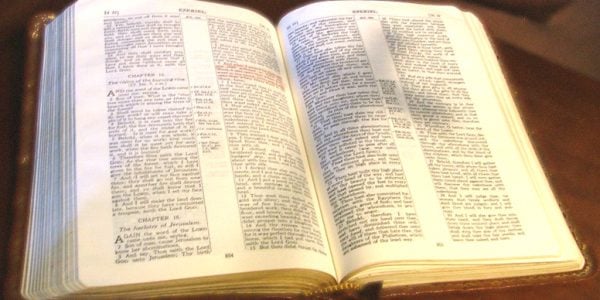
“Bible with Cross Shadow,” David Campbell, Flickr C.C.
The folks at Desiring God decided to go edgy with a recent blog post where the author said among other things that “doubt” is “slander against God.” The author provided a set of proof-texts which “prove” that the more we mature in our Christian journey, the more “steadfast” and “confident” we’re supposed to be in our faith. He said it’s okay to have some doubts early on in your Christian journey as long as you grow out of them by the time you’re a mature Christian. As I read the article (which you can google since I’m not going to subsidize their pageviews), it struck me that my problem with neo-Calvinists like the author of this article has more to do with their psychology than their theology.
Neo-Calvinists seem to operate with a rationalistic 18th century conception of psychology. For example, if you’re feeling afraid, just find all the Bible verses that tell you not to be afraid (the subject of another recent tweet from Desiring God) and read these verses until you stop feeling afraid. If they don’t convince you not to be afraid, that means you have a rebellious spirit and you need to ask God for forgiveness. If asking God for forgiveness for your insolence in persisting in fear doesn’t convince you to stop being afraid, then it probably means you don’t actually have a relationship with God at all and you’re predestined for damnation, which is too bad.
Okay I’m exaggerating. Nobody says any of these things aloud. But when you present Bible verses as rationalistic instant fixes to psychological problems like doubt, anxiety, fear, etc, the implication is that people are supposed to be instantaneously reprogrammed like robots after reading verses that “correct” their psychological problems, which are understood in this form of psychology as nothing more than “unbiblical thinking.”
When a Christian community establishes the expectation that people are supposed to be instantaneously reprogrammed by Bible verses, there’s a tremendous pressure on members of that community to play along like it works. And in this way, your church becomes a giant masquerade ball where people banter theologically precise small talk back and forth with each other as everyone represses their doubt, fear, anxiety, anger, etc, until the pressure becomes unbearable and some kind of volcanic eruption occurs.
No matter how zealously devout we are in our faith, our human brains don’t work mechanistically like that. In fact, the more loudly Christians perform their piety, the more likely there is deep, unaddressed trauma that is being compensated for. If we were actually reason-ordered robots, then neo-Calvinist psychology would work. Scripture is certainly a powerful resource for dealing with psychological issues, but we can’t just feed our brains logical input from the Bible like computer code. What I’ve found is that scripture doesn’t erase my problems upon reading it, but it does give me powerful language for crying out to God.
For example, I’ve said the Hebrew words for Psalm 27:8 as a mantra prayer hundreds of times: “My heart says of you, ‘Seek his face!’ Your face, Lord, I will seek. Do not hide your face from me.” I say that prayer whenever it seems like God is hiding. It’s so powerful to me. God, you told me to seek you; that’s exactly what I’m doing right now; where the ___ are you? It doesn’t solve anything. It doesn’t make my doubt or fear go away. But it does give me a healthy way to channel my doubt and fear. And what I’ve come to believe is that the more I experience God’s absence, the thirstier I become, which intensifies my experience of God’s presence when it returns.
So at least in my own prayer life, my doubts and anxieties end up being the means to deeper communion with God. If I were disingenuously pretending to be confident and steadfast in my faith all the time, I would have a shallow prayer life because my prayers would be just part of a script to perform. Doubt doesn’t dishonor God; doubt pushes us more deeply into the arms of God.
The real danger isn’t doubt; it’s disengagement. Our relationship with God is like a marriage. We can have fights; we can be exasperated when God leaves the toilet seat up or lets the water boil over on the stove; we can feel completely out of love with God. All of this can be worked through as long as there’s a presumption that no matter what, we’re going to stay in relationship. The problem is when our doubts and struggles become the rationalization for disengaging. And I would contend that a complete rupture of our faith life is more likely to happen if we’re part of a masquerade ball church whose members feel pressured to project a perfectly confident, doubt-free faith life. The angriest atheists I’ve met have always been ex-evangelicals.
I’m currently in a counseling program that was founded by a conservative evangelical named John Townsend who has spent much of his career undoing the damage of bad psychology in the evangelical church. Townsend has taught us about a concept called containment that is one of the most important skills for us to develop as counselors. Containment means I’m able to “contain” my client’s doubt, rage, delusions, fantasies, and any other terror they throw at me. Containment is the ability to remain unshocked and non-judgmental through anything. The more verbally violent my client is, the more likely they are terrified of being rejected and thrown out because of the unspeakable things they’re saying. Containment doesn’t mean that I’m dishonest about affirming things I shouldn’t affirm. It does mean that my focus is on creating a gracious, safe environment for my client to self-reflect.
The antidote to doubt is not an argument that disproves it using Bible verses. The antidote is patient, lived grace, i.e. containment for the one who’s living through it. Humans are not rational creatures; we are creatures who rationalize. We do not need rational arguments to correct rationalizations that have deep emotional underpinnings. We need to feel safe and loved until the volcanic anxiety fueling our rationalizations is dissipated and the scandals that had plagued us no longer feel all that important.
There are many things about the Bible that perplex me. I am never going to be comfortable with the parts of the Old Testament where God seems like a petty ancient tribal deity. The reason my discomfort doesn’t create an obstacle in my relationship with God is not because some neo-Calvinist wrote a book with the perfect argument that proves exhaustively why everything ascribed to God in the Old Testament makes complete sense and is perfectly loving. No, the reason my discomfort doesn’t take me out of relationship with God is because I have received enough grace from other Christians to trust in God’s grace regardless of the perpetually unresolved hangups I will continue to have with parts of the Bible until I die.
There are many things that I have doubts about, but I believe in God’s grace. I want to embody that grace the best I can wherever I go with whomever I interact. That may be another reason my doubts don’t derail me. I’m completely invested in the vision God has given me for my life. When you’ve put all your chips in, it’s a lot harder to say nope, I disagree with that Bible verse so I guess that means I have to walk away from everything. My understanding of how to live out God’s grace may evolve, but I know that embodying God’s grace in some form of pastoral ministry will always be what I’m going to do with my life.
Psychology matters, even though traditions that besmirch “anthropocentric” theology tend to belittle it instinctively. It’s all fine and good to say it’s all about Jesus; it’s not about us, etc. Maybe that’s good theology. Just remember that Jesus made it all about whichever person was suffering the most wherever he went. He would stop his sermons in the middle to heal the sick and lame when he had six other days of the week to work with. So if it’s all about Jesus, be like Jesus and use your words and actions for healing instead of winning arguments.
Check out my book How Jesus Saves the World From Us!
Please support our campus ministry NOLA Wesley as a one-time donor or monthly patron!
Previous Post

January 3, 2018
On Playing Chicken With Nuclear War
Next Post

January 12, 2018 How Can We Talk Forgiveness in the Age of #MeToo?
Browse Our Archives
Select a Category Advent Beauty Will Save the World Bible Big Picture: Ephesians Bloggers Book Christian salvation and the Beautitudes Culture Daily Office Danceable Homiletics Deadly Sins Deep Roots: Genesis Devotions Dominican Republic May 2011 El Principio Misericordia (The Mercy Principle) Five verses God tattooed on my heart Fundraising FutureGospel Good Biblical Words Henri Nouwen Interview Jennings' Christian Imagination Jesus inside the beltway Jesus Is My Candidate Jesus vs the Pharisees Jesus vs. Plato Journey to Eternity Looking Back on 2012 Love Actually Monday Merton Monday Merton Music Occupy the manger On Earth As It Is In Heaven Original Sin Podcast Poetry Politics Prayer Psalm 119 Radical Jesus 101 Reviews Sermon on the Mount Sermons Spanish Bible study Special Series Spiritual but not religious Synchroblog Theology Things that made me think Thomas a Kempis Ugliness Into Beauty Uncategorized Viaje Dominicano 2013 Walking in the Valley (Lent) Welcome: It's More than a Mat Wild Goose 2013 Wrestling
Select a Month March 2022 January 2022 December 2021 September 2021 April 2021 September 2020 August 2020 July 2020 June 2020 May 2020 April 2020 March 2020 February 2020 January 2020 December 2019 November 2019 October 2019 September 2019 August 2019 June 2019 May 2019 April 2019 March 2019 February 2019 January 2019 December 2018 November 2018 October 2018 September 2018 August 2018 July 2018 June 2018 May 2018 April 2018 March 2018 February 2018 January 2018 December 2017 November 2017 October 2017 September 2017 August 2017 July 2017 June 2017 May 2017 April 2017 March 2017 February 2017 January 2017 December 2016 November 2016 October 2016 September 2016 August 2016 July 2016 June 2016 May 2016 April 2016 March 2016 February 2016 January 2016 December 2015 November 2015 October 2015 September 2015 August 2015 July 2015 June 2015 May 2015 April 2015 February 2015 January 2015 December 2014 November 2014 October 2014 September 2014 August 2014 July 2014 June 2014 May 2014 April 2014 March 2014 February 2014 January 2014 December 2013 November 2013 October 2013 September 2013 August 2013 July 2013 June 2013 May 2013 April 2013 March 2013 February 2013 January 2013 December 2012 November 2012 October 2012 September 2012 August 2012 July 2012 June 2012 May 2012 April 2012 February 2012 January 2012 December 2011 November 2011 October 2011 September 2011 August 2011 July 2011 June 2011 May 2011
Follow Us!
TAKE THE
Religious Wisdom Quiz
True or False: Mark records Jesus' birth narrative in Bethlehem.
Select your answer to see how you score.
FALSE TRUE
Related posts from Mercy Not Sacrifice

When God's A Cop, Every Cop Is God


"All People Are Holy": The Theology Of Alexandria...

Epimenides And The Plague Of Athens
TRENDING AT PATHEOS Progressive Christian

Let Matthew 25 Guide You to a Greater...
With the crisp feel of fall in the air, our minds quickly...

Can a Chatbot Touch Your Soul?
Can a chatbot offer genuine spiritual counsel? One conversation brought me to...

Religion and Politics: How Should We Then Live?
Two cultural axioms get repeated in polite company. Don't mix religion and...

7 Things We Get Wrong About Giving Thanks
It's a time of year when many of us turn to the...

Uncaging Truth: Spirituality Beyond Institutions
The Lost Connection: Why True Spirituality, Not Religion, Is the Key to...

Christ the King? Maybe We've Misunderstood the Crown
What do we mean when we say that Jesus is King? What...
view all Progressive Christian blogs
Ad-Free & Subscriber Log-In Subscription Support
- About Us
- 2026 Calendar
- Videos
- Podcasts
- Library of World Religions
- Faith In Media Tracker
- Advertise With Us
- Write for Us
- Privacy Policy
- Terms of Service
- Do Not Sell My Data
- Contact Us
- Radiant Digital
- Manage Newsletter Subscriptions
- Unsubscribe From Notifications
- Sitemap
Copyright 2008-2026, Patheos, part of the Radiant Digital network of media brands. All rights reserved.
Subscription Support Ad-Free & Subscriber Log-In
Follow Patheos