
BuddhistCatholicContemplativeEvangelicalGeneral ChristianHinduJewishLatter-day SaintMuslimNew VisionsProgressive Christian
Beliefs
- Buddhist
- Catholic
- Contemplative
- Evangelical
- General Christian
- Hindu
- Jewish
- Latter-day Saint
- More Voices
- Muslim
- New Visions
- Pagan
- Progressive Christian
Topics
- Religion News
- Food and Religion
- Sports and Religion
- Religious Art
- Religious Music and Entertainment
- Religious Events
- History and Religion
- Style and Religion
- Politics and Religion
- Women in Religion
- Recreation Outdoors and Religion
- Business Finance and Religion
- Careers Workplace and Religion
- Education and Religion
- Family Parenting and Religion
- Health Fitness and Religion
- Home and Religion
- Relationships and Religion
- Technology and Religion
- Travel and Religion
Columnists
- Buddhist Columnists
- Business Finance and Religion Columnists
- Careers Workplace and Religion Columnists
- Catholic Columnists
- Contemplative Columnists
- Education and Religion Columnists
- Evangelists Columnists
- Family Parenting and Religion Columnists
- General Christian Columnists
- Health Fitness and Religion Columnists
- Hindu Columnists
- History and Religion Columnists
- Home and Religion Columnists
- Jewish Columnists
- More Voices Columnists
- Latter Day Columnists
- Muslim Columnists
- New Visions Columnists
- Nonreligious Columnists
- Pagan Columnists
- Politics and Religion Columnists
- Progressive Columnists
- Recreation Outdoors and Religion Columnists
- Relationships and Religion Columnists
- Religion News Columnists
- Religious Art Columnists
- Religious Events Columnists
- Religious Music and Entertainment Columnists
- Sports and Religion Columnists
- Style and Religion Columnists
- Technology and Religion Columnists
- Travel and Religion Columnists
- Women in Religion Columnists
Resource Library
- 2026 Calendar
- Library of World Religions
- The 100 Most Holy Places on Earth
- Patheos Answers
- Podcasts
- Videos
- Faith Leaders Database
- Anglican Episcopalian
- Bahai
- Baptist
- Buddhism
- Christianity
- Confucianism
- Eastern Orthodoxy
- Hinduism
- Holiness and Pentecostal
- ISKCON
- Islam
- Judaism
- Lutheran
- Methodist
- The Church of Jesus Christ of Latter-day Saints
- New Age
- Paganism
- Presbytarian and Reformed
- Protestantism
- Religion Behind the Scenes
- Roman Catholic
- Scientology
- Shia Islam
- Sikhism
- Sufism
- Sunni Islam
- Taoism
- Zen
- See all religions
Research Tools
 Ad-Free & Subscriber Log-In Subscription Support
Ad-Free & Subscriber Log-In Subscription Support
Follow Patheos 

- Trending:
- Forgiveness
- |
- Marriage
- |
- Consciousness
- |
- Death Penalty
- |
- Election
- |
- Halloween
 Mercy Not Sacrifice
-
More
- Home
- Progressive Christian
- Atonement: a basic explanation
Atonement: a basic explanation
Last updated on: June 26, 2017 at 9:47 am by Morgan Guyton
Atonement: a basic explanation 2017-06-26T09:47:11-05:00 Morgan Guyton
Patheos Explore the world's faith through different perspectives on religion and spirituality! Patheos has the views of the prevalent religions and spiritualities of the world.
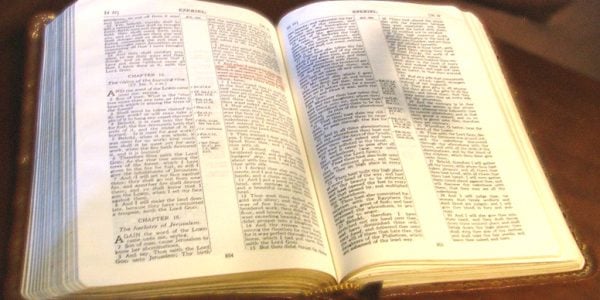
“Bible with Cross Shadow,” David Campbell, Flickr C.C.
Atonement is the centerpiece of Christian theology. It’s a compound word that literally means what God does through Jesus’ sacrifice on the cross to rescue humans from our self-alienation and make us “at one” with him. In other words, atonement describes how God removes our fear and shame so that we can face him with peace and integrity despite being sinners in a sinful world.
There’s been a lot of argument about atonement in recent years, particularly around descriptions of atonement that make God look like a bloodthirsty, angry tyrant. What frustrates me to no end are Christians who seem to enjoy making Christianity more contentious than it has to be, which pushes so many good people away. So I wanted to write something very basic about how to understand atonement for people who are going to stop reading if I use seminary words like “penal substitution” or “Christus victor.”
The most important thing about Jesus’ cross is that it’s the place God provides for sin to be destroyed. When I say sin, what I mean are things I do that cause harm, or injustice, and things I do that make me harmful, or idolatry. Injustice is more obviously sinful than idolatry, which just means worshiping something other than God like drugs, money, sex, or power, which in turn makes us toxic people.
The power of sin lies in its aftereffects. It creates blame and guilt. These in turn destroy our ability to be honest and peaceful. The impact is cyclical and cumulative. I sin because I have been sinned against by others and because I am defiant and resentful about the consequences of my prior sins.
Our world is not only filled with the direct impact of harmful behavior but more importantly with a complex suffocating spiderweb of blame and guilt that increasingly controls our behavior like puppet strings. When the Bible talks about sin, it’s not just talking about our individual mistakes but the colossal spiderweb of toxic power dynamics and broken relationships that are the cumulative residue of billions of peoples’ mistakes.
What Jesus does by dying for our sins on the cross is to say, “Stop blaming each other! Blame me so I can set you free from blame.” To accept Jesus’ sacrifice for my sins and the sins that others have committed against me means that I renounce the blame and guilt that poisons human community. I put my shame and resentment on Jesus’ cross so that I can live as a person who is unafraid to admit my mistakes and unburdened by the need to hold grudges against other people. When Christians actually make use of God’s gift of atonement, we become free-spirited, empathetic, humble, generous, patient, and joyful (i.e. the opposite of how too many Christians are today).
Now all of this would just be a weird intellectual exercise were it not for the means that Jesus has given us to participate in his eternal sacrifice every time we come together to worship. Jesus says in John 6:54 that in order to have eternal life, we must eat his flesh and drink his blood. Yes, it sounded incredibly creepy when he first said it and many disciples left him at that point.
But what Jesus meant is that he is able to put himself inside of us and make Christians into his physical body in the world through the celebration of holy communion which is the centerpiece of Christian spiritual practice and more important than any abstract theological concept. Though Jesus is not walking around the world right now as a brown-skinned Middle Eastern man, Christians believe that he enters into our physical presence every time we partake of the bread and wine of communion.
Whenever we take communion, we have an opportunity to let go of our guilt and our grudges so that we can receive new life from Jesus. Communion is what makes Jesus’ sacrifice on the cross physically tangible to us. The reason we need to do it as often as possible is because we continue to walk through a world littered by the spiderweb puppet strings of blame and guilt. We need to continually renounce the world’s toxicity and give it to Jesus to put on his cross. Every time we take communion, it resets our freedom and reestablishes Jesus’ physical presence in the world through the people who are healed by his body and blood.
A third way that Jesus’ cross figures into our lives is through the command that he gave us that summarizes Christian discipleship: take up your cross and follow me (Mark 8:34). In other words, atonement not only refers to something Jesus did for us but also something Jesus invites us to participate in. The apostle Paul writes, “I have been crucified with Christ so it is no longer I who live but Christ who lives within me” (Galatians 2:19-20). Obviously Paul did not literally die on the cross next to Jesus. What he’s talking about is a mystical reality. He also says in Romans 6:5 that we are resurrected with Jesus after being crucified with him.
Basically Jesus’ cross and resurrection give me a new way of defining my life journey. In one sense, taking up my cross means that I am constantly offering myself to God to crucify the sin that remains in me so I can be resurrected into new life. That’s the way many Christians understand it, which is fine but it’s insufficient. Understanding what it means to take up my cross requires examining why Jesus got killed. Jesus was crucified because he angered the religious elites by constantly showing solidarity to the world’s outsiders whether they were sick people he healed on the Sabbath or tax-collectors he partied with or prostitutes he revered as models of hospitality.
To take up your cross means to emulate Jesus’ life of risk-taking solidarity. It is the opposite of building your life around self-preservation. Jesus says in Luke 9:24, “Those who want to save their life will lose it, but those who lose it for my sake will save it.” The earliest Christians considered martyrdom to be the inevitable result and ultimate expression of their faith. St. Ignatius of Antioch wasn’t sure that he could call himself a Christian until he had faced the lions in the Roman coliseum.
Now there’s a lot of mischief that comes about through Christian attempts to camouflage their self-preservation as martyrdom. The culture wars of the past four decades have been a means for very comfortable Christians to cast themselves as martyrs by saying things that make other people mad. Jesus was not crucified because he stood up for religious purity against the corruption of surrounding pagan culture. He was crucified by the religious elites because his solidarity with marginalized people threatened their understanding of religious purity.
So if taking up our crosses is going to look like what Jesus did that got him crucified, it will look like costly solidarity with marginalized people whatever form that takes. It’s not the self-justifying ideological political posturing that fills so many Facebook feeds, but love-rooted community building and advocacy for the sake of building the kingdom of God. When Christian atonement actually works, the result will be a community where nobody is marginalized because God’s people have put both their reputations and bodies on the line to bring healing and reconciliation to all just like Jesus did on his cross.
I recognize that I’m leaving out some aspects or theories of atonement that seminarians like to nerd out about, but I think this is good enough for a basic explanation. First, God rescues us from the blame and guilt that imprison so much of humanity by putting our sins on Jesus’ cross. Second, God makes us into Jesus’ body and fills us with his resurrected life every time we receive holy communion. Third, God gives us our crosses to take up and enter the world with risk-taking solidarity in order to restore the kingdom of God.
Previous Post

June 22, 2017
A Response to Seedbed's Five Marks of Theological Liberalism
Next Post

June 28, 2017 The fascinating intersectionality of the word "cuck"
Browse Our Archives
Select a Category Advent Beauty Will Save the World Bible Big Picture: Ephesians Bloggers Book Christian salvation and the Beautitudes Culture Daily Office Danceable Homiletics Deadly Sins Deep Roots: Genesis Devotions Dominican Republic May 2011 El Principio Misericordia (The Mercy Principle) Five verses God tattooed on my heart Fundraising FutureGospel Good Biblical Words Henri Nouwen Interview Jennings' Christian Imagination Jesus inside the beltway Jesus Is My Candidate Jesus vs the Pharisees Jesus vs. Plato Journey to Eternity Looking Back on 2012 Love Actually Monday Merton Monday Merton Music Occupy the manger On Earth As It Is In Heaven Original Sin Podcast Poetry Politics Prayer Psalm 119 Radical Jesus 101 Reviews Sermon on the Mount Sermons Spanish Bible study Special Series Spiritual but not religious Synchroblog Theology Things that made me think Thomas a Kempis Ugliness Into Beauty Uncategorized Viaje Dominicano 2013 Walking in the Valley (Lent) Welcome: It's More than a Mat Wild Goose 2013 Wrestling
Select a Month March 2022 January 2022 December 2021 September 2021 April 2021 September 2020 August 2020 July 2020 June 2020 May 2020 April 2020 March 2020 February 2020 January 2020 December 2019 November 2019 October 2019 September 2019 August 2019 June 2019 May 2019 April 2019 March 2019 February 2019 January 2019 December 2018 November 2018 October 2018 September 2018 August 2018 July 2018 June 2018 May 2018 April 2018 March 2018 February 2018 January 2018 December 2017 November 2017 October 2017 September 2017 August 2017 July 2017 June 2017 May 2017 April 2017 March 2017 February 2017 January 2017 December 2016 November 2016 October 2016 September 2016 August 2016 July 2016 June 2016 May 2016 April 2016 March 2016 February 2016 January 2016 December 2015 November 2015 October 2015 September 2015 August 2015 July 2015 June 2015 May 2015 April 2015 February 2015 January 2015 December 2014 November 2014 October 2014 September 2014 August 2014 July 2014 June 2014 May 2014 April 2014 March 2014 February 2014 January 2014 December 2013 November 2013 October 2013 September 2013 August 2013 July 2013 June 2013 May 2013 April 2013 March 2013 February 2013 January 2013 December 2012 November 2012 October 2012 September 2012 August 2012 July 2012 June 2012 May 2012 April 2012 February 2012 January 2012 December 2011 November 2011 October 2011 September 2011 August 2011 July 2011 June 2011 May 2011
Follow Us!
TAKE THE
Religious Wisdom Quiz
Which prophet was a shepherd and a sycamore-fig farmer?
Select your answer to see how you score.
Daniel Joel Amos Micah
Related posts from Mercy Not Sacrifice


When God's A Cop, Every Cop Is God

"All People Are Holy": The Theology Of Alexandria...

Why Kevin DeYoung's "Culture War Strategy" Fails
TRENDING AT PATHEOS Progressive Christian

What Being a Modern-Day Apostle Means to Me
In my last column, I discussed the ins and outs of modern-day...

Did Ancient China Once Worship the God of...
Across human history, a common thread weaves through the origins of the...

Love Your Neighbor – Including Earth-Kin: Lev. 19,...
God’s command to love your neighbor means acting in an ethical and...

Lead a Church Study of “Jesus and Lao...
Guest writer Jack Thomas (The Irreverent Reverend) reflects on leading his church...

Pastoral Wisdom for Responding to Sermon Pushback
Getting sermon pushback on your social justice sermon? Learn practical, Proverbs-based strategies...

Principles for Understanding the Apostolic Ministry Today
Whenever people discover that my formal ministry title is "apostle," as in...
view all Progressive Christian blogs
Ad-Free & Subscriber Log-In Subscription Support
- About Us
- 2026 Calendar
- Videos
- Podcasts
- Library of World Religions
- Faith In Media Tracker
- Advertise With Us
- Write for Us
- Privacy Policy
- Terms of Service
- Do Not Sell My Data
- Contact Us
- Radiant Digital
- Manage Newsletter Subscriptions
- Unsubscribe From Notifications
- Sitemap
Copyright 2008-2026, Patheos. All rights reserved.
Subscription Support Ad-Free & Subscriber Log-In
Follow Patheos