
BuddhistCatholicContemplativeEvangelicalGeneral ChristianHinduJewishLatter-day SaintMuslimNew VisionsProgressive Christian
Beliefs
- Buddhist
- Catholic
- Contemplative
- Evangelical
- General Christian
- Hindu
- Jewish
- Latter-day Saint
- More Voices
- Muslim
- New Visions
- Pagan
- Progressive Christian
Topics
- Religion News
- Food and Religion
- Sports and Religion
- Religious Art
- Religious Music and Entertainment
- Religious Events
- History and Religion
- Style and Religion
- Politics and Religion
- Women in Religion
- Recreation Outdoors and Religion
- Business Finance and Religion
- Careers Workplace and Religion
- Education and Religion
- Family Parenting and Religion
- Health Fitness and Religion
- Home and Religion
- Relationships and Religion
- Technology and Religion
- Travel and Religion
Columnists
- Buddhist Columnists
- Business Finance and Religion Columnists
- Careers Workplace and Religion Columnists
- Catholic Columnists
- Contemplative Columnists
- Education and Religion Columnists
- Evangelists Columnists
- Family Parenting and Religion Columnists
- General Christian Columnists
- Health Fitness and Religion Columnists
- Hindu Columnists
- History and Religion Columnists
- Home and Religion Columnists
- Jewish Columnists
- More Voices Columnists
- Latter Day Columnists
- Muslim Columnists
- New Visions Columnists
- Nonreligious Columnists
- Pagan Columnists
- Politics and Religion Columnists
- Progressive Columnists
- Recreation Outdoors and Religion Columnists
- Relationships and Religion Columnists
- Religion News Columnists
- Religious Art Columnists
- Religious Events Columnists
- Religious Music and Entertainment Columnists
- Sports and Religion Columnists
- Style and Religion Columnists
- Technology and Religion Columnists
- Travel and Religion Columnists
- Women in Religion Columnists
Resource Library
- 2026 Calendar
- Library of World Religions
- The 100 Most Holy Places on Earth
- Patheos Answers
- Podcasts
- Videos
- Faith Leaders Database
- Anglican Episcopalian
- Bahai
- Baptist
- Buddhism
- Christianity
- Confucianism
- Eastern Orthodoxy
- Hinduism
- Holiness and Pentecostal
- ISKCON
- Islam
- Judaism
- Lutheran
- Methodist
- The Church of Jesus Christ of Latter-day Saints
- New Age
- Paganism
- Presbytarian and Reformed
- Protestantism
- Religion Behind the Scenes
- Roman Catholic
- Scientology
- Shia Islam
- Sikhism
- Sufism
- Sunni Islam
- Taoism
- Zen
- See all religions
Research Tools
 Ad-Free & Subscriber Log-In Subscription Support
Ad-Free & Subscriber Log-In Subscription Support
Follow Patheos 

- Trending:
- Forgiveness
- |
- Marriage
- |
- Consciousness
- |
- Death Penalty
- |
- Election
- |
- Halloween
 Mercy Not Sacrifice
-
More
- Home
- Progressive Christian
- Jesus’ cross shows that divine authority comes from the margins
Jesus’ cross shows that divine authority comes from the margins
Last updated on: May 3, 2017 at 6:55 am by Morgan Guyton
Jesus’ cross shows that divine authority comes from the margins 2017-05-03T06:55:26-05:00 Morgan Guyton
Patheos Explore the world's faith through different perspectives on religion and spirituality! Patheos has the views of the prevalent religions and spiritualities of the world.
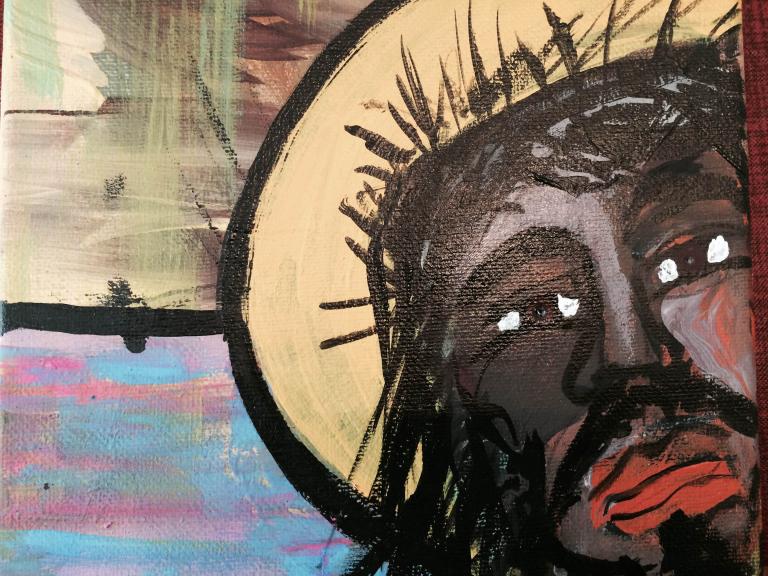
Painting by Bec Cranford-Smith
There’s been a storm in white evangelical Christian twitter recently. Tish Warren, an Anglican priest, wrote a piece in Christianity Today asking who’s in charge of the Christian blogosphere. She focused on the way that popular Christian writer and blogger Jen Hatmaker changed her stance on the gays and wondered what tradition she gets her authority from. While conservatives like Warren think of authority in terms of tradition, the authority I understand to be central to Christianity is the authority of Jesus’ cross. This authority has long since been buried under the institutional, imperial authority of church tradition, but the cross is the ultimate measure of the validity of any claim to Christian authority.
Christianity was originally built upon the hearts that were “cut” when three thousand Jews realized they’d crucified their messiah (Acts 2:37). That is how the cross’s authority is supposed to work. It cuts our hearts. It convicts us of our sin, while simultaneously showing solidarity to the victims of our sin. This is unlike any other form of authority that human civilization has come up with. Worldly authority is established through coercive violence, not through nonviolent suffering. Victims of ignoble state executions are not supposed to be revered as kings. A cross is supposed to be a disgrace. For Jesus to insist upon the cross as his coronation says something about the authority God chooses to most perfectly represent himself: it comes from the margins.
Those who exercise authority as coercion and control are not exercising the authority of the cross, which means they forfeit the right to call their authority Christian. People whose authority is cruciform do not coerce or control other people. They love as fiercely as Jesus did, and their love is what compels obedience. There have been Christians like this throughout the centuries. Sometimes they have been part of the official tradition. Sometimes they have been in positions of power where they could impose violence on other people if they chose. But their Christian authority has come from their willingness to bear their crosses and inspire discipleship through their love.
The church’s apostolic tradition is valid to the degree that it has obeyed the simple command of Jesus to take up our crosses (Mark 8:34). Christian apostles are those who bear crosses like Jesus, which means that the church’s apostolicity is called into question when it turns to imperial violence in forms like the Crusades, the Inquisition, the European religious wars, the colonial conquest, or the many other acts of violence that have been anointed by the church often as hideous forms of “evangelism.” In Galatians 3, Paul says that those who have the faith of Abraham are more legitimately heirs of Abraham than those who can trace their biological ancestry to Abraham. I don’t see why the same logic shouldn’t apply to Christian authority. Those who carry crosses are Jesus’ apostles; those who carry swords are not, no matter whose heads have been anointed by bishops.
All this is to say that an uncritical appeal to tradition as authority is incompatible with a cruciform understanding of Christian authority. Deference to tradition is inherently Eurocentric because of the reality of Christian history. The reason it’s harder for non-white-men to appeal to any established Christian tradition is because it’s incredibly recent that non-white-men have been given a voice in Christianity at all. They only have traditional authority to the degree that their theology and hermeneutics conform to the sensibilities of centuries of European culture. Under what tradition did black slaves gain the authority to theologize in their spirituals? They would fail to meet Tish Warren’s standards too. They had to make up their own tradition because the established tradition wasn’t for them. But they have profound authority as the crucified victims of the colonial brutality that European Christendom blessed for centuries. And their songs have incredible theology that deserve more examination than merely singing them in church every fifth Sunday for the sake of “diversity.”
The liberation theologies that have arisen over the past fifty years are based on the premise that the people who have been crucified have more authority to provide us with a word from God than the Christians with institutional power who have done the crucifying. In other words, liberation theology is essentially a restoration of the conditions of Acts 2:37 after centuries of burying the authority of Jesus’ wounds under an imperial, coercive, utterly un-cruciform institution. To me, liberation theology is an essential corrective and critique of the uncritical appropriation of inherited theology that did not stop colonialism. Not every popular blogger is a liberation theologian, but the criteria by which we evaluate Christian voices who operate outside of institutional authority must be more than their conformity to established tradition or their credentialing within established institutions. Here are the questions we should be asking. Does it look like Jesus’ cross? How do those who are being crucified today receive it?
A Christian tradition that has done little to process its sinful legacy has little authority with me on the basis of its apostolicity. It is filled with incredible resources like any imperial starship that can be scavenged, but I do not submit to it simply because it’s tradition. I plunder it like a scavenger and try to find the pieces that help me to take up my cross to march with Jesus and those who are being crucified with him. What’s much more important to me is to hear how marginalized people process the Christian gospel. Jesus said he came to proclaim good news to the poor, so confirming whether something is good news to marginalized people should be a basic criterion by which we measure the legitimacy of our gospel.
For example, while Martin Luther had many great things to say, a gospel formed by centering the emotional needs of a neurotic monk has unsurprisingly resulted in a Protestant salvation story that has little to say about restorative justice for the marginalized (though many renegade Lutherans throughout the centuries have forged a radical, beautiful gospel). Of course Martin Luther himself would say look at the cross if you want to see God. Perhaps he would also agree that the people carrying crosses have greater authority to speak for God than those whose authority is based on institutional power.
Check out my book How Jesus Saves the World From Us!
Subscribe to our podcast Crackers and Grape Juice!
Support our campus ministry NOLA Wesley by becoming a patron or one-time donor!
Previous Post

April 27, 2017
The narrative that's destroying United Methodism
Next Post
May 1, 2017 Jesus is illegal
Browse Our Archives
Select a Category Advent Beauty Will Save the World Bible Big Picture: Ephesians Bloggers Book Christian salvation and the Beautitudes Culture Daily Office Danceable Homiletics Deadly Sins Deep Roots: Genesis Devotions Dominican Republic May 2011 El Principio Misericordia (The Mercy Principle) Five verses God tattooed on my heart Fundraising FutureGospel Good Biblical Words Henri Nouwen Interview Jennings' Christian Imagination Jesus inside the beltway Jesus Is My Candidate Jesus vs the Pharisees Jesus vs. Plato Journey to Eternity Looking Back on 2012 Love Actually Monday Merton Monday Merton Music Occupy the manger On Earth As It Is In Heaven Original Sin Podcast Poetry Politics Prayer Psalm 119 Radical Jesus 101 Reviews Sermon on the Mount Sermons Spanish Bible study Special Series Spiritual but not religious Synchroblog Theology Things that made me think Thomas a Kempis Ugliness Into Beauty Uncategorized Viaje Dominicano 2013 Walking in the Valley (Lent) Welcome: It's More than a Mat Wild Goose 2013 Wrestling
Select a Month March 2022 January 2022 December 2021 September 2021 April 2021 September 2020 August 2020 July 2020 June 2020 May 2020 April 2020 March 2020 February 2020 January 2020 December 2019 November 2019 October 2019 September 2019 August 2019 June 2019 May 2019 April 2019 March 2019 February 2019 January 2019 December 2018 November 2018 October 2018 September 2018 August 2018 July 2018 June 2018 May 2018 April 2018 March 2018 February 2018 January 2018 December 2017 November 2017 October 2017 September 2017 August 2017 July 2017 June 2017 May 2017 April 2017 March 2017 February 2017 January 2017 December 2016 November 2016 October 2016 September 2016 August 2016 July 2016 June 2016 May 2016 April 2016 March 2016 February 2016 January 2016 December 2015 November 2015 October 2015 September 2015 August 2015 July 2015 June 2015 May 2015 April 2015 February 2015 January 2015 December 2014 November 2014 October 2014 September 2014 August 2014 July 2014 June 2014 May 2014 April 2014 March 2014 February 2014 January 2014 December 2013 November 2013 October 2013 September 2013 August 2013 July 2013 June 2013 May 2013 April 2013 March 2013 February 2013 January 2013 December 2012 November 2012 October 2012 September 2012 August 2012 July 2012 June 2012 May 2012 April 2012 February 2012 January 2012 December 2011 November 2011 October 2011 September 2011 August 2011 July 2011 June 2011 May 2011
Follow Us!
TAKE THE
Religious Wisdom Quiz
I am confidence in what is hoped for and assurance about what is not seen. Without me, it's impossible to please God. What am I?
Select your answer to see how you score.
Belief Hope Trust Faith
Related posts from Mercy Not Sacrifice


When God's A Cop, Every Cop Is God

Why Kevin DeYoung's "Culture War Strategy" Fails

Why True Christianity Is Anarchist
TRENDING AT PATHEOS Progressive Christian

What Being a Modern-Day Apostle Means to Me
In my last column, I discussed the ins and outs of modern-day...

Did Ancient China Once Worship the God of...
Across human history, a common thread weaves through the origins of the...

Love Your Neighbor – Including Earth-Kin: Lev. 19,...
God’s command to love your neighbor means acting in an ethical and...

Lead a Church Study of “Jesus and Lao...
Guest writer Jack Thomas (The Irreverent Reverend) reflects on leading his church...

Pastoral Wisdom for Responding to Sermon Pushback
Getting sermon pushback on your social justice sermon? Learn practical, Proverbs-based strategies...

Principles for Understanding the Apostolic Ministry Today
Whenever people discover that my formal ministry title is "apostle," as in...
view all Progressive Christian blogs
Ad-Free & Subscriber Log-In Subscription Support
- About Us
- 2026 Calendar
- Videos
- Podcasts
- Library of World Religions
- Faith In Media Tracker
- Advertise With Us
- Write for Us
- Privacy Policy
- Terms of Service
- Do Not Sell My Data
- Contact Us
- Radiant Digital
- Manage Newsletter Subscriptions
- Unsubscribe From Notifications
- Sitemap
Copyright 2008-2026, Patheos. All rights reserved.
Subscription Support Ad-Free & Subscriber Log-In
Follow Patheos