
BuddhistCatholicContemplativeEvangelicalGeneral ChristianHinduJewishLatter-day SaintMuslimNew VisionsProgressive Christian
Beliefs
- Buddhist
- Catholic
- Contemplative
- Evangelical
- General Christian
- Hindu
- Jewish
- Latter-day Saint
- More Voices
- Muslim
- New Visions
- Pagan
- Progressive Christian
Topics
- Religion News
- Food and Religion
- Sports and Religion
- Religious Art
- Religious Music and Entertainment
- Religious Events
- History and Religion
- Style and Religion
- Politics and Religion
- Women in Religion
- Recreation Outdoors and Religion
- Business Finance and Religion
- Careers Workplace and Religion
- Education and Religion
- Family Parenting and Religion
- Health Fitness and Religion
- Home and Religion
- Relationships and Religion
- Technology and Religion
- Travel and Religion
Columnists
- Buddhist Columnists
- Business Finance and Religion Columnists
- Careers Workplace and Religion Columnists
- Catholic Columnists
- Contemplative Columnists
- Education and Religion Columnists
- Evangelists Columnists
- Family Parenting and Religion Columnists
- General Christian Columnists
- Health Fitness and Religion Columnists
- Hindu Columnists
- History and Religion Columnists
- Home and Religion Columnists
- Jewish Columnists
- More Voices Columnists
- Latter Day Columnists
- Muslim Columnists
- New Visions Columnists
- Nonreligious Columnists
- Pagan Columnists
- Politics and Religion Columnists
- Progressive Columnists
- Recreation Outdoors and Religion Columnists
- Relationships and Religion Columnists
- Religion News Columnists
- Religious Art Columnists
- Religious Events Columnists
- Religious Music and Entertainment Columnists
- Sports and Religion Columnists
- Style and Religion Columnists
- Technology and Religion Columnists
- Travel and Religion Columnists
- Women in Religion Columnists
Resource Library
- 2026 Calendar
- Library of World Religions
- The 100 Most Holy Places on Earth
- Patheos Answers
- Podcasts
- Videos
- Faith Leaders Database
- Anglican Episcopalian
- Bahai
- Baptist
- Buddhism
- Christianity
- Confucianism
- Eastern Orthodoxy
- Hinduism
- Holiness and Pentecostal
- ISKCON
- Islam
- Judaism
- Lutheran
- Methodist
- The Church of Jesus Christ of Latter-day Saints
- New Age
- Paganism
- Presbytarian and Reformed
- Protestantism
- Religion Behind the Scenes
- Roman Catholic
- Scientology
- Shia Islam
- Sikhism
- Sufism
- Sunni Islam
- Taoism
- Zen
- See all religions
Research Tools
 Ad-Free & Subscriber Log-In Subscription Support
Ad-Free & Subscriber Log-In Subscription Support
Follow Patheos 

- Trending:
- Forgiveness
- |
- Marriage
- |
- Consciousness
- |
- Death Penalty
- |
- Election
- |
- Halloween
 Mercy Not Sacrifice
-
More
- Home
- Progressive Christian
- “Do not withhold good from those to whom it is due” (Proverbs 3:27)
“Do not withhold good from those to whom it is due” (Proverbs 3:27)
Last updated on: February 28, 2017 at 10:46 am by Morgan Guyton
“Do not withhold good from those to whom it is due” (Proverbs 3:27) 2017-02-28T10:46:39-05:00 Morgan Guyton
Patheos Explore the world's faith through different perspectives on religion and spirituality! Patheos has the views of the prevalent religions and spiritualities of the world.
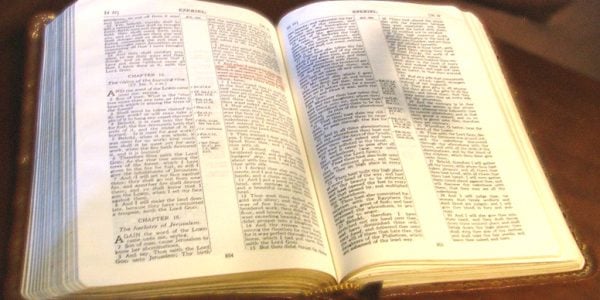
“Bible with Cross Shadow,” David Campbell, Flickr C.C.
This past weekend in worship, we had the opportunity to consider Proverbs 3:27. In the NRSV and NIV translations of the Bible, it says, “Do not withhold good from those to whom it is due.” But in the New Living Translation, it says, “Do not withhold good from those who deserve it.” This difference in translation seemed like a powerful enough metaphor to merit a blog post.
The Hebrew word that is getting translated is ba’al which means “owner, husband, or lord” according to my lexicon. So it’s a strange use of the word. It’s saying that the recipient of the good that you do is the “owner” of the good you do, which seems to suggest that they are entitled to it. There is nothing I can see about the word ba’al which connotes an assessment of merit. It’s simply not the word you would use to describe whether or not someone is “worthy” of receiving good.
Now the NLT’s primary agenda is to write the Bible in more accessible language. “Those to whom it is due” is an awkward phrase, so the translators figured they could paraphrase with “those who deserve it.” But this interpretive move invokes an American capitalist subtext. American capitalism divides those in need of financial aid into two categories: the “deserving poor” and “undeserving poor.”
Homeless military vets, especially those with missing limbs, are part of the “deserving poor” (unless they’re struggling with addiction which completely discredits them). Other “deserving poor” would include anyone who is physically or mentally incapacitated enough to be dependent on others. The “undeserving poor” for the most part are people who are poor because they had sex out of wedlock and/or dropped out of high school, which are the two reasons that most people of color are presumed to be poor.
But Proverbs 3:27 is not asking us to make judgments about the recipients of our good based on their merit. Verse 28 elaborates: “Do not say to your neighbor, ‘Go, and come again, tomorrow I will give it’—when you have it with you.” So who is the one to whom my good is due? My neighbor, plain and simple. Proverbs 3:27 is doing the opposite of telling us to judge whether or not others deserve our help. It’s saying you owe it to your neighbors to help them. When our neighbors ask for help and we help them, we are giving them what we owe them. Proverbs 3 is built on an entirely different understanding of community than the radically individualist meritocracy in which Americans live.
So what does this mean about the homeless guy with the strong whiskey breath who’s asking for a dollar? Do we owe him that dollar? By no means. We owe him good, which is to say we owe him the time and consideration to act according to his best interest to the best of our discernment instead of impulsively reacting and dehumanizing him. It’s reasonable to evaluate whether we are enabling addiction with our well-intentioned but harmful good deeds.
What is absent from our analysis is the question of merit. There is no one who doesn’t deserve our help because every human being has infinite worth as a child of God. This doesn’t mean that we can help everybody all the time in exactly the way that they ask. It does mean that we need to stop making up myths in our minds about “undeserving” poor people we don’t know in order to make ourselves comfortable with not helping them.
Detoxify your Christianity this Lent! Check out my book How Jesus Saves the World From Us and our FB livestream #DetoxifyChristianity.
Please support inclusive, justice-seeking campus ministry in a time when it’s desperately needed. You can become a monthly patron for as little as $5 a month or a one-time contributor. No amount is too small!

Next Post

March 1, 2017 My ashes are my promise to resist sin (Ezekiel 9:4)
Browse Our Archives
Select a Category Advent Beauty Will Save the World Bible Big Picture: Ephesians Bloggers Book Christian salvation and the Beautitudes Culture Daily Office Danceable Homiletics Deadly Sins Deep Roots: Genesis Devotions Dominican Republic May 2011 El Principio Misericordia (The Mercy Principle) Five verses God tattooed on my heart Fundraising FutureGospel Good Biblical Words Henri Nouwen Interview Jennings' Christian Imagination Jesus inside the beltway Jesus Is My Candidate Jesus vs the Pharisees Jesus vs. Plato Journey to Eternity Looking Back on 2012 Love Actually Monday Merton Monday Merton Music Occupy the manger On Earth As It Is In Heaven Original Sin Podcast Poetry Politics Prayer Psalm 119 Radical Jesus 101 Reviews Sermon on the Mount Sermons Spanish Bible study Special Series Spiritual but not religious Synchroblog Theology Things that made me think Thomas a Kempis Ugliness Into Beauty Uncategorized Viaje Dominicano 2013 Walking in the Valley (Lent) Welcome: It's More than a Mat Wild Goose 2013 Wrestling
Select a Month March 2022 January 2022 December 2021 September 2021 April 2021 September 2020 August 2020 July 2020 June 2020 May 2020 April 2020 March 2020 February 2020 January 2020 December 2019 November 2019 October 2019 September 2019 August 2019 June 2019 May 2019 April 2019 March 2019 February 2019 January 2019 December 2018 November 2018 October 2018 September 2018 August 2018 July 2018 June 2018 May 2018 April 2018 March 2018 February 2018 January 2018 December 2017 November 2017 October 2017 September 2017 August 2017 July 2017 June 2017 May 2017 April 2017 March 2017 February 2017 January 2017 December 2016 November 2016 October 2016 September 2016 August 2016 July 2016 June 2016 May 2016 April 2016 March 2016 February 2016 January 2016 December 2015 November 2015 October 2015 September 2015 August 2015 July 2015 June 2015 May 2015 April 2015 February 2015 January 2015 December 2014 November 2014 October 2014 September 2014 August 2014 July 2014 June 2014 May 2014 April 2014 March 2014 February 2014 January 2014 December 2013 November 2013 October 2013 September 2013 August 2013 July 2013 June 2013 May 2013 April 2013 March 2013 February 2013 January 2013 December 2012 November 2012 October 2012 September 2012 August 2012 July 2012 June 2012 May 2012 April 2012 February 2012 January 2012 December 2011 November 2011 October 2011 September 2011 August 2011 July 2011 June 2011 May 2011
Follow Us!
TAKE THE
Religious Wisdom Quiz
What was Amos' profession?
Select your answer to see how you score.
Fisherman Carpenter Tentmaker Shepherd
Related posts from Mercy Not Sacrifice


Our Sin Is Not A Zero Sum Game

Good Biblical Words: A Series Introduction

TRENDING AT PATHEOS Progressive Christian

What Being a Modern-Day Apostle Means to Me
In my last column, I discussed the ins and outs of modern-day...

Did Ancient China Once Worship the God of...
Across human history, a common thread weaves through the origins of the...

Love Your Neighbor – Including Earth-Kin: Lev. 19,...
God’s command to love your neighbor means acting in an ethical and...

Lead a Church Study of “Jesus and Lao...
Guest writer Jack Thomas (The Irreverent Reverend) reflects on leading his church...

Pastoral Wisdom for Responding to Sermon Pushback
Getting sermon pushback on your social justice sermon? Learn practical, Proverbs-based strategies...

Principles for Understanding the Apostolic Ministry Today
Whenever people discover that my formal ministry title is "apostle," as in...
view all Progressive Christian blogs
Ad-Free & Subscriber Log-In Subscription Support
- About Us
- 2026 Calendar
- Videos
- Podcasts
- Library of World Religions
- Faith In Media Tracker
- Advertise With Us
- Write for Us
- Privacy Policy
- Terms of Service
- Do Not Sell My Data
- Contact Us
- Radiant Digital
- Manage Newsletter Subscriptions
- Unsubscribe From Notifications
- Sitemap
Copyright 2008-2026, Patheos. All rights reserved.
Subscription Support Ad-Free & Subscriber Log-In
Follow Patheos