
BuddhistCatholicContemplativeEvangelicalGeneral ChristianHinduJewishLatter-day SaintMuslimNew VisionsProgressive Christian
Beliefs
- Buddhist
- Catholic
- Contemplative
- Evangelical
- General Christian
- Hindu
- Jewish
- Latter-day Saint
- More Voices
- Muslim
- New Visions
- Pagan
- Progressive Christian
Topics
- Religion News
- Food and Religion
- Sports and Religion
- Religious Art
- Religious Music and Entertainment
- Religious Events
- History and Religion
- Style and Religion
- Politics and Religion
- Women in Religion
- Recreation Outdoors and Religion
- Business Finance and Religion
- Careers Workplace and Religion
- Education and Religion
- Family Parenting and Religion
- Health Fitness and Religion
- Home and Religion
- Relationships and Religion
- Technology and Religion
- Travel and Religion
Columnists
- Buddhist Columnists
- Business Finance and Religion Columnists
- Careers Workplace and Religion Columnists
- Catholic Columnists
- Contemplative Columnists
- Education and Religion Columnists
- Evangelists Columnists
- Family Parenting and Religion Columnists
- General Christian Columnists
- Health Fitness and Religion Columnists
- Hindu Columnists
- History and Religion Columnists
- Home and Religion Columnists
- Jewish Columnists
- More Voices Columnists
- Latter Day Columnists
- Muslim Columnists
- New Visions Columnists
- Nonreligious Columnists
- Pagan Columnists
- Politics and Religion Columnists
- Progressive Columnists
- Recreation Outdoors and Religion Columnists
- Relationships and Religion Columnists
- Religion News Columnists
- Religious Art Columnists
- Religious Events Columnists
- Religious Music and Entertainment Columnists
- Sports and Religion Columnists
- Style and Religion Columnists
- Technology and Religion Columnists
- Travel and Religion Columnists
- Women in Religion Columnists
Resource Library
- 2026 Calendar
- Library of World Religions
- The 100 Most Holy Places on Earth
- Patheos Answers
- Podcasts
- Videos
- Faith Leaders Database
- Anglican Episcopalian
- Bahai
- Baptist
- Buddhism
- Christianity
- Confucianism
- Eastern Orthodoxy
- Hinduism
- Holiness and Pentecostal
- ISKCON
- Islam
- Judaism
- Lutheran
- Methodist
- The Church of Jesus Christ of Latter-day Saints
- New Age
- Paganism
- Presbytarian and Reformed
- Protestantism
- Religion Behind the Scenes
- Roman Catholic
- Scientology
- Shia Islam
- Sikhism
- Sufism
- Sunni Islam
- Taoism
- Zen
- See all religions
Research Tools
 Ad-Free & Subscriber Log-In Subscription Support
Follow Patheos 

- Trending:
- Advent
- |
- Forgiveness
- |
- Thanksgiving
- |
- Election
- |
- Seasonal Holidays
- |
- Marriage
 Mercy Not Sacrifice
-
More
- Home
- Progressive Christian
- Jesus didn’t get crucified for writing a strongly worded letter to the Sanhedrin
Jesus didn’t get crucified for writing a strongly worded letter to the Sanhedrin
Last updated on: February 23, 2017 at 11:21 am by Morgan Guyton
Jesus didn’t get crucified for writing a strongly worded letter to the Sanhedrin 2017-02-23T11:21:33-05:00 Morgan Guyton
Patheos Explore the world's faith through different perspectives on religion and spirituality! Patheos has the views of the prevalent religions and spiritualities of the world.
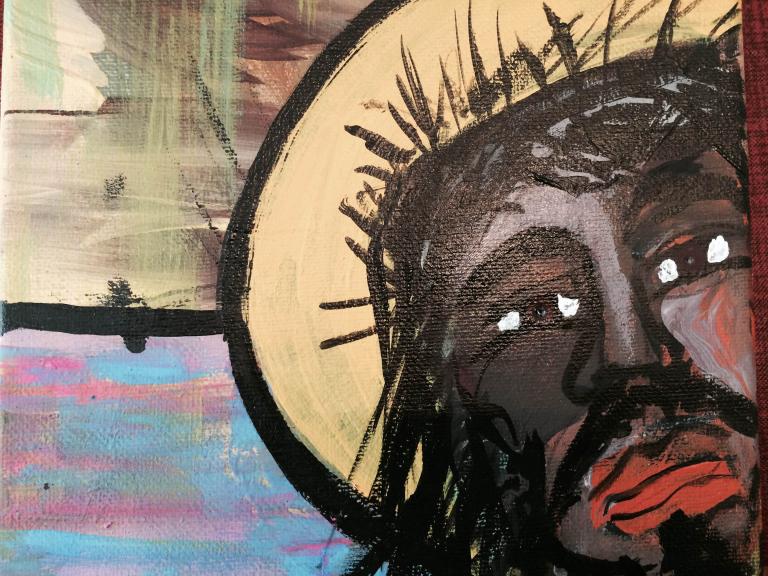
Painting by Bec Cranford-Smith
Mark Van Steenwyk had an interesting proposal in a recent Sojourners article: taking disruptive direct action to white nationalist churches during their worship services over Lent. I’ve contemplated this idea. I don’t think I would ever do it personally because I would lose my job very quickly that way. But I’m haunted by the reality of what Jesus modeled for us. The primary way that Jesus got the religious leaders mad enough to crucify him was by disrupting their sacred worship space. He tells us specifically to emulate him by taking up our crosses and following him.
There were two main ways that Jesus was disruptive. It started out with his Sabbath healings. We don’t often stop to think about what this would look like logistically. You know those people who take over the “joys and concerns” time during mainline Protestant worship services? The ones who have a new problem every week and make everybody in the room groan and roll their eyes because they don’t know how to be concise? What if every time one of these folks stood up to talk, Jesus walked over to them and started speaking in tongues over them to pray for their healing and the worship service became two hours long for that reason?
And even that wouldn’t be as disruptive as Jesus was. What if Jesus interrupted the choir while it was singing the anthem because somebody in the congregation had a withered hand? What if the reason Jesus couldn’t get through his sermon in the prescribed 12 minutes and 35 seconds was because he had to stop mid-sentence every few minutes to heal somebody? What if Jesus wasn’t even the lead pastor but just some homeless guy in the back who would stand up every few minutes to loudly cast demons out of people in the pews?
And these examples don’t even work as analogies because first century Jews were way more committed to the concept of laying a day entirely aside for God than 21 century Protestants are. Jesus didn’t just heal on the Sabbath. He healed on the Sabbath during the worship gathering. As the synagogue ruler says in Luke 13:14, Jesus had six other days to work with. None of his healings were for urgent, life-threatening conditions. But instead he took the focus off of God’s glory and put it on human infirmity (or rather he made God’s glory about God’s solidarity with human infirmity). If the Calvinists had been alive then, Jesus would have been crucified way sooner.
The straw that broke the camel’s back was Jesus’ temple cleansing. This wasn’t one of those “civil disobedience” photo ops where you arrange it all ahead of time with the police so that they use the plastic handcuffs and let you go in less than an hour. I remember doing one of those staged civil disobediences once in support of a labor union. It’s the only time I’ve been to jail. All I remember about the incident was the union rep standing with a wad of hundred dollar bills at the jail, slapping them down on the counter as each of us walked out.
What Jesus did involved breaking things in a rude, chaotic way without permission or prior notification. He didn’t gently take the objects off of the money changers’ tables and place them on the ground. He turned the tables over. There’s no way that physical damage wasn’t done. There’s no way that the animals he drove out of the temple courtyard filed out in orderly fashion. They probably shattered a few ceramic objects themselves on the way out.
It was after this act of insurrection that Jesus had to be crucified. Because 21st century white Protestantism has turned Jesus’ cross into an ahistorical mathematical formula, we don’t think very often about what he did to provoke his crucifixion and whether or not we’re supposed to emulate his disruptive behavior. When white Christians ask “What would Jesus do?” they’re not thinking about the brown-skinned anarchist who smashed tables in the narthex of the Jerusalem temple. They’re thinking about the dreamy, sweet, nice, white, blue-eyed Jesus in the portraits of their church hallways.
What if taking up our crosses to follow Jesus signifies our willingness to be impolite and disruptive in order to bear witness to the truth? I’ve become more and more convinced as I continue to study what both Jesus and Paul say about salvation that we are saved by being crucified and resurrected with Jesus rather than simply “believing” that Jesus died for our sins. Atonement is incorporation into Christ’s life, death, and resurrection. That sure seems like what Paul is saying in Galatians 2:20-21 and Romans 6:3-6. Crucifixion both physical and figurative is essential to Christian discipleship.
The American evangelical gospel has been unsurprisingly domesticated into a self-validation of white middle-class culture. If we are basically nice, agreeable people who know the right doctrinal catchphrases, give ten percent of our income to the church, don’t pose a burden on others, keep our sex inside of a heterosexual marriage, and give up 2-3 Saturdays a year to church service projects, that’s fruit enough to confirm that we’ve been officially “born again.”
I’m starting to wonder if we are actually born again as we are crucified with Jesus, not as a change of forensic status but as an awakening to the spirit who lives within us (1 Cor 3:16). Maybe one of the ways to experience rebirth is to start yelling like a Hebrew prophet in the middle of a church worship service. I don’t think I could ever do that. As feisty as my words are online, I’m a very diminutive, nervous person in real life.
I’m also ambivalent about the effectiveness of a disruptive direct action. Anything that makes white nationalist Christians feel persecuted seems like glucose to feed their cancerous ideology. Still I am wary of the way that white middle-class Christians like me conflate social propriety and morality because Jesus never did that. And I do think that evangelizing white nationalist Christianity is one of the most urgent tasks the church faces in our time. I’m unsure of the right way to go about this, but I’m not presuming that disruption of their worship is off the table as a means of witness. Whatever is done should be done only after tremendous prayer.
Detoxify your Christianity this Lent! Check out my book How Jesus Saves the World From Us or follow our FB livestream #DetoxifyChristianity on Tuesday nights at 9:30 pm EST / 6:30 pm PST.
Please support our campus ministry NOLA Wesley in our efforts to rebuild flooded homes in western Louisiana this spring break.
Previous Post

February 20, 2017
When will political incorrectness stop being a family value?
Next Post

February 28, 2017 "Do not withhold good from those to whom it is due" (Proverbs 3:27)
Browse Our Archives
Select a Category Advent Beauty Will Save the World Bible Big Picture: Ephesians Bloggers Book Christian salvation and the Beautitudes Culture Daily Office Danceable Homiletics Deadly Sins Deep Roots: Genesis Devotions Dominican Republic May 2011 El Principio Misericordia (The Mercy Principle) Five verses God tattooed on my heart Fundraising FutureGospel Good Biblical Words Henri Nouwen Interview Jennings' Christian Imagination Jesus inside the beltway Jesus Is My Candidate Jesus vs the Pharisees Jesus vs. Plato Journey to Eternity Looking Back on 2012 Love Actually Monday Merton Monday Merton Music Occupy the manger On Earth As It Is In Heaven Original Sin Podcast Poetry Politics Prayer Psalm 119 Radical Jesus 101 Reviews Sermon on the Mount Sermons Spanish Bible study Special Series Spiritual but not religious Synchroblog Theology Things that made me think Thomas a Kempis Ugliness Into Beauty Uncategorized Viaje Dominicano 2013 Walking in the Valley (Lent) Welcome: It's More than a Mat Wild Goose 2013 Wrestling
Select a Month March 2022 January 2022 December 2021 September 2021 April 2021 September 2020 August 2020 July 2020 June 2020 May 2020 April 2020 March 2020 February 2020 January 2020 December 2019 November 2019 October 2019 September 2019 August 2019 June 2019 May 2019 April 2019 March 2019 February 2019 January 2019 December 2018 November 2018 October 2018 September 2018 August 2018 July 2018 June 2018 May 2018 April 2018 March 2018 February 2018 January 2018 December 2017 November 2017 October 2017 September 2017 August 2017 July 2017 June 2017 May 2017 April 2017 March 2017 February 2017 January 2017 December 2016 November 2016 October 2016 September 2016 August 2016 July 2016 June 2016 May 2016 April 2016 March 2016 February 2016 January 2016 December 2015 November 2015 October 2015 September 2015 August 2015 July 2015 June 2015 May 2015 April 2015 February 2015 January 2015 December 2014 November 2014 October 2014 September 2014 August 2014 July 2014 June 2014 May 2014 April 2014 March 2014 February 2014 January 2014 December 2013 November 2013 October 2013 September 2013 August 2013 July 2013 June 2013 May 2013 April 2013 March 2013 February 2013 January 2013 December 2012 November 2012 October 2012 September 2012 August 2012 July 2012 June 2012 May 2012 April 2012 February 2012 January 2012 December 2011 November 2011 October 2011 September 2011 August 2011 July 2011 June 2011 May 2011
Follow Us!
TAKE THE
Religious Wisdom Quiz
Who killed Goliath?
Select your answer to see how you score.
Samson Saul David Jonathan
Related posts from Mercy Not Sacrifice

When God's A Cop, Every Cop Is God

Why Kevin DeYoung's "Culture War Strategy" Fails

Why True Christianity Is Anarchist
TRENDING AT PATHEOS Progressive Christian

Bridging the Gap Between God and Man
From Far Off to the Ultimate Embrace “God is a Spirit: and...

Let Matthew 25 Guide You to a Greater...
With the crisp feel of fall in the air, our minds quickly...

Can a Chatbot Touch Your Soul?
Can a chatbot offer genuine spiritual counsel? One conversation brought me to...

Religion and Politics: How Should We Then Live?
Two cultural axioms get repeated in polite company. Don't mix religion and...

7 Things We Get Wrong About Giving Thanks
It's a time of year when many of us turn to the...

Uncaging Truth: Spirituality Beyond Institutions
The Lost Connection: Why True Spirituality, Not Religion, Is the Key to...
view all Progressive Christian blogs
Ad-Free & Subscriber Log-In Subscription Support
- About Us
- 2026 Calendar
- Videos
- Podcasts
- Library of World Religions
- Faith In Media Tracker
- Advertise With Us
- Write for Us
- Privacy Policy
- Terms of Service
- Do Not Sell My Data
- Contact Us
- Radiant Digital
- Manage Newsletter Subscriptions
- Unsubscribe From Notifications
- Sitemap
Copyright 2008-2026, Patheos, part of the Radiant Digital network of media brands. All rights reserved.
Subscription Support Ad-Free & Subscriber Log-In
Follow Patheos