
BuddhistCatholicContemplativeEvangelicalGeneral ChristianHinduJewishLatter-day SaintMuslimNew VisionsProgressive Christian
Beliefs
- Buddhist
- Catholic
- Contemplative
- Evangelical
- General Christian
- Hindu
- Jewish
- Latter-day Saint
- More Voices
- Muslim
- New Visions
- Pagan
- Progressive Christian
Topics
- Religion News
- Food and Religion
- Sports and Religion
- Religious Art
- Religious Music and Entertainment
- Religious Events
- History and Religion
- Style and Religion
- Politics and Religion
- Women in Religion
- Recreation Outdoors and Religion
- Business Finance and Religion
- Careers Workplace and Religion
- Education and Religion
- Family Parenting and Religion
- Health Fitness and Religion
- Home and Religion
- Relationships and Religion
- Technology and Religion
- Travel and Religion
Columnists
- Buddhist Columnists
- Business Finance and Religion Columnists
- Careers Workplace and Religion Columnists
- Catholic Columnists
- Contemplative Columnists
- Education and Religion Columnists
- Evangelists Columnists
- Family Parenting and Religion Columnists
- General Christian Columnists
- Health Fitness and Religion Columnists
- Hindu Columnists
- History and Religion Columnists
- Home and Religion Columnists
- Jewish Columnists
- More Voices Columnists
- Latter Day Columnists
- Muslim Columnists
- New Visions Columnists
- Nonreligious Columnists
- Pagan Columnists
- Politics and Religion Columnists
- Progressive Columnists
- Recreation Outdoors and Religion Columnists
- Relationships and Religion Columnists
- Religion News Columnists
- Religious Art Columnists
- Religious Events Columnists
- Religious Music and Entertainment Columnists
- Sports and Religion Columnists
- Style and Religion Columnists
- Technology and Religion Columnists
- Travel and Religion Columnists
- Women in Religion Columnists
Resource Library
- 2026 Calendar
- Library of World Religions
- The 100 Most Holy Places on Earth
- Patheos Answers
- Podcasts
- Videos
- Faith Leaders Database
- Anglican Episcopalian
- Bahai
- Baptist
- Buddhism
- Christianity
- Confucianism
- Eastern Orthodoxy
- Hinduism
- Holiness and Pentecostal
- ISKCON
- Islam
- Judaism
- Lutheran
- Methodist
- The Church of Jesus Christ of Latter-day Saints
- New Age
- Paganism
- Presbytarian and Reformed
- Protestantism
- Religion Behind the Scenes
- Roman Catholic
- Scientology
- Shia Islam
- Sikhism
- Sufism
- Sunni Islam
- Taoism
- Zen
- See all religions
Research Tools
 Ad-Free & Subscriber Log-In Subscription Support
Ad-Free & Subscriber Log-In Subscription Support
Follow Patheos 

- Trending:
- Forgiveness
- |
- Marriage
- |
- Consciousness
- |
- Death Penalty
- |
- Election
- |
- Halloween
 Mercy Not Sacrifice
-
More
- Home
- Progressive Christian
- Intersectionality for bewildered white evangelicals
Intersectionality for bewildered white evangelicals
Last updated on: November 16, 2016 at 8:56 pm by Morgan Guyton
Intersectionality for bewildered white evangelicals 2016-11-16T20:56:30-05:00 Morgan Guyton
Patheos Explore the world's faith through different perspectives on religion and spirituality! Patheos has the views of the prevalent religions and spiritualities of the world.
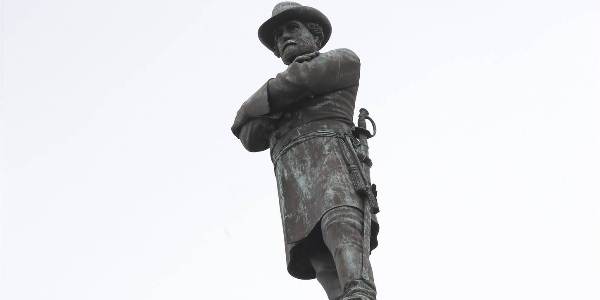
New Orleans statue of Robert E. Lee
In the Washington Post this week, white evangelical millennial leader Katelyn Beaty said, “I can’t defend my people. I barely recognize them.” 81% of white evangelicals voted for Donald Trump. As Trump begins to fill his leadership team with boldly open white supremacists like Steve Bannon and Kris Kobach, white evangelicals like Beaty are right to be horrified, whether or not they voted for Trump. This calls for a season of introspection, because I think the different oppressions white evangelicals have historically supported are coming from the same basic ideology. I want to talk about something we call intersectionality in the activist community.
Intersectionality refers to the way that oppression doesn’t happen in isolation. Different oppressions intersect with one another. Sometimes they add onto each other, like in the case of a black transwoman who has to navigate racism, misogyny, and transphobia all at the same time. Other times, their relationships are more complex, like white women who are oppressed by misogyny and respond with racism.
But I’d like to talk about intersectionality from the vantage point of the oppressor’s ideology rather than the experience of the oppressed, which I can’t really speak to. Basically, I think there’s a common thread in all the ideologies of oppression that my people have used over the last five hundred years. And I want to start five hundred years ago with a debate between the Spanish theologians Juan Gines de Sepulveda and Bartolome de las Casas about what should be done with the natives in the New World. Sepulveda argued that natives should be “civilized” by the Spaniards through their enslavement (or massacred if they refused). Las Casas argued that native culture had inherent dignity and should be treated with the same respect as any European culture the Spaniards interacted with. We all know who won that debate, but the ideological foundation is what’s relevant.
Sepulveda’s view was shaped by a concept he called el ordenimiento de mandar y obedecer (the order of command and obedience), which he believed to be the essential foundation of civilization. Without this hierarchical order in which each person stayed in his/her place, society would fall apart. Sepulveda pointed to the passage that Christians today call the Great Commission where Jesus says, “All authority on heaven and earth have been given to me” (Matthew 28:18). He argued that because the Spanish king was a Christian, he received Jesus’ authority over all the earth by extension, which meant that non-Christian people were rightfully under his authority.
Las Casas’ line of argument took an entirely different shape. Though he did reference Christian scripture, the heart of his argument was his testimony about the sacred practices of the natives he had gotten to know. He claimed that their religious practices, even those involving human sacrifice, showed that they had a concept of the divine, and thus they shared inherent human dignity, no matter how strange or problematic their customs were. Las Casas still wanted to share Christianity with the natives. But he didn’t want to impose it on them. He wanted to share the gospel in a way that respected their dignity. And he didn’t believe that Jesus’ authority gave Spaniards the right to confiscate native lands or enslave them.
So for Sepulveda, healthy humanity depends upon its conformity to a hierarchical order in which it’s clear who commands and who obeys. For Las Casas, healthy humanity depends upon our ability to recognize the unique inherent dignity of each individual human. Order vs. dignity. I really think that’s the core of every debate we’ve had in Western civilization for the past five hundred years over how to treat marginalized people.
If you look through the historical ideological justifications for patriarchy, white supremacy, and heteronormativity, you’ll find a consistent appeal to order. We couldn’t have women in the workplace for the same reason that we couldn’t have black men dating white women for the same reason that we couldn’t have two women getting married. It disrupts the order that society depends upon to function. Sure, everyone flips open the Bible for proof-texts, but when you read the Bible looking for appeals to order, that’s what you find. The way that Sepulveda twisted the Great Commission into a justification for colonialism is no more of an interpretive leap than using Jesus’ teaching against divorce as a prescription for heteronormativity.
The Bible looks completely different whether you read it looking for order or dignity. Consider a famous passage that has been abused so egregiously in evangelical purity culture: “Don’t you know that your body is a temple and the Holy Spirit lives within you?” (1 Corinthians 3:16). If everything in the Bible is about order and obedience, then it’s obvious that this passage is about how adolescent girls should wear extra large t-shirts over their one-piece swimsuits at youth group pool parties so their cleavage won’t show.
But imagine if a transgender person opened the Bible to this passage with fresh eyes that had somehow avoided all the toxicity of evangelical purity culture. What could it say to someone reading the Bible looking for dignity? You’re beautiful and divine. It seems heretical for me to even write that, though it’s the plainest meaning of those words. It’s absolutely mind-blowing to think that our bodies are sacred temples where the Holy Spirit lives. That’s incredibly empowering.
We read in the next verse that “if anyone destroys God’s temple, God will destroy that person.” For the order-seeking hermeneutic, the meaning is obvious. Don’t modify anything about your body surgically which would be “destroying” God’s temple, since the “truth” of your body is whatever can be adjudicated externally by authority figures, not the mysterious mixture of chemistry, psychology, and anatomy that actually is your reality.
But for the one who reads the Bible looking for dignity, getting “top surgery” or “bottom surgery” is no more destroying God’s temple than getting braces or fixing a deviated septum in your nose. Why couldn’t Paul’s words be a warning to oppressors who attack other peoples’ temples since they don’t fit into our order? What if God destroys those who attack other peoples’ bodies whether physically or psychologically? What if people who disrespect the inherent dignity of others are handed over to the monstrosity of their sin?
The white evangelical church is in desperate need of introspection as we face the disaster of the next four years. What kind of humanity does God want to create among us? Does God want to “make America great again” by restoring the hierarchical order in which white men are the authority figures they have been for the past five hundred years of colonial Christianity? Or does God want a humanity in which every person’s dignity is treasured in its irreplaceable uniqueness? Order is a lot easier on those who put themselves in charge than dignity is; all they have to do to be “holy” is to police others. Tremendous spiritual discipline and holiness is required to create a community where everyone’s dignity is valued.
When we read the Bible with a dignity-seeking hermeneutic, then all the clobber passages fall away, whether they’re anti-black, anti-woman, or anti-queer. When the point of biblical ethics is to promote human dignity, the point of Leviticus is to prevent sexual violence through the use of taboo. The point of Romans 1 is to show how idolatry produces injustice through the cultivation of toxic spiritual fruit. The point of 1 Corinthians 6 is to compare filing lawsuits against fellow believers to drunkenness, theft, temple prostitution, and other more obvious forms of sleaze.
The next four years are going to be ugly. But my prayer is that whatever monstrosity they produce will annihilate any last shred of credibility that 500 years of toxic colonial Christianity still has, so that people who look like me will finally be overthrown. Our church will probably look like the wreckage of the European church before this is over. But I dare to hope that Jesus can save us from ourselves and make Christians into people who fight for the dignity of every human identity.
Check out my book How Jesus Saves the World From Us!
Subscribe to our podcast Crackers and Grape Juice!
Support our campus ministry NOLA Wesley!
Previous Post

November 15, 2016
A teachable moment for white United Methodist youth
Next Post

November 19, 2016 Winter begins (a poem)
Browse Our Archives
Select a Category Advent Beauty Will Save the World Bible Big Picture: Ephesians Bloggers Book Christian salvation and the Beautitudes Culture Daily Office Danceable Homiletics Deadly Sins Deep Roots: Genesis Devotions Dominican Republic May 2011 El Principio Misericordia (The Mercy Principle) Five verses God tattooed on my heart Fundraising FutureGospel Good Biblical Words Henri Nouwen Interview Jennings' Christian Imagination Jesus inside the beltway Jesus Is My Candidate Jesus vs the Pharisees Jesus vs. Plato Journey to Eternity Looking Back on 2012 Love Actually Monday Merton Monday Merton Music Occupy the manger On Earth As It Is In Heaven Original Sin Podcast Poetry Politics Prayer Psalm 119 Radical Jesus 101 Reviews Sermon on the Mount Sermons Spanish Bible study Special Series Spiritual but not religious Synchroblog Theology Things that made me think Thomas a Kempis Ugliness Into Beauty Uncategorized Viaje Dominicano 2013 Walking in the Valley (Lent) Welcome: It's More than a Mat Wild Goose 2013 Wrestling
Select a Month March 2022 January 2022 December 2021 September 2021 April 2021 September 2020 August 2020 July 2020 June 2020 May 2020 April 2020 March 2020 February 2020 January 2020 December 2019 November 2019 October 2019 September 2019 August 2019 June 2019 May 2019 April 2019 March 2019 February 2019 January 2019 December 2018 November 2018 October 2018 September 2018 August 2018 July 2018 June 2018 May 2018 April 2018 March 2018 February 2018 January 2018 December 2017 November 2017 October 2017 September 2017 August 2017 July 2017 June 2017 May 2017 April 2017 March 2017 February 2017 January 2017 December 2016 November 2016 October 2016 September 2016 August 2016 July 2016 June 2016 May 2016 April 2016 March 2016 February 2016 January 2016 December 2015 November 2015 October 2015 September 2015 August 2015 July 2015 June 2015 May 2015 April 2015 February 2015 January 2015 December 2014 November 2014 October 2014 September 2014 August 2014 July 2014 June 2014 May 2014 April 2014 March 2014 February 2014 January 2014 December 2013 November 2013 October 2013 September 2013 August 2013 July 2013 June 2013 May 2013 April 2013 March 2013 February 2013 January 2013 December 2012 November 2012 October 2012 September 2012 August 2012 July 2012 June 2012 May 2012 April 2012 February 2012 January 2012 December 2011 November 2011 October 2011 September 2011 August 2011 July 2011 June 2011 May 2011
Follow Us!
TAKE THE
Religious Wisdom Quiz
Three friends came to comfort but ended up accusing. A fourth spoke with more wisdom. What were their names in order of arrival?
Select your answer to see how you score.
Eliphaz, Bildad, Zophar, and Elihu Zophar, Elihu, Eliphaz, and Bildad Elihu, Zophar, Bildad, and Eliphaz Bildad, Eliphaz, Elihu, and Zophar
Related posts from Mercy Not Sacrifice

Donald Trump And The Exorcism Of White America

When God's A Cop, Every Cop Is God


"All People Are Holy": The Theology Of Alexandria...
TRENDING AT PATHEOS Progressive Christian

What Being a Modern-Day Apostle Means to Me
In my last column, I discussed the ins and outs of modern-day...

Did Ancient China Once Worship the God of...
Across human history, a common thread weaves through the origins of the...

Love Your Neighbor – Including Earth-Kin: Lev. 19,...
God’s command to love your neighbor means acting in an ethical and...

Lead a Church Study of “Jesus and Lao...
Guest writer Jack Thomas (The Irreverent Reverend) reflects on leading his church...

Pastoral Wisdom for Responding to Sermon Pushback
Getting sermon pushback on your social justice sermon? Learn practical, Proverbs-based strategies...

Principles for Understanding the Apostolic Ministry Today
Whenever people discover that my formal ministry title is "apostle," as in...
view all Progressive Christian blogs
Ad-Free & Subscriber Log-In Subscription Support
- About Us
- 2026 Calendar
- Videos
- Podcasts
- Library of World Religions
- Faith In Media Tracker
- Advertise With Us
- Write for Us
- Privacy Policy
- Terms of Service
- Do Not Sell My Data
- Contact Us
- Radiant Digital
- Manage Newsletter Subscriptions
- Unsubscribe From Notifications
- Sitemap
Copyright 2008-2026, Patheos. All rights reserved.
Subscription Support Ad-Free & Subscriber Log-In
Follow Patheos