
BuddhistCatholicContemplativeEvangelicalGeneral ChristianHinduJewishLatter-day SaintMuslimNew VisionsProgressive Christian
Beliefs
- Buddhist
- Catholic
- Contemplative
- Evangelical
- General Christian
- Hindu
- Jewish
- Latter-day Saint
- More Voices
- Muslim
- New Visions
- Pagan
- Progressive Christian
Topics
- Religion News
- Food and Religion
- Sports and Religion
- Religious Art
- Religious Music and Entertainment
- Religious Events
- History and Religion
- Style and Religion
- Politics and Religion
- Women in Religion
- Recreation Outdoors and Religion
- Business Finance and Religion
- Careers Workplace and Religion
- Education and Religion
- Family Parenting and Religion
- Health Fitness and Religion
- Home and Religion
- Relationships and Religion
- Technology and Religion
- Travel and Religion
Columnists
- Buddhist Columnists
- Business Finance and Religion Columnists
- Careers Workplace and Religion Columnists
- Catholic Columnists
- Contemplative Columnists
- Education and Religion Columnists
- Evangelists Columnists
- Family Parenting and Religion Columnists
- General Christian Columnists
- Health Fitness and Religion Columnists
- Hindu Columnists
- History and Religion Columnists
- Home and Religion Columnists
- Jewish Columnists
- More Voices Columnists
- Latter Day Columnists
- Muslim Columnists
- New Visions Columnists
- Nonreligious Columnists
- Pagan Columnists
- Politics and Religion Columnists
- Progressive Columnists
- Recreation Outdoors and Religion Columnists
- Relationships and Religion Columnists
- Religion News Columnists
- Religious Art Columnists
- Religious Events Columnists
- Religious Music and Entertainment Columnists
- Sports and Religion Columnists
- Style and Religion Columnists
- Technology and Religion Columnists
- Travel and Religion Columnists
- Women in Religion Columnists
Resource Library
- 2026 Calendar
- Library of World Religions
- The 100 Most Holy Places on Earth
- Patheos Answers
- Podcasts
- Videos
- Faith Leaders Database
- Anglican Episcopalian
- Bahai
- Baptist
- Buddhism
- Christianity
- Confucianism
- Eastern Orthodoxy
- Hinduism
- Holiness and Pentecostal
- ISKCON
- Islam
- Judaism
- Lutheran
- Methodist
- The Church of Jesus Christ of Latter-day Saints
- New Age
- Paganism
- Presbytarian and Reformed
- Protestantism
- Religion Behind the Scenes
- Roman Catholic
- Scientology
- Shia Islam
- Sikhism
- Sufism
- Sunni Islam
- Taoism
- Zen
- See all religions
Research Tools
 Ad-Free & Subscriber Log-In Subscription Support
Ad-Free & Subscriber Log-In Subscription Support
Follow Patheos 

- Trending:
- Forgiveness
- |
- Marriage
- |
- Consciousness
- |
- Death Penalty
- |
- Election
- |
- Halloween
 Mercy Not Sacrifice
-
More
- Home
- Progressive Christian
- Why Standing Rock is incomprehensible to most white people
Why Standing Rock is incomprehensible to most white people
Last updated on: October 28, 2016 at 11:35 am by Morgan Guyton
Why Standing Rock is incomprehensible to most white people 2016-10-28T11:35:51-05:00 Morgan Guyton
Patheos Explore the world's faith through different perspectives on religion and spirituality! Patheos has the views of the prevalent religions and spiritualities of the world.
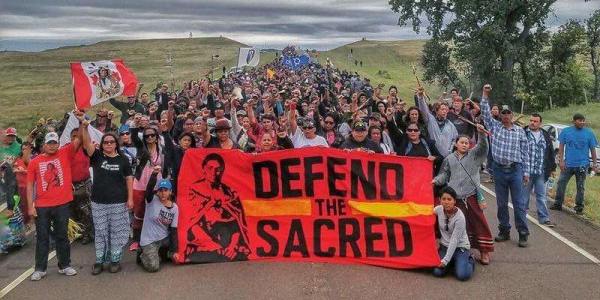
“Defend the Sacred” (Huffington Post)
I’ve had an image haunting my mind for the past several months. At a progressive Christian gathering this summer, there was a drum circle late at night. I’ve experienced some powerful spiritual encounters during drum circles, so I went. It was cool until an older white man started making nonsensical “Indian” noises like “Heyah! Heyah!” and then a bunch of other people started doing it. It made me feel sick. So I tried to redirect by singing some of the Taize Christian chants that I’ve learned in Latin like “Veni sancte spiritus.” But nobody was interested in singing in Latin, which is the closest thing that white people have to ancient sacred words. They wanted to play “Indian.”
This ugly memory comes to mind as I contemplate the tragedy happening at Standing Rock in North Dakota and the suspicion I have that it doesn’t make sense to most white people. An oil pipeline is being constructed through sacred native lands. It’s true that it also might threaten the water supply of the Standing Rock Reservation. But the main issue according to LaDonna Bravebull Allard, the original organizer of the protest, is the desecration of sacred land:
Of the 380 archeological sites that face desecration along the entire pipeline route, from North Dakota to Illinois, 26 of them are right here at the confluence of these two rivers. It is a historic trading ground, a place held sacred not only by the Sioux Nations, but also the Arikara, the Mandan, and the Northern Cheyenne. The U.S. government is wiping out our most important cultural and spiritual areas. And as it erases our footprint from the world, it erases us as a people. These sites must be protected, or our world will end, it is that simple. Our young people have a right to know who they are. They have a right to language, to culture, to tradition. The way they learn these things is through connection to our lands and our history. If we allow an oil company to dig through and destroy our histories, our ancestors, our hearts and souls as a people, is that not genocide?
I imagine that many good-hearted people want to sympathize with these concerns. I don’t think anyone outside of the alt-right is openly ridiculing them. A Hillary Clinton campaign spokesperson recently said that it’s important to “listen to all sides” and take everyone’s perspective into account in order to have a reasonable, sensitive process. But ultimately, protecting a “historic trading ground” makes about as much sense to most white people as letting our preschoolers leave their train tracks all over the living room when company is coming over.
I’m sure whenever native activists have gotten an audience with any other government official who wasn’t a complete jerk, they have listened with great sympathy the entire time they were talking, just like good parents listen patiently to their children when it’s time to pick up the train tracks and move on. It’s sad; it’s sweet; but in the grownup world, pipelines just have to be built. They’re using all the best technology; they’ll be very gentle; they’ll put the bones back in the ground when they’re done; you won’t even notice there’s a big piece of metal carrying toxic fluids through the ground when they’ve buried it.
The reason a “historic trading ground” is a quaint but ultimately uncompelling concept to most white people is because we are definitively a people without roots. Whiteness means assimilation into a generic, cosmopolitan humanity. Irish and Italian and Polish immigrants were not white until they were assimilated into the great melting pot, stopped speaking with accents, and stopped dreaming about their homeland. Our loss of authentic cultural identity is an invisible tragedy that manifests itself in dozens of clumsy cultural appropriations like singing “Heyah!” when dancing around a campfire as a profoundly disrespectful, bizarre lampoon of sacred tradition.
I have no idea where my ancestors were buried, nor would that knowledge have any meaning to me if I got onto ancestry.com and researched it. Because I have been socialized to view physical space as interchangeable. My wife leaves the TV on the real estate channel most of the time. We watch hours and hours of shows about houses that could be transplanted into any suburban cul-de-sac anywhere in America. What matters are things like a big yard, an updated kitchen, curb appeal, a good view. And most importantly, will it sell for more than what you bought it for?
Even the idea of having a family home that gets passed down from generation to generation has become quaint and odd to white sensibilities. Who cares whether or not your great-grandma used to bake pies on your counter-top as long as it’s granite?
I’ve said before that the greatest battle of our age is between the sacrament and the commodity. Do the objects in our world have value because they radiate God’s glory or because the market has given them a price-tag? All of our social conflicts ultimately boil down to this question, especially the sexuality debates that Christians never stop talking about. Are our bodies sacred temples of God’s mystery or are they commodities to be bought, sold, and consumed? Many Christians say that human bodies are God’s temples but leave everything else about creation to the market’s dominion, partly because they have a toxic, gnostic doctrine of creation as inherently fallen and valueless.
If the purpose of creation is to glorify God (which is about as conservative evangelical a statement as you can make), that means that every inch of creation is sacred and irreplaceably particular. If everything is generic and interchangeable, then the market has displaced God as our source of value no matter what ideologies we use to mask that.
The apostle Paul writes that “creation waits with eager longing for the revealing of the children of God, for the creation was subjected to futility, not of its own will but by the will of the one who subjected it” (Romans 8:19-20). The basic problem of humanity is our disharmony with God and all the sacred beauty that glorifies God. We have subjected creation to futility because we have seen it as an object to conquer, exploit, and marketize into profit. Capitalism is the most metastasized form of the human brokenness Augustine called “humanity curved inward upon itself.” It is our collective fear and mistrust that turns reality into an all-consuming plantation of commodities.
Paul defines the purpose of Christianity as a “ministry of reconciliation” (2 Corinthians 5:18). Many white Christians view this reconciliation as an abstract, juridical process that takes place in a disembodied heaven where we go after spending our lives in disembodied, generic suburbias. But Paul makes it very clear that reconciliation includes every aspect of creation. It’s not merely something that happens in a divine ledger book; it is our reintegration into the song of God and our rediscovery of the sacred world that God created.
In this sense, LaDonna Bravebull Allard and the native peoples who have gathered with her are much better ministers of reconciliation than most Christians ever have been. If God’s glory is actually more than an ideological code term to us, then Christians need to defend the sacred against the hegemony of the market. This is a religious freedom issue if there ever was one. Christians need to stand with the people of Standing Rock.
Check out my book How Jesus Saves the World From Us!
Subscribe to our podcast Crackers and Grape Juice!
Like my author page on Facebook!
Previous Post

October 27, 2016
Are people of color protecting our country from fascism?
Next Post
October 31, 2016 Which Holy Spirit will show up to the United Methodist commission?
Browse Our Archives
Select a Category Advent Beauty Will Save the World Bible Big Picture: Ephesians Bloggers Book Christian salvation and the Beautitudes Culture Daily Office Danceable Homiletics Deadly Sins Deep Roots: Genesis Devotions Dominican Republic May 2011 El Principio Misericordia (The Mercy Principle) Five verses God tattooed on my heart Fundraising FutureGospel Good Biblical Words Henri Nouwen Interview Jennings' Christian Imagination Jesus inside the beltway Jesus Is My Candidate Jesus vs the Pharisees Jesus vs. Plato Journey to Eternity Looking Back on 2012 Love Actually Monday Merton Monday Merton Music Occupy the manger On Earth As It Is In Heaven Original Sin Podcast Poetry Politics Prayer Psalm 119 Radical Jesus 101 Reviews Sermon on the Mount Sermons Spanish Bible study Special Series Spiritual but not religious Synchroblog Theology Things that made me think Thomas a Kempis Ugliness Into Beauty Uncategorized Viaje Dominicano 2013 Walking in the Valley (Lent) Welcome: It's More than a Mat Wild Goose 2013 Wrestling
Select a Month March 2022 January 2022 December 2021 September 2021 April 2021 September 2020 August 2020 July 2020 June 2020 May 2020 April 2020 March 2020 February 2020 January 2020 December 2019 November 2019 October 2019 September 2019 August 2019 June 2019 May 2019 April 2019 March 2019 February 2019 January 2019 December 2018 November 2018 October 2018 September 2018 August 2018 July 2018 June 2018 May 2018 April 2018 March 2018 February 2018 January 2018 December 2017 November 2017 October 2017 September 2017 August 2017 July 2017 June 2017 May 2017 April 2017 March 2017 February 2017 January 2017 December 2016 November 2016 October 2016 September 2016 August 2016 July 2016 June 2016 May 2016 April 2016 March 2016 February 2016 January 2016 December 2015 November 2015 October 2015 September 2015 August 2015 July 2015 June 2015 May 2015 April 2015 February 2015 January 2015 December 2014 November 2014 October 2014 September 2014 August 2014 July 2014 June 2014 May 2014 April 2014 March 2014 February 2014 January 2014 December 2013 November 2013 October 2013 September 2013 August 2013 July 2013 June 2013 May 2013 April 2013 March 2013 February 2013 January 2013 December 2012 November 2012 October 2012 September 2012 August 2012 July 2012 June 2012 May 2012 April 2012 February 2012 January 2012 December 2011 November 2011 October 2011 September 2011 August 2011 July 2011 June 2011 May 2011
Follow Us!
TAKE THE
Religious Wisdom Quiz
Who is described as the "son of encouragement" and traveled with Paul?
Select your answer to see how you score.
Barnabas Luke Mark Silas
Related posts from Mercy Not Sacrifice

Donald Trump And The Exorcism Of White America

"All People Are Holy": The Theology Of Alexandria...


Can We Have a Queer, Erotic God?
TRENDING AT PATHEOS Progressive Christian

What Being a Modern-Day Apostle Means to Me
In my last column, I discussed the ins and outs of modern-day...

Did Ancient China Once Worship the God of...
Across human history, a common thread weaves through the origins of the...

Love Your Neighbor – Including Earth-Kin: Lev. 19,...
God’s command to love your neighbor means acting in an ethical and...

Lead a Church Study of “Jesus and Lao...
Guest writer Jack Thomas (The Irreverent Reverend) reflects on leading his church...

Pastoral Wisdom for Responding to Sermon Pushback
Getting sermon pushback on your social justice sermon? Learn practical, Proverbs-based strategies...

Principles for Understanding the Apostolic Ministry Today
Whenever people discover that my formal ministry title is "apostle," as in...
view all Progressive Christian blogs
Ad-Free & Subscriber Log-In Subscription Support
- About Us
- 2026 Calendar
- Videos
- Podcasts
- Library of World Religions
- Faith In Media Tracker
- Advertise With Us
- Write for Us
- Privacy Policy
- Terms of Service
- Do Not Sell My Data
- Contact Us
- Radiant Digital
- Manage Newsletter Subscriptions
- Unsubscribe From Notifications
- Sitemap
Copyright 2008-2026, Patheos. All rights reserved.
Subscription Support Ad-Free & Subscriber Log-In
Follow Patheos