
BuddhistCatholicContemplativeEvangelicalGeneral ChristianHinduJewishLatter-day SaintMuslimNew VisionsProgressive Christian
Beliefs
- Buddhist
- Catholic
- Contemplative
- Evangelical
- General Christian
- Hindu
- Jewish
- Latter-day Saint
- More Voices
- Muslim
- New Visions
- Pagan
- Progressive Christian
Topics
- Religion News
- Food and Religion
- Sports and Religion
- Religious Art
- Religious Music and Entertainment
- Religious Events
- History and Religion
- Style and Religion
- Politics and Religion
- Women in Religion
- Recreation Outdoors and Religion
- Business Finance and Religion
- Careers Workplace and Religion
- Education and Religion
- Family Parenting and Religion
- Health Fitness and Religion
- Home and Religion
- Relationships and Religion
- Technology and Religion
- Travel and Religion
Columnists
- Buddhist Columnists
- Business Finance and Religion Columnists
- Careers Workplace and Religion Columnists
- Catholic Columnists
- Contemplative Columnists
- Education and Religion Columnists
- Evangelists Columnists
- Family Parenting and Religion Columnists
- General Christian Columnists
- Health Fitness and Religion Columnists
- Hindu Columnists
- History and Religion Columnists
- Home and Religion Columnists
- Jewish Columnists
- More Voices Columnists
- Latter Day Columnists
- Muslim Columnists
- New Visions Columnists
- Nonreligious Columnists
- Pagan Columnists
- Politics and Religion Columnists
- Progressive Columnists
- Recreation Outdoors and Religion Columnists
- Relationships and Religion Columnists
- Religion News Columnists
- Religious Art Columnists
- Religious Events Columnists
- Religious Music and Entertainment Columnists
- Sports and Religion Columnists
- Style and Religion Columnists
- Technology and Religion Columnists
- Travel and Religion Columnists
- Women in Religion Columnists
Resource Library
- 2026 Calendar
- Library of World Religions
- The 100 Most Holy Places on Earth
- Patheos Answers
- Podcasts
- Videos
- Faith Leaders Database
- Anglican Episcopalian
- Bahai
- Baptist
- Buddhism
- Christianity
- Confucianism
- Eastern Orthodoxy
- Hinduism
- Holiness and Pentecostal
- ISKCON
- Islam
- Judaism
- Lutheran
- Methodist
- The Church of Jesus Christ of Latter-day Saints
- New Age
- Paganism
- Presbytarian and Reformed
- Protestantism
- Religion Behind the Scenes
- Roman Catholic
- Scientology
- Shia Islam
- Sikhism
- Sufism
- Sunni Islam
- Taoism
- Zen
- See all religions
Research Tools
 Ad-Free & Subscriber Log-In Subscription Support
Ad-Free & Subscriber Log-In Subscription Support
Follow Patheos 

- Trending:
- Forgiveness
- |
- Marriage
- |
- Consciousness
- |
- Death Penalty
- |
- Election
- |
- Halloween
 Mercy Not Sacrifice
-
More
- Home
- Progressive Christian
- Christian spirituality for a non-Christian audience
Christian spirituality for a non-Christian audience
Last updated on: October 18, 2016 at 10:32 pm by Morgan Guyton
Christian spirituality for a non-Christian audience 2016-10-18T22:32:43-05:00 Morgan Guyton
Patheos Explore the world's faith through different perspectives on religion and spirituality! Patheos has the views of the prevalent religions and spiritualities of the world.
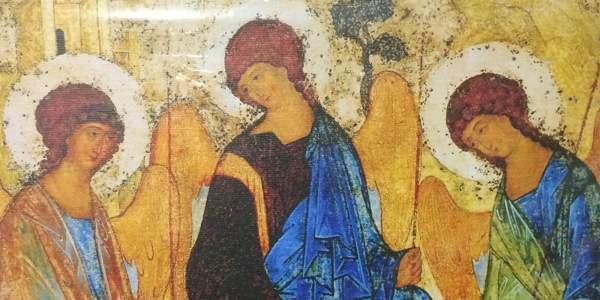
My Rublev Trinity icon
I’ve been offered an amazing opportunity by the Tulane Hillel rabbi Yonah Schiller to talk about Christian spirituality with his freshman seminar class. I’m writing this blog post in order to attempt a fresh, accessible articulation of Christian spirituality. I should begin with a disclaimer that this will be a more progressive, mystical account of Christianity than what you’re used to hearing from American Christians. But I believe that mainstream Christianity in our country has been corrupted by a number of factors like institutionalism, consumerism, colonialism, patriarchy, and white supremacy. So as unusual as this account may sound, I honestly believe it’s authentic Christianity.
1. God is a dance party
At the core of Christian spirituality is the quirky belief that God is somehow three and one at the same time. In the Bible, the three persons of God are named Father, Son, and Holy Spirit. Christians believe these three entities are completely interconnected and mutually synergistic enough that they are not separate gods but one God. The early church used the Greek word perichoresis to describe this interconnection. I think the best English translation for that word is “dance party” (perhaps because I make electronic dance music as a hobby). I believe the creative core of the universe is fundamentally a dance party in which every aspect of creation is continually being brought into deeper resonance and harmony.
“Father” is simply a word for “source” or “origin.” This describes the aspect of God that is utterly beyond us and at the root of all reality. The Father’s love is the foundation of all existence. It’s important to understand the word Father as a metaphor that does not gender God as a stern old man sitting on a cloud. Some progressive Christians have adopted alternative gender-neutral language to avoid perpetuating patriarchy. I retain the traditional language in order to remain in conversation with more conservative Christians.
“Son” describes the aspect of God that is manifested in creation, most perfectly Christians believe in a 1st century human being named Jesus (or actually Yahashua). Christ is not Jesus’ last name but the Greek word for “anointed.” We believe that the divine anointing Jesus Christ innately embodied is a gift he offers to all of the human community. Our term for those who are brought into this collective anointing is the “body of Christ.”
“Holy Spirit” describes the energy of God that brings harmony and reconciliation to the universe. We believe that the Holy Spirit is constantly instigating love and healing in the world. The Christian apostle Paul teaches that our bodies are temples where the Holy Spirit lives. The Holy Spirit speaks and works through people and circumstances to draw us deeper into the dance party of God so we can experience a life of perfect delight and belonging.
2. Humans are prisms of divine light
The Bible teaches that humanity is created “in the image of God.” I interpret this to mean that we are created to be divine, though we are not the source of our own divinity. Each of us has an infinite depth into the heart of God that goes far beyond our conscious awareness.
It’s like each of us is a prism that filters God’s light in a unique pattern of colors that are essential to the larger work of art God is creating. The more we are spiritually “opened” and “emptied” of distracting heart clutter, the more beautifully we will radiate God’s light. The problem is that our prisms have been crusted over with sin so that we are disconnected from the divine light that gives us life.
3. We cannot avoid the overwhelming corruption of sin
We are born into a humanity whose wounds and anxieties are inevitably written into our souls long before we have any awareness. That’s what the mythical story of Adam and Eve is about. God tells them not to eat a fruit that will “open their eyes.” When they eat the fruit, they discover their nakedness and hide in the bushes from God.
It is the fear and shame of our spiritual nakedness (a.k.a. self-consciousness) that is the foundation for sin. We hurt ourselves and other people because our fear and shame alienate us from God’s loving presence. The oppressive social structures of our world are the product of the fear and shame of billions of people over thousands of years of human history. We are collectively responsible for the morally complicated mess that is hurting all of us, though it’s not entirely our fault either. Sin does not just describe the mistakes we make; more problematically it is the residue of our mistakes (pain, guilt, resentment, mistrust, etc) that makes it impossible for us to see reality with integrity. For example, white supremacy is an invisible, ubiquitous residue of centuries of sin that causes white people to harm people of color in complete innocence because of the presumptions they are born into.
Sin can be divided into two categories: idolatry and injustice. Idolatry concerns our addictive attachment to finite created things which cut us off from experiencing authentic connection to God. Injustice concerns the things we do or support that harm other people. Idolatry causes injustice, because the more we are disconnected from our divine source, the more we self-medicate addictively and lash out at the people around us. This happens on a macro scale as well. The various idols of the global market create crushingly miserable poverty, warfare, and famine for marginalized people.
4. Jesus overcomes humanity’s sin through his life, death, and resurrection
Christians believe that Jesus is God’s incarnate solidarity with humanity and that Jesus’ life, death, and resurrection reveal a solidarity intentionally directed toward the lowest and most marginalized members of humanity. Jesus lived as a devout though eccentric Jew, which is part of why Christianity has a complicated and tragically oppressive historical relationship with Judaism. Jesus’ ministry was a scandal to his fellow religious leaders because he continuously violated their traditions whenever compassion required it. He alienated the religious and political establishment through his blistering prophetic critiques and his association with the most sinful people (tax collectors and prostitutes). So he was ultimately put on trial and executed by the Roman Empire.
Jesus’ death on a Roman cross was the most humiliating, excruciating form of execution in his world. Drawing on their Jewish tradition of sacrifice, Jesus’ followers interpreted his death as a sacrifice to heal humanity of our sin. To claim that God offered himself to humanity for sacrifice in Jesus rather than expecting humanity to offer him their sacrifices is the scandalous (and often ignored) core of Christian theology. Sacrifice is a weird religious phenomenon that I can’t do justice in limited space. But the basic idea is that Jesus absorbs all the sublimated violence within the human social structure as a brutal act of violence against his body, which names and judges all sin, providing a means for those who mystically embrace this sacrifice to be purged and liberated from the shame of their sin. Or put differently, Jesus absorbs all our rage and blame and punishment so that we can forgive each other and move forward.
Christians believe that Jesus was resurrected from the dead after his crucifixion. There is a range of understanding about what this actually means. What’s most critical is that Jesus receives vindication and victory through his resurrection which provides Christians with hope that no matter how hopeless the injustice we face in our lives, God will ultimately resurrect and vindicate us in the end. For me personally, my hope in God’s ultimate victory rests in the miracle of Jesus’ physical bodily resurrection. Though I don’t think miracles happen often, I need to believe that the world is not entirely at the mercy of scientific law.
5. Christians are invited to be crucified and resurrected with Jesus
The core of Christian spirituality is built around our mystical participation in the crucifixion and resurrection of Jesus. The first step is to admit that we need divine help and to renounce our need to be right and self-sufficient. Once we gain the freedom to be wrong and dependent, it becomes safe to acknowledge our sins (anxieties, addictions, resentments, mistakes, etc) as impurities that need to be “crucified” out of our soul so that we can be “resurrected” with new life. In my view, this mystical appropriation of crucifixion and resurrection in lived daily spiritual practice is more important to Christian spirituality than having correct doctrinal beliefs. Doctrine matters to the degree that it helps us to be crucified and resurrected with Jesus.
The other aspect of our participation in Jesus’ crucifixion and resurrection is his command to “take up your cross and follow me.” I believe this means that we are called to walk in solidarity with those who are being crucified in our world and risk our own crucifixion (social, spiritual, physical or otherwise). To me, this means standing with immigrants, people of color, queer people, and other marginalized folk even if it requires compromising our social status and physical safety as a result. Though there are certainly great costs to a life of solidarity, the reward is a life that is authentic and sacred.
6. Heaven is communion, hell is alienation, eternal life is perfect presence
The most perverse distortion of Christian teaching in our day is the idea that heaven and hell are places where you go as a reward or punishment after you die. Particularly egregious is the claim that people who “believe” the right things go to heaven and people who don’t go to hell. Heaven is the perfect belonging and joy of being completely integrated into the dance of God and thus empowered to have beautifully authentic relationships with other people. Hell is the alienation of self-absorption that keeps us from connecting with God and other people so that we can be miserably lonely even in the midst of a crowd of groupies and admirers.
Though no one can explain the mystery of death, I believe that if we have cultivated authentic connection with God, we will experience joy and belonging. If we have languished in self-obsession, we will experience loneliness and alienation. For me as a Christian, being crucified and resurrected with Jesus is the means by which I gain authentic connection with God and other people to “enter” heaven. Though I believe Jesus offers the best “story” for spiritual transformation, I don’t presume that God can’t provide other religions with their own means of “getting into heaven.”
Heaven and hell are different manifestations of the concept that Jesus calls “eternal life,” which is often misunderstood to mean simply an afterlife that lasts forever. I’ve come to understand “eternal life” as perfect presence. It’s when I am set free from my resentments about the past and anxieties about the future enough to be fully awake to the present moment. I think Christian eternal life might be very similar to what the Buddhists call nirvana (even if saying that will make some Christians call me a heretic). I’ve had about a dozen moments in my life when I experienced eternal life. It’s an indescribable experience of being completely woven into the love of the universe. Paradoxically, eternal life happens to me most often when the circumstances of my life are the shittiest, but in those wonderful moments, nothing else matters.
My quest for eternal life has drawn me into a weekly rhythm of mystical spiritual practices. I fast on Mondays and Fridays. I pray using prayer beads every time I have to walk or drive places. I try to visit the prayer labyrinth in Audubon Park at least once a week, and I also go to a fountain in my neighborhood several nights a week to pour out my heart to God. To me, prayer is life. When I’m living prayerfully, my life is heaven. When I’m mindlessly scrolling on my phone, my life is hell.
Sadly, too many Christians define themselves according to rationalistic ideologies and positions on social issues rather than the spiritual practice we need to connect with God. All of our love is supposed to flow out of the foundation of our spiritual practice. If we are anchored in the eternal life of dancing with God, we will live with compassion and justice. And that’s what it means to be a citizen of heaven.

Next Post

October 25, 2016 Election Day Communion
Browse Our Archives
Select a Category Advent Beauty Will Save the World Bible Big Picture: Ephesians Bloggers Book Christian salvation and the Beautitudes Culture Daily Office Danceable Homiletics Deadly Sins Deep Roots: Genesis Devotions Dominican Republic May 2011 El Principio Misericordia (The Mercy Principle) Five verses God tattooed on my heart Fundraising FutureGospel Good Biblical Words Henri Nouwen Interview Jennings' Christian Imagination Jesus inside the beltway Jesus Is My Candidate Jesus vs the Pharisees Jesus vs. Plato Journey to Eternity Looking Back on 2012 Love Actually Monday Merton Monday Merton Music Occupy the manger On Earth As It Is In Heaven Original Sin Podcast Poetry Politics Prayer Psalm 119 Radical Jesus 101 Reviews Sermon on the Mount Sermons Spanish Bible study Special Series Spiritual but not religious Synchroblog Theology Things that made me think Thomas a Kempis Ugliness Into Beauty Uncategorized Viaje Dominicano 2013 Walking in the Valley (Lent) Welcome: It's More than a Mat Wild Goose 2013 Wrestling
Select a Month March 2022 January 2022 December 2021 September 2021 April 2021 September 2020 August 2020 July 2020 June 2020 May 2020 April 2020 March 2020 February 2020 January 2020 December 2019 November 2019 October 2019 September 2019 August 2019 June 2019 May 2019 April 2019 March 2019 February 2019 January 2019 December 2018 November 2018 October 2018 September 2018 August 2018 July 2018 June 2018 May 2018 April 2018 March 2018 February 2018 January 2018 December 2017 November 2017 October 2017 September 2017 August 2017 July 2017 June 2017 May 2017 April 2017 March 2017 February 2017 January 2017 December 2016 November 2016 October 2016 September 2016 August 2016 July 2016 June 2016 May 2016 April 2016 March 2016 February 2016 January 2016 December 2015 November 2015 October 2015 September 2015 August 2015 July 2015 June 2015 May 2015 April 2015 February 2015 January 2015 December 2014 November 2014 October 2014 September 2014 August 2014 July 2014 June 2014 May 2014 April 2014 March 2014 February 2014 January 2014 December 2013 November 2013 October 2013 September 2013 August 2013 July 2013 June 2013 May 2013 April 2013 March 2013 February 2013 January 2013 December 2012 November 2012 October 2012 September 2012 August 2012 July 2012 June 2012 May 2012 April 2012 February 2012 January 2012 December 2011 November 2011 October 2011 September 2011 August 2011 July 2011 June 2011 May 2011
Follow Us!
TAKE THE
Religious Wisdom Quiz
What is a "cubit's" approximate length according to the Bible?
Select your answer to see how you score.
12 inches 18 inches 24 inches 36 inches
Related posts from Mercy Not Sacrifice


Donald Trump And The Exorcism Of White America

When God's A Cop, Every Cop Is God

TRENDING AT PATHEOS Progressive Christian

Why Christians Have a Sacred Duty to Vote:...
The Bible offers strong support for the sacred duty to vote. Here...

What Being a Modern-Day Apostle Means to Me
In my last column, I discussed the ins and outs of modern-day...

Did Ancient China Once Worship the God of...
Across human history, a common thread weaves through the origins of the...

Love Your Neighbor – Including Earth-Kin: Lev. 19,...
God’s command to love your neighbor means acting in an ethical and...

Lead a Church Study of “Jesus and Lao...
Guest writer Jack Thomas (The Irreverent Reverend) reflects on leading his church...

Principles for Understanding the Apostolic Ministry Today
Whenever people discover that my formal ministry title is "apostle," as in...
view all Progressive Christian blogs
Ad-Free & Subscriber Log-In Subscription Support
- About Us
- 2026 Calendar
- Videos
- Podcasts
- Library of World Religions
- Faith In Media Tracker
- Advertise With Us
- Write for Us
- Privacy Policy
- Terms of Service
- Do Not Sell My Data
- Contact Us
- Radiant Digital
- Manage Newsletter Subscriptions
- Unsubscribe From Notifications
- Sitemap
Copyright 2008-2026, Patheos. All rights reserved.
Subscription Support Ad-Free & Subscriber Log-In
Follow Patheos