
BuddhistCatholicContemplativeEvangelicalGeneral ChristianHinduJewishLatter-day SaintMuslimNew VisionsProgressive Christian
Beliefs
- Buddhist
- Catholic
- Contemplative
- Evangelical
- General Christian
- Hindu
- Jewish
- Latter-day Saint
- More Voices
- Muslim
- New Visions
- Pagan
- Progressive Christian
Topics
- Religion News
- Food and Religion
- Sports and Religion
- Religious Art
- Religious Music and Entertainment
- Religious Events
- History and Religion
- Style and Religion
- Politics and Religion
- Women in Religion
- Recreation Outdoors and Religion
- Business Finance and Religion
- Careers Workplace and Religion
- Education and Religion
- Family Parenting and Religion
- Health Fitness and Religion
- Home and Religion
- Relationships and Religion
- Technology and Religion
- Travel and Religion
Columnists
- Buddhist Columnists
- Business Finance and Religion Columnists
- Careers Workplace and Religion Columnists
- Catholic Columnists
- Contemplative Columnists
- Education and Religion Columnists
- Evangelists Columnists
- Family Parenting and Religion Columnists
- General Christian Columnists
- Health Fitness and Religion Columnists
- Hindu Columnists
- History and Religion Columnists
- Home and Religion Columnists
- Jewish Columnists
- More Voices Columnists
- Latter Day Columnists
- Muslim Columnists
- New Visions Columnists
- Nonreligious Columnists
- Pagan Columnists
- Politics and Religion Columnists
- Progressive Columnists
- Recreation Outdoors and Religion Columnists
- Relationships and Religion Columnists
- Religion News Columnists
- Religious Art Columnists
- Religious Events Columnists
- Religious Music and Entertainment Columnists
- Sports and Religion Columnists
- Style and Religion Columnists
- Technology and Religion Columnists
- Travel and Religion Columnists
- Women in Religion Columnists
Resource Library
- 2026 Calendar
- Library of World Religions
- The 100 Most Holy Places on Earth
- Patheos Answers
- Podcasts
- Videos
- Faith Leaders Database
- Anglican Episcopalian
- Bahai
- Baptist
- Buddhism
- Christianity
- Confucianism
- Eastern Orthodoxy
- Hinduism
- Holiness and Pentecostal
- ISKCON
- Islam
- Judaism
- Lutheran
- Methodist
- The Church of Jesus Christ of Latter-day Saints
- New Age
- Paganism
- Presbytarian and Reformed
- Protestantism
- Religion Behind the Scenes
- Roman Catholic
- Scientology
- Shia Islam
- Sikhism
- Sufism
- Sunni Islam
- Taoism
- Zen
- See all religions
Research Tools
 Ad-Free & Subscriber Log-In Subscription Support
Ad-Free & Subscriber Log-In Subscription Support
Follow Patheos 

- Trending:
- Forgiveness
- |
- Marriage
- |
- Consciousness
- |
- Death Penalty
- |
- Election
- |
- Halloween
 Mercy Not Sacrifice
-
More
- Home
- Progressive Christian
- Can the gospel be orthodox and inclusive?
Can the gospel be orthodox and inclusive?
Last updated on: August 18, 2016 at 3:23 pm by Morgan Guyton
Can the gospel be orthodox and inclusive? 2016-08-18T15:23:01-05:00 Morgan Guyton
Patheos Explore the world's faith through different perspectives on religion and spirituality! Patheos has the views of the prevalent religions and spiritualities of the world.
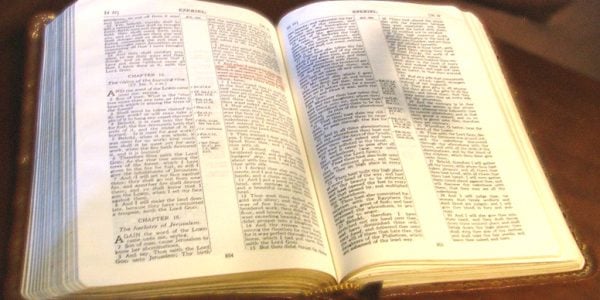
“Bible with Cross Shadow,” David Campbell, Flickr C.C.
One of the tragedies of our civil war in United Methodism has been the bifurcation of the terms “orthodox” and “inclusive” according to whether one opposes or supports LGBT inclusion in the church. Both sides are operating with a caricature of the other. Does supporting orthodoxy mean that you’re innately pharisaic? Does supporting LGBT inclusion mean that you no longer have a coherent gospel? A recent Confessing Movement newsletter asked “What is the gospel?” So I wanted to take a moment to answer that question as I understand it in a way that I think is both orthodox and inclusive.
First, we need to acknowledge that the Bible contains many different articulations of the Christian gospel. Every Pauline letter has a different slant on what the life, death, and resurrection of Jesus accomplish for humanity.
In Romans 5, Jesus’ cross and resurrection justify sinners and provide eternal life. In 1 Corinthians 1, the message of the cross is good news to the weak and the foolish whom God has chosen to shame the strong and the wise. In Colossians 2, Jesus triumphs over the powers and principalities through his cross and resurrection. In Ephesians 2, Jesus’ cross destroys the dividing wall between Jews and Gentiles. In Philippians 2, Jesus’ cross models the self-emptying that is the foundation of Christian ethics.
These are only a few versions of the good news that the apostle Paul has to share. The quest for one all-encompassing articulation of the gospel often causes Christians to sideline large portions of the biblical text as secondary and inessential and to cram these secondary texts awkwardly into an overly simplified doctrinal system. The pop-evangelical “Romans Road” gospel of American Christianity turns salvation into an individualist consumer product of afterlife insurance rather than recognizing Jesus’ work as a cosmic act of liberation. It’s a tremendous irony when Christians who denounce the infiltration of worldly values into Christianity advocate a gospel that has been shaped by the intuitions of a door-to-door sales model of evangelism.
In general terms, the Christian gospel describes the way that the life, death, and the resurrection of Jesus deliver humanity from sin so that we can be reconciled to one another and to God. But there are many ways to articulate the transformation that is accomplished on both a personal and global level.
In the Wesleyan articulation of the gospel, we give emphasis to justification and sanctification as the two basic aspects of our salvation. If we accept the justification of Jesus’ sacrifice for our sins, then we can receive the sanctification that the Holy Spirit accomplishes by perfecting our love. This is because the basic thing we need to be liberated from is self-justification, our imprisoning need to be right at all times. Sanctification can only happen among people who know that they are wrong and that they are loved unconditionally by God.
So how does inclusion play into the gospel as I’ve described it? Does inclusion mean that people no longer need to be justified and sanctified because everyone is just fine exactly the way they are? This is what conservatives seem to think when they hear the word inclusion, and indeed there may actually be progressive Christians who believe this (though I haven’t met any). If inclusion negates spiritual transformation, I would agree with conservatives that it is no longer orthodox Christianity.
But I see inclusion fitting into the gospel in a different way. Inclusion is not the negation of my need for transformation; it is the reason I need to be transformed. The way I put in a tweet is to say that John 3:16 only accomplishes the gospel when it causes Matthew 25 to happen. It seems like many conservatives make Matthew 25 an ancillary bonus to the real gospel; I would say that Matthew 25 is the fulfillment of gospel. The world receives its good news when Christians respond to their liberation from sin with the pursuit of mercy and justice for all.
We are not justified and sanctified to be trophies on God’s shelf of holiness. Christian holiness is always for the sake of our hospitality toward the other, as Miroslav Volf so aptly demonstrates in his monumental Exclusion and Embrace. That’s what it means that God desires mercy not sacrifice. God needs our hearts to be emptied of their idols so that we can be his solidarity with humanity. True holiness is sacrifice for the sake of mercy.
If my heart is divided and distracted by sin, I am not available to share God’s love with people who are alienated and marginalized. The ultimate goal of my holiness in conjunction with the holiness of every other Christian is to create a world of shalom, the just peace where everyone contributes and everyone belongs. That’s why I reject any vision of the world in which a subsection of humanity is told that they simply don’t belong, not because their identity actually undermines their love of God and neighbor but because previous centuries didn’t have a category for them.
I can understand why my egotism, my greed, my gluttony, laziness, my envy, my anger, my lust, and many other types of sin interfere with my ability to be self-emptied and thus sabotage God’s reconciliation of humanity to himself. These aspects of my character need to be put on Jesus’ cross so that I can be made into a new creature who is radically hospitable and capable of full, rich communion with God and other people. What I cannot understand is how a person’s non-normative sexual orientation or gender identity inherently sabotages God’s reconciliation of humanity.
When I read the Bible given my understanding of why sin is bad and what God is trying to accomplish through Jesus, I simply don’t see condemnations of minority sexualities or gender identities as such. I see condemnations of promiscuity, adultery, and pagan sexual rituals, all of which were endemic to the historical context (no, Robert Gagnon did not persuade me otherwise) and all of which are understandably incompatible with Christian teaching.
So when I fight for queer inclusion in the church, I’m not fighting against the pursuit of holiness that is critically necessary to the reconciliation God wants to accomplish. I’m fighting against a caricature of that holiness that seems to me like a self-congratulatory normality which is itself sabotaging God’s reconciliation of humanity. Any time holiness is equated with living inside of a norm for its own sake and for no other reason, it doesn’t look to me like the holiness Jesus embodied. It doesn’t make us like Jesus to spend most of our energy talking and thinking about the sin that we perceive in others.
I think the most important Wesleyan doctrine is Christian perfection, the pinnacle of Christian holiness. It is the best news of the Wesleyan gospel and our greatest hope: that the Holy Spirit can empty our hearts of their idols and fill them entirely with love for God and neighbor. The perfection of Christian perfection is not the flawless articulation of doctrine that so many Christians seem to have as their goal. It means that we have been absolutely and thoroughly conquered by love.
I hope that one day the thing people most notice about me is that I have been conquered by love. As a pastor, it seems more fruitful to help my students encounter and embrace the conquering love of Jesus than to preach a moral legalism of sin management. In my own experience, it is not my efforts to feel guilty about sin that liberate me from sin; it is the degree to which my desire has been captivated by God. So that’s the best I can do in talking about the gospel right now. I’m learning more every day and I’m happy to receive any wisdom you have to share.
Check out my book How Jesus Saves the World From Us!
Subscribe to our podcast Crackers and Grape Juice!
Like my author page on Facebook!
Previous Post

August 16, 2016
What is the gospel?
Next Post

August 18, 2016 American exceptionalism (a poem inspired by Ryan Lochte)
Browse Our Archives
Select a Category Advent Beauty Will Save the World Bible Big Picture: Ephesians Bloggers Book Christian salvation and the Beautitudes Culture Daily Office Danceable Homiletics Deadly Sins Deep Roots: Genesis Devotions Dominican Republic May 2011 El Principio Misericordia (The Mercy Principle) Five verses God tattooed on my heart Fundraising FutureGospel Good Biblical Words Henri Nouwen Interview Jennings' Christian Imagination Jesus inside the beltway Jesus Is My Candidate Jesus vs the Pharisees Jesus vs. Plato Journey to Eternity Looking Back on 2012 Love Actually Monday Merton Monday Merton Music Occupy the manger On Earth As It Is In Heaven Original Sin Podcast Poetry Politics Prayer Psalm 119 Radical Jesus 101 Reviews Sermon on the Mount Sermons Spanish Bible study Special Series Spiritual but not religious Synchroblog Theology Things that made me think Thomas a Kempis Ugliness Into Beauty Uncategorized Viaje Dominicano 2013 Walking in the Valley (Lent) Welcome: It's More than a Mat Wild Goose 2013 Wrestling
Select a Month March 2022 January 2022 December 2021 September 2021 April 2021 September 2020 August 2020 July 2020 June 2020 May 2020 April 2020 March 2020 February 2020 January 2020 December 2019 November 2019 October 2019 September 2019 August 2019 June 2019 May 2019 April 2019 March 2019 February 2019 January 2019 December 2018 November 2018 October 2018 September 2018 August 2018 July 2018 June 2018 May 2018 April 2018 March 2018 February 2018 January 2018 December 2017 November 2017 October 2017 September 2017 August 2017 July 2017 June 2017 May 2017 April 2017 March 2017 February 2017 January 2017 December 2016 November 2016 October 2016 September 2016 August 2016 July 2016 June 2016 May 2016 April 2016 March 2016 February 2016 January 2016 December 2015 November 2015 October 2015 September 2015 August 2015 July 2015 June 2015 May 2015 April 2015 February 2015 January 2015 December 2014 November 2014 October 2014 September 2014 August 2014 July 2014 June 2014 May 2014 April 2014 March 2014 February 2014 January 2014 December 2013 November 2013 October 2013 September 2013 August 2013 July 2013 June 2013 May 2013 April 2013 March 2013 February 2013 January 2013 December 2012 November 2012 October 2012 September 2012 August 2012 July 2012 June 2012 May 2012 April 2012 February 2012 January 2012 December 2011 November 2011 October 2011 September 2011 August 2011 July 2011 June 2011 May 2011
Follow Us!
TAKE THE
Religious Wisdom Quiz
How many disciples did Jesus have?
Select your answer to see how you score.
Seven Twelve Twenty Ten
Related posts from Mercy Not Sacrifice


When God's A Cop, Every Cop Is God

My Best Teachers Are People I Cannot Win

Why Kevin DeYoung's "Culture War Strategy" Fails
TRENDING AT PATHEOS Progressive Christian

What Being a Modern-Day Apostle Means to Me
In my last column, I discussed the ins and outs of modern-day...

Did Ancient China Once Worship the God of...
Across human history, a common thread weaves through the origins of the...

Love Your Neighbor – Including Earth-Kin: Lev. 19,...
God’s command to love your neighbor means acting in an ethical and...

Lead a Church Study of “Jesus and Lao...
Guest writer Jack Thomas (The Irreverent Reverend) reflects on leading his church...

Pastoral Wisdom for Responding to Sermon Pushback
Getting sermon pushback on your social justice sermon? Learn practical, Proverbs-based strategies...

Principles for Understanding the Apostolic Ministry Today
Whenever people discover that my formal ministry title is "apostle," as in...
view all Progressive Christian blogs
Ad-Free & Subscriber Log-In Subscription Support
- About Us
- 2026 Calendar
- Videos
- Podcasts
- Library of World Religions
- Faith In Media Tracker
- Advertise With Us
- Write for Us
- Privacy Policy
- Terms of Service
- Do Not Sell My Data
- Contact Us
- Radiant Digital
- Manage Newsletter Subscriptions
- Unsubscribe From Notifications
- Sitemap
Copyright 2008-2026, Patheos. All rights reserved.
Subscription Support Ad-Free & Subscriber Log-In
Follow Patheos