
BuddhistCatholicContemplativeEvangelicalGeneral ChristianHinduJewishLatter-day SaintMuslimNew VisionsProgressive Christian
Beliefs
- Buddhist
- Catholic
- Contemplative
- Evangelical
- General Christian
- Hindu
- Jewish
- Latter-day Saint
- More Voices
- Muslim
- New Visions
- Pagan
- Progressive Christian
Topics
- Religion News
- Food and Religion
- Sports and Religion
- Religious Art
- Religious Music and Entertainment
- Religious Events
- History and Religion
- Style and Religion
- Politics and Religion
- Women in Religion
- Recreation Outdoors and Religion
- Business Finance and Religion
- Careers Workplace and Religion
- Education and Religion
- Family Parenting and Religion
- Health Fitness and Religion
- Home and Religion
- Relationships and Religion
- Technology and Religion
- Travel and Religion
Columnists
- Buddhist Columnists
- Business Finance and Religion Columnists
- Careers Workplace and Religion Columnists
- Catholic Columnists
- Contemplative Columnists
- Education and Religion Columnists
- Evangelists Columnists
- Family Parenting and Religion Columnists
- General Christian Columnists
- Health Fitness and Religion Columnists
- Hindu Columnists
- History and Religion Columnists
- Home and Religion Columnists
- Jewish Columnists
- More Voices Columnists
- Latter Day Columnists
- Muslim Columnists
- New Visions Columnists
- Nonreligious Columnists
- Pagan Columnists
- Politics and Religion Columnists
- Progressive Columnists
- Recreation Outdoors and Religion Columnists
- Relationships and Religion Columnists
- Religion News Columnists
- Religious Art Columnists
- Religious Events Columnists
- Religious Music and Entertainment Columnists
- Sports and Religion Columnists
- Style and Religion Columnists
- Technology and Religion Columnists
- Travel and Religion Columnists
- Women in Religion Columnists
Resource Library
- 2026 Calendar
- Library of World Religions
- The 100 Most Holy Places on Earth
- Patheos Answers
- Podcasts
- Videos
- Faith Leaders Database
- Anglican Episcopalian
- Bahai
- Baptist
- Buddhism
- Christianity
- Confucianism
- Eastern Orthodoxy
- Hinduism
- Holiness and Pentecostal
- ISKCON
- Islam
- Judaism
- Lutheran
- Methodist
- The Church of Jesus Christ of Latter-day Saints
- New Age
- Paganism
- Presbytarian and Reformed
- Protestantism
- Religion Behind the Scenes
- Roman Catholic
- Scientology
- Shia Islam
- Sikhism
- Sufism
- Sunni Islam
- Taoism
- Zen
- See all religions
Research Tools
 Ad-Free & Subscriber Log-In Subscription Support
Ad-Free & Subscriber Log-In Subscription Support
Follow Patheos 

- Trending:
- Forgiveness
- |
- Marriage
- |
- Consciousness
- |
- Death Penalty
- |
- Election
- |
- Halloween
 Mercy Not Sacrifice
-
More
- Home
- Progressive Christian
- Is there a Christianity that isn’t toxic?
Is there a Christianity that isn’t toxic?
Last updated on: October 16, 2016 at 3:12 pm by Morgan Guyton
Is there a Christianity that isn’t toxic? 2016-10-16T15:12:11-05:00 Morgan Guyton
Patheos Explore the world's faith through different perspectives on religion and spirituality! Patheos has the views of the prevalent religions and spiritualities of the world.
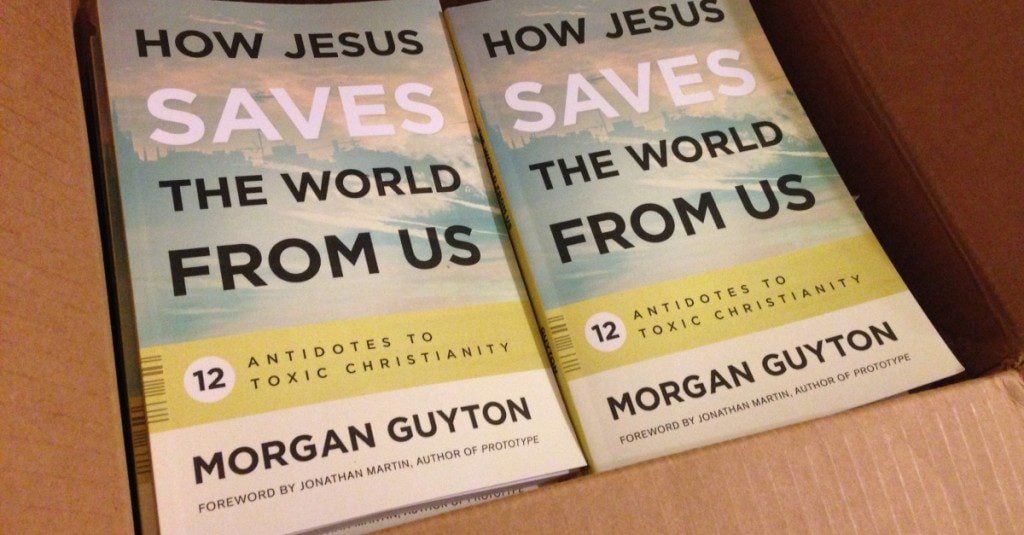
Have American Christians become what Jesus came to stop us from being? It’s not an unreasonable question after decades of toxic culture war. Growing up Southern Baptist, I used to think there were two kinds of Christians: those who were vocal about God’s desire to burn most of humanity in hell and those who were conflicted and embarrassed about it.
It wasn’t until I walked through the doors of a mostly queer United Methodist church in my early twenties that I discovered a very different and much more beautiful gospel. My journey since then has given me a very different understanding of Christian salvation than I had growing up. My first book How Jesus Saves the World From Us: 12 Antidotes to Toxic Christianity seeks to articulate the much more beautiful gospel shared with me by Christians who had been rejected by the church. Here are the twelve touchstones of the gospel they taught me.
1) Worship Not Performance
Jesus says we can only receive the kingdom of God if we become like children. That’s because children know how to worship. They live in a world of wonder and delight without worrying about what others think of them. Until they lose their innocence.
The story of Adam and Eve captures the moment when we discover our nakedness, when we become afraid and ashamed, when we start blaming others. We become performers who are focused on satisfying our critics, the biggest of whom is God. All the time God’s heart is broken, and he wants to rescue us from this toxic mistrust so that we can share in his joy like we did when we were children.
Tragically, so much Christian worship today is a performance where we try to say hallelujah louder than the people around us. God wants us to stop performing for him so that we can bask in his love for us and worship.
2) Mercy Not Sacrifice
One of the most important things God says in the Bible is Hosea 6:6: “I desire mercy not sacrifice.” Jesus pulls out this quote in his argument with the religious authorities. The American Dream teaches us that if we make the right sacrifices, we will have a good life, which means that people who don’t have a good life haven’t made the right sacrifices and don’t deserve our help.
We all have to make sacrifices, but it’s toxic if we expect to be rewarded for them. God wants to save us from the entitlement and bitterness of using our sacrifices to justify ourselves by revealing his mercy to us. That’s why Jesus puts our sins on the cross: not because God needs a blood payment for our sins, but because God wants to replace our self-justifying sacrifice with mercy. The more that we accept God’s mercy and stop trying to earn our legitimacy through sacrifice, the more we can be God’s mercy in the world.
3) Empty Not Clean
Jesus’ greatest argument with the religious authorities was over the nature of holiness. They saw holiness as a question of staying clean and following a set of rules to prove their loyalty to God. Jesus argued that holiness is about emptying your heart of anxieties, addictions, and agendas so that it can be filled with God’s love.
This is best illustrated in the story of the Good Samaritan. The priest and the Levite walked past the wounded traveler because they were focused on staying clean. The Samaritan stopped because he was “moved with pity.”
A heart full of distracting idols cannot be moved by other peoples’ suffering. Also it’s not enough to spend our lives doing service work for other people. That can turn into another form of “cleanliness” that makes us toxic. If we want our service to come from a place of compassion, we need to engage in spiritual disciplines like prayer and fasting to empty our hearts first.
4) Breath Not Meat
The apostle Paul says to live according to the spirit instead of the flesh. This is one of the most widely misunderstood Christian teachings. For Paul to talk about the flesh negatively does not mean we’re supposed to hate physical pleasure. “Flesh” is an inadequate translation of the Greek word sarx which is better translated as “meat.” Meat is a perfect metaphor for dead life because meat is life that was killed for the sake of consumption.
When we live as mindless consumers, our bodies become like a lump of meat. A much richer physical life is attained by those who seek to become the breath of God, rather than a lump of meat. Spiritual life is not unphysical. It is physicality lived with perfect elegance. Our bodies become beautiful temples when we savor life instead of just consuming it.
5) Honor Not Terror
One of the most troubling things the Bible says is that “the fear of the Lord is the beginning of wisdom.” So many Christians think we’re supposed to be afraid of God. But the “fear” that is being spoken of here is really a reverence for the truth. It is living with intentionality and integrity. Ironically, many atheists display a much deeper “fear of the Lord” through their integrity than Christians who only believe in God because they’re afraid.
Jesus’ crucifixion is the image God wants us to see when we think about how he reigns over the world. What we should fear is doing further violence to a bleeding man who is gasping for air. People live with much greater honor when they’re afraid of crucifying Jesus than when they’re afraid of God’s punishment.
6) Poetry Not Math
2 Timothy 3:16 says that “all scripture is God-breathed.” Too many Christians read this statement like a word problem in math class rather than a line of poetry. In math class, what you do with word problems is turn them into simple equations to be solved. That’s what many Christians do with scripture. They reduce it into formula. They see “God-breathed,” and they think that just means the Bible is without error.
When we reduce the Bible to formulas, we take God’s breath out of it, which is the one thing that gives it life. Every verse in the Bible has an infinite depth of meaning depending on how the Holy Spirit uses it in the lives of each person reading it. That’s what I mean by calling it poetry. When we make it a formula, we are giving ourselves the authority as interpreters. When we recognize its infinite mystery, the Bible retains its authority over us as a poem.
7) Communion Not Correctness
One of the most toxic things about American Christianity is the way so many Christians are obsessed with having the right answer. Being right has become way more important than being loving. The purpose of Christian doctrine is not to make us correct, but to draw us into the deepest possible communion with God.
It is the witness of the prayers and wrestling of two thousand years of Christians. They weren’t perfect. Some of them did terrible things. But they discovered ways of talking about God that gave them an incredible connection to divine mystery. Christian doctrine is toxic when it turns into a never-ending argument of people who are infatuated with their own eloquence. Christian doctrine is beautiful when it creates a community of people who are deeply connected with God and each other.
8) Temple Not Program
What our society needs today more than anything else is sacred time and sacred space. Everyone is in a hurry to achieve, to climb the career ladder, to get their kids into good colleges, to increase the resale value of their houses. Churches too often play right into this toxic culture of achievement by providing more programs to add to an already hectic week. Too often, we tell people who are trying very hard to try harder.
What people need is not another program, but a temple. They need to hear the voice that says, “Come and rest.” They need for the sanctuary of our churches to be an actual sanctuary instead of a town hall meeting. In a world where people don’t know how to relax, our churches need to teach the world how to sit in God’s lap and do nothing. If church continues to be just another anxious, hyper-busy volunteer group, people will continue to lose interest.
9) Solidarity Not Sanctimony
Another quarrel Jesus had with the religious authorities was about how to define sin. For the religious authorities, sin was two things: breaking the rules and disobeying authority figures. Under this definition of sin, it’s not sin if the Bible doesn’t tell you explicitly not to do it or if you’re at the top of a chain of command. This is why many Christian communities have become toxic, spiritually abusive spaces.
What Jesus calls out as sin is the failure to love. He consistently takes a posture of solidarity, standing up for people, rather than sanctimony, standing up for the rules. This isn’t to say that rules are unimportant. But every rule must submit itself to the authority of the great commandment to love God and love neighbor. Perfect love is our ultimate goal. Anything short of that is sin, but we have a gracious God who is constantly replacing our sin with love.
10) Outsiders Not Insiders
The word for church in Greek is ekklesia which is a compound word meaning those who have been “called out” from the world. The original church was made up of outsiders and misfits who didn’t fit in the culture of the Roman Empire as well as the insiders who renounced their privilege to live in community with them. Too often, the church today tailors its theology and sense of morality to validate the superiority of the insiders rather than create a safe space for outsiders.
When Jesus tells us to take up our crosses and follow him, he’s not just telling us to stop cussing, doing drugs, and having premarital sex, which is a relatively easy insider version of morality. Jesus is telling us to renounce our worldly status and power to submit ourselves fully to the world’s outsiders. When insiders lose their safety by becoming outsiders, the world becomes safe for everyone. That’s what the church is supposed to look like.
11) Servanthood Not Leadership
Toxic Christianity has a major leadership fetish. There are dozens of conferences every year about Christian leadership, which too often is about maximizing your influence over other people as guru John Maxwell puts it. Our social media age is defined by “leaders” who have a huge influence but no responsibility.
Jesus defines leadership as servanthood. He says whoever wishes to be great must be the greatest servant. He doesn’t make “servant” a meaningless adjective to slap on the front of leadership, because for Jesus, leadership is about washing the feet of those you are called to nurture and empower. Christian leadership is about helping members of a community gain confidence in their gifts so that they can be God’s ministers to the world. Your worth as a leader should be measured by how many people you have empowered not how many people you control.
12) Kingdom Not Stadium
Over the past thirty years, our landscape has filled with giant megachurch stadiums. I’m sure the Holy Spirit has been part of their growth, but I worry how much they have thrived on triumphalist hype, the feeling that they’re winning. I am not called as a Christian pastor to build a stadium of adoring fans who flock to hear the one right gospel. Rather, I am called to accompany people on their journey into God’s kingdom as a fellow pilgrim seeking to enter the kingdom more deeply.
So when I share my faith with another person, Christian or not, I expect to be evangelized by them at least as much as they are evangelized by me. Real evangelism is not about inviting people to be an audience in my stadium. It’s about falling more deeply in love with God and expecting every other person to be an angel sent from God to teach me something. God will accept into the kingdom many people who bitterly disagree with me. Figuring out how to share the heavenly banquet with them is the most difficult and most beautiful aspect of the Christian journey.
Like my author page on Facebook!
Subscribe to our podcast Crackers and Grape Juice!
Previous Post

June 30, 2016
Toxic Christian of the year: Jennifer Mayers
Next Post
July 2, 2016 Toxic Christianity, hate porn, and internet heroism
Browse Our Archives
Select a Category Advent Beauty Will Save the World Bible Big Picture: Ephesians Bloggers Book Christian salvation and the Beautitudes Culture Daily Office Danceable Homiletics Deadly Sins Deep Roots: Genesis Devotions Dominican Republic May 2011 El Principio Misericordia (The Mercy Principle) Five verses God tattooed on my heart Fundraising FutureGospel Good Biblical Words Henri Nouwen Interview Jennings' Christian Imagination Jesus inside the beltway Jesus Is My Candidate Jesus vs the Pharisees Jesus vs. Plato Journey to Eternity Looking Back on 2012 Love Actually Monday Merton Monday Merton Music Occupy the manger On Earth As It Is In Heaven Original Sin Podcast Poetry Politics Prayer Psalm 119 Radical Jesus 101 Reviews Sermon on the Mount Sermons Spanish Bible study Special Series Spiritual but not religious Synchroblog Theology Things that made me think Thomas a Kempis Ugliness Into Beauty Uncategorized Viaje Dominicano 2013 Walking in the Valley (Lent) Welcome: It's More than a Mat Wild Goose 2013 Wrestling
Select a Month March 2022 January 2022 December 2021 September 2021 April 2021 September 2020 August 2020 July 2020 June 2020 May 2020 April 2020 March 2020 February 2020 January 2020 December 2019 November 2019 October 2019 September 2019 August 2019 June 2019 May 2019 April 2019 March 2019 February 2019 January 2019 December 2018 November 2018 October 2018 September 2018 August 2018 July 2018 June 2018 May 2018 April 2018 March 2018 February 2018 January 2018 December 2017 November 2017 October 2017 September 2017 August 2017 July 2017 June 2017 May 2017 April 2017 March 2017 February 2017 January 2017 December 2016 November 2016 October 2016 September 2016 August 2016 July 2016 June 2016 May 2016 April 2016 March 2016 February 2016 January 2016 December 2015 November 2015 October 2015 September 2015 August 2015 July 2015 June 2015 May 2015 April 2015 February 2015 January 2015 December 2014 November 2014 October 2014 September 2014 August 2014 July 2014 June 2014 May 2014 April 2014 March 2014 February 2014 January 2014 December 2013 November 2013 October 2013 September 2013 August 2013 July 2013 June 2013 May 2013 April 2013 March 2013 February 2013 January 2013 December 2012 November 2012 October 2012 September 2012 August 2012 July 2012 June 2012 May 2012 April 2012 February 2012 January 2012 December 2011 November 2011 October 2011 September 2011 August 2011 July 2011 June 2011 May 2011
Follow Us!
TAKE THE
Religious Wisdom Quiz
True or False: All Scripture is God-breathed and is useful for teaching, rebuking, correcting and training in righteousness.
Select your answer to see how you score.
TRUE FALSE
Related posts from Mercy Not Sacrifice

Why Does The Knowledge of Good And Evil...


When God's A Cop, Every Cop Is God

TRENDING AT PATHEOS Progressive Christian

What Being a Modern-Day Apostle Means to Me
In my last column, I discussed the ins and outs of modern-day...

Did Ancient China Once Worship the God of...
Across human history, a common thread weaves through the origins of the...

Love Your Neighbor – Including Earth-Kin: Lev. 19,...
God’s command to love your neighbor means acting in an ethical and...

Lead a Church Study of “Jesus and Lao...
Guest writer Jack Thomas (The Irreverent Reverend) reflects on leading his church...

Pastoral Wisdom for Responding to Sermon Pushback
Getting sermon pushback on your social justice sermon? Learn practical, Proverbs-based strategies...

Principles for Understanding the Apostolic Ministry Today
Whenever people discover that my formal ministry title is "apostle," as in...
view all Progressive Christian blogs
Ad-Free & Subscriber Log-In Subscription Support
- About Us
- 2026 Calendar
- Videos
- Podcasts
- Library of World Religions
- Faith In Media Tracker
- Advertise With Us
- Write for Us
- Privacy Policy
- Terms of Service
- Do Not Sell My Data
- Contact Us
- Radiant Digital
- Manage Newsletter Subscriptions
- Unsubscribe From Notifications
- Sitemap
Copyright 2008-2026, Patheos. All rights reserved.
Subscription Support Ad-Free & Subscriber Log-In
Follow Patheos